
Beginner's Guide to Tracking Key Account Interactions in Fintech
In fintech, enterprise accounts and strategic partnerships are high-stakes relationships where a single missed signal can shift market dynamics. 🎯 Tracking key account interactions—such as partner announcements, product integrations, or regulatory filings—is not just about monitoring competitors; it’s about decoding their strategic priorities and market positioning. For example, when a major fintech partner quietly tests a new payment rail or expands into a new geography, it often signals a broader ecosystem shift. By systematically tracking these interactions, you can anticipate moves before they become public knowledge, giving you a competitive edge in responding to or countering them.
Practical steps to start:
- Identify your top 5–10 key accounts and partners
- Set up alerts for their press releases, blog posts, and social media activity
- Create a simple log to record each interaction (date, type, key takeaway)
- Review the log weekly to spot patterns—e.g., repeated mentions of a technology or region
Pro tip: Use a shared dashboard (like a CRM or competitor tracking tool) to centralize these signals and enable team-wide analysis. This practice turns raw data into actionable intelligence, helping you stay ahead in a fast-moving ecosystem.
Monitoring Ecosystem Collaborations and Consortiums
In fintech, ecosystem collaborations often signal emerging standards or technologies. Monitor consortiums like the Open Banking Standard or the Linux Foundation’s fintech projects. Track your competitors’ participation in open-source foundations—this reveals their strategic bets on shared infrastructure. 💡
Why this matters for your business: Consortium memberships can indicate which technologies your competitors are betting on. For instance, a competitor joining a cross-industry alliance on open-source payments may be planning to adopt that standard across their product suite. Knowing this early lets you align your own roadmap or forge counter-partnerships.
Example: Stripe’s recent move in cross-industry collaboration
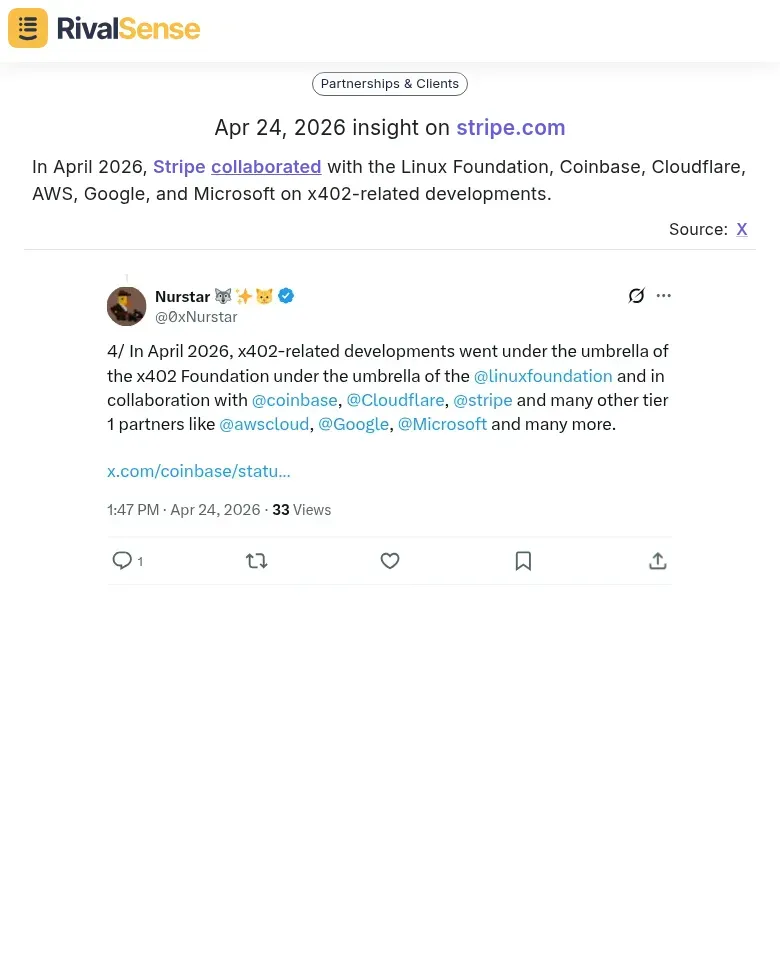
In April 2026, Stripe collaborated with the Linux Foundation, Coinbase, Cloudflare, AWS, Google, and Microsoft on x402-related developments. Tracking this type of consortium involvement helps you spot upcoming interoperability standards and potential shifts in payment infrastructure before they hit the mainstream.
Practical steps:
- Identify key alliances using tools like Crunchbase or CB Insights. Filter by fintech and cross-industry (e.g., banking + telecom).
- Check open-source contributions on GitHub or foundation membership lists (e.g., Hyperledger, FINOS).
- Map partner networks—use a spreadsheet to list each partner, their sector, and integration status. Look for overlaps: if Competitor A partners with a data aggregator and a neobank, they may be building an embedded finance stack.
Pro tip: Set Google Alerts for consortium names + your competitor’s name. When a new joint initiative is announced, analyze the press release for hints about shared APIs or data standards—these often precede product integrations.
By watching who collaborates with whom, you can predict which integrations will hit the market next and adjust your roadmap accordingly.
Decoding Product Announcements and Keynotes
Product announcements and keynotes from fintech competitors are goldmines of strategic intelligence. Here’s how to decode them systematically.
Why this matters for your business: Keynotes often lay out a competitor's vision for the next 12-24 months. By reading between the lines, you can identify their priority customer segments, technology investments, and partnership plans. This helps you avoid blind spots in your own strategy.
Example: Stripe’s 2026 Sessions keynote
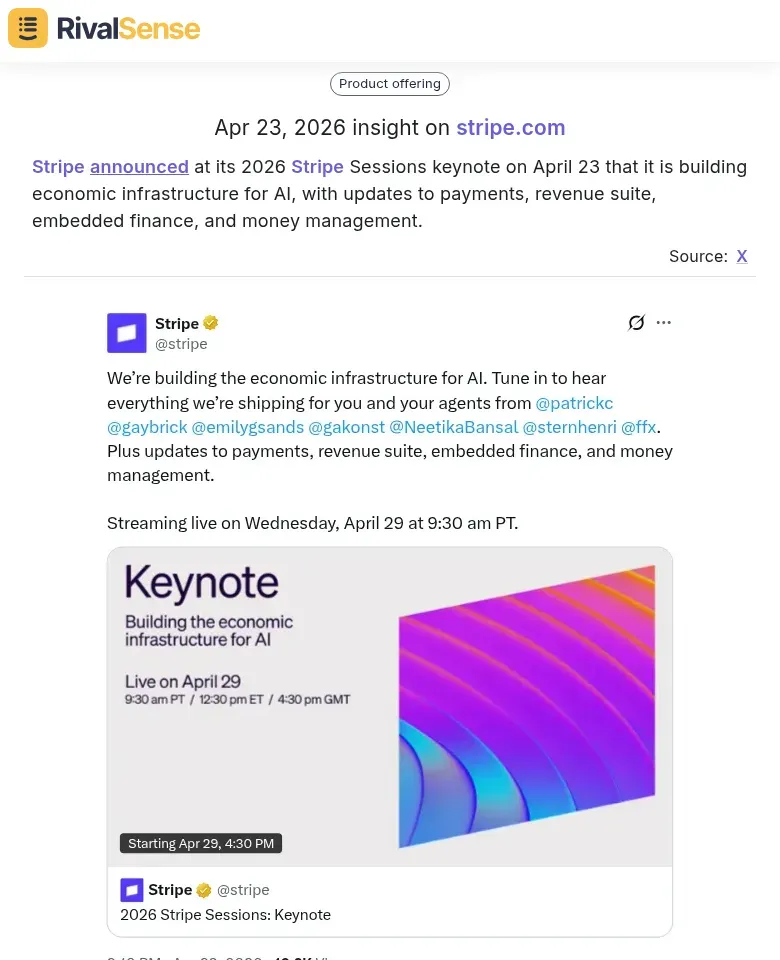
Stripe announced at its 2026 Stripe Sessions keynote on April 23 that it is building economic infrastructure for AI, with updates to payments, revenue suite, embedded finance, and money management. This move signals a major strategic pivot—tracking such keynotes helps you anticipate industry-wide changes and adapt your product positioning.
1. Extract Strategic Themes
During major events (e.g., Money20/20, Finovate), note recurring keywords and phrases. If a competitor mentions “embedded finance” five times, that’s a theme. Create a simple table:
| Event | Key Theme | Implied Priority |
|---|---|---|
| Stripe Sessions 2026 | AI infrastructure | #1 strategic bet |
| Finovate Spring 2026 | Real-time payments | #2 focus |
2. Map Features to Roadmaps
Don’t treat announcements as isolated. Plot each feature on a timeline. For example, if a competitor launches a BNPL API in Q1 and later a credit-scoring tool in Q3, they’re building a lending ecosystem. Use a public roadmap tracker (e.g., Product Hunt, their blog) to connect dots.
3. Infer Investment Areas & Customer Segments
Ask: Who is this feature for? A new “SMB onboarding” module signals a shift from enterprise to SMBs. A partnership with a neobank suggests a focus on embedded banking. Track press releases for target customer mentions.
Pro Tip: Set up Google Alerts for competitor names + “announces,” “launches,” “keynote.” Review monthly to spot patterns before they become obvious.
Checklist:
- [ ] Identify 3 strategic themes from last keynote
- [ ] Map 5 announced features to a 12-month timeline
- [ ] Note 2 new customer segments mentioned
- [ ] Compare with your own roadmap for gaps or opportunities
Leveraging Event Participation and Thought Leadership
Tracking where your competitors show up—and what they talk about—reveals their current priorities. Conferences, workshops, and roundtables are rich sources of intelligence on pain points and target audiences.
Why this matters for your business: Event participation often precedes product launches. If a competitor hosts a table at a founders’ lounge focused on fraud, they may be developing fraud-related features. Spotting these signals early lets you prepare competitive responses.
Example: Stripe’s Radar team at Stripe Sessions
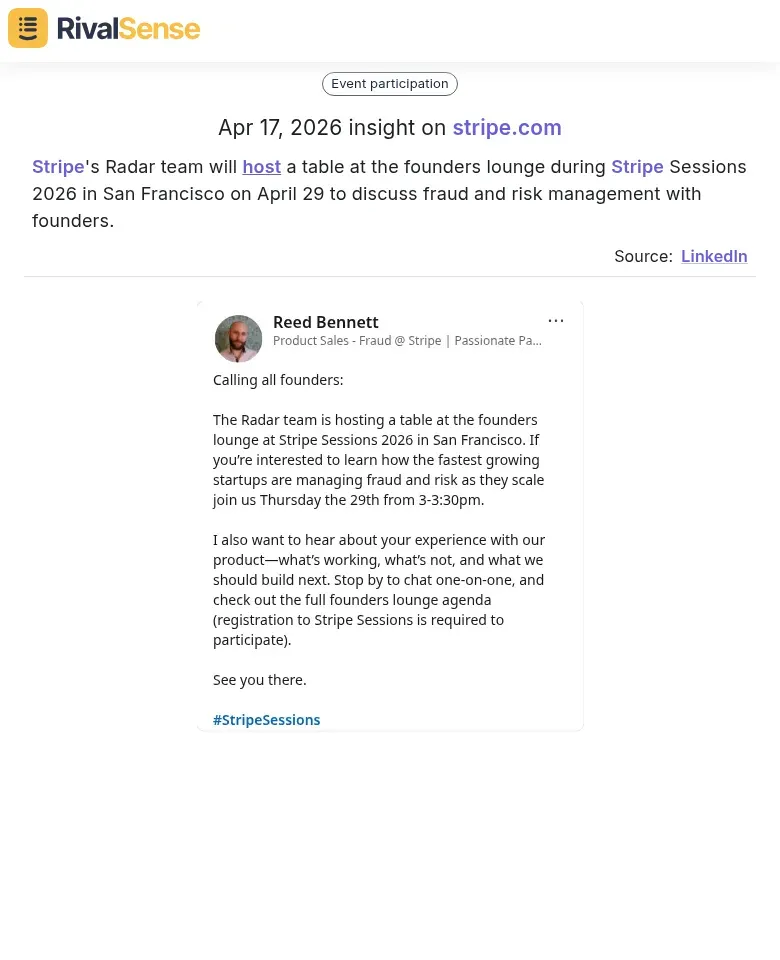
Stripe's Radar team will host a table at the founders lounge during Stripe Sessions 2026 in San Francisco on April 29 to discuss fraud and risk management with founders. This signals that Stripe is doubling down on fraud prevention for startups—valuable insight for your own product strategy.
How to track effectively:
- Start by monitoring which conferences your competitors sponsor or exhibit at. Use tools like RivalSense to log booth presence, speaking slots, and hosted sessions.
- Create a spreadsheet with columns: event name, date, booth size, session topics.
- Set up Google Alerts for key leaders' names combined with event keywords.
- When analyzing workshops or roundtables, note the pain points addressed—e.g., “real-time payments for SMBs” signals a target segment.
- Use LinkedIn to cross-reference attendee lists and identify which prospects visited competitor booths.
- Review content themes from hosted tables to spot shifts in focus, such as moving from compliance to customer experience.
This data helps you anticipate market moves and adjust your own strategy.
Building a Systematic Account Interaction Tracking Process
To build a systematic account interaction tracking process, start by setting up alerts for press releases, blog posts, and social media from key accounts. Use tools like Google Alerts, Feedly, or Mention to monitor keywords such as company names, product names, and executive names. For social media, leverage platforms like Brandwatch or native Twitter lists to track real-time updates.
Next, create a taxonomy to categorize interactions. Define clear categories:
- 🏢 Partnerships (e.g., joint ventures, integrations)
- 🚀 Product Launches (new features, beta releases)
- 🎤 Events (conferences, webinars)
- 📜 Regulatory Updates (compliance changes, licenses)
Tag each interaction with metadata like date, account name, category, and urgency level. This taxonomy enables consistent filtering and analysis.
Finally, integrate tracking data into competitive intelligence dashboards. Use tools like RivalSense or Tableau to aggregate alerts and categorized interactions. Build visualizations showing trends over time—e.g., a line chart of product launches per quarter across competitors. Set up automated reports to highlight spikes in activity, such as a sudden increase in partnership announcements, signaling a strategic shift. Regularly review dashboards to identify patterns and inform your strategy.
Conclusion: Turning Insights into Strategic Action
Synthesizing interaction patterns from competitor account moves reveals strategic signals. For example, if a rival fintech increases engagement with a payment processor, it may signal a new integration or partnership. Use these insights to inform your own partnership and product roadmap. Identify whitespace opportunities by mapping competitor account activities against your capabilities. If competitors overlook a segment (e.g., SMB lending in a specific region), that’s your cue to act.
Establish a monthly cadence to review tracking priorities: assess which accounts and signals matter most, adjust based on business goals, and archive stale data. Use this simple checklist:
- [ ] Review top competitor account interactions weekly
- [ ] Map patterns to your product/partnership pipeline monthly
- [ ] Reassess tracking focus quarterly
- [ ] Assign ownership for each opportunity and set clear follow-up deadlines
To make tracking effortless and never miss a critical signal, try out RivalSense for free. It tracks competitor product launches, pricing updates, event participations, partnerships, regulatory changes, management moves, and media mentions—across websites, social media, and registries—all delivered in a weekly email report. Get your first competitor report today and turn competitive intelligence into action.
📚 Read more
👉 Tracking Emerging Competitors: Unlocking Partnership & Client Insights
👉 Key Account Tracking Workflow: A Step-by-Step Guide to Outsmart Your Competition
👉 5 Real-World Competitor SWOT Examples for B2B Leaders
👉 How CrewAI's New Coding Skills Signal a Shift in Agentic AI Strategy