
Stop Learning About Competitor Moves from Press Releases
Why waiting for the press release means you're already months behind.
Monday morning: your top competitor issues a press release announcing a major product launch, a key partnership, or an expansion into a new market. Your CEO forwards it with a terse question: “Did we know about this?”
The uncomfortable truth? The move has been in the works for months. The product was in development. The partnership was negotiated. The regulatory filing was submitted. It was all sitting in the public record—you just weren’t watching the right places.
Press releases are the last mile of competitor intelligence. By the time a competitor decides to announce something publicly, they’ve already executed. You’re reacting to history, not anticipating the future.
The Problem with Press Release–Driven Monitoring
Most teams run their competitor intelligence on a reactive cadence: they wait for press releases, industry news, or worse, a customer mention. This approach has several blind spots:
- Press releases are curated. Competitors control what they announce and when. You see what they want you to see, not what’s actually happening.
- Timing is strategic. Announcements are timed for maximum external impact, not for your planning cycles. By the time you digest the news, your response window has shrunk.
- The signal is diluted. By the time a press release lands, analysts, competitors, and customers already know. You’ve lost any first-mover advantage in your response.
- You miss the pre-announcement signals. Product updates appear on websites first. Pricing changes hit landing pages before press releases. Regulatory filings are public before any news story. Job postings signal strategic shifts months ahead of official announcements.
Proactive competitor monitoring flips this. Instead of waiting for the press release, you track the signals that precede it.
What Changes When You Monitor Proactively
| Before (Press Release Driven) | With Proactive Monitoring |
|---|---|
| ❌ Quarterly or ad-hoc reviews, driven by press releases | ✅ Weekly briefings covering all competitor activity |
| ❌ Manually scan news, social media, and websites | ✅ Single auto-generated digest covering multiple sources |
| ❌ Misses early signals like website updates, pricing changes, new hires | ✅ Tracks 80+ sources including websites, social media, registries, and regulatory filings |
| ❌ Reactive—you find out when everyone else does | ✅ Proactive—you know before the press release is drafted |
| ❌ Effort scales linearly with team size | ✅ Predictable subscription model, unlimited competitors on enterprise plans |
How to Build a Competitor Press Release Monitoring System (Before the Press Release)
You don’t need a massive team or a six-figure budget. What you need is a systematic approach covering the right sources. Here’s a practical framework.
Step 1: Define Your Competitor Set
List your direct competitors, adjacent players, and potential new entrants. Don’t stop at the obvious names—include startups that could disrupt, companies in adjacent verticals that could expand into yours, and even your own customers who might build in-house solutions.
Tip: Review your list quarterly. Markets shift, and yesterday’s non-competitor might be today’s threat.
Step 2: Identify Pre–Press Release Signals
Press releases are the outcome. The signals come from these sources:
| Signal Type | Where to Monitor | Example |
|---|---|---|
| Product updates | Company website, changelogs, documentation | A new feature page goes live before any announcement |
| Pricing changes | Pricing pages, landing pages, customer portals | A competitor quietly updates pricing tiers |
| Event participation | Event websites, speaker lists, conference agendas | A competitor is listed as a sponsor for a key industry event |
| Partnerships | Press releases, joint landing pages, co-branded content | A partnership page appears on both companies’ websites |
| Regulatory filings | Government registries, patent offices, SEC filings | A patent application reveals a technology direction |
| Management changes | LinkedIn, company blog, executive bios | A new VP of Product is hired—signaling a strategic shift |
| Media mentions | News outlets, industry blogs, analyst reports | A feature article quotes a competitor’s CEO on future plans |
| Social media | LinkedIn posts, Twitter/X threads, Reddit, community forums | A competitor’s CTO posts about a technical challenge they’re solving |
| Hiring patterns | Job boards, LinkedIn, Glassdoor | A surge in hiring for a specific role (e.g., AI engineers) signals investment |
📊 Real-World Pre–Press Release Signals From RivalSense
These examples—caught by RivalSense’s automated monitoring—show the kind of early intelligence you can act on.
Product update caught before any major announcement
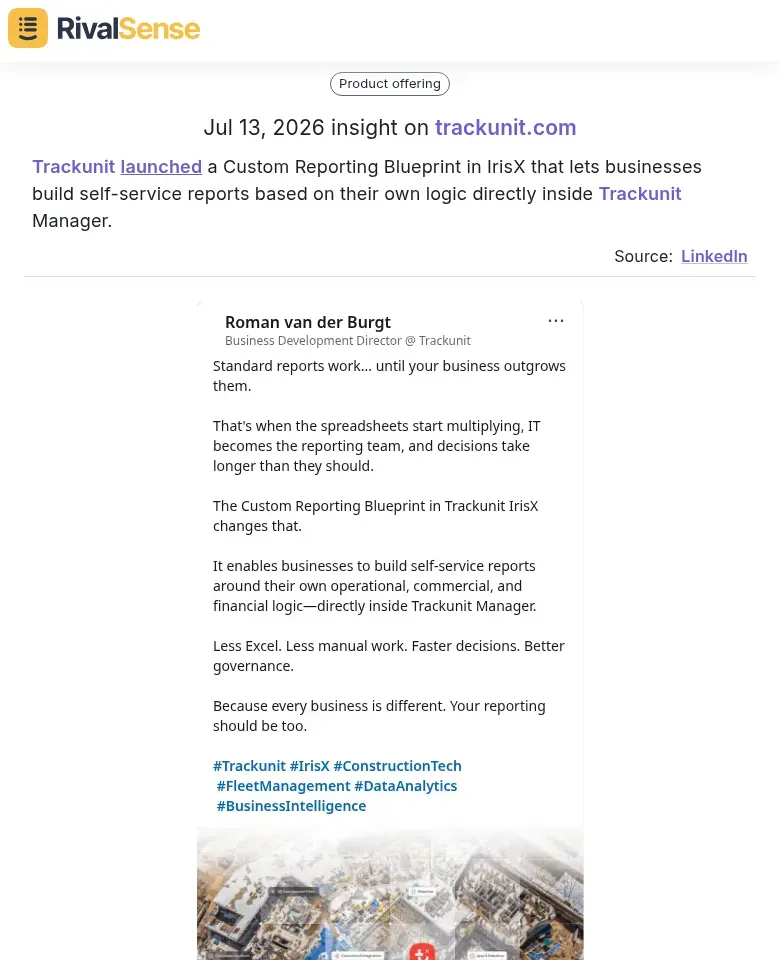
Trackunit launched a Custom Reporting Blueprint in IrisX that lets businesses build self-service reports based on their own logic directly inside Trackunit Manager.
🎯 Why this matters: A quiet product page update signals a new capability that could reshape customer expectations. Spotting it early gives you time to assess its impact on your own product roadmap and adjust positioning before prospects start asking about it.
Pricing page shift reveals a strategic pivot
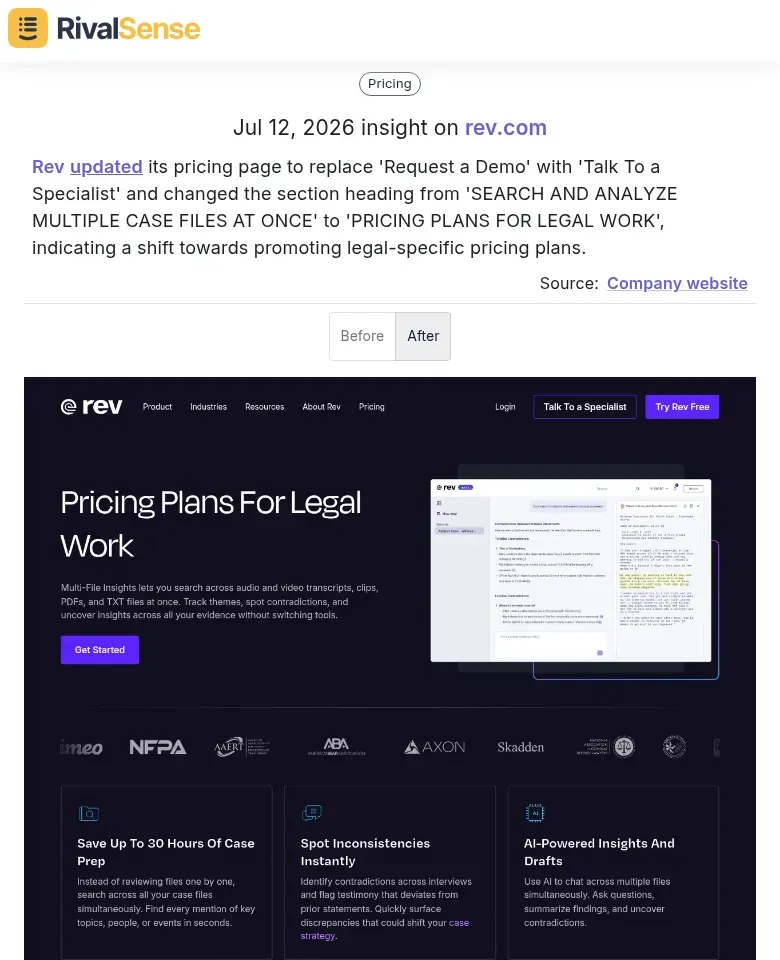
Rev updated its pricing page to replace 'Request a Demo' with 'Talk To a Specialist' and changed the section heading from 'SEARCH AND ANALYZE MULTIPLE CASE FILES AT ONCE' to 'PRICING PLANS FOR LEGAL WORK', indicating a shift towards promoting legal-specific pricing plans.
🎯 Why this matters: A pricing page overhaul is a deliberate strategic move—Rev is now targeting law firms. This tells you where they’re investing sales resources, which verticals might become more competitive, and where you can double down on your own messaging.
Product teaser drops weeks before the official launch
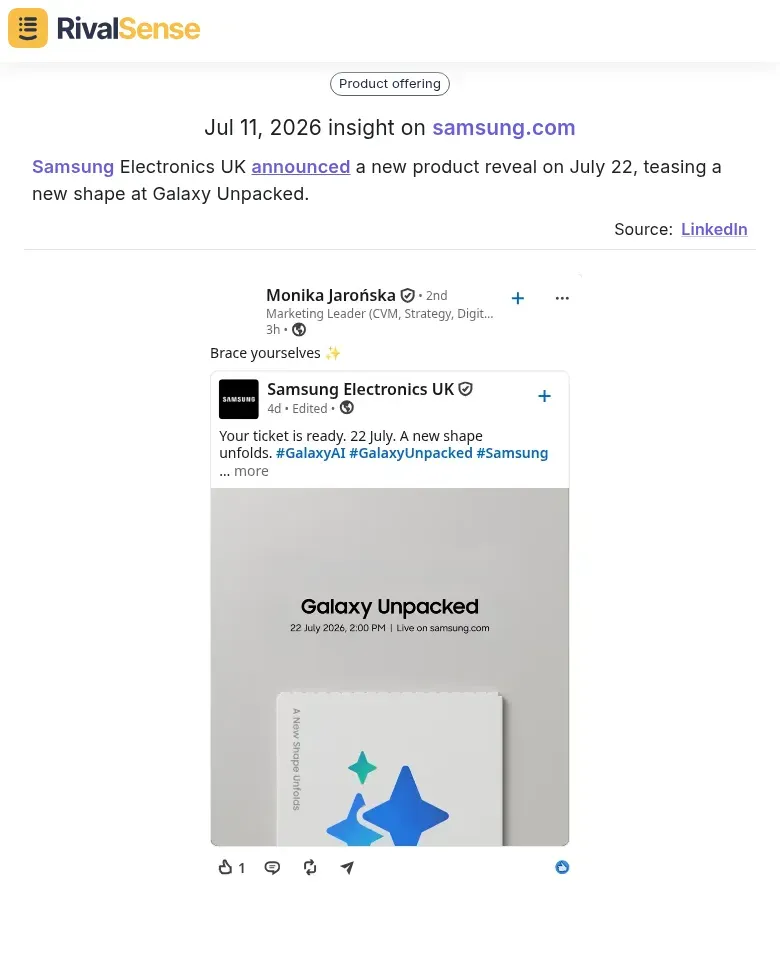
Samsung Electronics UK announced a new product reveal on July 22, teasing a new shape at Galaxy Unpacked.
🎯 Why this matters: Teasers like this give competitors a head start. While the press release won't land until launch day, you already know what's coming. That's valuable time to prepare your counter-messaging, content, or even a timing-based launch of your own.
Step 3: Set Up Tracking on Each Source
You can monitor these sources manually, but that’s time-consuming and prone to gaps. Tools like RivalSense automate the process by scanning 80+ sources across websites, social media, registries, and more—then delivering a curated weekly email report.
Here’s a checklist for setting up your tracking:
- [ ] Identify 5–10 competitors to monitor initially (add more as you scale)
- [ ] List the key sources for each competitor (website, LinkedIn, Twitter, product pages, pricing page, careers page)
- [ ] Set up Google Alerts for competitor names and key product terms (a free starting point)
- [ ] Use a competitive intelligence tool like RivalSense to aggregate sources into one weekly report
- [ ] Define your monitoring cadence: Weekly is minimum; daily for fast-moving markets
- [ ] Assign ownership: Someone on the team should review the report and flag action items
- [ ] Create a playbook for responding to different types of competitor moves (e.g., pricing drop, new feature, partnership)
Step 4: Review and Analyze Weekly
Set aside 30 minutes each week to review your competitive intelligence. Don’t just read—ask:
- What patterns do I see across competitors?
- Is there a strategic shift I should be aware of?
- Are any of these moves urgent? (e.g., a price cut that impacts your sales cycle)
- Which signals should I escalate to leadership?
Pro Tip: Create a simple scorecard for each competitor. Track metrics like product launch frequency, pricing changes, hiring velocity, and media sentiment. Over time, you’ll spot trends that press releases never mention.
Step 5: Distribute Intelligence Across Your Team
Competitive intelligence is worthless if it stays in one person’s inbox. Share relevant insights with:
- Sales: Pricing changes, competitive positioning, new features that could impact deals
- Product: New product launches, feature updates, technology investments
- Marketing: Messaging shifts, campaign themes, content strategies
- Leadership: Strategic moves, partnerships, regulatory risks
Common Questions About Competitor Monitoring
Q: How far in advance can I really know about competitor moves?
It varies by signal. Regulatory filings can give you 6–18 months of lead time. Website updates (like new product pages) can appear weeks before a launch. Hiring patterns can signal direction 3–6 months ahead. Even social media posts often preview announcements days or weeks early.
Q: Do I need to monitor all 80+ sources?
Not manually. Tools like RivalSense scan these sources automatically and surface only the relevant changes. You get a single weekly email with the highlights.
Q: What about new entrants I don’t know about?
Good monitoring systems detect new entrants by tracking domains and signals that don’t match your existing list. For example, if a new company starts hiring for roles in your space or publishing content targeting your customers, that’s a flag.
Q: How do I handle false positives?
In the first few weeks, you’ll see noise as the system learns what matters. Adjust filters, refine competitor lists, and within a month, the signal-to-noise ratio improves dramatically.
Q: Is a weekly cadence enough?
For most B2B companies, yes. The goal is to spot trends and prepare responses, not react in real-time. If you’re in a hyper-competitive market (e.g., SaaS with weekly product releases), you might want daily monitoring. RivalSense’s weekly email is designed for the former; fast-moving teams can supplement with webhook alerts.
The Bottom Line
Press releases are the echo, not the source. By the time a competitor issues a press release, the move has already happened. Your job is to see the move before the press release—to spot the product page update, the pricing change, the regulatory filing, the new hire.
Proactive competitor monitoring doesn’t require a dedicated team or a massive budget. It requires the right sources, a systematic process, and a tool that automates the heavy lifting.
The next time your CEO forwards a competitor’s press release, you want to be able to reply: “We saw that coming. Here’s what we’re doing about it.”
RivalSense helps B2B teams track competitor moves across 80+ sources—product launches, pricing updates, partnerships, regulatory changes, management moves, and more—and delivers everything in a weekly email report. No dashboards to check, no manual scraping. Just the intelligence you need, before the press release hits.
Ready to see what you're missing? Get your first competitor report today at RivalSense — for free.
📚 Read more
👉 Predictive Analysis: What Gives Your Competitors an Edge
👉 Wialon's ChatGPT Move Sparked Our Competitive Response
👉 Predict Competitor Moves Using Website Change Alerts
👉 A Beginner’s Guide to Tracking Key Account Goals in Tech
👉 3 Real-World Examples of Tracking Key Account Spend with Competitor Insights