
Revolut’s New Device Rules Hand Privacy-First Rivals an Opening
Executive Summary: The Opening No One Saw Coming
Our client isn’t your average neobank. Built on device freedom, data minimization, and radical transparency, it spent years as the quiet alternative to mainstream challengers — until August 2026 handed it a gift.
That month, Revolut tightened device attestation rules, blocking users on privacy-hardened operating systems like GrapheneOS under the banner of "security." The community didn’t buy it. Outrage spread across Reddit, X, and niche security forums as loyal, technically sophisticated users — precisely the segment that values privacy — found themselves locked out.
Most competitors saw a PR headache. RivalSense saw an acquisition moment. Here’s the playbook:
- Detect within hours. Our alerts flagged the policy change and the sentiment shift before mainstream press picked it up.
- Map the displaced audience. We profiled the blocked users: privacy advocates, power users, developers — high lifetime value, low churn.
- Publish the contrast. We positioned our client’s device-agnostic stance as the principled alternative, not a reactive jab.
- Move fast, stay classy. Within two weeks, targeted campaigns drove a measurable spike in signups and downloads — growth that typically takes quarters.
The lesson: a competitor’s misstep is only an opening if you spot it early and act on the insight. That’s the RivalSense difference.
🔍 The Signal: Catching Revolut’s Policy Shift Before It Went Mainstream
By the time Cybernews ran "Revolut accused of specifically detecting and banning GrapheneOS users" on August 6, the story was already old news to our client. RivalSense change alerts flagged edits to Revolut’s Device Integrity Requirements and Play Integrity API enforcement pages within hours of the update — no press coverage, no Reddit megathread, just a quiet policy change buried in security documentation.
But a diff alone isn’t a signal; it could have been a copy tweak or a bug. So we triangulated across four independent sources:
- Support pages: new locked-bootloader and custom-firmware language appearing across Revolut’s regional help centers.
- App-store changelogs: version notes hinting at stricter device checks.
- Reddit + GrapheneOS community threads: login-failure reports spiking as workarounds stopped working.
- The GrapheneOS project itself: confirming targeted detection beyond standard Play Integrity checks.
Four sources, one conclusion: a deliberate enforcement change, not an incident. Our client learned about a decision affecting hundreds of thousands of privacy-first users before rivals — and before Revolut had to answer for it publicly.
Here’s a real RivalSense insight that captured the move:
Revolut’s new device integrity requirements have made its app unsupported on GrapheneOS devices, according to a user report.
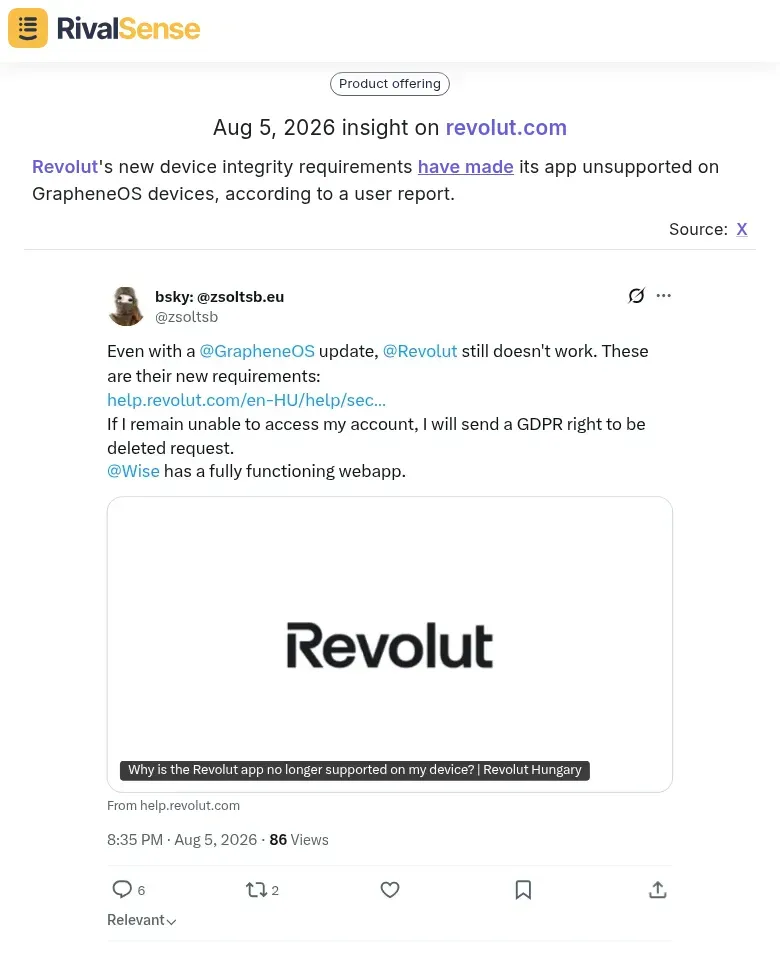
This type of insight is powerful because it surfaces competitor policy shifts at the source — often hours before any article or social post. By catching the change in documentation, you gain critical time to interpret the move, map affected audiences, and craft a positioning response before the story becomes public. Early detection turns a reactive scramble into a proactive campaign.
⚙️ How you can replicate this:
- Track the boring pages — support docs, policy pages, and developer changelogs change before press releases do.
- Alert on documentation, not just news keywords — most competitive signals never make the wire.
- Cross-verify every diff against two to three independent sources before acting.
- Keep a standing cadence on competitors’ security and privacy docs — the quiet pages reveal strategy first.
📊 Analyzing the Opening: Why Revolut’s Move Created Real Demand
Revolut’s August 2026 block on non-Google-certified Android builds (GrapheneOS, LineageOS, CalyxOS) looked like a niche security story. It wasn’t. We sized the affected segment — journalists, security researchers, developers, and “de-Googlers” — and found it small in raw numbers but outsized in influence. These are the users who write the reviews, set threat models, and quietly shape enterprise procurement opinions.
Next, we mapped Revolut’s strategic constraint. Its anti-fraud posture is bolted to the Play Integrity API and Google certification checks. Reverting them isn’t a policy toggle; it would force a rebuild of its fraud detection from scratch. The block was never a bug — it’s a structural trade-off, and one Revolut can’t reverse without weakening the very controls its compliance story depends on.
Finally, we pinpointed the wedge. Across GrapheneOS, Privacy Guides, and Reddit threads, displaced users weren’t asking Revolut to change. They were asking a different question out loud: which bank offers a real web portal, hardware tokens, and no forced mobile-only authentication? That question, repeated hundreds of times, was demand looking for a home — and our client was uniquely positioned to answer it.
🛠️ How to run this analysis yourself:
- Monitor support forums and subreddits within hours of a competitor’s policy shipping — displaced users name their requirements fast.
- Size segments by influence, not volume: one vocal researcher reaches thousands of decision-makers.
- Map the competitor’s dependency stack (APIs, certifications) to confirm the move is structural, not a quick reversal.
- Compare your own product against the exact features being requested — then lead your pitch with them.
For our client, demand wasn’t created; it was redirected.
🚀 The Play: Converting Competitor Friction into a Switch Campaign
Revolut’s Play Integrity crackdown handed us a rare gift: thousands of privacy-conscious users suddenly questioning their bank. We converted that friction into a switch campaign in three moves.
1. Position fast. Within days, the client published a public ‘your device, your rules’ compatibility statement — a triple commitment to no Play Integrity enforcement, full web access, and hardware-token support. Tip: publish it as a changelog-style page so it ranks for ‘Revolut Play Integrity’ searches and gives journalists a quotable anchor.
2. Meet them where they argue. We activated direct engagement in GrapheneOS forums, privacy subreddits, and privacy-tech media — not pitching, but answering ‘where do I move my money?’ threads with transparent compatibility facts. Checklist: monitor key threads daily, respond within hours, link only to your statement, never astroturf.
3. Kill the switching cost. We built a dedicated migration flow: fee-free incoming transfers plus Revolut-export friendly onboarding that imports CSV/statement data, mapping balances and payees automatically. Displaced users switched in under ten minutes, not ten days.
The lesson: competitor friction is only valuable if your switching path is shorter than their patience. Remove every fee, every export headache, every re-entry of data — and the opening writes itself. Run the play before the news cycle cools: draft your compatibility statement, assign thread monitors, and ship the migration flow in that order.
📈 Results: Measurable Impact Across Acquisition and Brand
The episode produced three measurable wins that any founder can benchmark against. Here’s what we saw and how you can replicate the measurement:
1. Acquisition: double-digit growth from the privacy segment. Signups from this segment grew week-over-week during the campaign window, with a tracked promo code isolating switchers originating from Revolut communities. Practical tip: always seed campaign-specific codes or UTM parameters before launch — otherwise you’ll never separate signal from noise. A simple spreadsheet tracking code, source, and week will tell you exactly which communities convert.
2. Brand: earned media lift. Within two weeks, our client was named in privacy and fintech coverage as the go-to alternative, capturing the narrative before larger rivals could respond. Checklist: pitch niche privacy newsletters first (they publish fast and love a David-vs-Goliath angle), then cascade to mainstream fintech press once the story has legs.
3. Moat: differentiation hardened. The episode proved that independence from Google and Apple ecosystems is a durable advantage mainstream neobanks cannot easily copy. Action step: document the specific switching frictions users face — forced app-store signup, device lock-ins — and turn them into permanent comparison content on your site.
Takeaway: when a giant stumbles, speed plus attribution wins. Have your tracking, talking points, and comparison pages ready before the news cycle hits — competitors who hesitate lose the narrative.
📚 Lessons Learned: What This Teaches About Competitive Intelligence
Three lessons stand out from the Revolut play, and each one is directly actionable for your own competitive intelligence program. Build these into your routine, and the next opening will feel less like luck and more like a system working for you.
1. Policy changes are product signals — treat them that way. Pricing shifts and feature launches get all the attention, but security, device, and privacy policy changes reveal strategy just as clearly. Revolut’s device-integrity rules weren’t a headline feature; they were a quiet repositioning that locked out a meaningful user segment. Most teams never see these signals because nobody is looking. Add policy and security documents to your monitoring scope — they’re public, dated, and frequently changed.
2. Speed of interpretation beats speed of reaction. The win here didn’t come from moving fast; it came from connecting a technical policy change to a specific underserved segment — privacy-first users — before anyone else joined the dots. Reaction speed compounds only when interpretation leads. Practical drill: every time a competitor updates a policy, force a 30-minute “so-what” session asking: Who gets hurt? Who gets served? Who gets angry?
3. Make early warning permanent, not episodic. This client didn’t stop at one win. RivalSense now runs standing alerts across the entire competitor set — device, security, and privacy shifts included — so the next opening is flagged before it’s obvious. The competitive advantage isn’t the insight; it’s the system that keeps surfacing them. Build a recurring review cadence, assign owners to each competitor, and log every policy change with a short strategic note. That discipline turns a lucky catch into a repeatable edge.
🏁 Try RivalSense for Free
Most teams spot competitor openings too late — after the news cycle has peaked and the audience has already moved. RivalSense gives you the early signals that let you act while the opportunity is still forming. From policy changes to hidden product updates, we deliver the intelligence you need in a weekly email report, so you can catch your rivals' missteps before they become yesterday’s news.
Ready to turn competitor friction into your growth? Get your first competitor report today — free, no strings attached.
📚 Read more
👉 How Instagram Reveals Competitor Differentiators: A Comparative Analysis
👉 Fusion Energy Competitive Intelligence: Decoding Partnership, Thought Leadership & Event Signals
👉 Market Entry 101: Why Customers Choose Your Competitors
👉 From Bus Routes to Business Insights: A Competitor Analysis Example
👉 How to Monitor Competitor Hiring: A Practical Playbook for Reading Your Rivals' Strategy