
Market Entry 101: Why Customers Choose Your Competitors
When a competitor opens a new office, launches in a new region, or hires for a new role, they’re not just spending money—they’re placing a bet. Every expansion decision is a strategic wager on where customer demand is heading, which budgets will open up, and how buying preferences are shifting. Crucially, they make these bets before that demand becomes public knowledge. By the time a market is obviously hot, the signal is already in your competitor’s playbook—and your customers’ inboxes.
Why does this matter to you? Because expansion moves are leading indicators. Read them early, and you gain a head start: time to sharpen your positioning, adjust pricing, or deepen relationships before customers even consider switching.
Practical tips for reading the signals:
- Watch job postings. A competitor hiring a “Head of Enterprise Sales” in a new region signals an enterprise push months before any announcement.
- Track office openings and partnerships. They reveal which verticals or geographies your rival believes are ripe for growth.
- Monitor funding rounds. Fresh capital often fuels expansion into adjacent markets—follow the money.
Build a simple signal-tracking checklist:
✅ Region
✅ Vertical
✅ New roles
✅ Timeline
Review it monthly. When you spot a move, ask one question: “If they’re right about this demand, what would I do differently today?”
That question is your competitive edge. The best time to defend your market is before the battle starts.
Local Hiring Signals Long-Term Commitment
When a competitor quietly posts five job openings in your city—sales, support, implementation—that’s not a hiring spree. It’s a declaration of intent. Payroll is the most expensive commitment a company can make, so direct local employment converts a market entry from an experiment into a long-term bet. Customers read this signal instantly.
Why? Because buyers are risk-averse. A vendor with a local team can meet face-to-face, resolve issues in your timezone, and navigate your regulations and business culture—factors buyers weigh far more heavily than product specs. That’s why many European buyers refuse to evaluate vendors without local entities, even for cloud-delivered products. Visible investment in a community and its economy signals the vendor will be around when things go wrong, not just during the sales cycle.
Practical playbook for tracking this:
- Monitor job postings in your target region monthly; a cluster of sales, support, and success roles in one city is the strongest commitment signal.
- Check for local entity registration, office address, and leadership hires with regional titles.
- Test responsiveness—speed of reply to local inquiries is a proxy for real investment.
- Note local event sponsorship, partnerships, and community hiring.
Real-world example – Airalo
RivalSense recently flagged that Airalo has officially established direct employment in the United Kingdom.

This type of insight reveals a long-term commitment that goes beyond a landing page or a reseller agreement. When you spot a competitor registering local entities and hiring full-time staff, treat it as a five-year bet, not a pilot. It’s a signal that the market has moved past the experimental phase and that serious buyers are now up for grabs.
If you see these signs from a competitor, ask yourself: what local investment can your company show today?
Physical Presence Builds Experiential Trust
No amount of pixel-perfect product photography can replace the feeling of cold aluminum in your palm or the click of a well-engineered hinge. For high-consideration purchases—enterprise hardware, medical devices, luxury goods, even premium SaaS with on-site onboarding—showrooms and physical locations are trust accelerators. They give hesitant buyers the proof they need before committing.
Why it works: In-person touchpoints let customers touch, test, and validate before committing. That hands-on experience directly reduces purchase anxiety and collapses what would otherwise be a lengthy trust-building cycle. A customer who spends ten minutes with a product walks away with more conviction than one who reads ten reviews.
Decode the location signal: Where a competitor opens a storefront is a strategic confession. A flagship in a premium district signals they’re courting high-value, lifestyle-driven buyers; a presence near industrial parks or tech hubs reveals a focus on operational buyers. Walk their neighborhoods and ask: Who lives here? What do they value? How does our offering fit that lifestyle?
Your action checklist:
- Plot competitor locations on a map and look for clusters, not just individual sites.
- Visit their showrooms incognito; note what’s demoed, what’s hidden, and how staff qualify visitors.
- Test your own product physically before launch—friction you feel, customers will feel.
Real-world example – Saatva
RivalSense picked up that Saatva will open a new showroom in Pittsburgh’s Shadyside neighborhood at a former Rite Aid on Walnut Street.

This isn’t just a real‑estate footnote; it’s a signal that Saatva is betting on an affluent, design‑conscious demographic in a walkable retail corridor—exactly the kind of buyer who wants to experience a mattress before spending four figures. Tracking physical‑presence moves like this allows you to anticipate your competitor’s ideal‑customer profile and refine your own targeting before they own the neighborhood.
Physical presence isn’t just real estate. It’s a message about who you’re built for—and a trust shortcut your rivals are already using.
Infrastructure Investment Targets Specific Pain Points
When competitors build purpose‑built infrastructure—high‑speed local servers, privacy‑first architecture, censorship‑resistant networks—they’re not upgrading hardware. They’re engineering for pain points your product ignores. Off‑the‑shelf infrastructure serves the average customer; purpose‑built infrastructure serves your prospect.
A German buyer needs GDPR‑compliant data residency; a founder in a restricted market needs uptime under scrutiny. These aren’t feature preferences—they’re deal‑breakers. When competitors engineer for speed, security, or reliability, those attributes become decisive buying triggers. Buyers compare your generic stack against their tailored one—and the gap shows in every benchmark, every SLA.
How to find the gaps:
- Map the regulatory landscape. Note data‑residency laws, privacy rules, and content restrictions per market—then flag which competitors advertise compliance as a headline feature.
- Audit infrastructure claims. Check engineering blogs, careers pages, and case studies for edge locations, certifications, or data‑center mentions.
- Interview switchers. Ask customers who moved between you and a competitor what infrastructure factors drove the decision.
- Read their pricing pages. Purpose‑built infrastructure justifies premium pricing—a reliable signal of investment priorities.
Real-world example – Proton
RivalSense detected that Proton launched 10 Gbps VPN servers in Oman, allowing users to bypass content restrictions and avoid state surveillance under its strict no‑logs privacy policy.
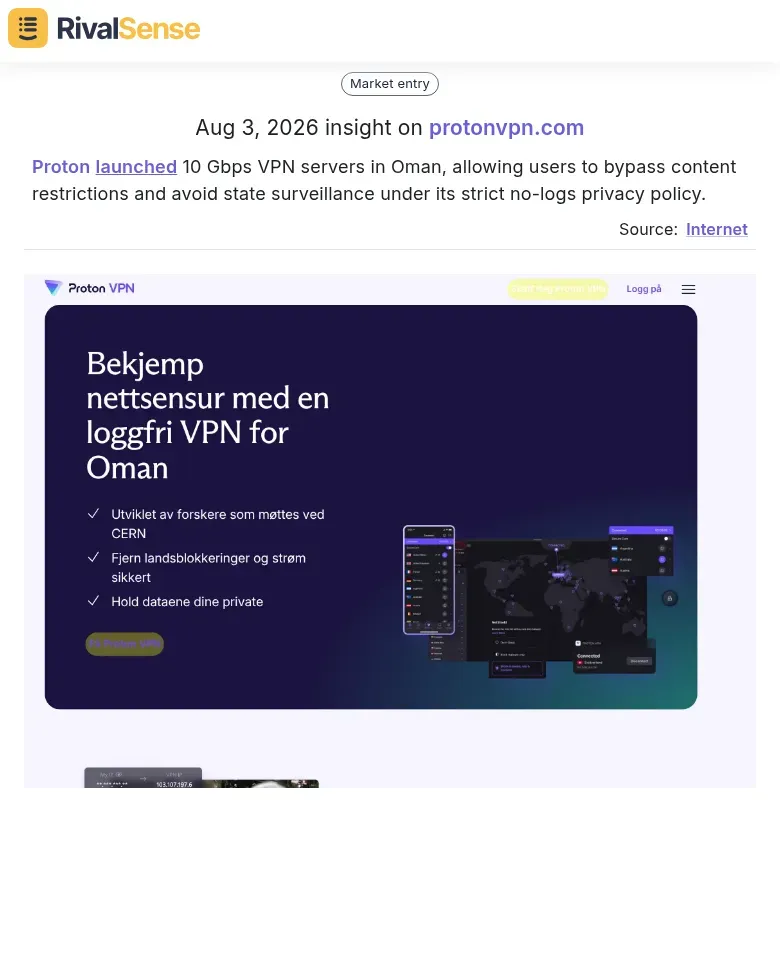
This type of awareness is gold for any B2B player in privacy‑sensitive verticals. By monitoring infrastructure launches, you learn exactly which pain points your competitor is betting on—speed in under‑served regions, censorship resistance, airtight privacy. It tells you where deals are being lost because your generic solution can’t meet localized must‑haves.
The takeaway: In some markets, privacy isn’t a preference—it’s survival. Regulatory and political context dictates which values customers prioritize. Position around those values, not your own assumptions.
Translating Rivals’ Moves Into Your Counter‑Strategy
Every competitor move—a new office, a hiring spree, an infrastructure launch—is really a bet on an unmet customer need. Your job isn’t to imitate the move; it’s to decode the need it serves, then decide whether and how to respond.
Step 1: Reverse‑map the expansion. When a rival enters a region or vertical, ask: which customer pain does this solve—speed, local compliance, language, trust? Write the need next to the move.
Step 2: Audit your own coverage. Score yourself 1–5 on each need the rival just validated. If they opened a local office for “proximity and trust” and you score a 2, that’s where deals will leak—and where you respond (a local partner, a support SLA, a flagship reference).
Step 3: Hunt their blind spots. Expansion forces trade‑offs. Every dollar spent on new‑region sales is a dollar not spent on product depth, integrations, or security. Mine review sites and win/loss notes for complaints rivals leave unaddressed, then position your offering directly against that gap.
Build a weekly monitoring cadence across three signal types:
| Signal Type | What It Reveals |
|---|---|
| New hires | Roadmaps 3–6 months before announcements |
| Physical locations | Go‑to‑market focus and buyer demographics |
| Infrastructure launches | Capability bets on speed, privacy, or compliance |
Tip: Protect a 30‑minute Friday ritual. One owner logs moves, maps each to the underlying need, and flags coverage gaps—so you respond in weeks, not quarters.
Turn Competitive Intelligence Into Action
The mistake most teams make isn’t missing the signals—it’s treating them as noise until it’s too late. Expansion signals are leading indicators: your rival posts a regional sales role 3–6 months before opening an office, files a trademark before rebranding, or secures warehouse capacity before promising next‑day delivery. Tracked in isolation, each looks like trivia. Tracked together, they forecast the market shift before customers feel it.
Build a signal stack with three layers:
- 🔍 Talent – Job postings by function, seniority, and geography (a cluster of enterprise AE roles signals a push upmarket).
- 🏢 Physical presence – Office leases, storefront permits, event sponsorships in a new city.
- 🛠️ Infrastructure – New integrations, API docs, certifications, or patents hinting at product capability.
The insight lives in the intersection. One new posting is noise; a posting plus a lease plus a new partnership is intent. RivalSense captures these signals early, surfacing the patterns that matter before they become common knowledge.
Then act early and deliberately. Run a monthly “expansion watch” review: assign owners to each signal layer, score confidence, and agree on triggers (e.g., “if X hires 3+ AEs in region Y, we launch a pilot there”). Waiting for the press release means your customers—and your competitor’s new sales team—have already moved.
Intelligence has a shelf life. The value isn’t in knowing; it’s in how fast you convert knowing into positioning, pricing, and pipeline decisions.
Don’t let your competitors’ next move catch you off guard. RivalSense tracks the market‑entry signals that matter—hiring, office openings, infrastructure bets—and delivers them in one weekly report. Try RivalSense for free and get your first competitor report today.
📚 Read more
👉 From Bus Routes to Business Insights: A Competitor Analysis Example
👉 How to Monitor Competitor Hiring: A Practical Playbook for Reading Your Rivals' Strategy
👉 Key Account Identification for Compliance Teams: A CEO's Productivity Playbook
👉 How NVIDIA’s cuEST 0.2.0 Gives Competitors Their Next Move
👉 Instagram Competitor Insight Checklist for Key Account Tracking