
How Instagram Reveals Competitor Differentiators: A Comparative Analysis
Annual reports and press releases tell you what competitors want you to know—months after the fact. Instagram shows you what they're actually doing, this week. A competitor's feed is a live, unfiltered operating log: product launches teased before the website updates, pricing hints buried in captions, hiring signals in "we're growing" posts, and customer pain points surfacing in comment threads.
Content cadence and engagement patterns are equally revealing. Posting 12 times a week versus twice a month signals team size and resource allocation. Track cadence, format mix (Reels vs. carousels vs. stories), and engagement rate—not just follower counts. A rival with 50K followers but a 0.2% engagement rate is broadcasting to an empty room; one with 8K followers and a 4% rate has a community worth studying. That gap reveals who's actually winning the trust battle.
Finally, run a comparative analysis across three to five competitors side by side. Every positioning statement claims "best-in-class"—but the content mix exposes true differentiators: one doubles down on tutorials (education-led), another on customer stories (proof-led), a third on founder content (personality-led).
Practical checklist:
- Snapshot each competitor's feed monthly: post count, format, and engagement rate
- Note recurring themes in their top-performing posts
- Mine comment sections for repeated customer complaints
- Benchmark your cadence against the median—then decide what to outdo
The differentiators hiding in your positioning deck are on your competitors' Instagram grids. Go look.
Decoding Go-to-Market Signals from Events and Community Engagement
Scroll through a competitor's Instagram during trade show season and you're watching their go-to-market strategy in real time. Where they exhibit signals their ICP, budget, and maturity: a seed-stage startup demoing at a niche SMB summit tells a different story than an enterprise player sponsoring a marquee keynote.
Run a quick event audit for each competitor:
- Event tier and niche vs. mainstream
- Booth size, location, speaking slots
- Event hashtags they push and repost volume
- Story frequency within 24 hours (the least polished, most honest signal)
Gamified booths—prize wheels, photo ops, AR filters—reveal how they educate a distracted crowd and convert foot traffic into qualified leads. Data shows gamified booths see roughly 40% more visitors and 30% better brand recall, so if a competitor invests there, they're buying memorability over reach. Count attendee reposts and compare engagement on booth posts vs. their average.
For example, LastPass invites attendees to visit booth #5112 at Black Hat USA to play a game about creating strong 12-character passwords and win swag—a clear investment in interactive lead capture and brand recall.
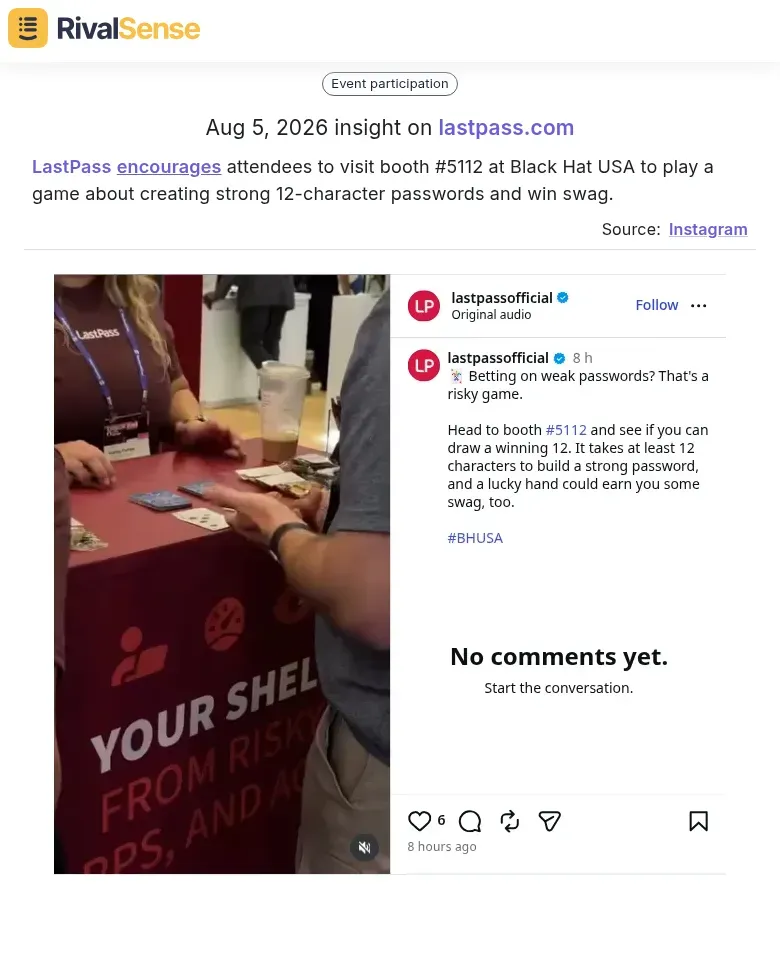
This type of insight is valuable because it reveals a competitor's budget allocation toward experiential marketing, their messaging priorities (in this case, cybersecurity awareness), and the specific audience they're targeting at a premier industry event. It tells you they're not just showing up—they're running a conversion-focused play.
Swag is the final tell. Utility-first merch (phone chargers, notebooks) signals a practical, ROI-driven brand; loud, quirky items signal a memorability-first playbook. Both attract different buyers.
Pro tip: keep a saved Instagram folder per competitor, screenshot event coverage weekly, and track three metrics—post frequency, hashtag reach, and engagement rate. Shifts here usually precede repositioning that shows up in pricing pages and earnings calls months later.
Uncovering Sales Strategy Through Distribution and Payment Tactics
When a competitor posts something that isn't their core product, don't scroll past it—that's a diversification signal. A SaaS company showcasing a $49 audit service or a hardware firm teasing a subscription tier is telling you exactly where they're running revenue experiments. Track these non-core offers in a simple spreadsheet: what they are, when they launched, and their pricing. Three or more in a quarter signals they're hedging their main revenue stream.
Consider Gen, which promotes new, sealed iPhone 17 devices with warranty at its Mendoza location, accepting multiple payment methods including USD, USDT, pesos, cards, and transfers. This isn't just a product post—it's a diversification into hardware resale and a strategic embrace of crypto-friendly payments.
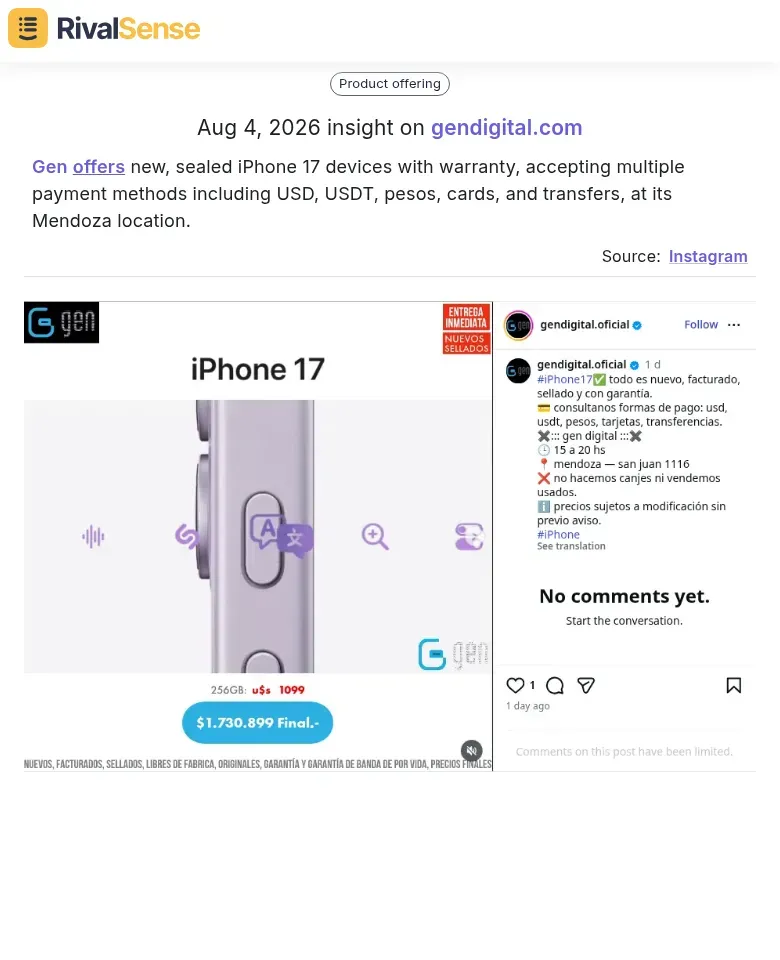
Tracking such offers uncovers where a competitor is testing new revenue lines and which buyer personas they're courting. The mix of fiat and crypto payments signals an appetite for tech-savvy, international, or underbanked segments—market intelligence you can use to adjust your own payment stack or positioning.
Payment options are quieter but more revealing. Watch for posts about installment plans, "buy now, pay later," annual-billing discounts, or regional payment methods like UPI or Pix. Each one maps to an underserved buyer segment—students, SMBs, price-sensitive markets—and a trust-building play. Quick checklist: (1) screenshot the payment mention, (2) note which buyer persona it targets, (3) check whether it also appears in paid ads. Paid push equals strategic bet, not experiment.
Finally, treat location and logistics posts as a channel map. A "now shipping to Germany" or "new office in Austin" update is a geographic expansion signal. Pair it with their follower growth in that region to gauge traction. Practical tip: keep a monthly expansion log capturing every location tag, shipping announcement, and warehouse photo. Two or more within 90 days means you should build that market into your own sales plan before they establish a beachhead.
Reading Brand Values Through Partnerships and Social Impact
Partnership announcements on Instagram are more than celebratory posts—they're strategic disclosures. When a brand tags a co-branded product, a reseller, or a tech integrator, they're revealing their ecosystem strategy and which players they trust to extend their credibility. Tip: audit the last 30 partnership posts from each competitor. Do they collaborate with enterprise giants or scrappy startups? That pattern signals whether they're chasing enterprise trust or innovation velocity.
CSR and education-focused content is equally revealing. A competitor that posts mentorship programs, scholarships, or sustainability initiatives is signaling employer brand and talent acquisition strategy. Checklist for your analysis:
- Do they highlight employees or external beneficiaries?
- Is the content reactive (disaster relief) or systematic (ongoing curriculum)?
- Do they quantify impact or keep it emotional?
Systematic, recurring initiatives—not one-off gestures—hint at long-term market development. Action step: create a simple scoring sheet rating each competitor's partnerships and social impact posts on three dimensions: consistency, specificity, and alignment with their core product.
Take Powerfleet’s partnership with ischoolafrica to bring inclusive education to Le Roux Schools. It's a systematic initiative tied to their core technology domain, building both brand goodwill and a future talent pipeline.
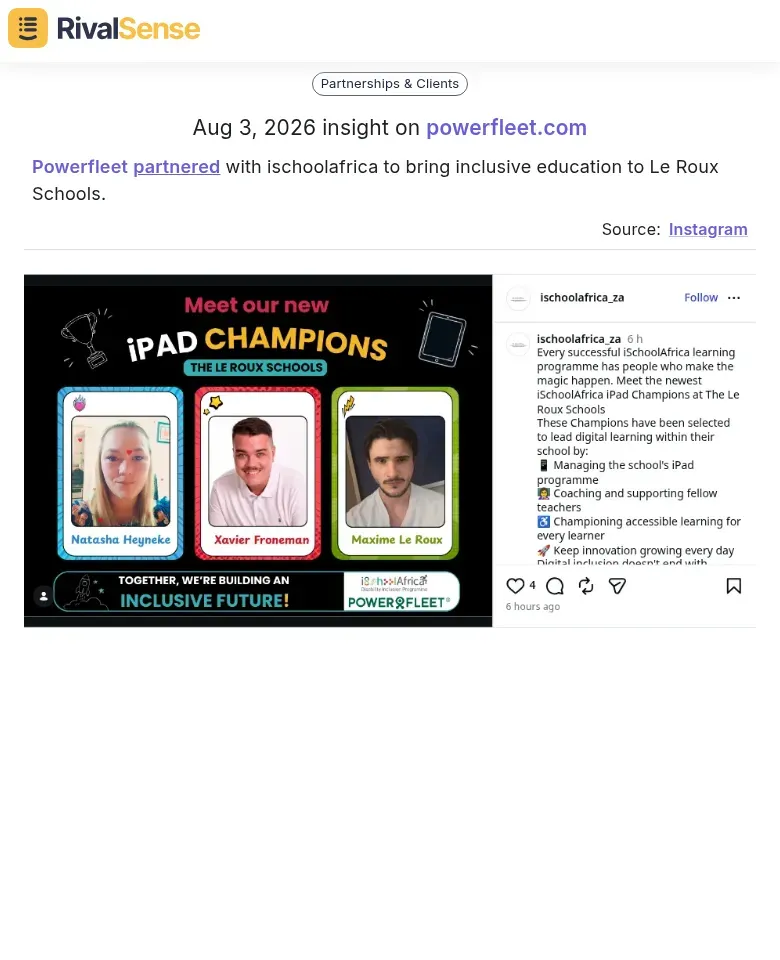
Insights like this are valuable because they signal where competitors are building long-term intangible assets—brand equity, community trust, and talent pipelines. A competitor that educates future users in its domain is creating a defensible moat that marketing spend alone can't breach.
Building a Systematic Competitor Instagram Analysis Framework
The problem with most Instagram competitor research: it's a screenshot gallery, not a system. Fix that with three moves.
1. Standardize before you compare. Build a tagging taxonomy of 5–8 content categories (product demos, education, customer stories, thought leadership, culture, promotions) and tag every post from every competitor consistently. Normalize everything: use engagement rate (engagement ÷ reach), not raw likes, and adjust for posting volume. A competitor publishing 20x/month will always beat a leaner account on totals—that doesn't make them better.
2. Track trends, not snapshots. Set a monthly rhythm: log posting cadence, engagement per category, new hashtags, and caption language. Watch for theme shifts. A sudden spike in customer-story posts or new vocabulary in captions often signals a repositioning 2–4 weeks before a campaign or product launch lands. Velocity is the leading indicator—flag any new theme rising ~50% week-over-week.
3. Triangulate before you act. Instagram is directional, not definitive. Treat every signal as a hypothesis until a second source confirms it: website copy changes, job postings, pricing pages, review sites, earnings calls. A useful priority rule: act on signals confirmed by two independent sources; log everything else to a watchlist for the next review.
Checklist: taxonomy defined → monthly log running → theme-shift alert set → two-source confirmation rule applied. That's the difference between scrolling and intelligence.
Turning Instagram Insights into Strategic Action
Collecting competitor intel is only half the battle—the real value comes from turning those observations into decisions. Here's how to operationalize what Instagram reveals.
1. Prioritize ruthlessly. Not every viral post or new feature deserves a response. Score each insight across three filters:
- Strategic relevance: Does it threaten your core positioning or serve a segment you target?
- Urgency: Is it a one-off experiment or a repeated pattern signaling a pivot?
- Feasibility of response: Can you realistically match, counter, or leapfrog it with current resources?
Rank insights into "act now," "monitor," and "park" buckets. A competitor's flashy giveaway may be urgent but irrelevant; a consistent shift toward sustainability content may be highly relevant and worth a roadmap slot.
2. Assign clear ownership. Ambiguity kills follow-through. Name a dedicated competitive intelligence owner (or small cross-functional team) responsible for weekly monitoring, maintaining a shared insights log, and bringing findings to quarterly roadmap reviews. Without a single owner, insights die in screenshots. Tie their output to a recurring ritual—e.g., a 30-minute monthly "competitor pulse" meeting where product, marketing, and sales translate findings into concrete roadmap items.
3. Refresh continuously. Competitor analysis is not a one-time project. Market shifts, new entrants, and platform algorithm changes make static reports stale within weeks. Re-run your comparison quarterly, watch for emerging signals (new content formats, messaging pivots, audience engagement spikes), and document what changed since last review.
Quick checklist: Score every insight → sort into action buckets → assign an owner → schedule monthly review → re-baseline quarterly. Differentiation is a moving target—keep aiming.
The manual Instagram detective work described here is powerful but time-consuming. RivalSense automates this entire process—tracking competitor product launches, pricing updates, event appearances, partnerships, and more across websites, social media, and registries, then delivering everything in a concise weekly email report. Try it for free and get your first competitor report today.
📚 Read more
👉 Fusion Energy Competitive Intelligence: Decoding Partnership, Thought Leadership & Event Signals
👉 Market Entry 101: Why Customers Choose Your Competitors
👉 From Bus Routes to Business Insights: A Competitor Analysis Example
👉 How to Monitor Competitor Hiring: A Practical Playbook for Reading Your Rivals' Strategy
👉 Key Account Identification for Compliance Teams: A CEO's Productivity Playbook