
How to Monitor Competitor Hiring: A Practical Playbook for Reading Your Rivals' Strategy
Most companies watch competitors the wrong way. They wait for the press release, the product launch, or the pricing change — and by then, the battle is already half over. But your rivals are broadcasting their strategy weeks or months in advance, in a place most teams never think to look: their job postings.
Every job a competitor posts is a confession. A new role for a "Machine Learning Engineer — Responsible AI" in a city where they've never operated tells you about a product pivot and a geographic expansion before any official announcement. Competitor hiring is one of the earliest, most reliable signals of strategic movement — you just have to know how to read it.
Here's a practical playbook for monitoring competitor hiring, spotting the shifts that matter, and turning them into decisions before they become public knowledge.
Why hiring is a leading indicator of strategy
Hiring happens in advance of outcomes. Companies hire the team before they ship the product, enter the market, or win the client. That makes job postings a leading indicator — while press releases, product launches, and pricing updates are lagging ones.
Concrete data backs this up. Before Microsoft publicly announced Copilot for Office 365 in March 2023, AI-related job postings had already surged by nearly 40% between September 2022 and January 2023 — even as the company laid off staff in other departments. Titles like "Prompt Engineer," "AI Safety Manager," and "Responsible AI Lead" appeared months before any product demo. Anyone tracking Microsoft's hiring could have predicted the strategy months in advance.
Recent market data shows why this matters more than ever:
- Openings are up, hiring is down. BambooHR's July 2025 Workforce Insights Report found job openings rose 21% globally while actual hiring fell 20%. Companies post roles as strategic signals and market-testing tools even when they aren't filling them.
- Hiring cycles are slowing. Huntr's Q2 2025 report (461,000 applications analyzed) showed the median time-to-offer rose 22% to 68.5 days — longer decision cycles mean postings sit visible for months, giving you more time to read them.
- Remote hiring is scaling fast. Oyster's 2025 Global Hiring Trends Report found 58% of organizations now employ remote tech talent across borders — double the 2020 rate. A job posting in a new geography is often the first sign of a distributed team being built.
What to monitor: the competitor hiring checklist
Don't just count job postings. Track these dimensions for each competitor:
- Role and function: Are they hiring engineers, salespeople, marketers, or support? A surge in sales enablement roles signals go-to-market expansion. A wave of DevOps roles signals infrastructure scaling.
- Seniority and level: A shift toward senior or leadership hires suggests a scale-up phase. A shift toward junior hires suggests cost optimization.
- Geography: New openings in markets where they have no presence indicate expansion, relocation, or a new delivery hub.
- Skills and tech stack: Job descriptions list frameworks, tools, and certifications. A sudden mention of a niche technology (e.g., a specific LLM, a compliance framework, a new cloud platform) hints at a product or regulatory move.
- Reporting lines: "Reports to VP of AI" tells you which functions are becoming strategically central.
- Posting duration and frequency: Roles that stay open for months — or get reposted — suggest recruiting struggles, retention issues, or a weak employer brand. Rapidly removed postings can signal restructuring or a canceled initiative.
- Compensation and benefits: Public salary ranges reveal how they're positioning against you for talent — and whether you need to adjust your own offers.
How to set up your monitoring system: 7 steps
Step 1: Build a watchlist
Pick 3–5 direct competitors plus a few emerging players in adjacent sectors. These "lens companies" give you a balanced view of your market's evolution. Add aspirational competitors too — the ones winning deals you want.
Step 2: Define your tracking fields
Standardize what you capture for every posting: job title, function, required skills, seniority, location, salary range, posting date, and posting status. Without a consistent taxonomy, you can't spot trends over time.
Step 3: Decide on sources
Monitor company career pages, LinkedIn, Indeed, niche job boards, and regional platforms. Career pages are often the most honest (no applicant-tracking noise), while aggregators reveal volume. Just beware: aggregators show duplicates, so dedupe before counting.
Step 4: Collect consistently
Job data is only valuable as a trend. Capture postings weekly at minimum, and retain history for 6–12 months. Spikes and drops matter more than absolute numbers.
Step 5: Analyze for patterns
Look for changes over time, not single postings. Compare this quarter to last quarter. Which functions are growing? Which geographies are new? What skills didn't exist in their postings six months ago?
Step 6: Validate with secondary signals
Cross-reference hiring patterns with funding news, leadership appointments, product launches, and partnerships. If hiring aligns with public moves, you have confirmation. If it doesn't, you may have found an under-the-radar strategy — which is often the more valuable insight.
For example, if you had been tracking hiring for autonomous vehicle companies, a surge of driver operations roles in Los Angeles and Miami might have tipped you off to Waymo's eventual expansion of Waymo for Business to those cities, as they recently announced. That expansion — now covering Los Angeles, Miami, Orlando, Phoenix, and San Francisco Bay Area — validates the predictive power of hiring signals when combined with official launch events. Monitoring such expansions through a tool that catches these announcements ensures you never miss a validation milestone.

Why this matters: Validating your hiring hypothesis with official news builds a more complete picture and confidence in your strategic response.
Step 7: Distribute and act
Intelligence that stays in a spreadsheet changes nothing. Share findings with the teams who act on them: product (for roadmap pivots), sales (for competitive positioning), talent (for pipeline and comp planning), and leadership (for strategy). Schedule a weekly 30-minute review instead of reacting to every alert in real time.
Patterns that deserve attention
- The pivot signal: A new function appears that didn't exist before (e.g., "AI Safety," "MLOps," "Data Privacy Officer"). This is often the earliest sign of a strategic change.
- The expansion signal: A hiring spike in a region where they have no office. Expect a market entry in 3–6 months.
- The struggle signal: The same role reposted for months. They can't fill it — which is a recruiting weakness you can exploit in the talent market.
- The contraction signal: Sudden removal of many postings. This can indicate a pivot, restructuring, or funding trouble.
- The investment signal: Hiring continues (or accelerates) in one function while others freeze — the company is concentrating resources on a bet.
Case study: what two consulting firms' hiring revealed
A classic example comes from two large management consulting firms. Firm A concentrated 67% of its postings in the Analyst function, with its next-largest share in Support. That profile signals a strategy of serving and retaining existing clients — efficiency over innovation. Firm B, while also analyst-heavy, invested heavily in IT and Engineering roles. That mix revealed a simultaneous bet on product and service advancement.
Read side by side, Firm A's hiring profile flagged a strategic vulnerability: no visible investment in product improvement. That's the kind of insight that changes how you position against a competitor — and you'd never get it from their marketing materials.
Common mistakes to avoid
- Monitoring volume, not substance: Counting postings tells you little. Track functions, skills, and locations.
- Reading one posting, not the trend: A single role is noise. A consistent pattern over months is a signal.
- Ignoring validation: Job data is strongest when combined with other signals. A hiring spike alone could be a reorg, not a growth push.
- Doing it all manually: Scraping career pages by hand doesn't scale. You'll miss postings and burn hours you should spend on analysis.
- Hoarding the intel: If insights don't reach the teams who act on them, the whole effort is wasted.
Make it systematic — and look beyond hiring
Competitor hiring is one of the strongest early-warning systems you have, but it's strongest as part of a broader intelligence program. Hiring tells you what a rival is building; product updates, pricing changes, partnerships, and management moves tell you what they're shipping. Read together, they form a full picture of where your market is heading.
This is where a tool like RivalSense fits in. RivalSense continuously tracks competitor activity across 80+ sources — company websites, social media, job boards, registries, and more — covering product launches, pricing updates, event participations, partnerships, regulatory changes, management shifts, media mentions, and hiring signals. For instance, you might learn about a competitor's strategic acquisition like Ken Griffin's Citadel acquiring $16 billion of Situational Awareness's public equity portfolio after the AI-focused hedge fund faced margin calls — signaling consolidation in the AI-driven finance market.
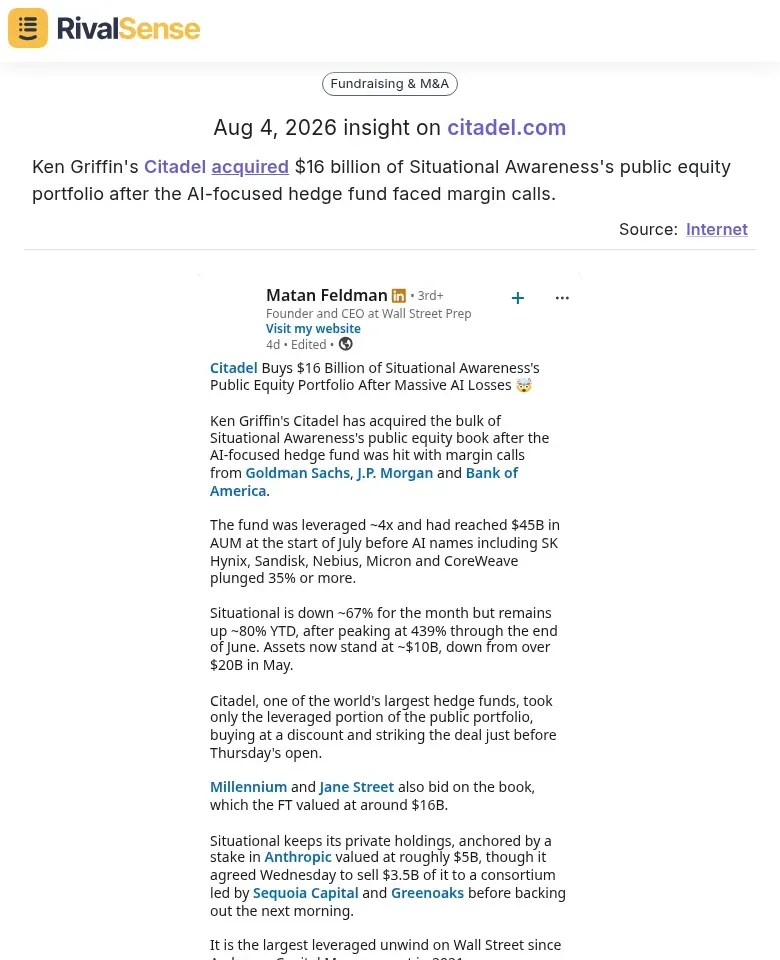
Why this matters: Acquisition intelligence reveals market consolidation and new competitive threats that hiring data alone might not catch.
Similarly, you could catch a new product release, such as Mapon launching Mapon Basic, a self-service GPS tracking product — suggesting a move toward easier onboarding and possibly a freemium model.
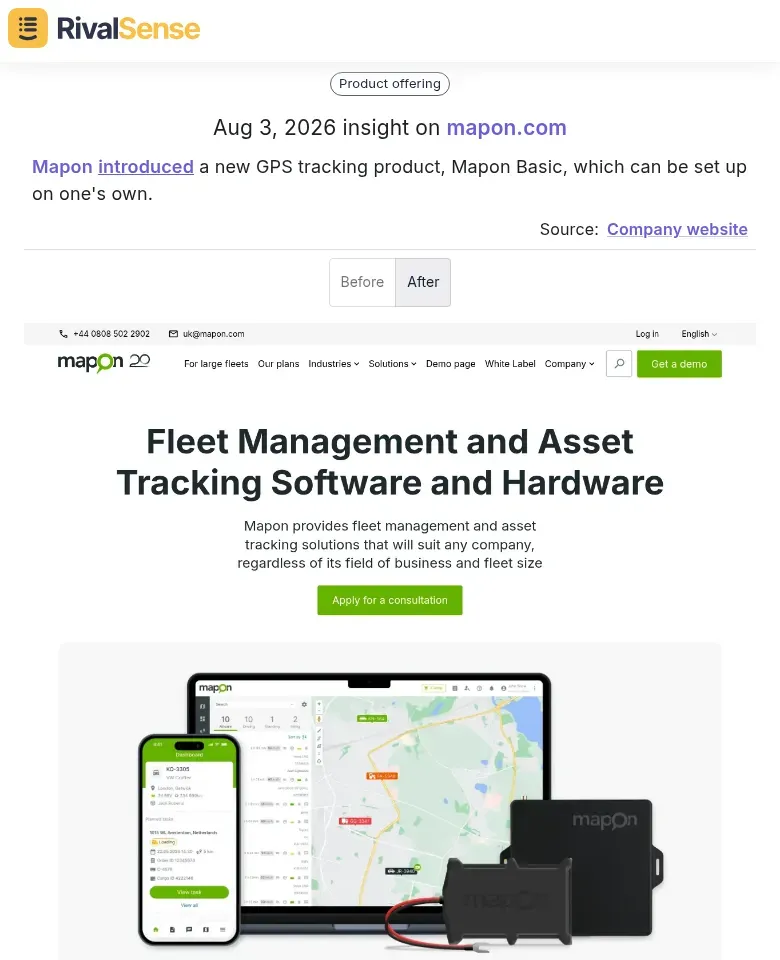
Why this matters: Product launch insights help you anticipate feature pivots and adjust your own roadmap before your competitor gains traction.
Everything lands in a single weekly email report, so you get the strategic picture without building a scraping pipeline or drowning in alerts. Use RivalSense to stay on top of the full competitive landscape, and apply this playbook to dig deeper into the hiring signals that matter most to your strategy.
The takeaway
Your competitors are telling you their plans — in their job postings. Monitor them systematically, track the right dimensions, validate with secondary signals, and route the insights to the teams who can act. Do it consistently, and you'll stop reacting to your rivals' moves and start anticipating them.
Quick-start checklist:
- ☐ Pick 3–5 direct competitors + 2–3 adjacent players
- ☐ Define tracking fields: role, function, level, skills, location, comp, duration
- ☐ Set up weekly collection from career pages + aggregators (deduped)
- ☐ Keep 6–12 months of history for trend analysis
- ☐ Review patterns monthly; validate against news, funding, and leadership moves
- ☐ Distribute a digest to product, sales, talent, and leadership
- ☐ Act: adjust talent pipelines, comp, positioning, and roadmap
Ready to turn competitor hiring into your strategic advantage without the manual grind? Try RivalSense for free at rivalsense.co. Get your first competitor report today — covering hiring signals, product moves, expansions, and more — straight to your inbox, so you can spend less time tracking and more time acting.
📚 Read more
👉 Key Account Identification for Compliance Teams: A CEO's Productivity Playbook
👉 How NVIDIA’s cuEST 0.2.0 Gives Competitors Their Next Move
👉 Instagram Competitor Insight Checklist for Key Account Tracking
👉 Data-Driven Insights: Track Telecom Competitor Pricing Moves
👉 Competitor Financials Cheat Sheet: Decoding M&A Signals to Stay Ahead