
Fusion Energy Competitive Intelligence: Decoding Partnership, Thought Leadership & Event Signals
Introduction: The Race to Fusion and Why Landscape Analysis Matters
Fusion energy has crossed an inflection point. In the past five years, the number of private fusion companies has grown from a handful to dozens, each betting on a different technical path — tokamaks, stellarators, inertial confinement, and novel magnetized target approaches. When technology alone no longer differentiates, competitive intelligence becomes the real strategic edge.
Yet most teams still track competitors the old way: comparing specs and roadmaps. That misses the bigger picture. In a capital-intensive, partnership-driven sector like fusion, the most telling moves happen off the product page — in who signs agreements with utilities, who publishes breakthroughs, and who shows up where the industry gathers.
This post introduces a repeatable framework for reading the landscape through three observable signal types:
- Partnership signals — New supply-chain deals, grid operators, and research collaborations reveal where capital and trust are flowing before revenue does.
- Thought leadership signals — Patent filings, preprint volume, and technical publications show which team is actually advancing the science, not just marketing it.
- Event presence signals — Speaking slots, conference sponsorships, and hiring at industry gatherings indicate momentum and commercial readiness.
Practical tip: Build a simple signal tracker in a spreadsheet — one row per competitor, one column per signal type — and update it monthly. Within two quarters, patterns emerge that no single product comparison can surface. The goal isn't to predict winners; it's to see the race as it's actually being run.
Strategic Partnerships as Credibility and Readiness Signals
When fusion players sign formal agreements—memorandums of understanding, offtake contracts, or licensing deals—they're telegraphing supply-chain readiness and a deliberate effort to de-risk delivery timelines. Commonwealth Fusion Systems' $1B+ power purchase agreement with Eni, its 200MW offtake with Google, and its grid-integration MOU with Dominion Energy collectively signal a credible buyer, a grid path, and aligned financiers behind a real target date. Contrast that with a rival whose only "partnerships" are research grants—the signal gap tells you who is serious about 2030.
Ecosystem and alliance memberships are equally revealing. They expose technology dependencies, preferred vendors, and strategic allies. When TAE Technologies signed a helium-3 supply and commercialization pact with Black Moon Energy, it exposed its fuel strategy. When Realta Fusion and Type One Energy licensed CFS's HTS magnets, they outsourced a critical component—and named their vendor for you.
Real‑world signal from RivalSense:
🔍 Proxima Fusion signed a Memorandum of Understanding with Freemelt, bringing the company into the Alpha Alliance.
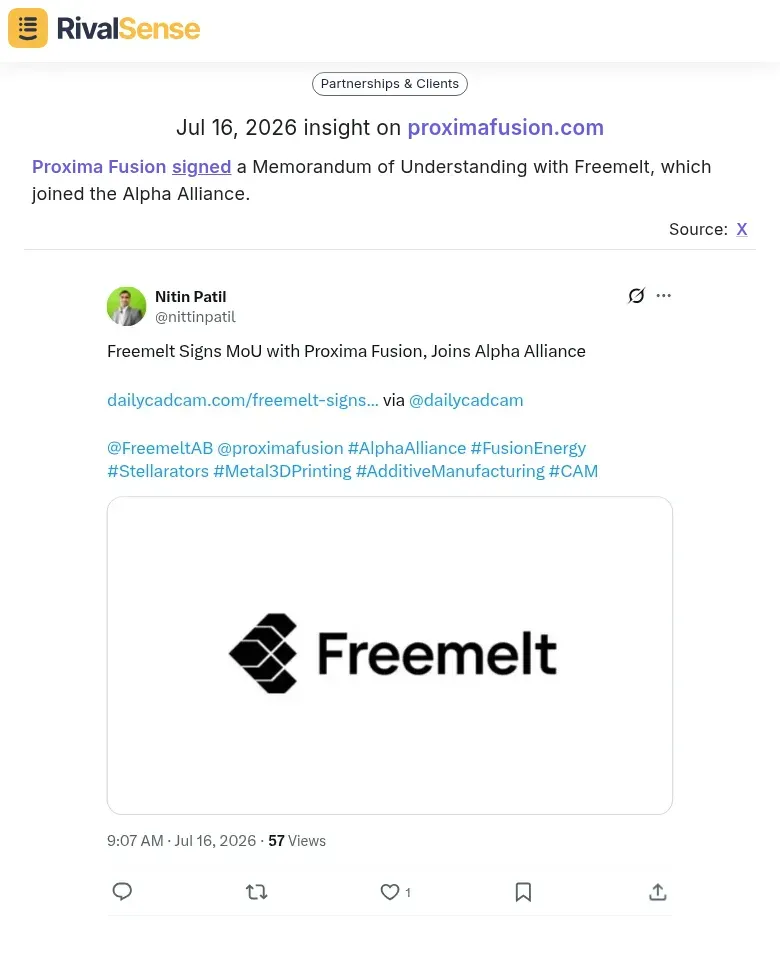
This kind of partnership insight is valuable because it reveals which supply‑chain players a competitor is aligning with early. Spotting it allows you to map technology dependencies, anticipate potential bottlenecks, and see emerging alliance ecosystems long before they affect procurement or timelines.
Practical tracking tips:
- Rank deal types by credibility: offtake agreements > MOUs > research collaborations.
- Categorize partners: utilities (grid path), suppliers (de-risking), or investors (capital alignment).
- Watch the pace—accelerating announcements often precede commercialization runs. Fusion Industry Association data shows supply-chain spend jumped 25% to $538M in 2025; follow where that money flows.
- Keep a simple tracker: date, partner, deal type, and strategic implication per competitor.
Thought Leadership and Narrative Control in Adjacent Markets
The most consequential competitive moves in fusion aren't happening in reactor halls — they're happening in earnings calls, keynotes, and blog posts about AI's insatiable energy appetite. Executives are deliberately entering adjacent, high-growth conversations to expand their total addressable market narrative. Helion's Microsoft PPA was framed less as a physics milestone, more as the answer to data-center power constraints; Google's 200 MW deal with Commonwealth Fusion Systems followed the same playbook. By positioning fusion as the fix for AI's electricity crunch, these companies capture mindshare among investors, hyperscaler customers, and policymakers simultaneously — three audiences that rarely listen to the same pitch.
Real‑world signal from RivalSense:
🎤 Proxima Fusion CEO Francesco Sciortino participated in a panel on powering the AI era at Founders Forum Global, explicitly discussing fusion's role in meeting AI's energy demands.
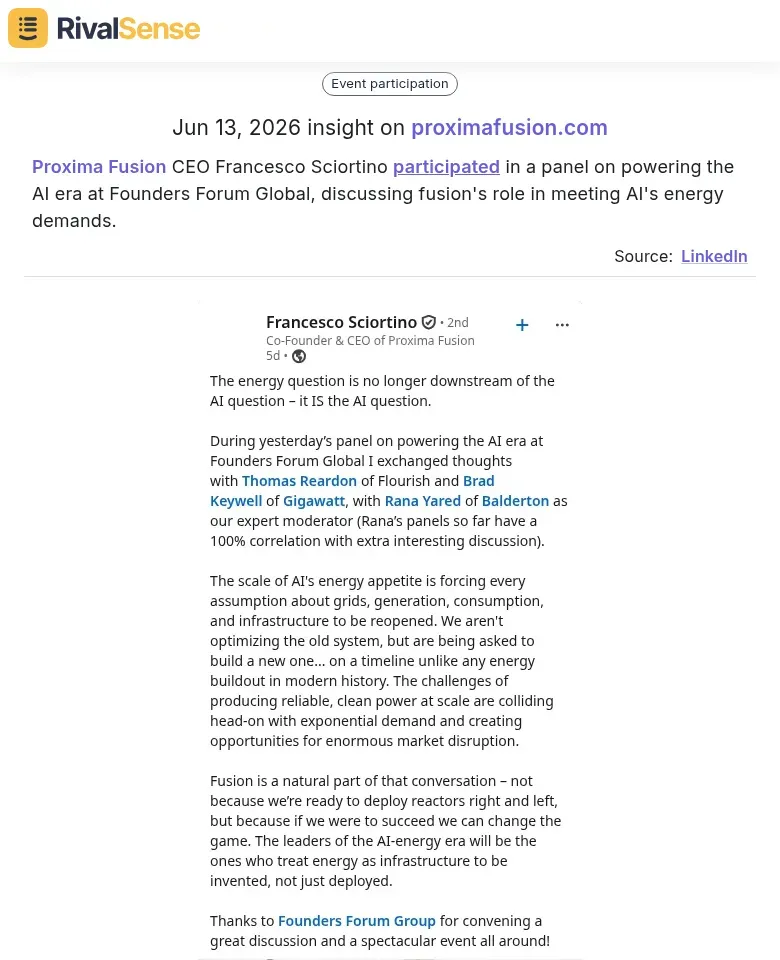
Tracking such thought‑leadership signals is strategic because it spots a competitor's narrative expansion before it becomes a formal repositioning. When a CEO starts framing fusion as "AI infrastructure," you're seeing the early seeds of a value‑proposition shift — giving you time to adjust your own messaging and differentiation.
How to track narrative control:
- Watch for new frames. When a competitor's commentary shifts from “clean baseload power” to “AI infrastructure,” they're redefining their market. Log every earnings-call and keynote mention.
- Map the audience. Note who each message targets (investors vs. policymakers vs. customers). A widening audience map signals TAM expansion.
- Spot pre-repositioning signals. Executives test language months before formal rebrands — a repeated new phrase is a leading indicator.
- Follow deal flow. PPAs with tech giants reveal when narrative becomes commercial reality — and which competitors have credible demand.
- Set alerts on adjacent keywords — “data center,” “hyperscaler,” “AI power” — to catch shifts early.
Tracking executive commentary lets you anticipate a competitor's value-proposition shift before the public repositioning lands — and adjust your own positioning first.
Event Presence as a Strategic Barometer
When the fusion industry gathers, who's on stage tells you more than any press release. Conference lineups are a live map of where competitors are networking — with investors, partners, and the talent they're courting. Track them as closely as you track funding announcements.
A speaking invitation at a flagship summit (IAEA Fusion Energy Conference, Fusion Industry Association events, major climate-tech showcases) isn't handed out randomly. Organizers vet speakers for credibility, so invitations correlate tightly with fundraising stage, industry standing, and market validation. A competitor upgraded from poster session to keynote? That's a signal their story is resonating — and likely that fresh capital is behind it.
Real‑world signal from RivalSense:
📅 Proxima Fusion co-founder Martin Kubie will speak at the Cherry Ventures Summit on June 9.
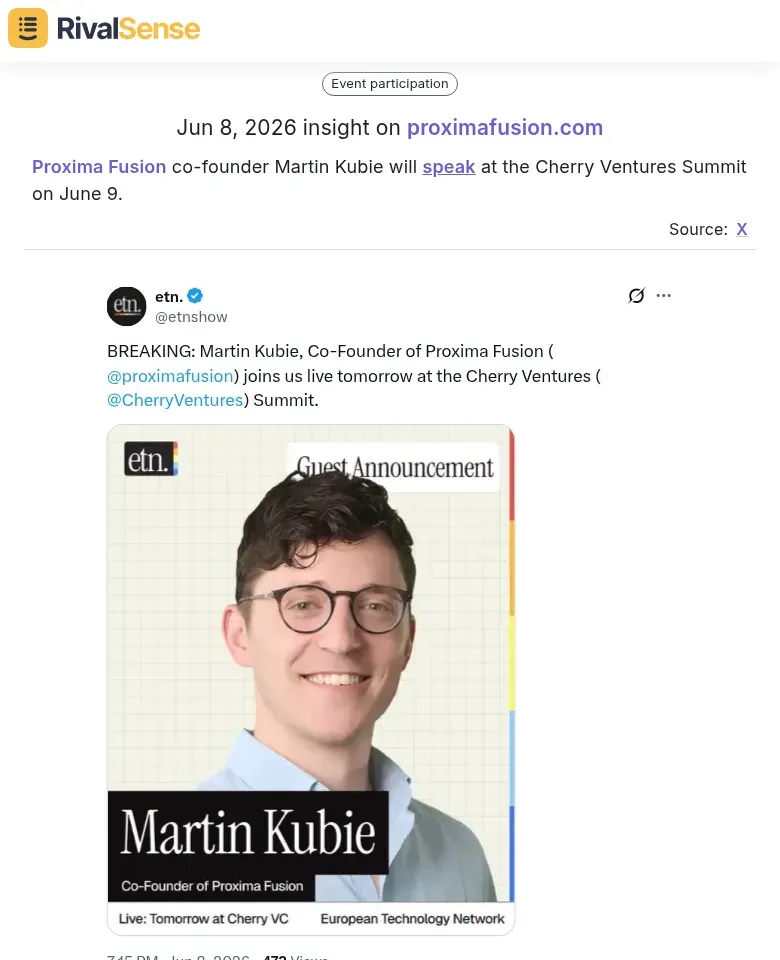
Monitoring event‑presence signals like this is powerful because a speaking slot at a venture‑focused summit flags active relationship‑building with key investors and top talent. It serves as a leading indicator of commercial readiness and often precedes funding or expansion announcements.
Practical playbook:
- Build a competitor-event calendar: list the 8–10 flagship fusion events for the year and log every competitor appearance — keynote, panel, exhibit hall.
- Watch for tier changes: track promotion from attendee → exhibitor → speaker → keynote. Each step up is an early signal.
- Pair appearances with timelines: keynotes often precede funding announcements by 6–8 weeks and hiring pushes by 4–6.
- Study panel composition: who sits next to whom reveals partnerships and investor networks.
- Set alerts on speaker announcements so you catch shifts within days, not months.
And remember the quietest competitor on the stage list can be the loudest signal — their absence may mean they're heads-down closing a round or prepping a major announcement.
Building a Systematic Competitive Signal Radar
Ad-hoc monitoring leaves you reacting to moves competitors made months ago. In a capital-intensive field like fusion energy, where milestones take years, you need a recurring cadence — not sporadic digging.
Step 1: Consolidate your signal sources. Build a shared tracker (a spreadsheet or Notion database) capturing three signal types: partnership announcements, thought-leadership content (papers, keynotes, posts), and event appearances (conferences, panels). Assign an owner and a weekly review slot. Ten focused minutes every Friday beats a frantic quarterly deep-dive.
Step 2: Triangulate qualitative with quantitative. A press release about a “major breakthrough” is only a story until you check the numbers. Cross-reference each signal against hard metrics: funding amounts, hiring velocity (job posts, headcount growth), and technology milestones (tests completed, filings). A competitor announcing a partnership while hiring goes quiet tells a different story than one with doubling headcount.
Step 3: Define early-warning indicators in advance. Set thresholds before shifts happen. Examples: three postings for one engineering role in a month = new tech push; a patent in a novel plasma regime = strategic pivot; a utility partnership = accelerating commercialization. Document these, review quarterly, escalate to leadership when triggered.
The goal isn't more data — it's faster answers to: “What is our competitor doing next, and what should we do?”
Turning Competitive Signals into Strategy
The signals you've collected across the fusion landscape are only as valuable as the strategy they inform. Here's how to turn competitive intelligence into action.
Build scenario plans, not forecasts. Map your signals against 3–4 plausible futures: rapid consolidation, technology convergence, or a prolonged capital winter. For each scenario, define what it means for your roadmap, hiring, and funding runway. Review quarterly — not annually.
Let insights drive three strategic choices:
- Partnerships — If signals show a bottleneck in supply chains, partner early with component suppliers before competitors lock them in.
- Narrative positioning — Differentiate on what rivals under-communicate. If everyone claims "fastest path to grid," stake out cost-per-MWh or supply-chain resilience instead.
- Differentiation — Double down on capabilities competitors are deprioritizing; that's where whitespace lives.
Make monitoring a habit, not a project. A practical checklist:
- Weekly: track competitor hires, patents, and funding announcements
- Monthly: review pricing moves and partnership news
- Quarterly: refresh your scenario matrix and competitive map
As the fusion market matures and consolidates, the gap between firms that react and firms that anticipate will widen. Continuous monitoring isn't overhead — it's the compounding edge that lets you move first while competitors read the news. Build the system now, and the landscape shifts become your advantage, not your threat.
🛰️ Stop digging. Start tracking.
The challenge of tracking partnerships, thought leadership, and event presence manually is daunting — but a tool like RivalSense automates competitor monitoring across company websites, social media, and registries, delivering a weekly email report with exactly these high‑signal insights.
Get your first competitor report today and see the shifts before they’re common knowledge: https://rivalsense.co/
📚 Read more
👉 Market Entry 101: Why Customers Choose Your Competitors
👉 From Bus Routes to Business Insights: A Competitor Analysis Example
👉 How to Monitor Competitor Hiring: A Practical Playbook for Reading Your Rivals' Strategy
👉 Key Account Identification for Compliance Teams: A CEO's Productivity Playbook
👉 How NVIDIA’s cuEST 0.2.0 Gives Competitors Their Next Move