
How Instagram Can Reveal Your Competitors' Trade Show Playbook (And How RivalSense Automates the Intel)
Instagram has quietly become one of the most powerful competitive intelligence tools for trade shows and product launches. While press releases come with polished spin, Instagram delivers raw, real-time coverage of venues, booth designs, influencer appearances, and attendee reactions – often days before official announcements. But manual scrolling can be inefficient. This guide shows you how to systematically extract trade show strategy from Instagram, and how a tool like RivalSense can surface the same insights (and more) without the grind.
🏟️ Tracking Event Participation and Product Launch Strategies
Competitors document their entire event journey on Instagram – from behind-the-scenes booth prep to countdown stories and live unveils. The setting, attendees, and launch timing all offer clues about budget allocation and target audience. For instance, adidas Golf launched its Fall Winter 2026 Originals Golf collection in Thailand, featuring the Endless Summer and Reciprocal lines, with brand ambassadors and celebrities attending the event at Siam Paragon. (insight captured by RivalSense)
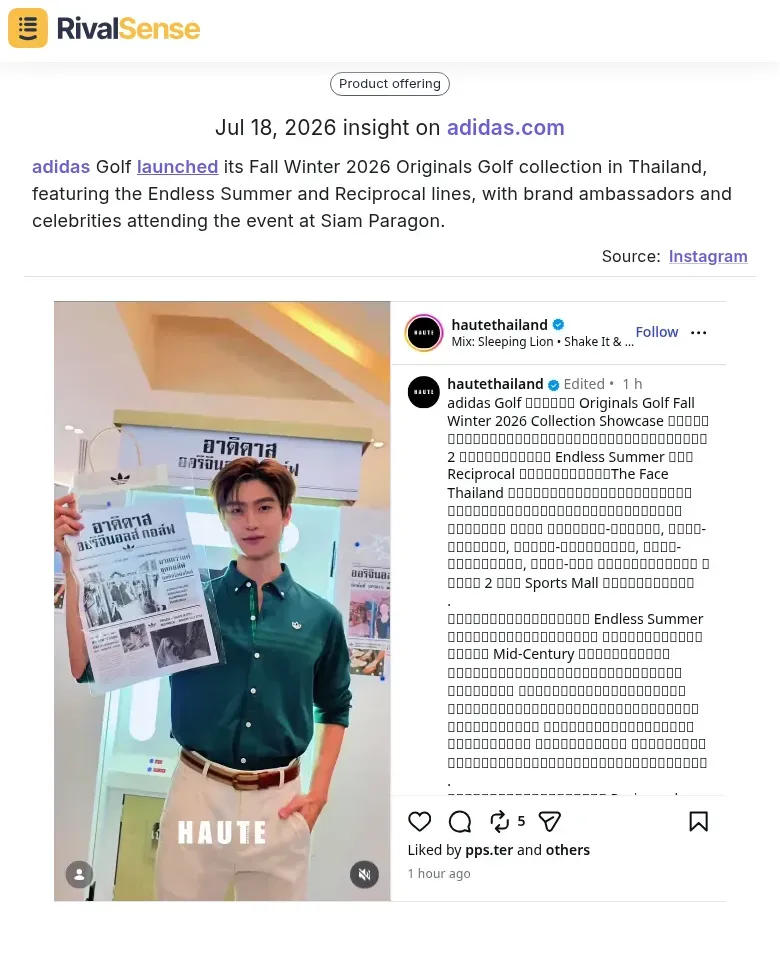
Why this insight matters: An event location like Siam Paragon signals a push into the Southeast Asian market, while front-row celebrities reveal which demographics (e.g., luxury lifestyle, golf enthusiasts) the brand is courting. Manually monitoring Instagram could have caught this launch, but RivalSense automatically flags such participation across websites, social media, and press, ensuring you never miss a competitor’s market entry move.
Practical steps to track competitors’ events:
- Search location tags for major trade show venues (e.g., Las Vegas Convention Center). Even brands that don’t publicly announce attendance will appear in others’ tagged posts.
- Follow event hashtags like #CES2026 or #SaaStrAnnual – competitors’ real-time product reveals and booth photos often surface here first.
- Set up a pre-event/post-event checklist:
| Phase | What to monitor | Competitive signal |
|---|---|---|
| Pre-event | Teaser stories, speaker announcements, “See you at…” posts | Investment level, key messaging, new product hint |
| During event | Live demos, influencer partnerships, booth foot traffic | Go-to-market priorities, sales enablement focus |
| Post-event | Recap reels, press mentions, attendee comments | Perceived success, lessons for your own next event |
💡 RivalSense advantage: Instead of building a separate tracker for each competitor, a weekly RivalSense report aggregates Instagram activity alongside other digital footprints (website updates, press appearances, social chatter) so you see the full launch picture.
⚙️ Uncovering Product Development and Innovation Signals
Beyond logos and slogans, Instagram reveals real product innovation – often before a formal press release hits. Brands post prototypes, packaging teases, and pre-show setup shots that inadvertently disclose upcoming features, materials, or design shifts. Meanwhile, industry influencers and media often compile “best of” lists that validate market direction.
For example, Hublot’s tennis-inspired tourbillon was featured among the best new skeleton watches of 2026. (insight from RivalSense)
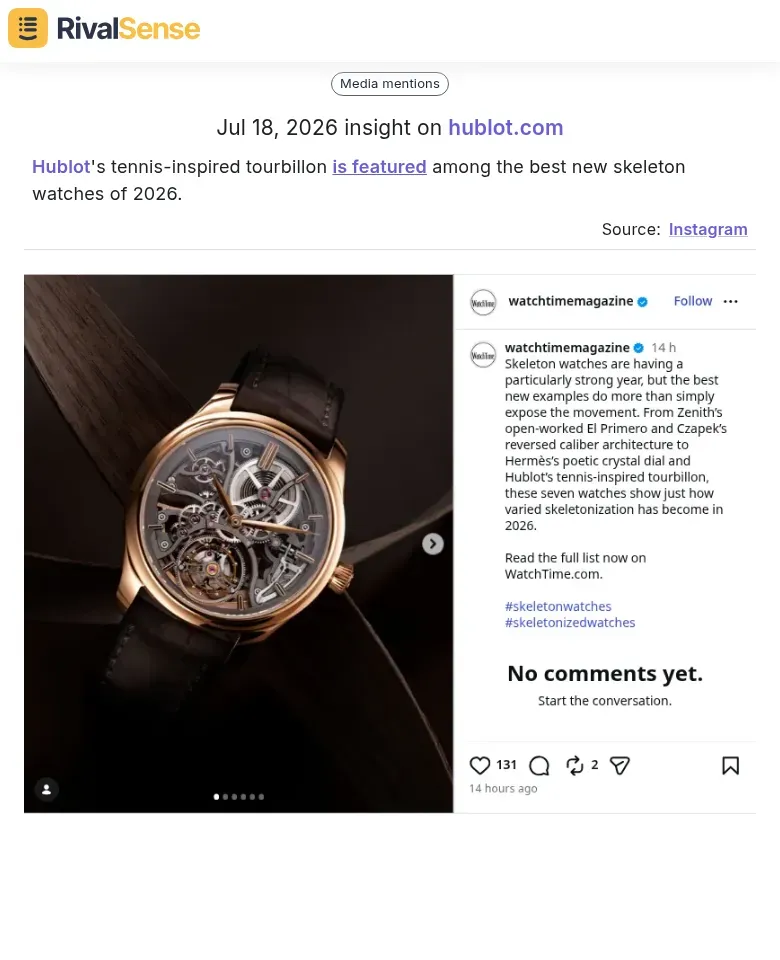
Why this insight matters: Inclusion in a “best new skeleton watches” roundup is a strong market validation signal. It tells you that high-horology skeleton designs are trending, that Hublot is investing in tennis-world associations, and that your own product roadmap might need to note this competitive luxury angle. Tracking such lists manually across Instagram, blogs, and magazines is daunting – RivalSense scans them automatically so you get early warning of which innovations are gaining traction.
How to spot product signals on Instagram:
- Monitor pre-show Stories: Look for materials, packaging, and color palettes in booth prep videos.
- Decode visual cues: A shift to sustainable packaging, brighter hues, or minimalist design can indicate repositioning.
- Follow 5–10 influencers in your niche; their roundup posts often surface up-and-coming products.
- Check tagged competitor posts at large events (CES, SXSW) to see booths side-by-side and compare feature emphasis.
✅ Quick checklist:
- [ ] Screenshot any post hinting at new features / design changes
- [ ] Note post engagement (likes, comments) to gauge audience excitement
- [ ] Cross-reference with future press releases (usually 2–4 weeks later) to validate
🧠 Analyzing Executive Thought Leadership and Strategic Positioning
CEOs and founders increasingly use Instagram to share hot takes on industry trends – and those posts often disclose strategic priorities before they appear in board decks. A carefully phrased critique of “old school” approaches, a coining of new terminology, or a shift in tone can signal where a competitor is betting next.
For instance, Descript CEO Laura Burkhauser defined ‘AI slop’ as content created with a cynical monetary incentive to maximize return, noting it existed before AI but is now amplified by volume. (insight from RivalSense)
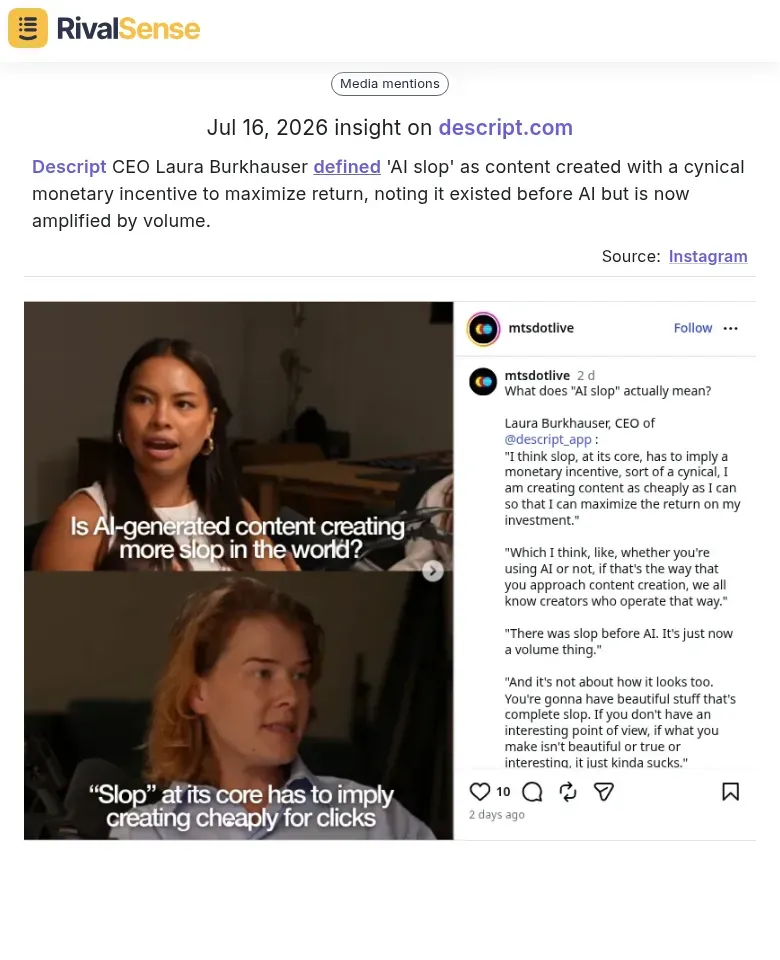
Why this insight matters: By publicly defining “AI slop,” Descript is positioning itself as a quality-over-quantity brand, likely steering product features toward authentic, human-centric AI tools. A competitor exec’s Reddit-style rant or Instagram carousel that dismisses a certain approach is a window into their evolving positioning – and a clue where you might differentiate.
How to turn exec posts into actionable intel:
- Track coinage and definitions: New terms or sharp critiques reveal what your rival wants to own – or distance from.
- Monitor engagement velocity: Posts that go viral signal resonant market sentiment; emulate or counter-position accordingly.
- Log tone shifts: A defensive vs. visionary tone can highlight upcoming pivots, funding pressure, or confidence.
Use a simple spreadsheet:
| Executive | Date | Theme | Engagement | Inferred Priority | Your Response Idea |
|---|---|---|---|---|---|
| CEO name | jul 12 | Redefining AI slop | 2.5k likes | Positioning as quality-first tool | Highlight human-edited outputs in your own marketing |
Manual tracking across multiple leaders is time-consuming. RivalSense automatically flags executive quotes and thought leadership posts (from Instagram, LinkedIn, podcasts, etc.) and delivers them in a curated weekly report, so your team can spot positioning shifts instantly.
📊 Building a Systematic Competitor Monitoring Routine (and Putting Intel to Work)
To transform Instagram from a distraction into a strategic asset, you need a repeatable process. Create three curated lists on Instagram: (1) direct competitor accounts, (2) trade show-specific hashtags (e.g., #CES2026), and (3) industry influencers who cover events. Use the “Favorites” feature to prioritize Stories, which disappear in 24 hours.
Daily checklist for trade show season:
- [ ] Morning scan (10 min): Check Stories, new posts, and live feeds from competitors and event hashtags.
- [ ] Afternoon capture: Save key visuals to a collection; note engagement counts.
- [ ] Insight logging: Enter findings into a simple log: Date | Competitor | Theme (Product/Marketing/ Strategy) | Insight | Action Item.
Post-event, turn those insights into your own booth strategy:
- Booth design audit – Build a mood board from competitor photos. If everyone uses minimalist white, consider bold contrast. Check lighting, interactive demos, staff positioning.
- Position gap analysis – Compare what they emphasize vs. what’s missing. If they talk only features, highlight customer success stories in your booth.
- Validate assumptions – Look at past show reels: long lines at one booth? Improve your traffic flow. A specific messaging style that gets saved a lot? Test similar language 30 days before your next event.
🚀 From Manual Instagram Scrolling to Automated Competitor Intelligence
Instagram is a treasure trove, but building a comprehensive picture requires monitoring many sources – event pages, news, product launches, executive interviews, and more. That’s where RivalSense steps in. It automatically tracks your competitors’ product updates, pricing changes, event participations, partnerships, media mentions, and thought leadership across company websites, social media, internet, and registries – including Instagram – and compiles them into a single weekly email report.
Imagine getting a digest that flags the adidas Golf launch in Thailand, Hublot’s design recognition, and the Descript CEO’s positioning statement, without having to hunt for them. You’d spend minutes on strategic analysis, not hours on manual scrolling.
Start turning competitor moves into your strategic advantage. Try RivalSense for free at https://rivalsense.co/ and get your first competitor report today.
📚 Read more
👉 Quick Hacks: Spot Competitor Innovation in AI Coding Tools
👉 Common Mistakes to Avoid When Tracking Competitor Employee Changes
👉 Competitor Analysis in Action: How Shufti’s Japan Pivot Reveals Hidden Market Shifts
👉 The Benefits of a Competitive Audit: A Practical Guide for Business Leaders
👉 Workflow Breakdown: Tracking Leaders to Boost Healthcare IT Consulting