
Common Mistakes to Avoid When Tracking Competitor Employee Changes
Overlooking the Strategic Context Behind Title Changes
One common mistake is tracking employee title changes without analyzing their strategic context. A title upgrade—like ‘Head of Sales, Global Accounts’ to ‘VP, AI Business Unit’—often signals entry into new segments. Tip: Create a “title change radar” that flags upgrades containing new keywords (e.g., ‘AI,’ ‘APAC’).
Geographic scope changes reveal growth priorities. A shift from ‘Director, ANZ’ to ‘Director, JAPAC’ suggests regional expansion.
For example, here’s a real insight RivalSense surfaced:
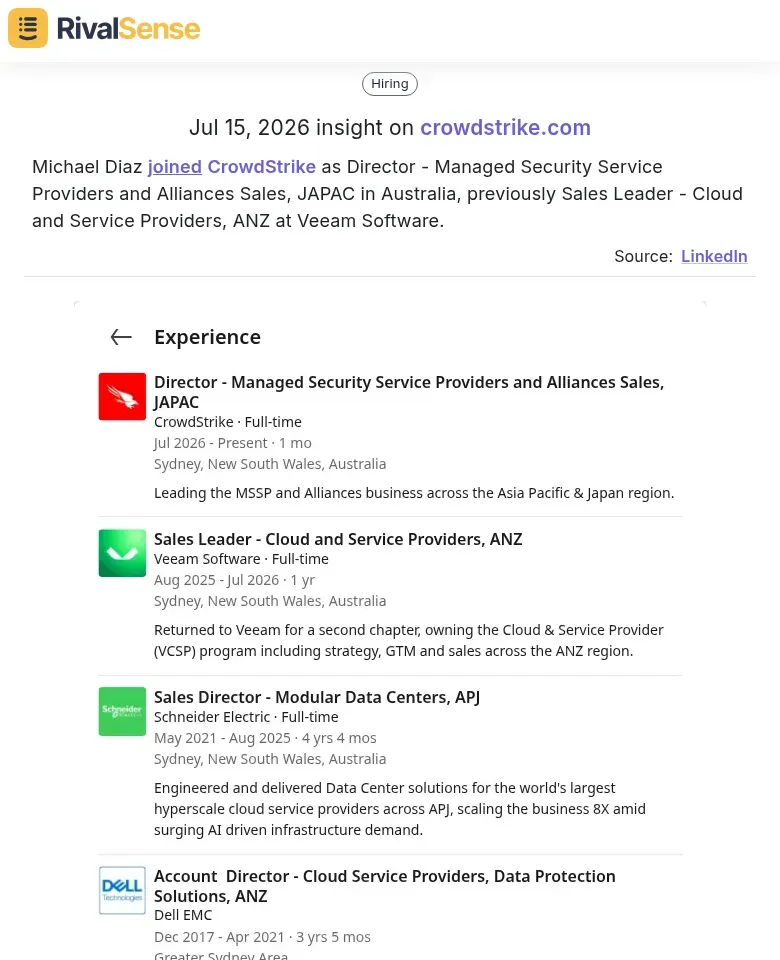
Michael Diaz moved from Veeam to CrowdStrike, expanding his scope from ANZ to JAPAC—a clear geographic promotion.
Tracking moves like this gives you early warning of a competitor’s regional expansion priorities, often months before any public announcement.
Checklist for geographic shifts:
- Note the old vs. new region.
- Cross-reference with company press releases or job postings in the new region.
- Watch for multiple employees shifting to the same geography—this confirms collective strategic intent.
A move between competitors can also indicate talent poaching or alignment with a competitor’s strategy. For instance:
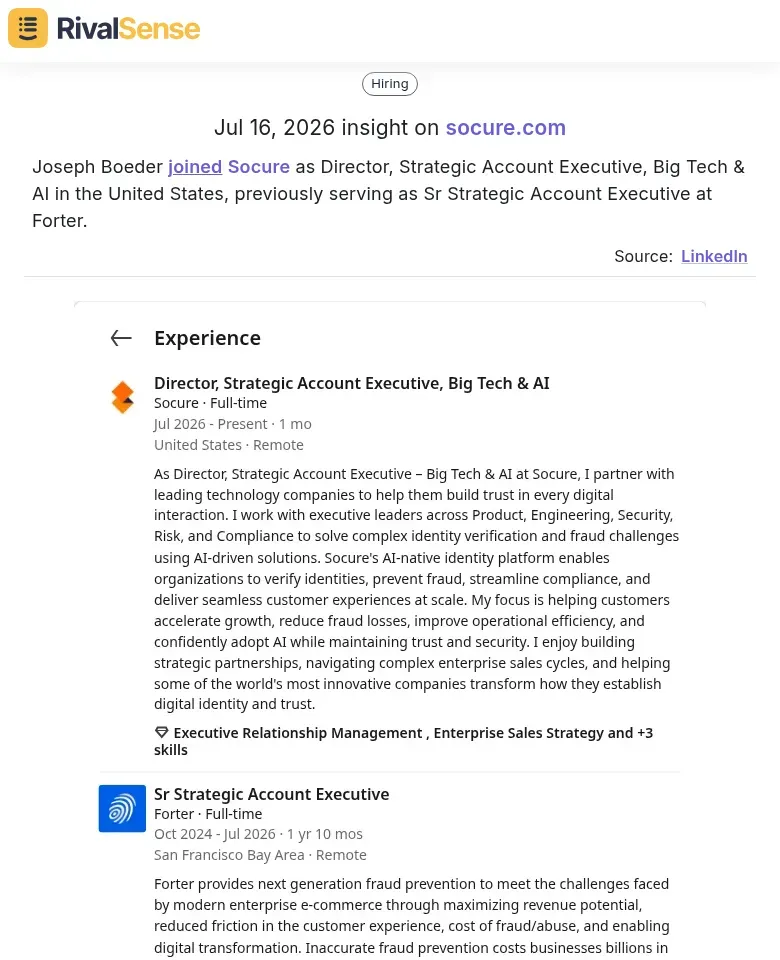
Joseph Boeder joined Socure from Forter, targeting Big Tech & AI—signaling a strategic push into a high-value new segment.
This type of hire reveals where your competitor is placing bets, allowing you to adjust your own product or sales positioning before they gain traction.
Action step: When a known competitor’s employee joins your sector, map their new role against your own hiring or product plans to detect potential competitive intelligence leaks.
By contextualizing title changes—new segments, regions, or competitor moves—you transform raw data into actionable strategic insights.
Ignoring New Market Entry and Expansion Hires
When tracking competitor employee changes, one common blind spot is overlooking hires that signal new market entry or expansion. A single job posting for a ‘Head of GTM, [New Region]’ or ‘Launch Manager’ can indicate your competitor is about to enter a new geographic market or vertical. These hires reveal that the competitive landscape is about to become more crowded, and early detection is critical for maintaining your advantage.
Take this real-world example from RivalSense:
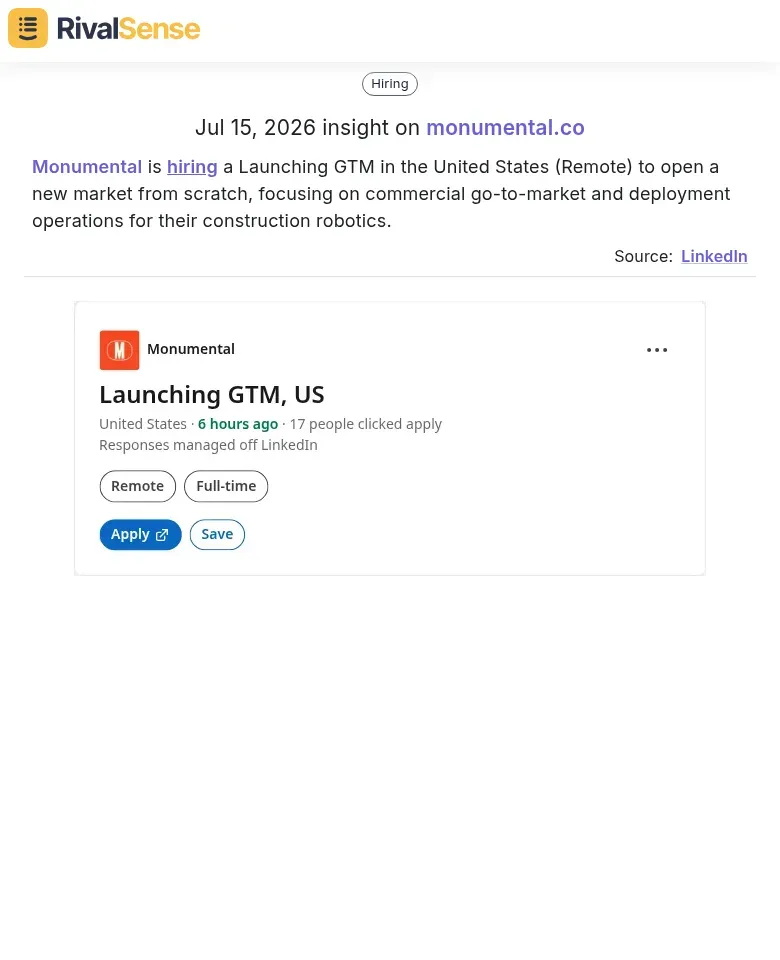
Monumental is hiring a Launching GTM to open a new market from scratch—an unmistakable signal of imminent expansion into the construction robotics space.
Catching a hire like this early allows you to assess the threat, reinforce your position in that market, and brief your sales team before the competitor even launches.
How to spot entry hires:
- Monitor senior roles with regional or vertical-specific titles (e.g., ‘GM, APAC’ or ‘Director of Enterprise Sales, Healthcare’).
- Set up alerts for keywords like ‘launch,’ ‘new market,’ ‘expansion,’ and specific country/industry terms.
- Track departures from your own team – if a senior person leaves for a competitor, they may be hired to spearhead a new market push.
Once you detect an entry hire, take action:
- Assess the threat – Map the new market to your own presence and identify overlap.
- Strengthen your positioning – Double down on local partnerships, customer relationships, or unique features in that segment.
- Prepare counter-messaging – Arm your sales team with competitive intelligence on the new entrant’s potential gaps.
Early detection of entry hires gives you a head start to prepare counter-strategies before your competitor even announces their launch.
Failing to Track the Full Talent Movement Ecosystem
Many companies track only direct competitors for employee moves, but this narrow focus misses critical signals. Talent flows from adjacent industries or emerging players can indicate shifting market dynamics. For example, a surge of hires from Forter or Veeam may reveal which companies are being raided for expertise—signaling competitive pressure or validating your own talent strategy.
Practical Steps:
- Broaden your tracking list to include adjacent industries, fast-growing startups, and companies that recently pivoted.
- Identify talent sources: Use LinkedIn or tools like RivalSense to map where new hires previously worked. A pattern of hires from one company suggests that firm is losing key people—a potential acquisition or partnership target.
- Monitor outflow: If your top engineers leave for a specific startup, investigate that startup. They may be building a competing product, or they could be a future partner.
Checklist:
- [ ] Track 10+ non-direct competitors.
- [ ] Log source companies for each new hire.
- [ ] Quarterly review of outflows to identify new threats or opportunities.
This full ecosystem view transforms employee movement data into strategic intelligence.
Neglecting the Timing and Velocity of Moves
When tracking competitor employee changes, many teams focus solely on headcount numbers, overlooking the critical dimension of timing. This blind spot can mask the story behind the moves.
A rapid succession of hires — say, 10+ new employees in a single month — often signals a major strategic pivot or a recent funding round. A startup that suddenly hires a VP of Sales, three account executives, and two customer success managers in two weeks is likely scaling go-to-market after a Series B close, not just filling open recs.
Seasonal hiring patterns reveal product cycles. A competitors’ hiring surge each February may correlate with their annual user conference launch. Track these rhythms to anticipate their market moves.
Departure timing matters too. Two key engineers leaving right after your competitor lost a flagship account? That’s likely turmoil, not coincidence. The same week three sales reps depart — just after their biggest customer churned — signals account-driven attrition.
Practical tip: Create a simple timeline chart for each competitor. Plot hires as green markers, departures as red. Look for 3+ hires in under 30 days, departures clustered within two weeks of customer losses, and recurring annual patterns (e.g., February hires, August departures). This velocity analysis turns raw HR data into strategic intelligence.
Treating Employee Changes as Isolated Events
A single new hire is rarely just a replacement. It might signal the start of a broader team build-up—for example, a sales director for a new region often precedes an entire sales unit. To catch these patterns,
📋 Action Steps:
- Map hires to business events: Correlate each move with recent product launches, earnings calls, or funding rounds. A cluster of engineering hires after a funding round hints at a new product push.
- Track cross-functionally: A marketing hire + a sales hire + a support hire in the same quarter could mean a geographic expansion. Use a shared spreadsheet or CI tool to tag moves by function and date.
- Look for clusters: Set alerts for 3+ hires in one department within 30 days. That’s rarely coincidence.
💡 Pro Tip: Create a simple timeline chart with competitors’ hires overlaid on their public events (product launches, earnings, press releases). Patterns like “sales hires spike before a regional launch” become obvious.
Siloed tracking—one person monitoring only engineering hires, another only marketing—misses the narrative. Combine data points across functions to see the full strategic picture.
Not Translating Insights into Actionable Strategy
Mistake: Treating competitor hires as mere data points instead of strategic signals.
The Fix: Build a system that forces action. When a competitor hires a senior sales leader from your industry, it’s not trivia—it’s a signal. Update your sales battle cards with that person’s known playbook. If they hire a product manager from a company known for feature X, prioritize X in your roadmap.
Actionable Checklist:
- Hiring: Within 48 hours of a key competitor hire, ask: “Does this create a gap in their team we can poach from?” or “Do we need to counter with a strategic hire of our own?”
- Sales & Positioning: If a competitor hires someone targeting your key accounts, immediately update your messaging to highlight differentiators. Run a war-gaming session with sales to predict their new pitch.
- Product: When a competitor hires from an adjacent industry, investigate if they’re pivoting. Adjust your own product roadmap accordingly.
Pro Tip: Set up automated alerts for competitor employee changes and link them to a task in your CRM or project management tool. Each alert should trigger a review (e.g., “Review competitor hire within 48 hours and assign a response owner”).
Without this loop, tracking is data hoarding, not intelligence. ROI comes from action, not observation.
Turn Employee Movements into Your Competitive Edge
Manually monitoring dozens of companies for hiring signals is time‑consuming and error‑prone. RivalSense automates the entire process—tracking competitor employee changes, launches, pricing shifts, and more across websites, social media, and registries—and delivers a curated weekly report directly to your inbox.
👉 Try RivalSense for free and get your first AI‑powered competitor report today. Stop guessing; start acting on real‑time intelligence.
📚 Read more
👉 Competitor Analysis in Action: How Shufti’s Japan Pivot Reveals Hidden Market Shifts
👉 The Benefits of a Competitive Audit: A Practical Guide for Business Leaders
👉 Workflow Breakdown: Tracking Leaders to Boost Healthcare IT Consulting
👉 How Lumia's New Security Features Prompted a Rival's Response