
Pricing Trends: Key Account Tracking Insights for Competitive Edge
In today’s fast-moving markets, pricing isn’t just a number—it’s a signal. Competitors’ pricing shifts reveal their strategic priorities, inventory pressures, and market positioning. For instance, a sudden discount in B2B software often signals a push for market share, while a price hike in retail may indicate premium repositioning. Real-time tracking of promotions and discounts gives you actionable intelligence to adjust your own pricing strategy proactively.
Practical steps to get started:
- Set up automated alerts for competitor price changes using tools like RivalSense.
- Categorize pricing moves (e.g., permanent vs. promotional, percentage vs. absolute).
- Correlate changes with external events (e.g., earnings calls, product launches).
- A/B test your own pricing based on competitor signals—e.g., match a discount temporarily to defend market share.
Pro tip: Track not just list prices but also bundling, subscription tiers, and hidden fees. A competitor’s new “freemium” tier might be a play for top-of-funnel leads, not a revenue drop.
By monitoring pricing trends, you turn raw data into strategic foresight—keeping your business agile and competitive.
Decoding Promotional Tactics: From Membership Perks to Volume Discounts
When tracking competitors, pay close attention to shifts in their promotional tactics. For instance, if a rival removes membership perks like ‘Medlemspriser’ (member prices), it may signal a pivot toward broader audience targeting or cost optimization. This could mean they’re simplifying operations or aiming to attract new customers without loyalty commitments. Conversely, replacing specific product deals with category-wide promotions—e.g., ‘Köp 2 eller fler, få 25 % på kläder’ (Buy 2 or more, get 25% off clothing)—can boost average order value and clear inventory.
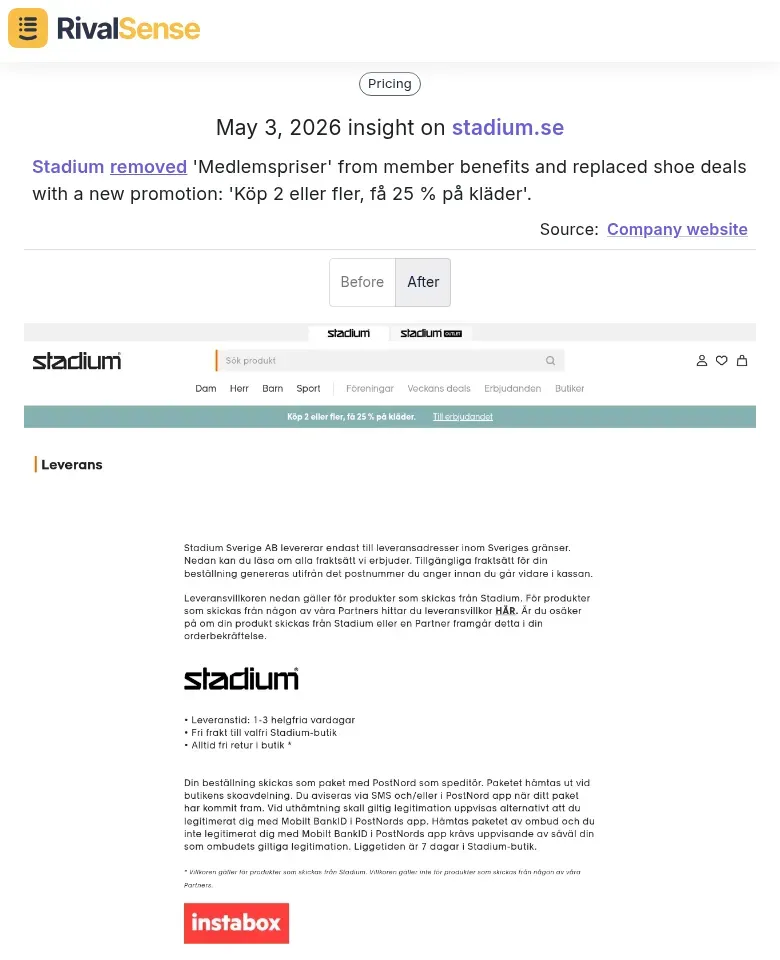
Real RivalSense Insight: A recent tracking alert showed that Stadium removed ‘Medlemspriser’ from member benefits and replaced shoe deals with a new promotion: “Köp 2 eller fler, få 25 % på kläder.” This type of shift is valuable because it reveals a strategic move from loyalty-based incentives to volume-driven discounts. For your business, it signals a potential increase in price sensitivity among their customer base and an opportunity to differentiate by reinforcing your own loyalty program.
Actionable Steps:
- Set up alerts for changes in pricing pages, loyalty program terms, and promotional banners.
- Categorize promotions (e.g., product-specific vs. category-wide) in a tracking spreadsheet to spot patterns.
- Analyze the impact on your own strategy: if a competitor drops member prices, consider testing a limited-time discount for new customers to capture switchers. If they shift to category-wide deals, evaluate bundling complementary products to increase basket size.
By monitoring these shifts, you can anticipate competitor moves and adjust your loyalty programs or bundling strategies proactively. For example, if a competitor consistently uses volume discounts, you might introduce a tiered loyalty program that rewards repeat purchases instead of one-off bulk buys.
Seasonal and Demand-Driven Extensions: Capitalizing on Urgency
When a competitor extends a promotion, it’s a clear signal: either demand is high and they want to capture more, or they’re struggling to hit targets and need to extend the window. Either way, it reveals urgency on their side. Tracking these extensions gives you a direct window into their sales performance and inventory pressure.
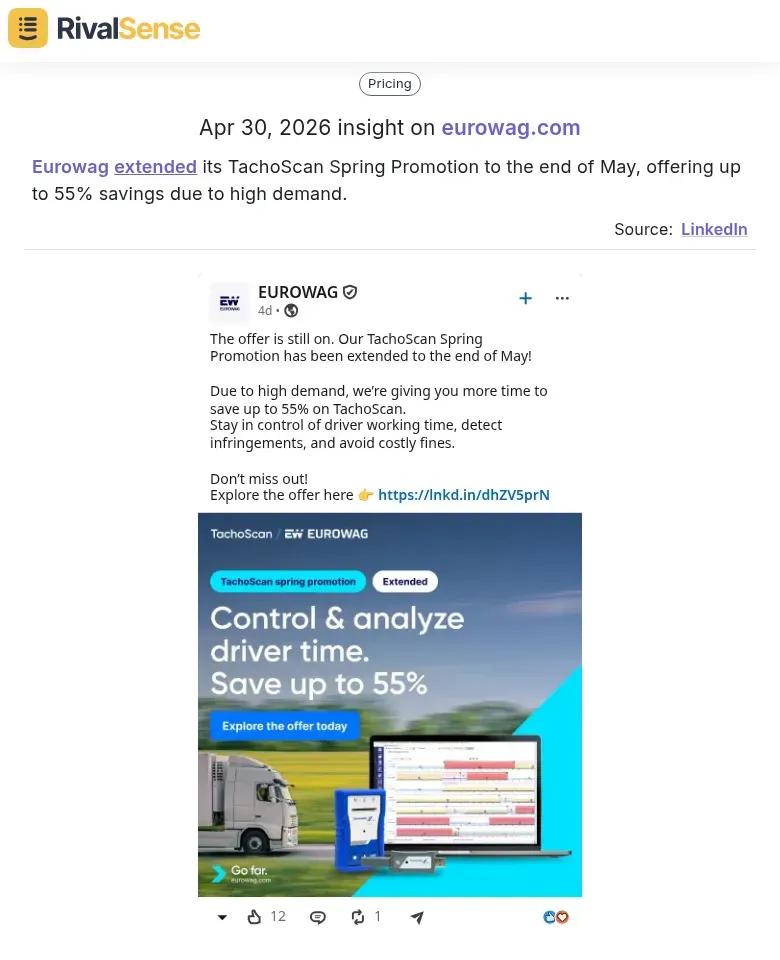
Real RivalSense Insight: We detected that Eurowag extended its TachoScan Spring Promotion to the end of May, offering up to 55% savings due to high demand. This type of extension is valuable because it indicates strong customer traction—but also suggests they may be trying to lock in annual commitments before a potential price increase. For your business, this is a cue to either match the urgency with a limited-time offer or highlight your own value proposition without deep discounts.
How to capitalize:
- Track extension patterns – Use a competitor tracking tool to log when promotions start, end, and get extended. If a competitor extends twice, they may be desperate for revenue.
- Time your counter-offer – Launch a limited-time alternative that overlaps with their extended window. For example, offer “20% off for the first 50 customers” to siphon their procrastinators.
- Create tiered urgency – If they offer “up to 55% off,” structure your own tiers: 10% off for 1-month, 25% off for 6-month, 40% off for annual. This encourages larger commitments while appearing more generous.
- Use countdown timers – Display a ticking clock on your pricing page to mirror their urgency, but with a clear end date (no extensions).
Checklist for action:
- [ ] Set up alerts for promotion extensions from top 5 competitors.
- [ ] Map their discount tiers vs. yours to identify gaps.
- [ ] Prepare a “flash sale” template that can launch within 24 hours of detecting an extension.
By tracking these patterns, you can turn their urgency into your advantage—either by matching their push or offering a better deal at the right moment.
Value Proposition Refinement: Highlighting Savings and Compliance
To refine your value proposition, start by analyzing competitors’ pricing pages for percentage savings claims. Use these benchmarks to craft your own savings messaging, but go further by linking savings to compliance. For instance, if a competitor highlights driver working time management, emphasize how your solution reduces fines and audit risks.
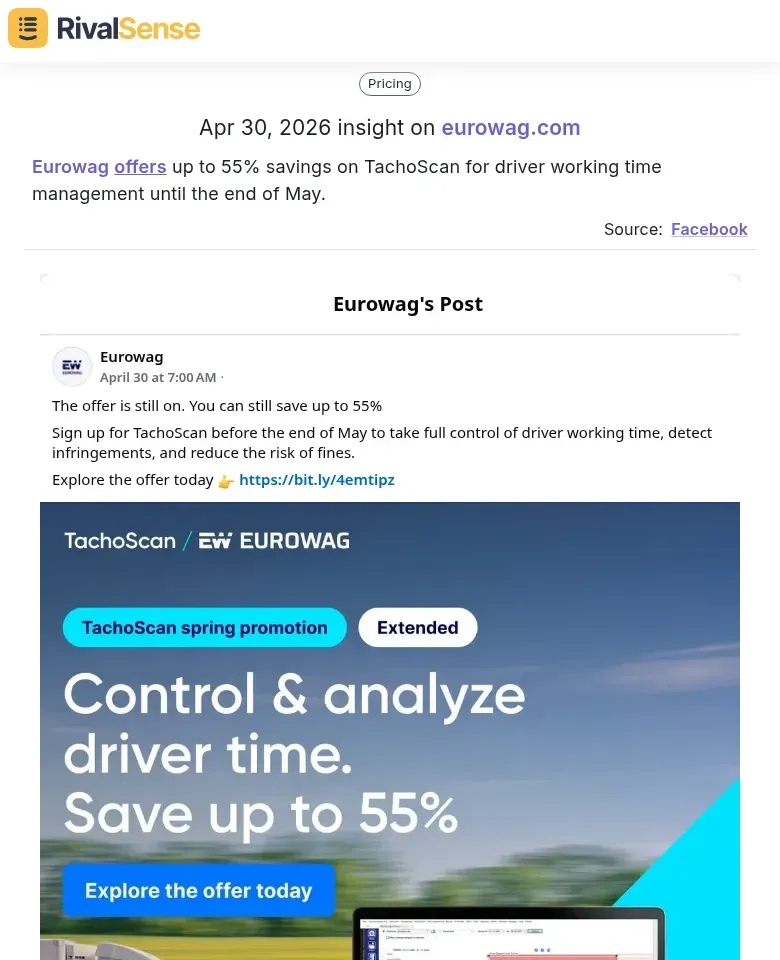
Real RivalSense Insight: We spotted that Eurowag offers up to 55% savings on TachoScan for driver working time management until the end of May. This insight is valuable because it shows how a competitor is bundling cost savings with regulatory compliance—a powerful combination for risk-averse buyers. By understanding this framing, you can map your own product’s features to both saving money and mitigating legal risks, creating a stronger value story.
Actionable steps:
- Audit competitor messaging: Identify top 3 savings claims and regulatory benefits they promote.
- Map to your features: Connect each competitor benefit to your product’s equivalent (e.g., automated logbooks for hours-of-service compliance).
- Quantify dual value: Create a simple ROI table showing cost savings + compliance risk reduction (e.g., “Save 40% on fuel + avoid $10k in penalties”).
- Test with ICP: Run A/B tests on landing pages—one highlighting savings only, another savings + compliance. Track conversion lift.
Tip: Use a checklist for your sales team: “Does our pitch mention both percentage savings and a specific compliance pain point?” This dual framing differentiates you from price-only competitors and builds trust with risk-averse buyers.
Actionable Frameworks for Tracking and Responding to Pricing Trends
To stay ahead, build a systematic approach to pricing intelligence. Start with automated monitoring: use tools like RivalSense to track competitor price changes, promo extensions, and benefit modifications in real time. Set up alerts for key metrics—list price, discount depth, bundle offers, and free trial periods. Next, analyze the frequency and timing of discounts. Map them against your own calendar to identify seasonal patterns (e.g., Black Friday spikes) or strategic shifts (e.g., a competitor suddenly offering annual discounts mid-Q2). Create a simple spreadsheet logging each change with date, competitor, and context—this reveals hidden tactics like “price anchoring” where a high base price is set before a deep discount. Finally, develop response playbooks with clear triggers. For example: if a competitor drops price >10%, match only if you have cost advantage; if they extend a promo, consider bundling extra features instead of cutting price; if they add a free tier, differentiate by emphasizing premium support. Test responses with A/B pricing on a segment before full rollout. Regularly review and update playbooks quarterly to adapt to market dynamics.
Conclusion: Turning Pricing Insights into Competitive Advantage
Consistent tracking of pricing trends uncovers hidden strategic signals from competitors—whether they’re testing premium tiers, discounting to gain share, or repositioning value. To turn these insights into a competitive advantage, integrate pricing intelligence into your broader competitive analysis. Start by setting up automated alerts for key competitors’ price changes, then cross-reference with product updates, marketing shifts, and customer feedback. This holistic view enables proactive decisions: adjust your own pricing before a rival’s launch, time promotions to counter their moves, or refine value communication to justify your price point. A practical step: create a monthly “pricing signal dashboard” that maps competitor changes to your response actions. Include a checklist: (1) monitor top 5 competitors weekly, (2) log price changes with context (e.g., bundling, discounts), (3) assess impact on your positioning, (4) decide on a response (match, differentiate, or ignore), and (5) track outcomes. By embedding pricing intelligence into your strategy, you move from reactive to proactive—turning raw data into a sustained edge.
Ready to start tracking competitor pricing trends, promotions, and extensions like the examples above? Try RivalSense for free today at https://rivalsense.co/ and get your first competitor report in hand—no commitment needed.
📚 Read more
👉 Competitor Analysis: How to Leverage Event Participation Insights (VMware Explore 2026 Case Study)
👉 Key Success Factors for Building a Best Practice Key Account Management Organization
👉 Key Account Management FAQs: Advanced Tactics for SEO & Content Marketing
👉 How Databricks' Startup Pivot Revealed a $2B Opportunity for Competitors
👉 How to Predict Your Rivals' Next Moves Using Twitter (With Real Examples)