
Key Account Management FAQs: Advanced Tactics for SEO & Content Marketing
Key Account Management (KAM) in B2B content strategy means prioritizing high-value accounts and tailoring content to their specific needs, decision stages, and competitive landscape. It goes beyond generic SEO—it’s about aligning content with the accounts you care about most.
The ABM + Competitive Intelligence Intersection
Combine account-based marketing (ABM) with competitive intelligence (CI) to uncover what your key accounts care about. For example, track which competitors they evaluate, what content they engage with, and their pain points. Use this intel to create content that positions your solution as the best fit.
Practical Steps to Drive Higher ROI
- Identify Tier-1 Accounts: Use firmographic and intent data to select 10–20 high-value accounts.
- Map Their Content Journey: Analyze the topics and formats they consume at each stage.
- Monitor Competitor Moves: Set up alerts for competitor mentions, product launches, or content changes targeting your accounts.
- Create Account-Specific Content: Develop case studies, comparison guides, or personalized landing pages.
- Measure Account-Level Impact: Track engagement, pipeline influence, and closed revenue per account.
💡 Pro Tip: Use a competitive tracking tool to monitor your key accounts’ interactions with competitors. Then create content that directly addresses the gaps or weaknesses you identify.
By focusing on a handful of strategic accounts, you’ll see higher conversion rates, stronger relationships, and better ROI from your SEO and content marketing efforts.
Identifying High-Value Accounts Through Competitive Research
To identify high-value accounts, start by analyzing your competitors' customer bases. Use tools like RivalSense to map which accounts are engaging with competitor content, attending their webinars, or downloading their resources. Combine this with intent data (e.g., surge in topic searches) and firmographics (industry, company size, revenue) to score accounts.
Build a tiered matrix:
| Tier | Criteria | Action |
|---|---|---|
| Tier 1 | High competitive overlap + high revenue potential (e.g., accounts actively evaluating competitors) | Personalized outreach |
| Tier 2 | Moderate overlap + moderate potential | Nurture with targeted content |
| Tier 3 | Low overlap but high growth signals | Monitor and educate |
Checklist:
- [ ] Identify top 10 competitor accounts
- [ ] Score by intent + firmographics
- [ ] Categorize into 3 tiers
- [ ] Assign account managers per tier
Real RivalSense Insight: Pricing Changes as a Strategic Signal
Tracking competitor pricing updates can reveal shifts in their strategy—like targeting new segments or defending market share. For example, RivalSense caught when Autodesk renamed its 'Forma Data Management Essentials' to 'Forma Data Management' and introduced a starting price of $45/month. For your key accounts, a price change like this might signal an opportunity to position your solution as more cost-effective or feature-rich. Use such insights to adjust your own pricing conversations or create comparison guides that highlight your value.

Tailoring Content to Key Accounts with SEO-Driven Personalization
To tailor content for key accounts, start by creating account-specific landing pages optimized for long-tail keywords that reflect each account's unique pain points. For example, if a key account is in healthcare, target phrases like "HIPAA-compliant data storage solutions for hospital networks" rather than generic "data storage."
Map content clusters to the buying journey:
| Journey Stage | Content Type | Example |
|---|---|---|
| Awareness | Industry reports | "State of Healthcare Data Security" |
| Consideration | Case studies | "How Hospital X Cut Costs with Our Platform" |
| Decision | ROI calculators | "Calculate Your Hospital's Potential Savings" |
For each key account, customize the cluster with their industry, role, or company name. Use dynamic content and personalization tokens to boost engagement. Swap headers, CTAs, and testimonials based on account attributes.
A simple checklist:
- [ ] Identify 3–5 long-tail keywords per account.
- [ ] Build a landing page with a personalized URL (e.g., /acme-solution).
- [ ] Insert tokens like {{company_name}} in headlines.
- [ ] A/B test dynamic CTAs (e.g., "See [Company]'s ROI").
💡 Pro tip: Use CRM data to trigger personalized email sequences linking to these pages, increasing relevance and conversion rates.
Aligning Content Marketing with Sales for Key Account Wins
To align content marketing with sales for key account wins, start by developing sales enablement materials that reflect your competitive positioning. Create battle cards, case studies, and comparison guides that sales can use to counter competitors' strengths. For example, if a competitor leads on pricing, arm your team with ROI calculators and value-based messaging.
Coordinate your content cadence with account outreach and nurturing sequences. Map content to the buyer's journey: send thought leadership for awareness, product demos for consideration, and customer testimonials for decision. Use a shared calendar so sales knows when new assets drop and can time their calls accordingly.
Measure content attribution to key account pipeline and revenue. Use UTM parameters, CRM integration, and multi-touch attribution models to track which pieces influence deals. Set up dashboards showing content engagement by account, pipeline influenced, and revenue closed. For instance, track if a whitepaper download correlates with a 20% higher win rate.
Checklist:
- [ ] Create 3 battle cards for top competitors
- [ ] Map content to 5 key account stages
- [ ] Set up UTM tracking for all gated content
- [ ] Build a shared content-sales calendar
- [ ] Run monthly attribution reports by account
Advanced Tactics: Competitor Monitoring and Content Gap Analysis
To stay ahead, set up real-time alerts for competitor moves targeting your key accounts. Use tools like Google Alerts, Mention, or RivalSense to monitor competitor blog posts, social updates, and press releases mentioning your key accounts. When a competitor publishes a case study or article featuring one of your accounts, you can quickly respond with a counter-narrative or a more detailed piece.
Conduct a content gap analysis to identify topics your key accounts care about but your competitors haven't addressed. Start by listing your top 3–5 key accounts and their pain points. Then, analyze competitor content using tools like Ahrefs or SEMrush to see what keywords they rank for. Cross-reference with your own content library. The gaps are your opportunities.
Refine your keyword strategy using competitive intelligence. For each gap topic, target long-tail keywords with high relevance and lower competition. Create differentiated content—e.g., original research, expert interviews, or interactive tools—that adds unique value beyond what competitors offer.
Real RivalSense Insight: Tracking Competitor Content Strategy
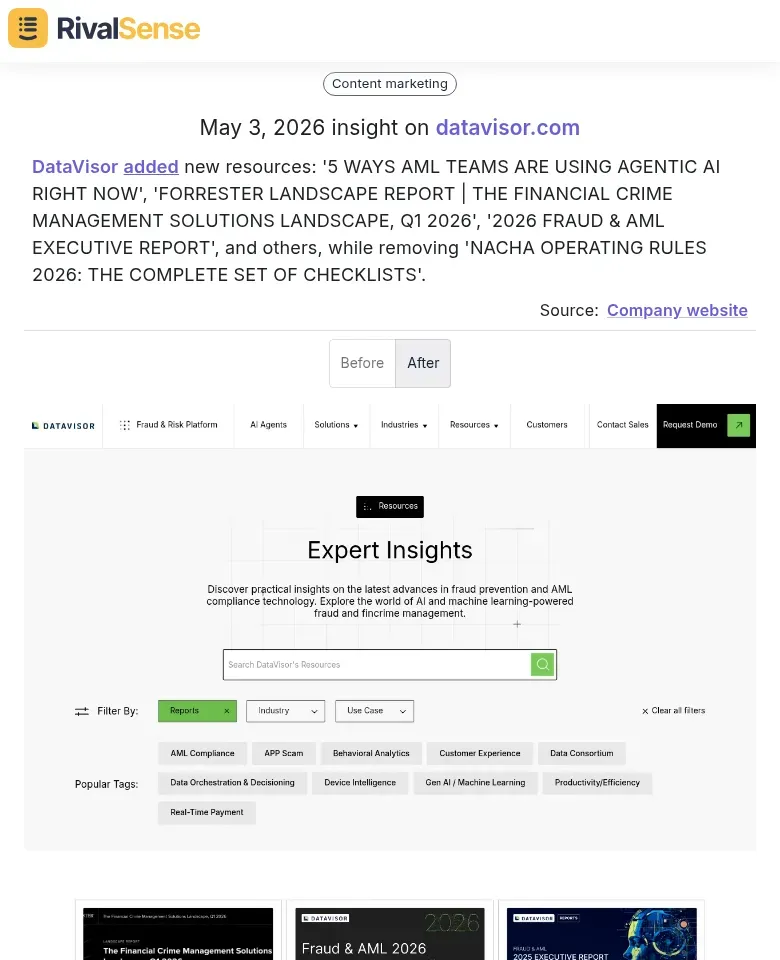
Monitoring what resources your competitors add or remove reveals their strategic priorities and messaging shifts. RivalSense spotted DataVisor adding resources like "5 Ways AML Teams Are Using Agentic AI Right Now" and "2026 Fraud & AML Executive Report," while removing "NACHA Operating Rules 2026: The Complete Set of Checklists." This signals a pivot from compliance-heavy content to AI-focused thought leadership. For your key accounts in fintech, this insight helps you anticipate competitor talking points and craft counter-content that fills the void left by their removed resource—or leads with a fresh angle on AI in AML.
Quick checklist:
- [ ] Set up alerts for key account names + competitor names
- [ ] Map top 5 key account pain points
- [ ] Audit competitor content for those topics
- [ ] Identify 3–5 content gaps
- [ ] Create differentiated content targeting those gaps
Measuring Success: KPIs and Continuous Optimization
To measure success in key account management, start by tracking account-level engagement metrics. Use tools like Google Analytics or HubSpot to monitor time on site, content downloads, page depth, and repeat visits for each target account. Create a dashboard that aggregates these signals per account.
Next, correlate SEO performance with account progression. Map keywords to funnel stages:
| Funnel Stage | Keyword Example | Account Signal |
|---|---|---|
| Top | "competitive intelligence software" | General research |
| Middle | "competitor tracking tools comparison" | Evaluating options |
| Bottom | "RivalSense demo" | Buying intent |
Track which accounts search for bottom-funnel terms and cross-reference with engagement data. For example, if an account downloads a case study after searching a demo keyword, that’s a strong buying signal.
Finally, iterate your content strategy based on win/loss analysis and competitive shifts. After a closed deal, interview the sales team to identify which content influenced the decision. For lost deals, analyze if competitors offered better resources or if your content missed key objections. Use these insights to refresh underperforming content, fill gaps, and adjust keyword targeting. Set a quarterly review cadence to update your content map based on new competitor moves or market changes.
Real RivalSense Insight: Product Evolution Signals Market Direction
Watching how competitors evolve their product offerings can inspire your own roadmap and content strategy. RivalSense observed Uber evolving from an app into a travel ecosystem, now booking 500k+ hotels and allowing users to earn hotel status on every ride or order. This expansion into adjacent services signals a move to increase customer lifetime value and stickiness. For your key accounts in the travel or mobility space, this insight helps you advise them on competitive threats or opportunities—and create content that positions your solution as essential for navigating that ecosystem shift.

Putting It All Together
Key Account Management for SEO and content marketing isn’t a one-time project—it’s an ongoing practice of monitoring, personalizing, and optimizing. By blending competitive intelligence with ABM tactics, you can serve your most valuable accounts with content that truly resonates and drives revenue.
Ready to put these advanced tactics into action? Try RivalSense for free to start tracking competitor product launches, pricing updates, content changes, and more—all delivered in a weekly email. Get your first competitor report today and take the guesswork out of your KAM strategy.
📚 Read more
👉 How Databricks' Startup Pivot Revealed a $2B Opportunity for Competitors
👉 How to Predict Your Rivals' Next Moves Using Twitter (With Real Examples)
👉 Monitor Competitor SEC Filings: A Step-by-Step Guide for Business Leaders
👉 Key Account Alerts: Spot Competitor Financial Moves First
👉 How One Integration Reveals Competitor Strategy: Algolia + Stripe