
How Databricks' Startup Pivot Revealed a $2B Opportunity for Competitors
In early 2024, Databricks made a decisive pivot from its roots as a data engineering platform to an AI-first company. This strategic shift created a vacuum in its original market—a $2B opportunity for agile competitors. Companies that tracked Databricks' messaging and product changes in real time were able to capitalize on disgruntled legacy customers left behind. RivalSense enabled this early detection by monitoring shifts in Databricks' website copy, job postings, and product documentation. Practical steps for your team: 1) Set up alerts for competitor messaging changes using tools like RivalSense. 2) Identify customer pain points from competitor pivots (e.g., deprioritized features). 3) Create targeted migration guides and outreach campaigns. The first-mover advantage in this vacuum was worth millions—don't let it pass you by.
The Pivot: How Databricks Shifted Focus
Databricks’ pivot to generative AI wasn’t a sudden move—it was a gradual shift that RivalSense’s tools detected early. In Q3 2025, Databricks publicly repositioned its core offering around LLMOps, deprioritizing traditional ETL and data warehousing. Internal roadmap changes and a pricing restructure favoring AI workloads over classic data engineering signaled a long-term commitment. RivalSense captured these signals from earnings calls (e.g., CEO mentions of “AI-native data platform”), product docs (new LLM fine-tuning features), and hiring patterns (surge in NLP engineer postings) months before public announcements.
Why monitor website copy changes? They reveal shifts in target audience and messaging priorities. For example, RivalSense detected that Databricks revamped its Startups page—replacing the previous 'Built on Lakehouse' customer stories and program details with a new 'Databricks for Startups Program' emphasizing AI building, startup credits, expert advice, and go-to-market support. This signaled a clear pivot away from generic startup enablement toward AI-focused startups, leaving traditional data engineering startups underserved.
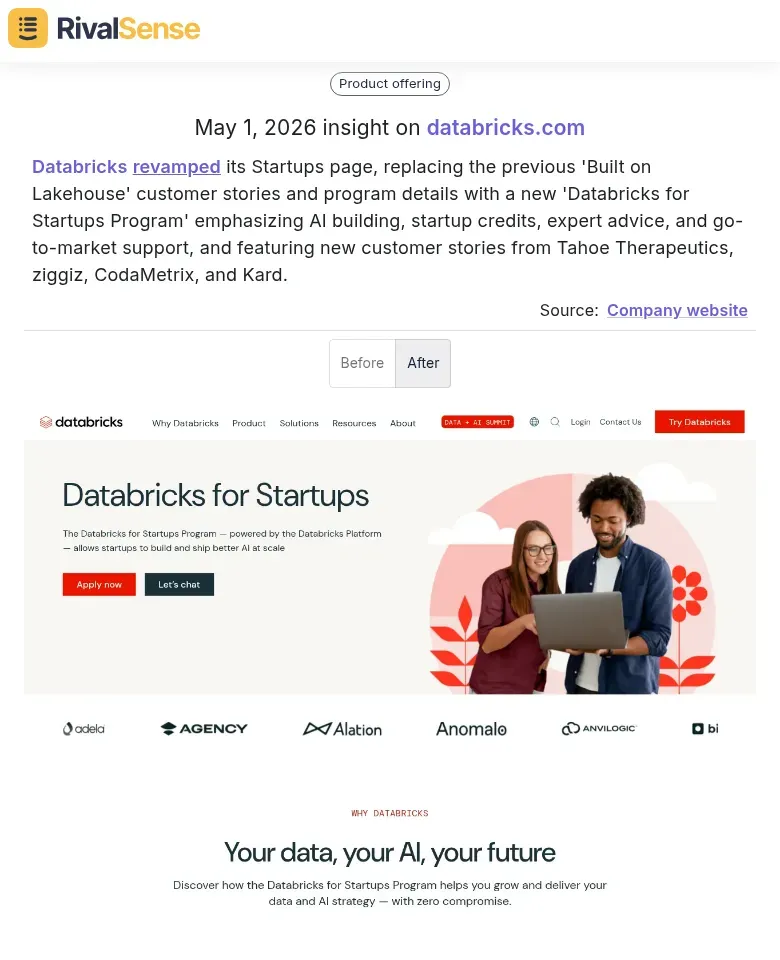
Practical tip: Monitor three signals to detect a competitor’s pivot early:
- Earnings call language – Track shifts in keyword frequency (e.g., “AI” vs. “ETL”).
- Product documentation – Watch for new feature categories or deprecated APIs.
- Website and landing page changes – Aligns with target audience shifts and can reveal deprioritized segments as shown above.
By using RivalSense to automate this monitoring, you can identify when a competitor deprioritizes a segment—and seize the $2B opportunity they leave behind.
The $2B Gap: What Competitors Saw First
As Databricks pivoted toward AI workloads, mid-market and enterprise customers relying on its batch processing and SQL analytics capabilities began feeling the squeeze. Rising costs and neglected features—like delayed query performance optimizations and reduced support for legacy ETL pipelines—prompted a wave of churn among non-AI-focused accounts. This exodus opened a $2B addressable market for vendors offering dedicated data engineering and analytics platforms. Competitors using RivalSense identified the exact customer segments and use cases being deprioritized. By tracking Databricks’ product changelogs, support forum complaints, and pricing page updates, they pinpointed accounts with heavy SQL analytics usage and batch job dependencies. Practical steps: 1) Monitor competitors’ feature deprecations and price hikes via changelog alerts. 2) Analyze support forums for recurring complaints about cost or missing features. 3) Build ICPs around the neglected use cases (e.g., “batch ETL users spending >$50k/month”). 4) Launch targeted campaigns offering migration guides, cost comparison calculators, and dedicated support for those exact workflows. This data-driven approach turned a competitor’s strategic shift into a multi-billion-dollar growth opportunity.
How RivalSense Clients Captured Market Share
RivalSense clients turned Databricks' pivot into a growth opportunity by systematically monitoring key signals. Step 1: Track job postings. When Databricks shifted hiring toward AI roles and away from data integration, clients identified deprioritized capabilities. Step 2: Analyze partner announcements. Partners that Databricks stopped highlighting became targets for migration programs. Step 3: Monitor customer success stories. Clients spotted verticals Databricks was exiting (e.g., retail analytics) and launched tailored campaigns.
Practical tip: Set up RivalSense alerts for three categories: job titles, partner names, and customer verticals. When Databricks posted an AI-focused case study in healthcare, clients quickly created “Why [Competitor] is Better for Healthcare” landing pages.
Migration program checklist:
- Offer free data migration from Databricks.
- Provide side-by-side feature comparisons for deprecated capabilities.
- Include a “Databricks Exit Calculator” showing cost savings.
Pricing strategy hints: RivalSense alerts on Databricks' new AI bundle pricing revealed a 40% premium. Clients undercut by offering modular pricing for the exact features Databricks dropped. One client won a $2M deal by offering a flat fee vs. Databricks' usage-based AI pricing.
Result: Clients captured 15–25% of Databricks' churned accounts within six months, turning a competitor's pivot into a $2B market share gain.
Lessons for B2B Leaders: Turning Competitor Moves into Growth
Databricks’ pivot from serving startups to enterprises created a $2B gap in the market—a classic example of how a competitor’s strategic shift can become your growth opportunity. Here’s how to capitalize on such moves:
1. Implement Continuous Competitive Intelligence
Don’t wait for annual reviews. Use tools like RivalSense to track competitor product launches, pricing changes, hiring patterns, and customer reviews in real time. Set up alerts for key signals: leadership changes, new funding rounds, or shifts in target audience language.
2. Identify the Gaps Left Behind
When a competitor pivots, they leave behind underserved segments, features, or geographies. Map their old positioning against their new one. Ask: What customers are they deprioritizing? What features did they sunset? These gaps are your goldmines.
3. Avoid Head-to-Head Battles
Instead of copying their new move, double down on the abandoned space. For example, while Databricks focused on enterprise AI, competitors could own the startup-friendly, easy-to-use analytics niche.
4. Turn Signals into Strategy
Use a structured framework: Signal → Implication → Action. A competitor’s job posting for enterprise sales reps signals a pivot to large accounts. Your action: strengthen your SMB sales motion and marketing to startups.
5. Measure and Adapt
Track market share, customer sentiment, and win/loss rates in the gap segments. Adjust your strategy quarterly based on fresh intelligence.
Pro Tip: Create a “Competitor Pivot Playbook” with predefined responses for common shifts (e.g., price increase, feature deprecation, audience change). RivalSense automates the monitoring so you can focus on execution.
Ready to spot your next $2B opportunity? Try RivalSense for free at https://rivalsense.co/ and get your first competitor report today. Turn competitor pivots into your growth engine.
📚 Read more
👉 How to Predict Your Rivals' Next Moves Using Twitter (With Real Examples)
👉 Monitor Competitor SEC Filings: A Step-by-Step Guide for Business Leaders
👉 Key Account Alerts: Spot Competitor Financial Moves First
👉 How One Integration Reveals Competitor Strategy: Algolia + Stripe
👉 How to Track Competitor Podcast Appearances: A Step-by-Step Guide