
How to Predict Your Rivals' Next Moves Using Twitter (With Real Examples)
In the race to win key accounts, the winners aren't just faster—they're better informed. While most teams wait for press releases or earnings calls, savvy founders and CEOs are mining Twitter for real-time, unfiltered signals about competitor moves. Twitter offers a raw feed of strategic shifts: a VP of Sales liking posts from a rival CRM, a product lead following a new category influencer, or a company retweeting a partner's launch. These micro-signals often precede formal announcements by weeks, giving you a critical window to adjust your positioning, outreach, or product narrative.
To turn noise into actionable intelligence, set up a systematic monitoring process:
- Create a private Twitter list of key competitors, their executives, and top salespeople.
- Use a tool like RivalSense to track follower changes, likes, and retweets—manual scrolling is too slow.
- Flag anomalies: a sudden surge in follows from a specific industry signals a new vertical push.
- Cross-reference with LinkedIn: if a competitor's sales team starts following procurement leaders at your target accounts, it's time to activate your champions.
Start today: pick your top three competitors, build a monitoring list, and check it daily. The next key account win could come from a tweet you catch before they do.
🏆 Spotting Awards and Industry Recognition to Gauge Credibility
Awards and industry recognition are powerful signals of credibility. When a competitor lands on a list like FinCrimeTech50 or wins a ‘Best in Class’ award, it’s not just a trophy—it’s a trust signal that influences buyer decisions. Tracking these wins on Twitter lets you react before the award is featured in the rival's sales deck.
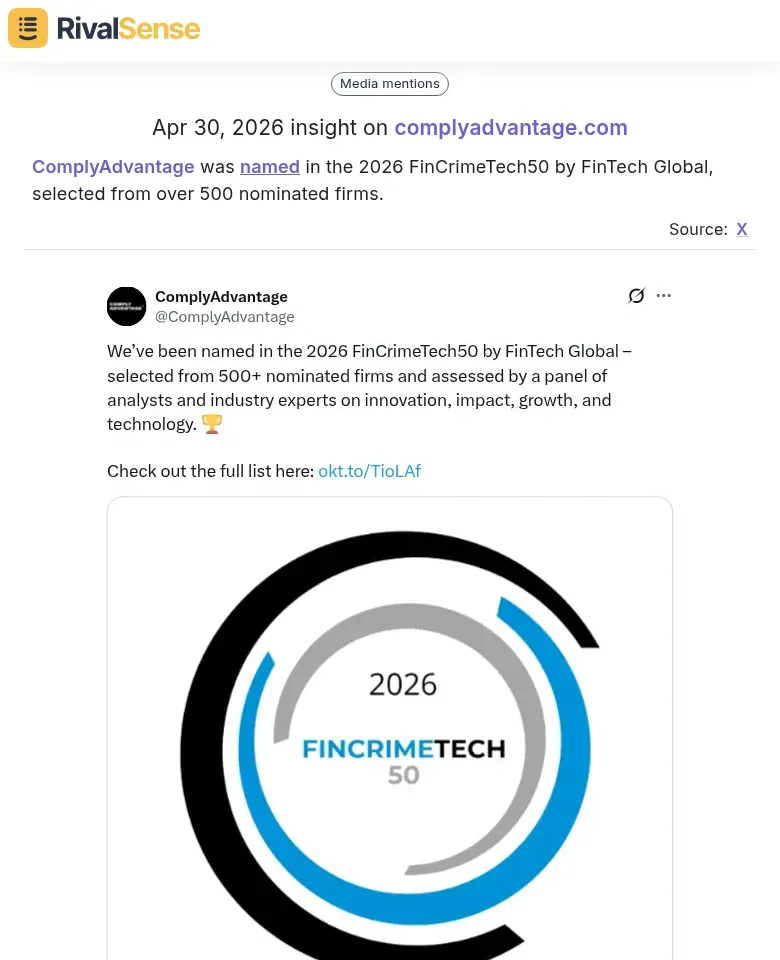
Example: ComplyAdvantage Named in FinCrimeTech50
ComplyAdvantage was named in the 2026 FinCrimeTech50 by FinTech Global, selected from over 500 nominated firms. This type of insight is valuable because it immediately signals to your prospects that a competitor has been vetted by a respected third party—making your job harder if you don't have similar proof points.
How to track this on Twitter:
- Set up keyword alerts for award names (e.g., “FinCrimeTech50,” “G2 Leader”) plus your competitors’ handles.
- Monitor hashtags like #Awards, #IndustryRecognition, or #Top50.
- Check competitors’ pinned tweets—they often highlight major wins.
What to do with the intel:
- Validate benchmarks: If a rival wins an award you didn’t, ask: What criteria did they meet? Use that to close gaps.
- Counter in sales: If a prospect mentions a competitor’s award, acknowledge it, then pivot: “Yes, they’re strong in X. However, our recent Y feature addresses Z, which their award criteria didn’t cover.”
- Position your strengths: If you win an award, amplify it on Twitter and in proposals. If not, highlight third-party reviews or case studies as alternative proof.
Pro tip: Create a simple spreadsheet tracking competitor awards, the awarding body, and the date. Over time, patterns emerge—e.g., a competitor may win the same award repeatedly, signaling a strategic focus area you can target.
👥 Tracking Executive Hires to Predict Strategic Pivots
When a rival appoints a new VP or C-level executive, it’s often a signal of strategic investment in a specific region, technology, or function. For example, hiring a Chief AI Officer suggests a pivot toward AI-led innovation, while a VP of EMEA Sales indicates plans to scale in Europe. Catching these hires on Twitter gives you weeks of lead time before the press release.
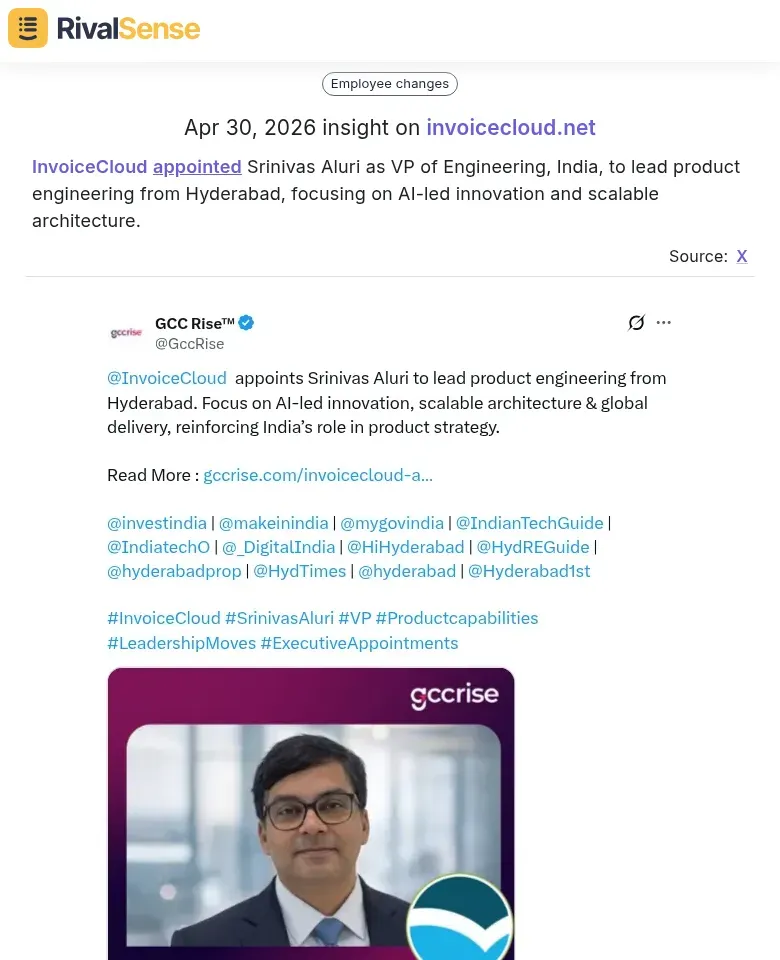
Example: InvoiceCloud Appoints Srinivas Aluri as VP of Engineering, India
InvoiceCloud appointed Srinivas Aluri as VP of Engineering, India, to lead product engineering from Hyderabad, focusing on AI-led innovation and scalable architecture. This insight is valuable because it reveals a competitor's investment in AI capabilities and a regional engineering hub—likely to speed up product releases and lower costs, which could affect your pricing or feature race.
How to track and interpret these signals:
- Monitor LinkedIn and Twitter announcements. Follow key competitors and set alerts for title changes like "VP," "SVP," or "Chief." Tools like RivalSense can automate this.
- Analyze the hire’s background. Did they come from a company known for a particular technology or market? A new VP of Engineering from a cloud-native firm may hint at a shift to microservices or SaaS.
- Look for clusters of hires. If a competitor hires multiple sales leaders in APAC within a quarter, expect a regional push.
- Cross-reference with job postings. A new VP of Product often precedes a wave of product manager openings, signaling a roadmap expansion.
Practical tip: Create a simple spreadsheet tracking each hire, their previous company, and the implied strategic move. Review monthly to spot patterns before they become public announcements.
By decoding executive hires, you can anticipate product roadmaps, market expansions, or technology pivots—and adjust your own strategy accordingly.
🤝 Monitoring Partnerships and Technology Integrations
Partnership announcements often signal co-innovation and reveal technology stack preferences. When a rival standardizes on specific hardware or platforms, it hints at future product capabilities—e.g., a cloud partnership may precede a SaaS launch. Twitter is often the first place these deals are teased.
Example: Autodesk Partners with Intel
Autodesk partnered with Intel to standardize Autodesk Inventor Professional on AI PCs with Intel Core Ultra and Arc Pro B390 GPU, enhancing ray tracing and 3D visualization. This insight is valuable because it shows a competitor locking in a hardware advantage that could improve performance and time-to-market for their users—potentially making your product feel inferior if you don't optimize similarly.
How to monitor:
- Set up Twitter alerts for your rivals and key tech vendors (e.g., AWS, Salesforce).
- Track hashtags like #partnership, #integration, or #builtwith.
- Use a competitive intelligence tool to log announcements and detect patterns.
Practical steps:
- Create a spreadsheet mapping each rival’s partners and integration categories.
- Note the date and context of each announcement.
- Look for clusters—multiple rivals partnering with the same vendor signals an ecosystem shift.
Checklist for threats:
- ☐ Is a rival integrating with a platform you rely on? They may undercut your value.
- ☐ Are they adopting an emerging tech (e.g., AI copilot) that could become table stakes?
- ☐ Have they dropped a previous partner? That may indicate a strategic pivot.
Use this intelligence to prioritize your own integrations or seek alternative partners before the market shifts.
🛠️ Turning Twitter Insights into a Competitive Playbook
To turn Twitter insights into a competitive advantage, build a repeatable playbook. Start by setting up a monitoring system: use tools like TweetDeck or RivalSense to track competitor handles, keywords (e.g., “new partnership,” “hiring,” “award”), and industry hashtags. Assign a team member to scan daily and log findings in a shared spreadsheet or CRM.
Next, categorize each insight by type—award, hire, partnership, product launch—and map it to potential impact on your key accounts. For example, if a rival hires a sales leader from your top account, they may target that relationship. If they win an award in a vertical you serve, they’ll likely use that in pitches.
Finally, develop proactive counter-strategies. For a competitor’s new partnership, prepare a one-pager comparing your integrated solution vs. theirs. If they announce a feature, prioritize your roadmap to fill gaps. Create a “competitive response” template: (1) insight summary, (2) affected accounts, (3) recommended action (e.g., tailored messaging, customer outreach), and (4) owner. Share weekly in a 15-minute standup.
Quick checklist:
- [ ] Set up Twitter alerts for 5 key competitors
- [ ] Define 3 insight categories (e.g., hires, wins, partnerships)
- [ ] Map each category to 2-3 potential account risks/opportunities
- [ ] Draft 1 counter-strategy per category
- [ ] Assign ownership and review cadence
🚀 Conclusion: Stay Ahead by Listening to the Signals
Consistent Twitter monitoring is a low-cost, high-impact competitive intelligence habit. By tracking your rivals’ tweets, replies, and follows, you can spot account wins, product shifts, and partnership moves early. But don't stop there—combine these social signals with other sources like press releases, job postings, and earnings calls for a holistic view of competitor strategy.
Practical steps to act on insights:
- Set up alerts: Use tools like TweetDeck or RivalSense to track keywords (e.g., "new client," "partnership") and competitor handles.
- Analyze patterns: Note the timing and tone of announcements—are they ramping up before a big launch?
- Cross-reference: Validate Twitter clues with LinkedIn hiring spikes or funding news.
- Move fast: When you spot a potential account win, reach out to the prospect with tailored value before your rival solidifies their position.
Checklist for weekly monitoring:
- [ ] Review competitor tweets for client shout-outs or case studies.
- [ ] Check who they follow—could indicate new partnerships.
- [ ] Note any changes in bio or pinned tweets signaling strategic shifts.
Act on insights quickly to win accounts before rivals solidify their position. The early bird doesn't just get the worm—it gets the deal.
Tired of manually scrolling through Twitter and missing critical updates? Try RivalSense for free at https://rivalsense.co/ to automate competitor tracking across websites, social media, registries, and more. Get your first competitor report today and stay one step ahead.
📚 Read more
👉 Monitor Competitor SEC Filings: A Step-by-Step Guide for Business Leaders
👉 Key Account Alerts: Spot Competitor Financial Moves First
👉 How One Integration Reveals Competitor Strategy: Algolia + Stripe
👉 How to Track Competitor Podcast Appearances: A Step-by-Step Guide
👉 Competitor Partnership Alerts: A 5-Step Monitoring Checklist