
Monitor Competitor SEC Filings: A Step-by-Step Guide for Business Leaders
In business, knowledge is power. While news headlines and industry chatter offer surface-level insights, SEC filings provide a legally mandated, granular view into competitors' financial health, new ventures, and strategic moves. These documents—including 8-Ks for material events, S-1s for IPOs, and 10-Ks for annual performance—reveal funding rounds, partnerships, regulatory changes, and more before they hit the mainstream.
Why this matters for competitive intelligence:
- Uncover new opportunities early: A competitor's 8-K announcing a major partnership or an S-1 for a spin-off signals where they're investing.
- Track financial trends: Aggregate filings to spot shifts in capital structure (e.g., debt issuances, equity raises).
- Benchmark performance: Compare your company’s growth metrics with disclosed revenue, R&D spend, or market expansion from peers’ filings.
Practical tip: Set up automated alerts for competitor CIK numbers on EDGAR. Use a tracking tool to flag keywords like "joint venture," "acquisition," or "new product." Dedicate 30 minutes weekly to review filings—focus on 8-Ks, S-1s, and 10-Ks. Cross-reference with press releases to validate. This systematic approach turns raw data into actionable intelligence, keeping your business ahead of the curve.
Identifying Key SEC Filing Types and Sources for Competitor Monitoring
To monitor competitors, focus on three key SEC filings: Form S-1 (IPO registration), Form 8-K (material events), and Form 10-K (annual report). These documents reveal strategic changes, new offerings, and business risks.
Sources & Automation:
- EDGAR: Search by competitor company name or CIK number. Use advanced search filters for form types.
- XBRL Feeds: Access structured data via SEC’s XBRL API to extract financial details programmatically.
- Aggregator Tools: Platforms like RivalSense streamline retrieval and flag relevant filings.
Pro Tips:
- Set Alerts: Use EDGAR’s RSS feeds or third-party tools to get notified when a competitor files. Filter by CIK or keywords like "underwriter," "co-manager," or "new product launch."
- Keyword Search: In Form 8-K, scan for "material definitive agreement" or "entry into a material agreement" to spot new partnerships early.
- Checklist:
- Identify top 5 competitors and their CIK numbers.
- Configure alerts for each CIK + form type (S-1, 8-K, 10-K).
- Review weekly: extract key announcements, offering size, and strategic moves.
By automating these steps, you’ll catch competitor activity days before public announcements.
Analyzing Transaction Data: Deal Size, Structure, and Timing Insights
To extract actionable intelligence from SEC filings, focus on three key data points: deal size, maturity dates, and transaction type. For example, a surge in large debt issuances (e.g., $500M+) may indicate a competitor is aggressively raising capital for acquisitions or expansion.
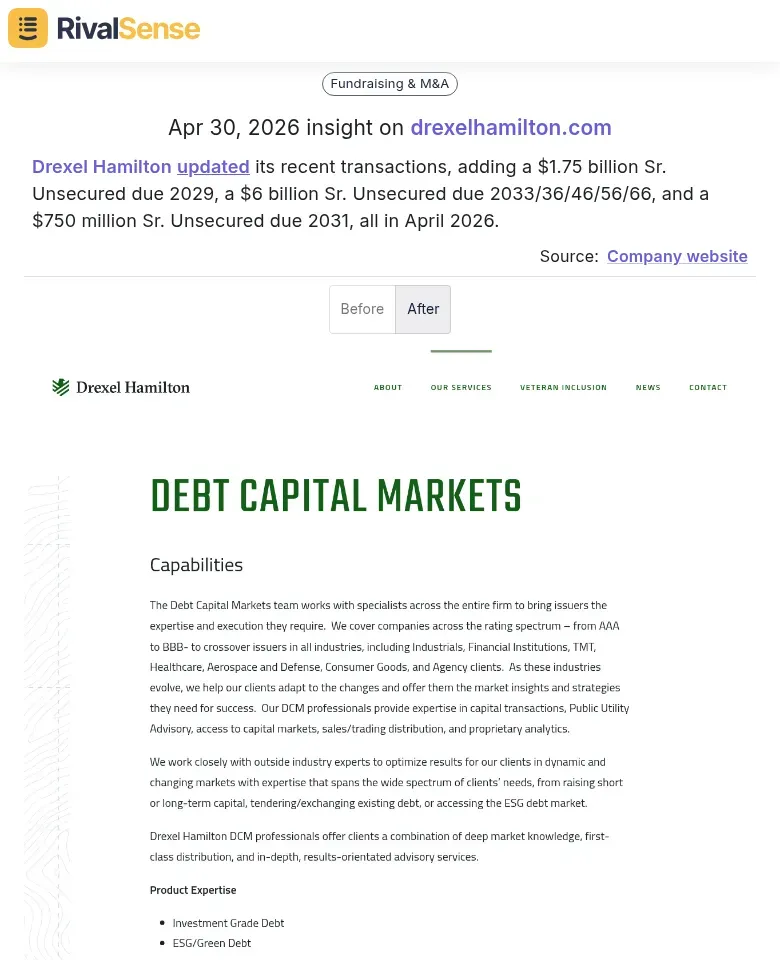
Real-World Example: RivalSense tracked that Drexel Hamilton updated its recent transactions, adding a $1.75 billion Sr. Unsecured due 2029, a $6 billion Sr. Unsecured due 2033/36/46/56/66, and a $750 million Sr. Unsecured due 2031, all in April 2026.
Why this matters: Understanding a competitor’s debt structure and timing helps you anticipate their capacity for future deals, potential liquidity moves, and strategic focus areas.
Use EDGAR’s advanced search to filter by form type (e.g., 424B5 for prospectus supplements) and date range. Create a tracking spreadsheet with columns for issuer, deal size, maturity, security type, and underwriter. Compare quarter-over-quarter to spot shifts—e.g., a company shifting from short-term to long-term debt might signal a bet on rising rates. Pro tip: Use XBRL tags to automate extraction via Python or Excel Power Query.
Detecting New Mandates, Partnerships, and Underwriting Roles from Prospectuses
Prospectuses filed with the SEC (e.g., S-1, 424B) are goldmines for detecting new mandates and underwriting roles. They explicitly list underwriters, co-managers, and selling agents, giving you a direct view of competitor deal participation.
Step 1: Identify Key Filings
- Search SEC EDGAR for S-1 (initial IPO filing) and 424B (final prospectus) for companies in your target sectors.
- Use ticker or CIK number; filter by filing date.
Step 2: Extract the Syndicate or Partner List
- Look for the “Underwriting” or “Selling Shareholders” section. The lead left underwriter is typically the top bookrunner; co-managers follow.
- For partnerships, check for “Material Agreements” sections.
Step 3: Track Role Changes
- Compare S-1 vs. final prospectus. A competitor moving from co-manager to lead underwriter signals growing market influence.
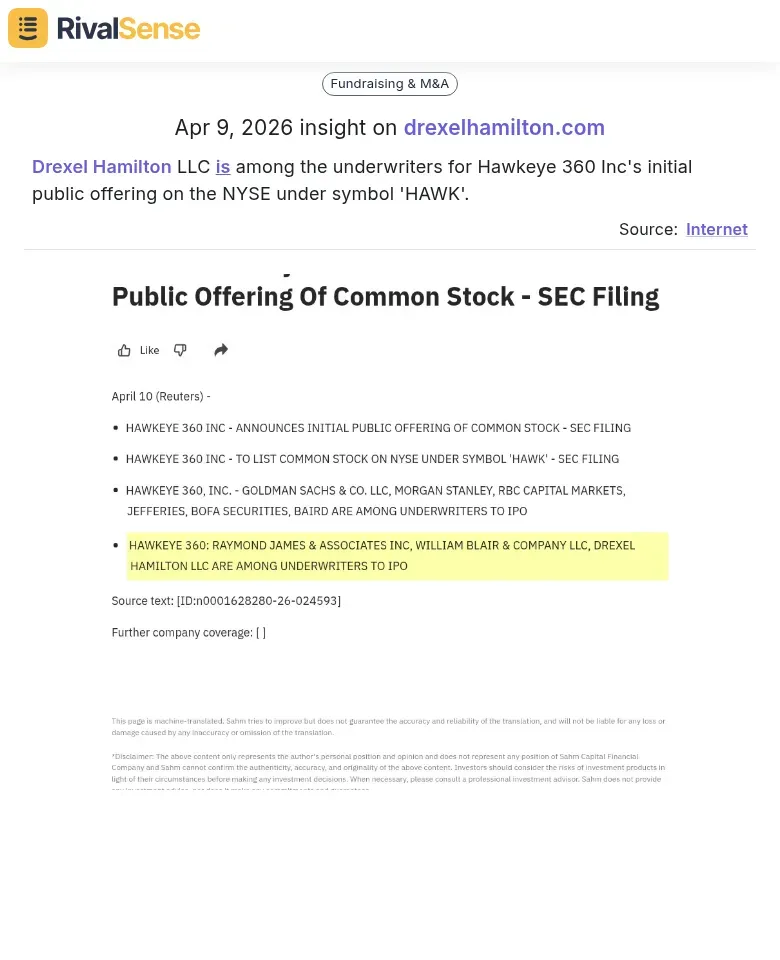
Real-World Example: RivalSense detected that Drexel Hamilton LLC is among the underwriters for Hawkeye 360 Inc’s initial public offering on the NYSE under symbol 'HAWK'.
Why this matters: Knowing which banks (or firms) are winning IPO mandates helps you benchmark your own advisory relationships and identify which competitors are gaining traction in high-growth sectors.
Step 4: Cross-Reference for Mandate Gains/Losses
- Create a simple spreadsheet: filing date, company, competitor name, role (lead, co-manager, selling agent).
- Flag any bank that appears in the final prospectus but not in the S-1 (new mandate) or vice versa (lost mandate).
Pro Tip: Set up automated alerts on EDGAR for S-1 filings in your coverage universe. Use Python or Zapier to parse the underwriting section and log changes weekly. This method gives you a real-time edge in spotting which firms are winning (or losing) deal flow.
Turning Filing Insights into Strategic Actions for Your Business
-
Refine Your Strategy with Transaction Patterns
- Identify sectors or deal structures where competitors are most active (e.g., healthcare IPOs, fintech debt issuances).
- Tailor your pitch books or partnership outreach to highlight your expertise in those areas, using competitor data to benchmark terms and multiples.
- Tip: Create a template that automatically populates competitor deal stats from your CI dashboard.
-
Capture Market Share from Exits or Reduced Activity
- Monitor SEC filings for signs a competitor is pulling back (e.g., declining deal count, asset sales).
- Proactively target their clients or partners with outreach campaigns emphasizing your stability and focus.
- Checklist:
- [ ] Set alerts for competitor asset sales or spin-offs.
- [ ] Map their top clients and prepare tailored value propositions.
- [ ] Track win/loss ratios to measure success.
-
Build a Competitive Intelligence Dashboard
- Aggregate key metrics from filings: deal count, average size, client retention rates, and sector concentration.
- Use tools like RivalSense to automate data extraction and visualization.
- Steps:
- Define KPIs (e.g., quarterly deal volume, top 5 clients by revenue).
- Connect filing data sources (EDGAR, SEDAR).
- Set up weekly refresh and distribute reports to deal teams.
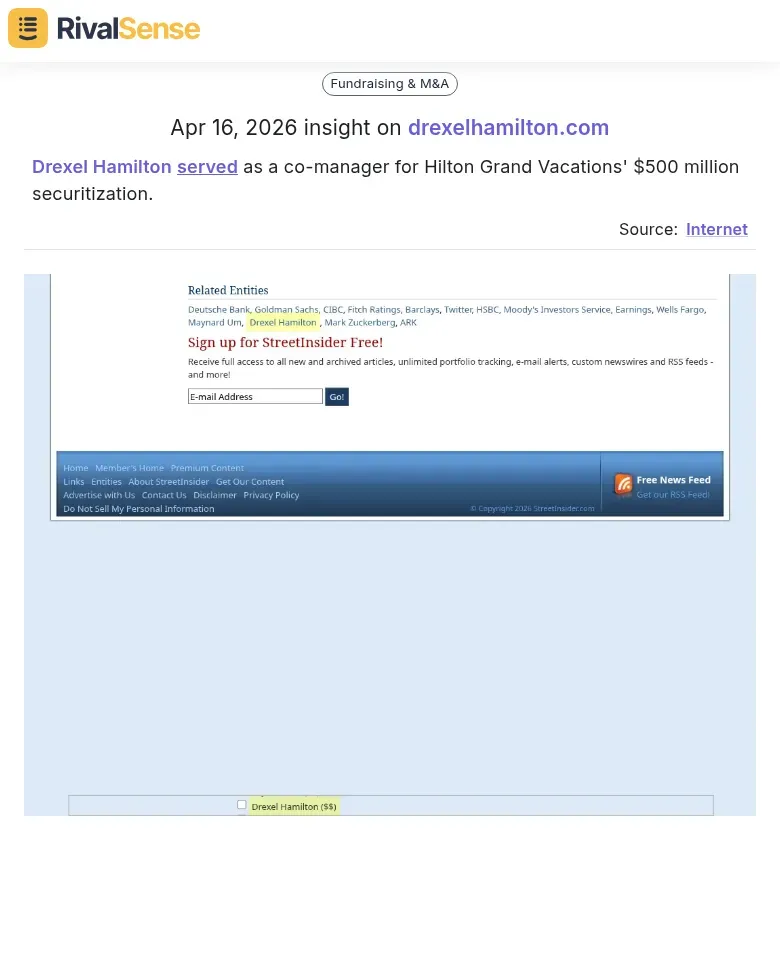
Real-World Example: RivalSense tracked that Drexel Hamilton served as a co-manager for Hilton Grand Vacations' $500 million securitization.
Why this matters: Identifying a competitor’s role in a large securitization reveals their focus on asset-backed deals and helps you target similar opportunities or counter-position your firm.
Pro Tip: Combine filing data with news and social signals for a 360° view. A dashboard that flags anomalies (e.g., sudden drop in filings) can give your team a first-mover advantage.
Conclusion: Building a Sustainable SEC Filing Monitoring Process
Building a sustainable SEC filing monitoring process doesn’t require a massive team—just the right cadence, data integration, and tools. Start by establishing a routine: set aside 1–2 hours weekly to scan new filings from top competitors, and a deeper monthly review to update competitive profiles. Use a simple checklist: (1) flag 8-Ks for material events, (2) extract key metrics from 10-K/10-Q, (3) note changes in risk factors or MD&A, and (4) update your competitive intelligence database.
Combine SEC data with other sources for a 360° view. For example, cross-reference a competitor's 10-K discussion of R&D spending with their recent press releases on product launches, and listen to earnings calls for context on strategic shifts. This triangulation reveals patterns that filings alone miss.
Finally, invest in tools that parse and visualize filing data. Automated alerts for specific keywords (e.g., “acquisition,” “restructuring”), dashboards that track changes over time, and AI-powered summaries can cut manual effort by 70% and surface actionable insights—like a competitor's sudden debt increase signaling a potential M&A spree. With the right process, SEC filings become a strategic asset, not a compliance chore.
Ready to simplify competitor tracking? Try RivalSense for free at https://rivalsense.co/ and get your first competitor report today. Our tool tracks product launches, pricing updates, partnerships, and SEC filing changes across the web and registries—all delivered in a weekly email report. Stop guessing, start strategizing.
📚 Read more
👉 Key Account Alerts: Spot Competitor Financial Moves First
👉 How One Integration Reveals Competitor Strategy: Algolia + Stripe
👉 How to Track Competitor Podcast Appearances: A Step-by-Step Guide
👉 Competitor Partnership Alerts: A 5-Step Monitoring Checklist
👉 How a Competitor's Calendar Update Sparked a Strategic Pivot (Real Insight Inside)