
Key Account Alerts: Spot Competitor Financial Moves First
Financial moves are among the most telling signals in competitive intelligence. A funding round, underwriting deal, or shift in asset management often precedes a strategic pivot—making them early indicators of where a competitor is headed. By tracking these moves, you can spot resource allocation priorities before they manifest in product launches, market expansions, or pricing changes.
Why this matters: A competitor’s balance sheet reveals their ambitions. A Series B focused on AI suggests they’re doubling down on automation; a new underwriting partnership hints at entering adjacent markets. Ignoring these signals leaves you reacting to moves, not anticipating them.
Practical steps to start monitoring:
- Set up alerts for key terms (e.g., “[competitor name] funding,” “[competitor name] underwriting”) on platforms like Crunchbase, PitchBook, or SEC filings.
- Create a financial signal tracker—a simple spreadsheet logging each event, amount, and inferred strategic intent.
- Map the move to your strategy: Ask, “Does this signal a threat to my market share, an opportunity to partner, or a need to adjust my roadmap?”
Proactive monitoring turns financial data into a competitive edge. Start small: pick one competitor and track their next three financial announcements. You’ll be surprised how early you can spot the next disruption.
Funding Rounds: Decoding Investment Signals
When a competitor closes a funding round, it's a loud signal about their trajectory. A Series A raise, for instance, typically indicates product-market validation and a shift to growth mode—expect aggressive hiring, marketing blitzes, and market share grabs. But the real insight lies in the details.
Decode the Amount: Compare the raise to industry medians. A round 2x the norm suggests ambition to capture significant market share; a smaller round might signal caution or a pivot. Use tools like Crunchbase to benchmark.
Analyze the Investors: Who’s backing them? Top-tier VCs (e.g., Sequoia, a16z) bring not just capital but strategic alliances, board influence, and network effects. A corporate VC (e.g., Salesforce Ventures) hints at potential partnerships or acquisition paths. Track investor portfolios to spot emerging ecosystems.
Actionable Steps:
- Set alerts on funding announcements via PitchBook or Google Alerts.
- Map the competitor’s new hires on LinkedIn within 30 days of the raise—correlate with their stated growth areas.
- Monitor their ad spend (e.g., via Similarweb) to gauge go-to-market intensity.
Pro Tip: If a competitor raises from a VC known for aggressive scaling, prepare for price wars or feature bloat. Adjust your positioning to emphasize stability and niche expertise.
💡 Real Insight from RivalSense
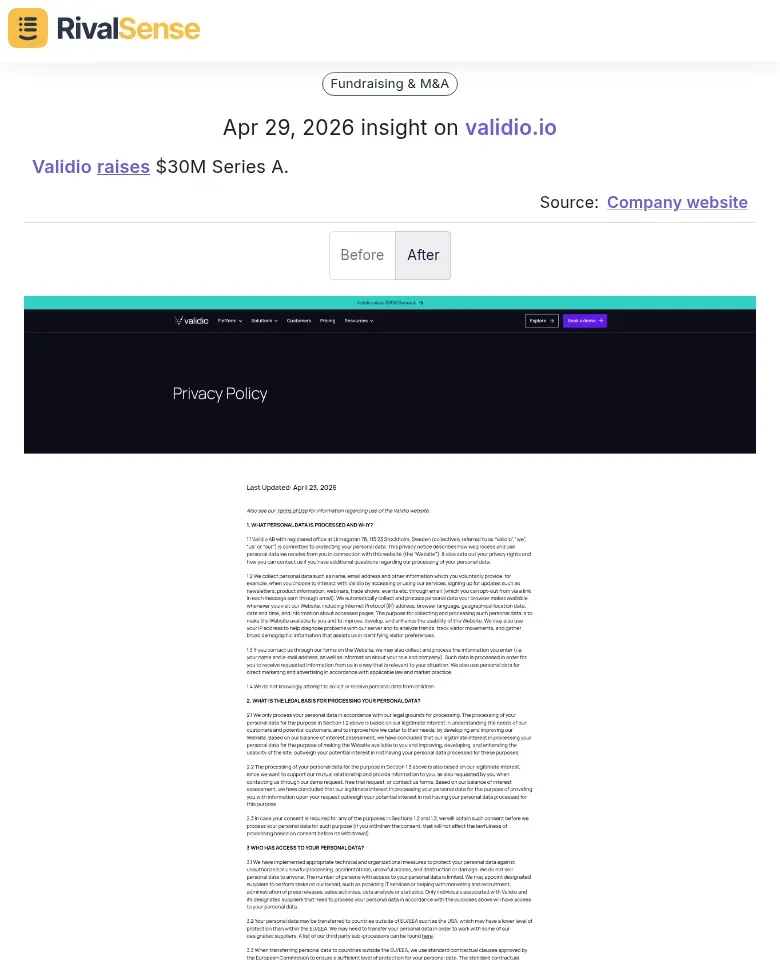
Example: Validio raises $30M Series A.
Why this type of insight is valuable: A Series A raise, especially at a notable amount like $30M, signals strong product-market fit and a clear growth mandate. For your strategy, this means you can expect the competitor to ramp up hiring, marketing, and feature development. Monitoring such funding events helps you anticipate resource allocation shifts—like entering new segments or undercutting on pricing—before they happen.
Underwriting and Capital Deployment: Reading Infrastructure Bets
When a competitor co-underwrites a large bond or debt instrument, it signals more than just financial muscle—it reveals their capacity to bankroll major projects. To decode these moves, track syndicated bond issuances in your industry. A competitor joining a $500M real estate development bond, for instance, may indicate a strategic pivot into property or infrastructure.
Practical steps:
- Monitor regulatory filings (e.g., SEC Form 8-K) for underwriting syndicate changes.
- Use tools like Bloomberg or PitchBook to spot new debt issuances by geography or sector.
- Cross-reference with press releases about capital deployment—look for language like “co-lead arranger” or “joint bookrunner.”
Checklist for analysis:
- [ ] Is the debt tied to a specific geography (e.g., Southeast Asia)?
- [ ] Does the industry align with their known focus or signal a new vertical?
- [ ] What does the size of their participation say about risk appetite?
Hint: A sudden increase in infrastructure-related underwriting often precedes physical asset builds—factories, data centers, or logistics hubs. Flag these early to anticipate competitive threats or partnership opportunities.
💡 Real Insight from RivalSense

Example: Siebert Williams Shank co-underwrites a $150 million private activity bond for Bedrock's Detroit developments.
Why this type of insight is valuable: Underwriting deals reveal a competitor’s financial capacity and strategic direction. Here, co-underwriting a large bond for urban development signals a bet on real estate and infrastructure. For you, this could mean new market entries or large-scale projects that might affect your supply chain, talent pool, or customer base. Spotting it early lets you adjust your own investments or partnerships.
Asset Management Shifts: Understanding Capital Reallocation
When a competitor returns outside investor cash or shifts to an exclusive management model, it's a strong signal they're prioritizing stability and control over rapid growth. For example, a hedge fund returning third-party capital to operate like a family office indicates a pivot to long-term, risk-averse strategies. Similarly, exclusive partnerships with major allocators like Millennium Management suggest a focus on concentrated, high-trust relationships rather than broad capital raising.
What to watch for:
- Return of capital: Announcements of returning investor funds or closing funds to new investors.
- Exclusive deals: Partnerships with a single or few large allocators, reducing dependency on diverse investor bases.
- Management changes: Appointing leaders with risk management or operational backgrounds.
Practical steps:
- Set up alerts for regulatory filings (e.g., SEC Form D) and press releases about capital returns or partnership changes.
- Analyze investor composition using tools like Crunchbase or PitchBook to spot shifts in funding sources.
- Monitor leadership hires via LinkedIn or news—new COOs or risk officers often accompany strategic pivots.
- Model competitor behavior: If they're focusing on profitability, expect less aggressive pricing or marketing spend, opening opportunities for your own growth initiatives.
Understanding these moves helps you anticipate competitive dynamics and adjust your strategy accordingly.
💡 Real Insight from RivalSense
Example: Jain Global will return all investor cash and manage money exclusively for Millennium Management under a new agreement.
Why this type of insight is valuable: A shift from raising external capital to managing money exclusively for a single entity signals a strategic pivot to stability and long-term relationships. For your competitive analysis, this suggests the competitor will be less aggressive in scaling but more focused on deep client retention and controlled operations. You can then adjust your own go-to-market—perhaps targeting the clients they leave behind or positioning your flexibility against their rigidity.
Building a Financial Intelligence Playbook
To build a financial intelligence playbook, start by setting up automated alerts for key triggers: funding announcements (Crunchbase, PitchBook), SEC filings (EDGAR), bond issuances, and partnership disclosures (PR Newswire). Use tools like Google Alerts, Feedly, or RivalSense to monitor these sources daily.
Next, analyze each financial move in context. Ask: Is this funding round typical for their stage? Does a bond issuance signal cash flow issues? Compare against industry benchmarks—e.g., a SaaS company raising debt might be unusual. Track historical patterns: if a competitor historically raises funds before a product launch, that pattern becomes a leading indicator.
Finally, cross-reference financial signals with other intelligence. A funding round + sudden hiring spree on LinkedIn + new marketing campaign often precedes a major product release. Create a simple matrix: for each competitor, map financial events against product launches, hiring surges, and marketing spend. This triangulation reveals strategic intent—like a Series B followed by a 50% sales team expansion signaling aggressive market capture. Use a shared dashboard (e.g., Notion, Airtable) to keep your team aligned on these cross-functional signals.
Conclusion: Turning Financial Signals into Strategic Advantage
Early detection of financial moves—funding rounds, M&A filings, or revenue shifts—lets you shift from reactive scrambling to proactive strategy. When you spot a competitor’s capital injection before they announce it, you can preemptively adjust your product roadmap, sales positioning, or partnership outreach.
To embed this intelligence into your workflow:
- Schedule weekly competitive reviews that include a 10-minute scan of financial signals (SEC filings, press releases, funding databases).
- Create an executive briefing template with a “Financial Moves” section—flag any material change in cash position, debt, or valuation.
- Assign a signal owner (e.g., a competitive intelligence lead) to track and interpret each type of financial event.
Refine your signal interpretation over time. After each major competitor move, ask: What did we predict? What actually happened? What signal would have given us more lead time? Log these lessons in a shared document. Over 3–6 months, you’ll build a personal “radar” that filters noise from actionable signals.
Start small: pick one competitor, set up a Google Alert for their company name + “funding” or “acquisition,” and review it every Monday. That single habit compounds into a strategic edge.
🚀 Ready to automate competitor financial tracking?
Join RivalSense for free and get weekly reports on competitor funding rounds, underwriting deals, asset management shifts, and more—delivered straight to your inbox. Start with your first competitor report today.
📚 Read more
👉 How One Integration Reveals Competitor Strategy: Algolia + Stripe
👉 How to Track Competitor Podcast Appearances: A Step-by-Step Guide
👉 Competitor Partnership Alerts: A 5-Step Monitoring Checklist
👉 How a Competitor's Calendar Update Sparked a Strategic Pivot (Real Insight Inside)
👉 Track Competitor Market Cap Signals via Facebook: A Step-by-Step Guide