
Competitor Partnership Alerts: A 5-Step Monitoring Checklist
In the fast-paced world of B2B, a competitor's new partnership can be a silent earthquake—reshaping market dynamics before you even feel the tremors. Whether it's a distribution deal, a technology integration, or a co-marketing agreement, alliances signal strategic pivots: entering new verticals, filling product gaps, or locking out rivals. Early detection gives you a first-mover advantage to adjust your positioning, approach potential partners first, or counter the threat. Proactive monitoring prevents surprises and directly informs your own partnership strategy.
Practical Tip: Set up Google Alerts for your top 5 competitors combined with keywords like “partner,” “integration,” “alliance,” and “collaboration.” For deeper coverage, use a competitor tracking tool like RivalSense to receive real‑time alerts on partnership announcements. Check these feeds weekly and flag any deal that touches your core market or customer segment. The goal isn't just to know—it's to act before the partnership gains traction.
Step 1: Define Your Monitoring Scope
Before tracking partnerships, you need clarity on who and what to monitor. Start by listing your top 5–10 competitors. For each, identify three categories of potential partners:
- Tech partners (e.g., API integrations, platform dependencies)
- Distribution partners (e.g., resellers, affiliate networks)
- Marketing partners (e.g., co-marketing campaigns, joint webinars)
Next, categorize partnership types to prioritize signals:
| Type | Example Signal |
|---|---|
| Integration | New API documentation, “built for X” badges |
| Co-marketing | Joint blog posts, co-branded ebooks |
| Reseller | Partner program launches, referral deals |
| Investment | Press releases about funding rounds, acquisitions |
Pro tip: Use Boolean search strings for efficient tracking. For instance: "competitor name" AND ("partner" OR "integration" OR "co-marketing").
Finally, set up monitoring for specific triggers:
- Joint press releases (monitor PR wires like Business Wire)
- Co-branded content (track competitor blogs and partner blogs)
- Shared events (check event speaker lists and sponsor pages)
Checklist:
- [ ] List of top competitors with partner categories
- [ ] Defined Boolean search queries
- [ ] RSS feeds for competitor blogs and partner program pages
- [ ] Alerts for competitor name + “partner” on Google Alerts or similar
Step 2: Set Up Automated Alerts
Manual monitoring is a recipe for missed opportunities. Automate the process with tools like Google Alerts, Mention, or RivalSense to receive instant notifications when competitors announce partnerships.
Where to monitor:
- Competitor websites & newsrooms – Check for press releases, blog posts, or “Partners” page updates.
- Social media – Follow their LinkedIn, Twitter, and YouTube channels. Many partnerships are teased on social before official announcements.
- RSS feeds – Use an RSS reader (e.g., Feedly) to aggregate competitor blog feeds in one place.
- API integrations – Connect tools like Zapier to push alerts into Slack, email, or your CRM.
Quick setup checklist:
- Create alerts for competitor names + keywords like “partner,” “alliance,” “integration,” “joins forces.”
- Set frequency to “as-it-happens” for real-time updates.
- Filter by source (news, blogs, social) to reduce noise.
- Use Boolean operators (e.g., “competitor A” AND “partner”) for precision.
Pro tip: Don’t limit alerts to direct competitors. Monitor adjacent players and industry leaders—they often signal emerging partnership trends before your rivals act.
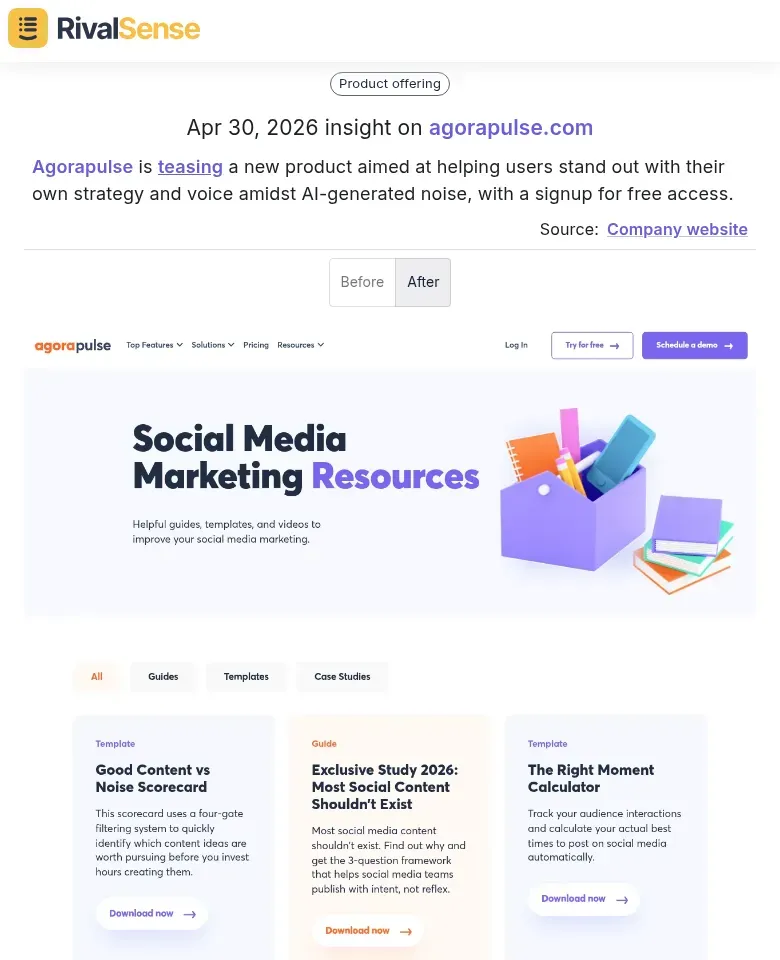
Also keep an eye out for product teasers – they can hint at a new direction before any official deal. For example, RivalSense surfaced that Agorapulse is teasing a new product aimed at helping users stand out with their own strategy and voice amidst AI-generated noise, with a signup for free access. That kind of alert gives you early intelligence on how a competitor plans to pivot.
Step 3: Analyze the Partnership's Strategic Impact
Once you've identified a competitor partnership, move beyond the announcement to assess its strategic weight. Use this three-part analysis:
1. Evaluate the Partner's Assets
- Market reach: Does the partner open new geographies, verticals, or customer segments for your competitor?
- Credibility: Is the partner a recognized authority? A tie-up with a trusted brand can boost your competitor's reputation.
- Complementary capabilities: Does the partnership fill a gap in your competitor's product or service? For example, a CRM integrating with an AI analytics tool creates a stronger combined offering.
2. Assess Impact on Your Positioning
- Customer value proposition: Does the partnership make your competitor's offer more compelling? Map your differentiators against the new combined value.
- Competitive moat: If the partner offers exclusive features or pricing, your competitor gains a unique advantage. Quantify the threat: will it affect churn or new logo wins?
3. Identify Threats & Opportunities
- Threats: Exclusive deals lock you out of key integrations. Watch for revenue-sharing models that incentivize the partner to favor your competitor.
- Opportunities: Look for partner gaps—segments or use cases the partnership doesn't cover. Can you partner with the same company on a different angle? Or target the partner's customers with a superior standalone solution?
Pro tip: Create a simple scorecard (1–5) for each dimension above. Compare scores across partnerships to prioritize your response efforts.
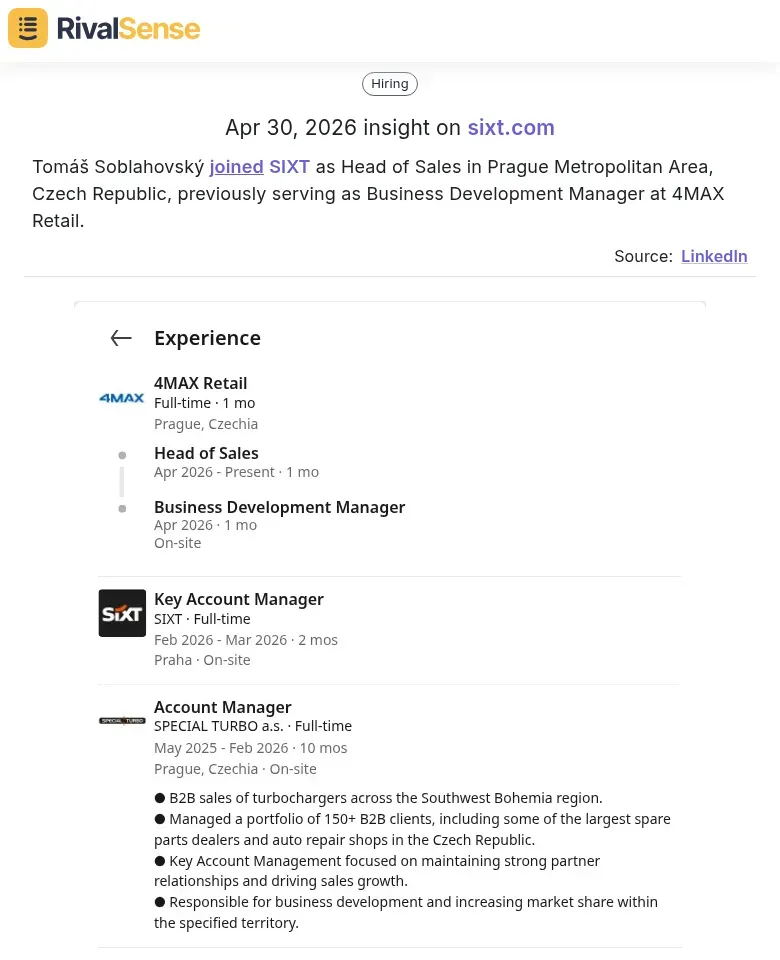
Beyond partnerships, keep an eye on key hires. A new executive can signal where a competitor is investing. For instance, RivalSense alerted that Tomáš Soblahovský joined SIXT as Head of Sales in Prague, previously Business Development Manager at 4MAX Retail. That move suggests SIXT is expanding its sales leadership in Central Europe – a potential market shift you need to track.
Step 4: React and Adapt Your Strategy
When a competitor announces a new partnership, your response should be deliberate, not reactive. Use this 3-step framework to decide your next move:
1. Assess the Threat Level
- Low threat: The partner doesn’t overlap with your target market or core offering. → Ignore and continue your current strategy.
- Medium threat: The partnership fills a gap they had, but you have alternatives. → Counter by strengthening your existing partner relationships (e.g., co-marketing campaigns, exclusive features) or pursuing alternative alliances that offer better terms.
- High threat: The deal directly challenges your unique value proposition or locks you out of a key channel. → Emulate by fast-tracking a similar partnership or differentiate by adjusting your messaging to highlight your unique strengths.
2. Action Checklist
- [ ] Schedule a partner strategy meeting within 48 hours.
- [ ] Reach out to your top 3 partners to reinforce alignment and explore joint initiatives.
- [ ] Update your competitive battle card with the new partnership details.
- [ ] Brief your sales team on how to address the partnership in conversations.
3. Adjust Your Roadmap
If the partnership creates new competitive pressure, consider:
- Accelerating features that directly compete with the combined offering.
- Adding integration support for the partner’s platform (if open) to neutralize exclusivity.
- Repositioning your product to emphasize areas where the competitor’s new alliance falls short.
Pro tip: Not every partnership warrants a response. If the deal doesn’t affect your core customer decision criteria, staying the course is often the smartest move. Save your resources for battles that matter.
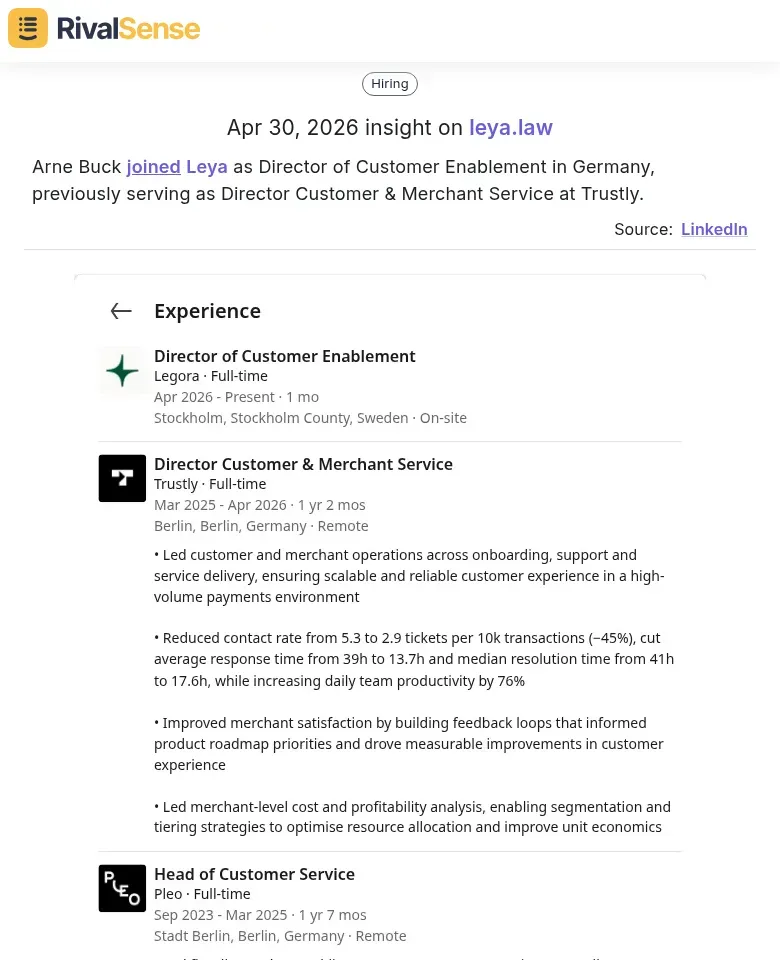
Similarly, a management change can require a strategic reaction. RivalSense spotted that Arne Buck joined Leya as Director of Customer Enablement in Germany, previously at Trustly. A new director focused on customer enablement suggests Leya is doubling down on post-sale success – you may need to reinforce your own customer health programs.
Step 5: Build a Continuous Monitoring Cadence
A one-time audit won’t cut it. Competitor partnerships evolve rapidly, so you need a rhythm that keeps your team alert without causing alert fatigue.
Set a Regular Review Schedule
- Weekly: Scan for new partnership announcements, press releases, and social media mentions. Use tools like Google Alerts, Crunchbase, or RivalSense to automate this.
- Monthly: Compile a brief competitive intelligence report highlighting the most impactful partnership moves. Share it with stakeholders.
- Quarterly: Conduct a deep-dive analysis of your top 3 competitors’ partnership strategies, noting shifts in their ecosystem.
Create a Cross-Functional Review Team
Involve representatives from product, sales, and marketing. Each brings a unique lens:
- Product: Assesses technical implications and integration opportunities.
- Sales: Identifies competitive positioning and deal risks.
- Marketing: Spots messaging changes and co-marketing plays.
Hold a 30-minute monthly sync to discuss findings, assign action items, and decide whether to escalate any alerts.
Iterate Your Checklist
Your monitoring checklist isn’t static. Every quarter, ask:
- Are we tracking the right partners? (Add new ones, drop irrelevant ones.)
- Are our alert sources still reliable? (Test and swap if needed.)
- What did we miss last quarter? (Update keywords and triggers.)
Pro Tip: Use a shared dashboard (e.g., Notion, Airtable) to log alerts, decisions, and follow-ups. This creates a living document that evolves with the market.
By building a cadence, you turn raw alerts into actionable intelligence—and stay ahead of your competitors’ next move.
Put It All Into Action
Partner alerts, product teasers, key hires – these signals are gold if you catch them early. But manually scanning dozens of sources is unsustainable. That’s why RivalSense tracks competitor product launches, pricing updates, event participations, partnerships, management changes, and media mentions across websites, social media, and public registries – and delivers a concise weekly report straight to your inbox.
Stop guessing what your competitors are up to. Try RivalSense for free and get your first competitor report today.
📚 Read more
👉 How a Competitor's Calendar Update Sparked a Strategic Pivot (Real Insight Inside)
👉 Track Competitor Market Cap Signals via Facebook: A Step-by-Step Guide
👉 How to Perform a Competitor SWOT Analysis in Nanotech
👉 Key Account Metrics from Competitor Events: A Cheat Sheet
👉 How a Single Product Page Update Revealed Sierra's Strategic Pivot