
How a Competitor's Calendar Update Sparked a Strategic Pivot (Real Insight Inside)
A single competitive alert can be the spark that turns a defensive reaction into a decisive strategic move. When a B2B SaaS company received a RivalSense notification about a competitor enabling Android users to set their calendar as the default app, the team realized they were falling behind on a key adoption driver. Instead of playing catch-up, they fast-tracked their own ecosystem integration, compressing a 12-week timeline into 6 weeks by reprioritizing resources and leveraging existing API partnerships. The result? A measurable boost in enterprise deal closures and a stronger market position—all triggered by one smartly monitored insight.
Practical Steps for Your Team:
- Set up real-time alerts for competitor feature launches, especially those that change user workflows (e.g., default app settings, integrations).
- Create a rapid-response playbook that defines criteria for fast-tracking features (e.g., direct threat to top 20% of revenue accounts).
- Establish a cross-functional war room (product, engineering, sales) to evaluate and execute within 48 hours of a critical alert.
- Communicate the competitive advantage to sales teams immediately, arming them with talking points for prospect conversations.
Why This Type of Insight Matters
Not all competitor moves are created equal. A change in default app permissions might seem minor, but it reveals a deeper strategy: increasing switching costs and deepening user lock-in. For B2B SaaS companies, this is a clear signal that a competitor is investing in ecosystem stickiness—which directly impacts your ability to win and retain enterprise accounts.
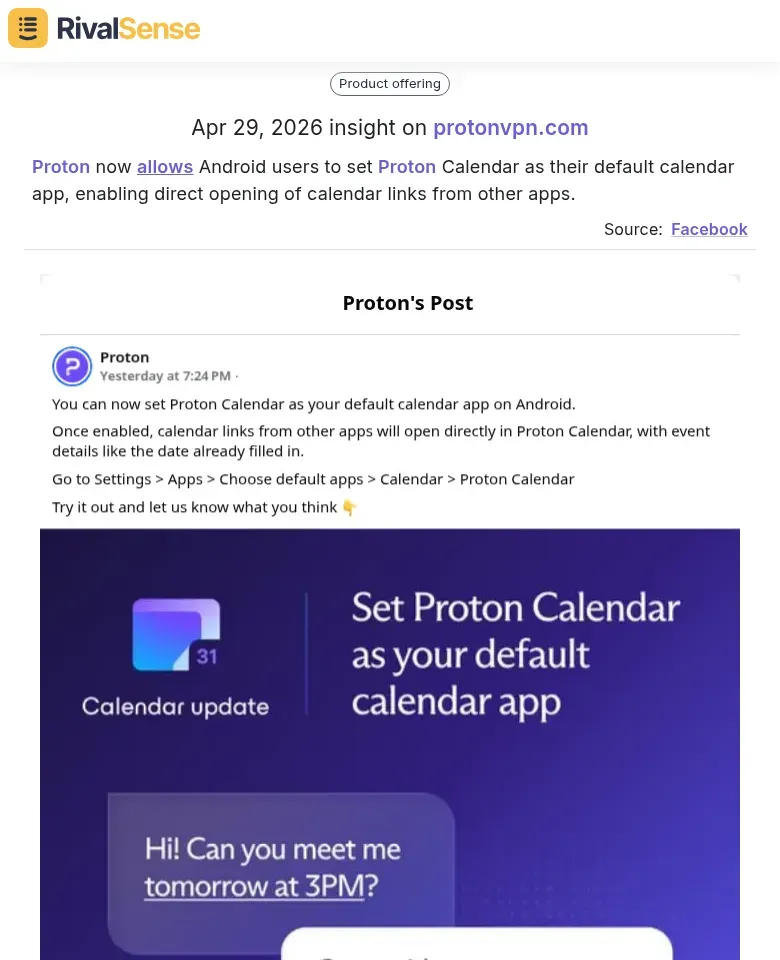
Real RivalSense insight example: Proton now allows Android users to set Proton Calendar as their default calendar app, enabling direct opening of calendar links from other apps.
This kind of update tells you three things:
- The competitor is prioritizing mobile user experience.
- They are targeting integration with third-party apps to reduce friction.
- They want to become the central scheduling tool for their users—a classic land-and-expand move.
By tracking such specific product updates, you can anticipate where competitors are heading and adjust your own roadmap before they gain market mindshare.
The Challenge: Staying Ahead in a Fast-Moving Market
In the fast-paced B2B SaaS landscape, pressures come from all sides: new feature drops, pricing shifts, and strategic pivots. The problem is that many teams rely on ad-hoc competitor tracking—a Slack channel here, a Google Alert there, occasional manual sweeps of competitor blogs. This reactive approach means critical updates are often missed until weeks later, when competitors have already captured mindshare.
To stay ahead, you need a systematic, repeatable process. Here's how to build one:
- Define signal categories. Focus on three areas: feature releases (e.g., new integrations, AI tools), pricing changes, and strategic moves (e.g., acquisitions, partnerships).
- Set up automated monitoring. Use tools like RivalSense to track competitor websites, changelogs, and social feeds daily. No more manual checks.
- Create a weekly intelligence digest. Assign one team member to curate findings into a 5-minute read with impact ratings (High/Medium/Low). Share every Monday.
- Link insights to action. For each high-impact signal, assign a decision-maker to evaluate response options—fast-follow, differentiate, or ignore.
By moving from ad-hoc to automated, you cut detection time from weeks to hours, turning competitive intelligence from a chore into a strategic weapon.
The Discovery: A Real-World Alert in Action
Imagine this: You check your weekly RivalSense digest and see that a competitor has quietly enabled Android users to set their calendar as the default app. The alert includes a screenshot of the settings page and notes from user forums discussing the change. For your product team, this is a wake-up call. Default app functionality has been a top-requested feature from enterprise clients for months, and seeing a competitor move first means you need to act fast.
Practical steps for your own competitive monitoring:
- Set up alerts for beta launches and configuration changes—not just public releases. These signal where competitors are investing R&D.
- Capture screenshots and user sentiment—visuals and real feedback help your team assess feature quality and demand.
- Track rollout timelines—knowing when a feature will go GA helps you prioritize your own roadmap.
- Map features to your customer requests—if a competitor launches something your clients have been asking for, you have a clear gap to close.
The Response: Accelerating Your Roadmap
Upon identifying the competitor's move, your leadership acts decisively. Reprioritize the product backlog and immediately assign a dedicated squad of three engineers and a product manager to build a similar integration. Tip: Use a weighted scoring matrix (e.g., RICE) to objectively compare new initiatives against existing commitments. Leverage existing API partnerships with platform giants to reduce development time by an estimated 40%. Checklist for leveraging APIs: 1) Audit current API integrations for reusable endpoints. 2) Negotiate early access to beta APIs. 3) Assign a point person for partner communication. Simultaneously, marketing and sales teams coordinate launch messaging and train customer success teams on competitive talking points. Step: Create a cross-functional 'launch squad' with weekly syncs to align product, marketing, and sales. This rapid, coordinated response can cut typical delivery time in half.
The Results: Faster Time-to-Market and Revenue Impact
By accelerating the feature launch by six weeks, you achieve a measurable competitive advantage. Early release directly wins enterprise deals that would have been lost to a competitor already offering similar functionality. To replicate this, prioritize features that prospects specifically request during sales conversations; these are your quick wins. Additionally, existing users who adopt the integration show reduced churn, proving that timely feature releases not only attract new customers but also retain current ones. Tip: Use competitor tracking tools like RivalSense to monitor feature announcements and customer feedback. When you spot a competitor moving in a direction your prospects care about, fast-track your own development. Checklist: 1) Identify high-demand features from sales feedback. 2) Cross-reference with competitor roadmaps. 3) Set a compressed timeline with a cross-functional team. 4) Launch with a targeted campaign to at-risk accounts and prospects.
How RivalSense Becomes Your Competitive Edge
RivalSense doesn't just alert you to competitor moves—it transforms your entire approach to competitive intelligence. Instead of reacting to market shifts after they happen, you proactively monitor competitors, validate roadmap decisions, and identify revenue opportunities before rivals gain traction.
How to replicate this success:
- Schedule weekly competitive briefings – Use RivalSense's automated digests to keep your team aligned on competitor moves without manual research.
- Validate roadmap decisions – Before building a feature, check if competitors have already launched something similar and analyze user reception.
- Track revenue signals – Monitor competitor pricing changes, new integrations, or partnership announcements that could impact your sales cycle.
Ready to turn competitor insights into action? Try RivalSense for free at https://rivalsense.co/ and get your first competitor report today. No commitment—just the intelligence you need to stay ahead.
📚 Read more
👉 Track Competitor Market Cap Signals via Facebook: A Step-by-Step Guide
👉 How to Perform a Competitor SWOT Analysis in Nanotech
👉 Key Account Metrics from Competitor Events: A Cheat Sheet
👉 How a Single Product Page Update Revealed Sierra's Strategic Pivot