
Master Pricing Insights: Key Account Models for Competitive Edge
Pricing isn't just a number—it's a strategic signal. Every price change your competitor makes reveals their priorities: Are they chasing market share with aggressive discounts? Signaling premium quality with a price hike? Or testing willingness to pay with tiered plans? Understanding these moves directly impacts your customer acquisition, retention, and profitability.
Why this matters now: In today's volatile markets, pricing intelligence is your early warning system. A sudden price drop from a rival might indicate they're losing customers or launching a new product. A price increase could mean they're confident in their value proposition—or desperate to cover rising costs.
Practical steps to get started:
- Set up automated tracking for competitor pricing pages and press releases. Tools like RivalSense can alert you to changes in real time.
- Categorize each move—is it a permanent shift, a limited-time promo, or a bundle deal? Context is key.
- Map pricing to positioning. A freemium model suggests a land-and-expand strategy; usage-based pricing hints at targeting high-volume users.
Pro tip: Don't just react. Use pricing insights to anticipate industry shifts. If multiple competitors move to subscription models, the market is signaling a preference for recurring revenue. Adjust your strategy before you're left behind.
Tiered Pricing Adjustments: Segmenting Customers for Maximum Impact
Tiered pricing adjustments let you fine-tune revenue without alienating your core base. For example, a SaaS platform might reduce rates for high-balance tiers (e.g., accounts over $10k) while keeping entry-level prices unchanged. This protects mass-market users and tests price sensitivity in premium segments.
A real-world example of tiered rate adjustments comes from the fintech space. Revolut recently reduced interest rates on Instant Access Savings for Standard, Plus, Metal, and Ultra plans (balances above £200,000) by 0.1% AER, while Premium and Ultra (up to £200,000) rates remained unchanged. This type of competitive insight is valuable because it reveals how a rival is subtly adjusting value across customer segments—signaling where they see pricing power and where they're trying to retain mass-market users. You can use such intelligence to audit your own tier structure and identify opportunities to optimize margins without triggering backlash.
Steps to implement:
- Segment by value – Group customers by usage, balance, or lifetime value (e.g., Bronze/Silver/Gold).
- Target selectively – Adjust pricing for one tier at a time. Start with the highest-value segment to maximize impact.
- Communicate clearly – Explain changes as “rewards for loyalty” or “optimized plans.” Use emails or in-app messages to reinforce fairness (e.g., “Gold members now save 15%”).
Checklist for success:
- [ ] Define clear tier criteria (e.g., monthly spend > $1k).
- [ ] Run A/B tests on one tier before rolling out.
- [ ] Monitor churn and adoption rates per segment.
Pro tip: Use tier-specific landing pages or dashboards to make customers feel the change is personalized. This boosts perceived value and reduces friction. By adjusting rates per tier, you optimize revenue while maintaining trust across all segments.
Shifting from Broad Incentives to Targeted Support
To maximize incentive ROI, shift from blanket discounts to targeted support programs. Start by segmenting your user base using behavioral data—identify power users (e.g., top 20% by transaction volume) and high-quality merchants (e.g., low churn, high LTV). Replace broad fee waivers with tiered benefits: offer dedicated account management, reduced transaction fees, or early access to new features only to these segments.
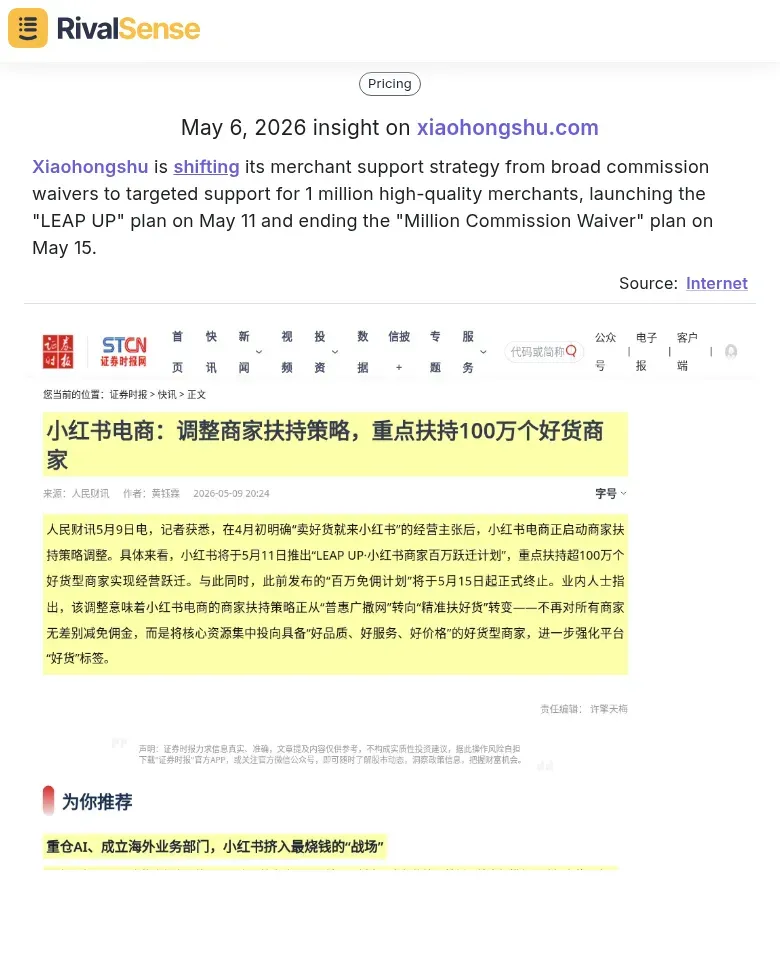
A notable shift in this direction comes from Xiaohongshu (Little Red Book), which is moving from broad commission waivers to targeted support for 1 million high-quality merchants. They launched the "LEAP UP" plan on May 11 and ended the "Million Commission Waiver" plan on May 15. Tracking such strategic pivots is critical for B2B leaders because it signals a maturing marketplace—your competitors are optimizing incentives for retention and high LTV. You can benchmark your own incentive structure against this trend to avoid leaving money on the table.
Practical steps:
- Audit current incentives – list all discounts and waivers, calculate total cost, and measure impact on retention and revenue.
- Define targeting criteria – use metrics like monthly active usage, average order value, or referral rate.
- Launch a pilot program – roll out targeted support to a small group (e.g., 5% of users) and compare churn and engagement against a control group.
- Communicate changes clearly – explain to affected users why they qualify for enhanced support, and to others why broad waivers are ending (e.g., to invest in better features).
Expect short-term churn from low-value users, but track cohort retention over 6 months—quality segments typically show 20–30% higher lifetime value. This transition signals market maturity and strengthens ecosystem health.
Leveraging Promotional Multipliers to Drive Engagement
To maximize engagement, apply time-limited multipliers (e.g., 3X or 4X rewards) to specific user segments. This creates urgency and drives immediate action. Tip: Use countdown timers in your app or email to reinforce scarcity.
A prime example comes from Rockstar Games, which offers 3X RDO$, Gold, and XP for the Naturalist role in Red Dead Online, plus 4X RDO$ and XP in Naturalist Free Roam Events and 3X Rewards on the Featured Series. Understanding how competitors use multipliers to boost engagement with specific features or roles can inspire your own promotional tactics—especially if you're a B2B platform looking to drive adoption of underused capabilities.

Steps to implement:
- Identify underused features or roles – e.g., a rarely used reporting module or a specific job title like “Analyst.”
- Set a multiplier window – Keep it short (48–72 hours) to sustain urgency.
- Promote via targeted channels – Email, in-app banners, or Slack notifications for B2B.
Checklist for success:
- [ ] Define clear start/end times
- [ ] Track redemption rates per segment
- [ ] A/B test multiplier levels (2X vs. 4X)
For dual engagement, offer multipliers on both currency (e.g., credits) and experience points (e.g., badges). This appeals to both transactional and status-driven users. Example: A SaaS platform gave 3X credits and 3X XP for completing a demo request, resulting in a 40% lift in demo submissions and a 25% increase in feature adoption among dormant users.
Lessons for Your Pricing Strategy: Actionable Frameworks
1. Treat competitor pricing moves as signals, not templates. When a rival shifts prices, audit your own tier structure. Ask: Does our value ladder still align with customer segments? Use a simple checklist:
- [ ] Are our tiers differentiated by clear feature/usage increments?
- [ ] Do lower tiers serve as entry points, not value traps?
- [ ] Can customers easily upgrade as they grow?
2. Balance short-term promos with long-term value. Discounts can spike conversions but erode perceived worth. Instead of blanket cuts, try:
- Time-bound bundles (e.g., “Add premium support for 30 days free”).
- Usage-based credits (e.g., “Get $50 credit when you refer a colleague”).
- Annual commitment perks (e.g., two months free) to lock in loyalty.
3. Monitor customer reactions to competitor changes. Use social listening, review sites, and support tickets to spot unmet needs. For example, if users complain about a rival’s price hike, survey your own base: “What would you pay for [feature X]?” This reveals pricing gaps you can fill with a new tier or add-on.
Pro tip: Set up a monthly “pricing pulse” meeting to review competitor moves, customer sentiment, and tier performance. Small, data-driven tweaks beat big, reactive overhauls.
Conclusion: Building a Sustainable Competitive Edge Through Pricing Intelligence
In a dynamic market, pricing is never a set-and-forget lever. Continuous competitive pricing analysis is essential to stay ahead. To build a sustainable edge, integrate pricing insights with broader market research—combine competitor price changes with feature updates, customer sentiment, and market trends for a holistic strategy.
Practical Steps:
- Set up automated tracking – Use tools like RivalSense to monitor competitor price changes, discounting patterns, and packaging shifts in real time. This frees your team from manual data collection.
- Establish a review cadence – Weekly check-ins on pricing alerts, monthly deep dives into competitive positioning.
- Cross-functional alignment – Share insights with product, sales, and marketing teams to inform feature prioritization and campaign messaging.
- Test and iterate – Run A/B tests on price adjustments based on intelligence, measuring impact on conversion and retention.
Checklist for Success:
- [ ] Automated competitor price tracking active
- [ ] Pricing insights integrated into monthly strategy reviews
- [ ] Clear escalation path for significant competitor moves
By leveraging automation, you shift from reactive firefighting to proactive strategy—turning pricing intelligence into your competitive moat.
Ready to start tracking competitor pricing moves like these? Try RivalSense for free at rivalsense.co and get your first competitor report today.
📚 Read more
👉 Why Tracking Leadership Changes Is a Competitive Intelligence Must-Have
👉 How to Track Competitor Glassdoor Reviews: A Practical Guide for Competitive Intelligence
👉 CRM Workflow for Key Account Tracking in Marine Port Services
👉 How Databricks’ EHR Deal Reveals a Gap in Your Competitive Strategy