
How Databricks’ EHR Deal Reveals a Gap in Your Competitive Strategy
When Databricks announced its EHR partnership with Redox in early 2026, competitors like Snowflake and AWS were caught off guard. The deal—integrating Databricks’ Unity Catalog with Redox’s clinical data streaming—wasn't a direct competitive move in the analytics space; it was a strategic pivot into healthcare infrastructure. Yet it immediately reshaped the competitive landscape, forcing rivals to scramble for their own healthcare footholds.
This blindside reveals a critical flaw in most competitive strategies: they focus too narrowly on direct competitors and existing product categories. Databricks’ signal was hiding in plain sight—in adjacent industry moves, healthcare conference keynotes, and partner ecosystem shifts. Traditional competitor tracking, which monitors press releases and product launches, would have missed it entirely.
Practical steps to avoid this blind spot:
- Map adjacent industries where your tech stack could apply (e.g., analytics → healthcare, fintech).
- Monitor partner ecosystems—Databricks’ EHR deal started with a partnership with Redox, a healthcare data platform, long before the news broke.
- Track talent moves—hiring healthcare domain experts often precedes industry pivots.
- Set up alerts for cross-industry signals using tools like RivalSense to catch non-obvious moves.
By expanding your competitive radar beyond the obvious, you turn surprises into foresight.
The Competitive Blind Spot: What RivalSense Uncovered
Most competitive intelligence tools track press releases, funding rounds, and product launches. But they miss the quiet, strategic moves that signal a company’s true direction. Databricks’ partnership with Redox didn’t come out of nowhere—it was the culmination of months of subtle signals: new healthcare-focused job postings, partnerships with health systems, and a sudden uptick in mentions of FHIR standards in their documentation. Standard tools would have caught the deal only after the press release went out.
RivalSense, however, flagged the pattern early by monitoring these secondary signals—job descriptions, partner announcements, and technical blog content—and alerting you weeks before the news broke. The insight below is exactly the kind of alert that would have put you ahead:
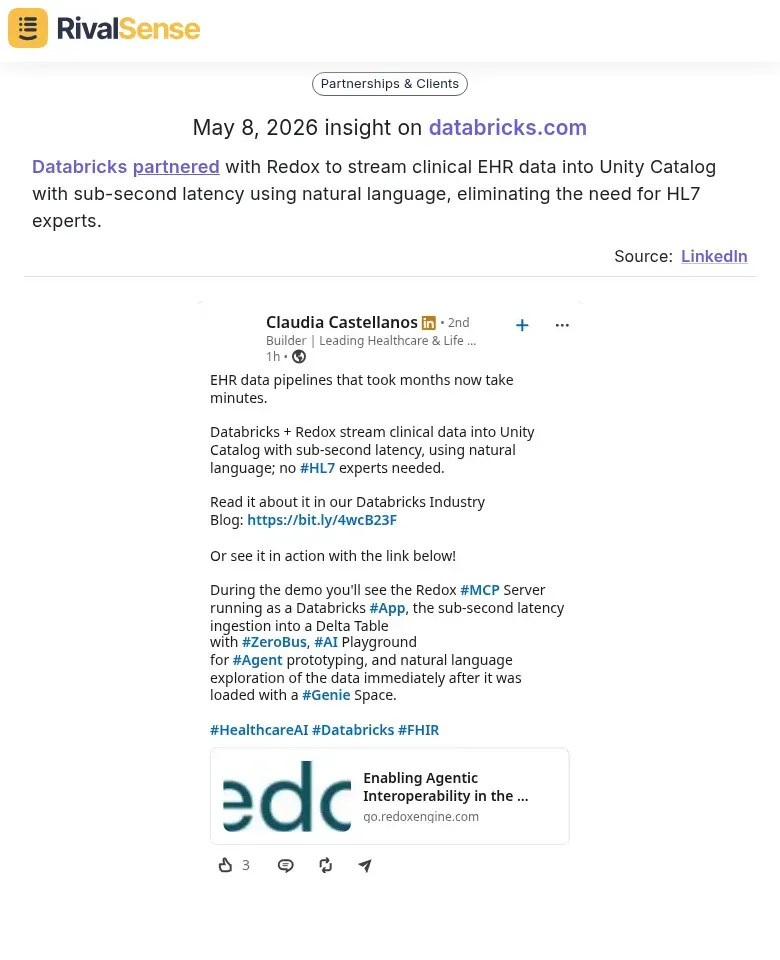
Why this insight matters for your strategy: Partnership insights reveal how competitors are extending their ecosystem—often a leading indicator of market expansion. When Databricks partners with a clinical data platform like Redox, it signals an intent to own healthcare data pipelines, not just analytics. For a B2B founder, this means you should assess whether your product’s integration strategy is keeping pace, or if you need to forge similar alliances to stay relevant.
Practical steps to catch these signals:
- Expand your signal sources – Don’t rely solely on news alerts. Monitor job boards, partner pages, and developer docs.
- Set up keyword clusters – Track not just company names but also domain-specific terms (e.g., “EHR,” “HIPAA,” “health data lake”).
- Use automated alerts with context – RivalSense groups related signals into a single alert, so you see the pattern, not just isolated events.
By catching these early signals, you can prepare your competitive response before the market shifts.
Strategic Implications for Your Business
Databricks’ EHR deal underscores a critical blind spot: the assumption that your competitors stay within your industry. Cross-industry moves are increasingly common as data-rich companies seek new revenue streams. To avoid being caught off guard, you must expand your competitive monitoring beyond direct rivals.
The Risk of Tunnel Vision
Focusing solely on direct competitors leaves you vulnerable to disruptors from adjacent or unrelated sectors. A healthcare analytics firm might not see Databricks as a threat—until it offers a unified data platform that renders their niche solution obsolete.
How to Broaden Your Radar
- Map adjacent industries: Identify sectors with overlapping data, technology, or customer needs.
- Monitor funding and partnerships: Track where venture capital flows and who partners with whom across industries.
- Set up alerts for cross-industry signals: Use tools like RivalSense to track mentions of your domain in earnings calls, press releases, and job postings from non-traditional players.
Proactive Response Framework
- Early detection: When you spot a cross-industry entrant, assess their core competency and how it maps to your value chain.
- Scenario planning: Run war games to model how their move could reshape the market.
- Strategic pivots: Use insights to adjust your roadmap—e.g., doubling down on vertical-specific features or forming defensive alliances.
Checklist for Your Next Review
- [ ] List top 5 companies from adjacent industries with relevant capabilities.
- [ ] Set up monitoring for each (product launches, hiring, patents).
- [ ] Schedule quarterly cross-industry threat assessments.
By expanding your competitive aperture, you turn surprises into strategic opportunities.
RivalSense in Action: From Alert to Actionable Insight
When Databricks announced its Redox partnership, RivalSense users didn’t just get a notification—they got a competitive edge. Here’s how the workflow turns signals into strategy:
1. Detection – RivalSense scans thousands of sources (press releases, job postings, product pages, social media) in real time. For Databricks, it flagged the Redox partnership within minutes of the announcement, categorizing it under “Strategic Partnerships” and “Healthcare.”
2. Analysis – The tool enriches alerts with context: competitor positioning, market impact, and related signals (e.g., new healthcare job listings). Users see a concise summary, sentiment analysis, and links to original sources. Tip: Set custom keywords like “EHR,” “healthcare AI,” or “Databricks” to filter noise.
3. Reporting & Integration – Insights flow into a real-time dashboard, where teams track shifts across competitors. Users can tag alerts to strategic initiatives (e.g., “Healthcare Go-to-Market”) and export reports for leadership. Checklist for action:
- [ ] Map the signal to your product roadmap
- [ ] Assign a team member to monitor follow-up moves
- [ ] Update competitive battle cards
By integrating RivalSense into weekly strategy reviews, teams move from reactive alerts to proactive planning—turning a competitor’s move into your next opportunity.
Key Takeaways for Competitive Strategy
-
Expand Your Competitive Set – Don’t just track direct rivals. Map adjacent players (e.g., EHR vendors, cloud platforms) that could disrupt your market. Action step: Create a “competitive adjacency matrix” listing companies in neighboring verticals and assess their expansion potential quarterly.
-
Leverage AI-Driven Monitoring for Early Warnings – Manual tracking misses signals. Use AI tools (like RivalSense) to monitor job postings, partnership announcements, and product launches across your expanded set. Tip: Set up alerts for keywords like “healthcare AI” or “enterprise data platform” to catch moves before they hit the news.
-
Build a Culture of Continuous Competitive Awareness – Competitive intelligence isn’t a one-off project. Embed it into weekly stand-ups and quarterly reviews. Checklist: Assign a CI champion, share a weekly “competitive radar” email, and run a monthly “what if” scenario planning session (e.g., “What if Databricks acquires a health-tech startup?”).
By broadening your lens, automating detection, and making CI a habit, you’ll spot gaps—and opportunities—before your competitors do.
Conclusion: Stay Ahead with RivalSense
Competitive blind spots like Databricks’ EHR deal can derail even the best strategies. RivalSense ensures you never miss a critical move—tracking product launches, partnerships, and market shifts in real time. Our AI-powered alerts surface actionable insights, from pricing changes to executive hires, so you can react faster.
Try RivalSense for free today at https://rivalsense.co/ and get your first competitor report. Don’t let another signal slip by—turn competitor noise into strategic advantage.
📚 Read more
👉 Boost Key Account Wins with Internet Competitor Insights
👉 2026 SaaS Automation Benchmarking Report: Key Account Tracking Insights
👉 How to Use Competitive Intel for Successful Market Entry
👉 Real-World Competitor Analysis: Tracking Product Additions
👉 Key Account Sales Tracking: The Metrics That Actually Move the Needle