
Boost Key Account Wins with Internet Competitor Insights
In account-based selling, winning key accounts often hinges on understanding not just your customer, but also their competitive landscape. Monitoring competitor activities online provides real-time intelligence that lets sales teams anticipate customer needs, preempt objections, and position solutions with precision. By tracking three insight types—events (product launches, webinars), organizational changes (hires, partnerships), and financial signals (funding rounds, earnings calls)—you can tailor outreach that resonates. Practical tip: Set up Google Alerts for your top 5 competitors and key accounts to receive daily digests. Then, before each key account meeting, scan the latest alerts to identify recent competitor moves that might influence your customer's priorities. This habit ensures you walk in armed with context that builds credibility and accelerates deal velocity.
Spotting Competitor Events and Trade Show Presence
Tracking where your competitors exhibit or speak reveals their strategic priorities and target audiences. A competitor suddenly sponsoring a fintech conference? They’re likely chasing financial sector deals. This type of insight helps you align your messaging with the exact pain points your prospects are hearing about from rivals.
How to gather intel:
- Monitor competitor websites, press releases, and social media for event announcements.
- Use tools like RivalSense to automatically track event participation and booth themes.
- Scan session agendas—are they pushing a new product feature or a specific industry vertical?
What to analyze:
- Booth themes: A focus on “AI-driven automation” signals a product pivot.
- Speaker topics: If they’re talking about “cost optimization,” they may be targeting budget-conscious buyers.
- Audience engagement: Heavy networking at a compliance event suggests they’re solving regulatory pain points.
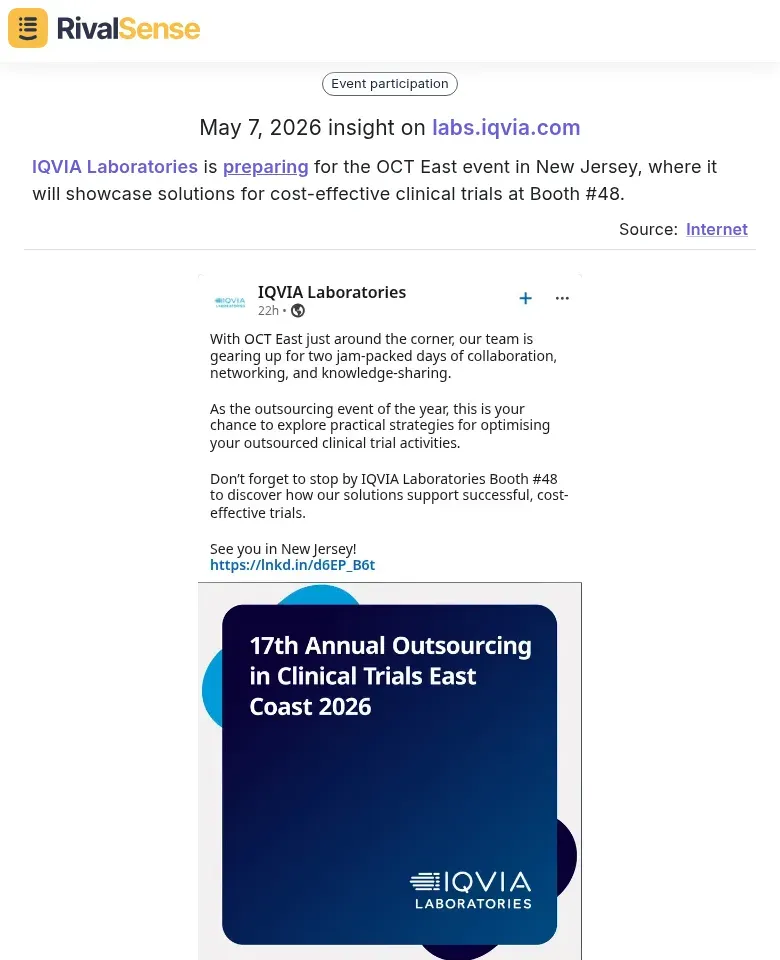
Real-world example: IQVIA Laboratories is preparing for the OCT East event in New Jersey, where it will showcase solutions for cost-effective clinical trials at Booth #48. Knowing this, you can prepare your sales team to discuss how your offering delivers even greater cost savings or addresses limitations the competitor’s booth might gloss over.
Turn insights into action:
- Position your solution as the superior alternative. If they emphasize “speed,” you counter with “accuracy + speed.”
- Prepare your sales team with talking points that highlight gaps in the competitor’s event messaging.
- Attend the same events (or similar ones) to engage prospects directly, armed with knowledge of what competitors are pitching.
Pro tip: Create a simple event tracker spreadsheet with columns for event name, competitor booth theme, session topics, and key takeaways. Review monthly to spot shifts in focus areas before your key accounts do.
Decoding Organizational Restructuring and Talent Moves
Organizational restructuring—layoffs, acquisitions, office openings—offers a window into competitors' strategic priorities and vulnerabilities. Understanding these moves is critical because they directly affect your key accounts' perception of stability and innovation.
How to act on these signals:
- Monitor job boards and LinkedIn for sudden hiring spikes or layoff announcements. Use tools like RivalSense to track changes in headcount by department.
- Analyze acquisition news—does the target bring new tech or talent? If a competitor buys a voice-AI firm, expect a voice-enabled product soon.
- Map office openings to geographic expansion plans. A new R&D hub in your region could mean a future competitive threat.
- Create a restructuring watchlist for top competitors. Note each event, its likely impact, and assign a risk score (1–5) for your key accounts.
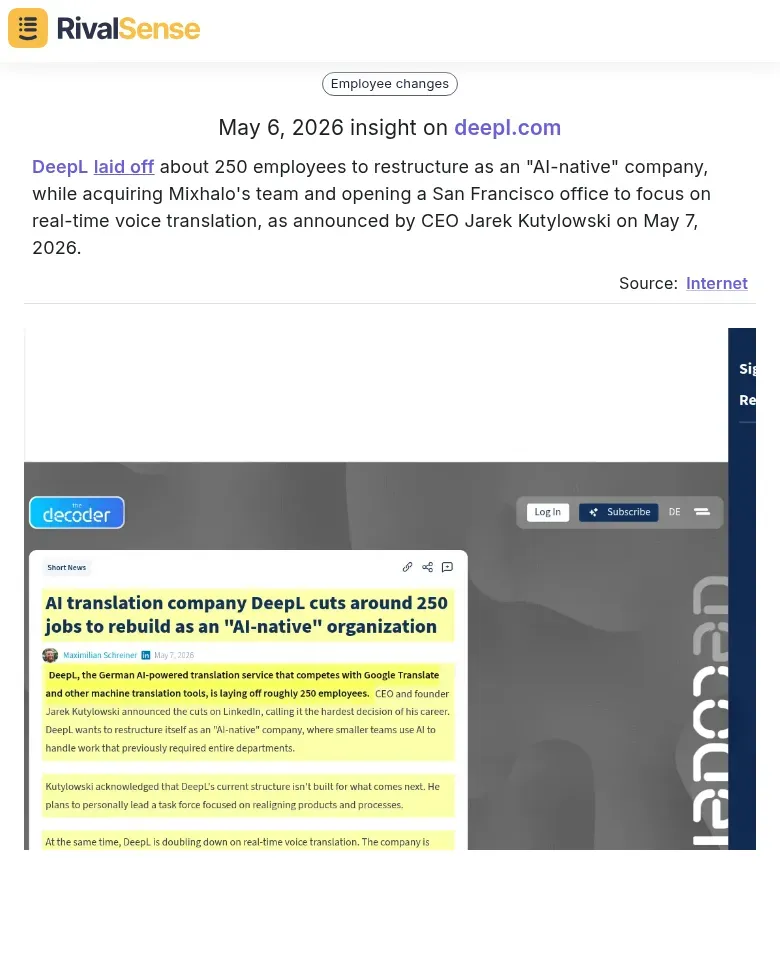
Real-world example: DeepL laid off about 250 employees to restructure as an "AI-native" company, while acquiring Mixhalo's team and opening a San Francisco office to focus on real-time voice translation, as announced by CEO Jarek Kutylowski on May 7, 2026. This signals a pivot toward voice AI — you can anticipate upcoming product features and proactively address any customer concerns about your own voice capabilities.
Pro tip: When a competitor lays off sales staff, reach out to affected reps—they may bring account intelligence or even become future hires.
Mining Earnings Calls and Financial Reports for Strategic Clues
Earnings calls and financial reports are goldmines for competitive intelligence. They reveal not just past performance but also forward-looking strategy. Financial signals — like revenue guidance shifts — help you anticipate competitor pricing moves or investment priorities before they become public.
Practical Steps:
- Listen to conference calls – Focus on CEO/CFO commentary about challenges, priorities, and strategic shifts. Phrases like "investing in R&D" or "expanding into verticals" hint at future moves.
- Analyze financial ratios – Compare gross margins, CAC payback, and revenue per employee. A competitor with rising margins but flat revenue may be optimizing for profitability, not share gain.
- Create a scorecard – Track 5–7 key metrics (e.g., ARR growth, churn rate, operating margin) quarterly. Highlight outliers—they often signal a strategic pivot.
Real-world example: QuinStreet will report Q3 2026 earnings on May 7, 2026, with a conference call at 5:00 PM ET, expecting revenue of $336.22 million and EPS of $0.32. Knowing these expectations allows you to benchmark your own performance and prepare counter-messaging if their results beat or miss projections.
Pro Tip: Use a simple red/yellow/green rating for each metric relative to industry benchmarks. This instantly shows where you lead or lag.
By systematically mining these reports, you’ll uncover strategic clues—like a competitor’s shift to enterprise sales or a new pricing model—before they hit the market.
Turning Insights into Account-Specific Action Plans
Once you've gathered competitive intelligence, the real value lies in applying it to specific key accounts. Start by mapping competitor moves—such as product launches, pricing changes, or leadership shifts—to each account's unique context. Identify risks (e.g., a competitor's new feature that directly threatens your value prop) and opportunities (e.g., a competitor's service outage that erodes trust).
Craft tailored messaging that highlights competitor weaknesses. For example, if a competitor struggles with customer support, position your account management as a key differentiator. Use a simple matrix: for each account, list competitor weaknesses, your corresponding strengths, and a specific message to test.
Time your outreach around competitor events. If a competitor announces a price hike, reach out with a cost-saving alternative. If they release a buggy update, offer a seamless migration path. Use a calendar to track competitor webinars, earnings calls, and product launches.
Actionable checklist:
- [ ] For each key account, list top 3 competitor moves affecting them.
- [ ] Identify 1-2 competitor weaknesses to exploit.
- [ ] Draft 3 messaging variations tied to those weaknesses.
- [ ] Set reminders for competitor events and schedule outreach 48 hours after.
Building a Sustainable Competitive Intelligence Workflow
To build a sustainable competitive intelligence workflow, start by automating monitoring. Use tools like Google Alerts, Crunchbase, or RivalSense to track competitor events, news, and financial updates. Set up keyword alerts for product launches, funding rounds, leadership changes, and earnings calls. Aggregate feeds into a centralized dashboard (e.g., Slack, Notion) for real-time visibility.
Next, distill raw data into digestible briefs. Create a standardized template: one-page summaries covering competitor moves, implications for your accounts, and suggested actions. Assign a CI lead to curate weekly digests for sales and account teams. Include a "so what" section—e.g., "Competitor X launched a discount for healthcare verticals; proactively offer bundled pricing to your top 5 healthcare accounts."
Finally, measure impact. Track win rates for accounts where CI was used vs. those without. Use CRM tags to log CI-informed actions. Run quarterly reviews: compare account growth, retention, and deal velocity. Adjust your workflow based on what drives wins. A simple checklist: (1) Monitor daily, (2) Brief weekly, (3) Review monthly, (4) Refine quarterly. This loop turns intelligence into a repeatable advantage.
Putting these insights into practice consistently is challenging without the right tools. Try RivalSense for free and get your first weekly competitor report today — automatically tracking events, restructuring, financial signals, and more across your competitive landscape.
📚 Read more
👉 2026 SaaS Automation Benchmarking Report: Key Account Tracking Insights
👉 How to Use Competitive Intel for Successful Market Entry
👉 Real-World Competitor Analysis: Tracking Product Additions
👉 Key Account Sales Tracking: The Metrics That Actually Move the Needle
👉 How to Predict Your Competitors' Next Content Moves (and Win in App Dev)