
How to Track Competitor Glassdoor Reviews: A Practical Guide for Competitive Intelligence
Glassdoor reviews are a goldmine of competitive intelligence. They reveal your competitors' internal struggles, cultural shifts, and strategic priorities — often months before they become public. But manually scraping reviews every week is tedious and noisy. Here's a practical system to track competitor Glassdoor reviews efficiently, with actionable steps and tips.
Why Track Competitor Glassdoor Reviews?
- Early warning signals: A sudden spike in negative reviews often precedes leadership changes, layoffs, or product pivots.
- Cultural insights: Understand how competitors treat employees — this impacts their ability to hire top talent.
- Strategic clues: Reviews mentioning "restructuring," "new management," or "burnout" can hint at internal turmoil.
- Benchmarking: Compare your own Glassdoor rating against competitors to gauge employer brand strength.
Step-by-Step: How to Track Competitor Glassdoor Reviews
Step 1: Identify Your Key Competitors
List 3–5 direct competitors. Focus on those you compete with for customers and talent.
Step 2: Set Up Manual Monitoring (Quick Start)
- Bookmark each competitor's Glassdoor page.
- Schedule a 15-minute weekly review block.
- Note: Overall rating trend, recent review volume, recurring themes (e.g., "management," "work-life balance").
Step 3: Automate with AI (Recommended)
Use an AI tool like Claude to generate a monthly competitor review report. Here's a simple workflow:
- Collect reviews: Copy recent Glassdoor reviews (last 30 days) for each competitor.
- Feed into AI: Paste into Claude with this prompt:
"Summarize these Glassdoor reviews for [Competitor Name]. Give me: (1) a one-paragraph synopsis of overall sentiment, (2) top 3 notable trends, (3) 2–3 specific quotes or insights worth paying attention to."
- Review output: Spend 5 minutes reading the AI summary.
Pro tip: Don't try to track everything. Focus on the top 2–3 insights per competitor. Noise kills actionability.
Step 4: Integrate into a Broader Competitive Intelligence System
Glassdoor is just one signal. For a complete picture, you need to track:
- Product launches and updates
- Pricing changes
- Event participations
- Partnerships
- Management changes
- Media mentions
This is where a tool like RivalSense comes in. RivalSense automatically tracks 80+ sources — including company websites, social media, news, and registries — and delivers a weekly email report with the most important updates on your competitors. No manual scraping, no noise. Just the signals that matter.
Putting It All Together: Real-World Examples from RivalSense
Tracking Glassdoor alone gives you only part of the story. When you combine employee sentiment with other signals, you uncover powerful strategic insights. Here are three real examples RivalSense detected that show how different data points connect:
🌿 Eventbrite's Shift to Nature-Focused Local Events
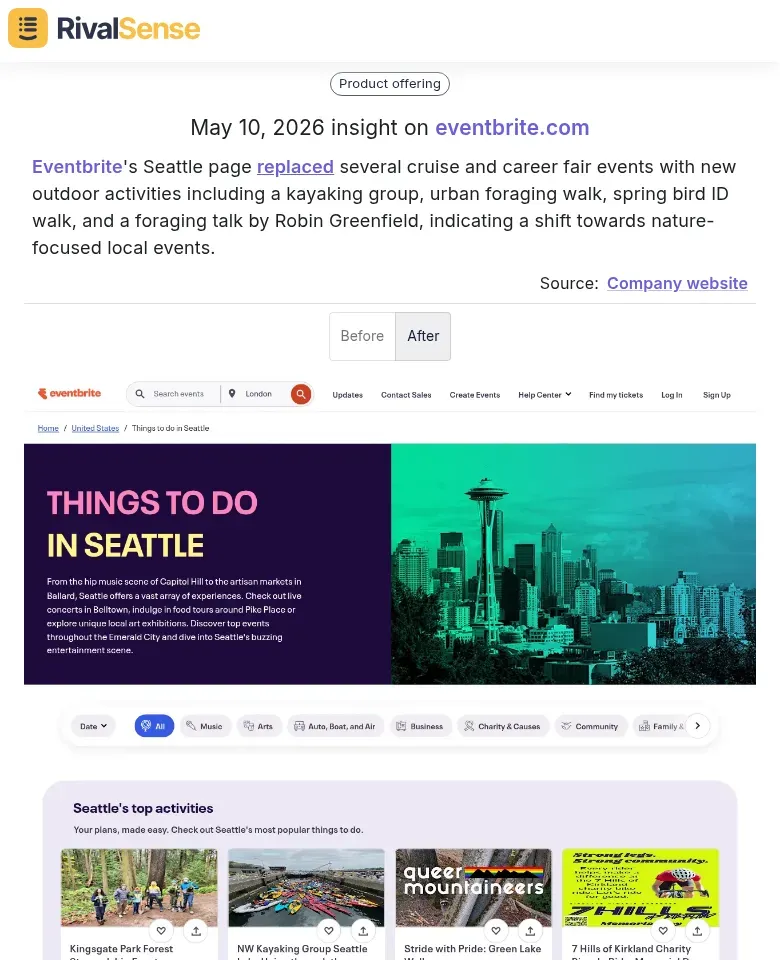
RivalSense spotted that Eventbrite's Seattle page replaced several cruise and career fair events with new outdoor activities including a kayaking group, urban foraging walk, spring bird ID walk, and a foraging talk by Robin Greenfield. This indicates a strategic shift towards nature-focused local events.
Why this matters for your strategy: If your competitor is pivoting their event offerings, you might see changes in their hiring (e.g., need for outdoor event specialists) or customer base. Combining this with Glassdoor reviews about "new direction" or "exciting changes" can confirm the strategy is real — and help you decide whether to follow, counter, or avoid that niche.
🎨 Canva's Template Library Becomes a Marketplace
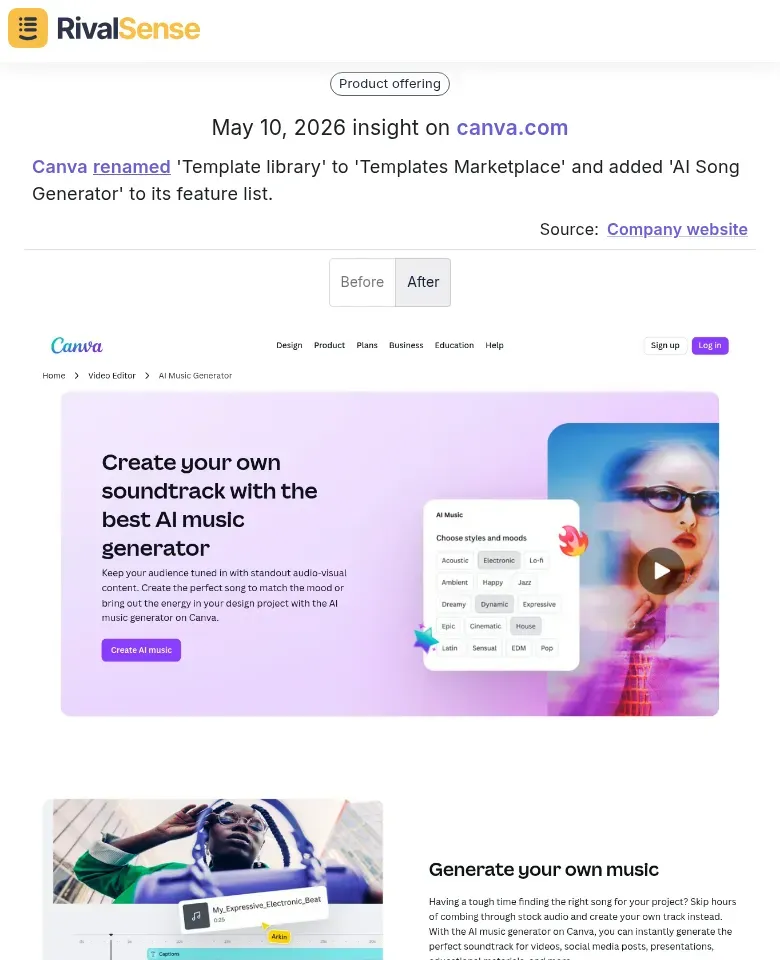
RivalSense detected that Canva renamed 'Template library' to 'Templates Marketplace' and added 'AI Song Generator' to its feature list. A simple naming change and feature addition can signal a broader monetization or product evolution strategy.
Why this matters for your strategy: Product naming changes often reflect internal prioritisation. If you see a positive Glassdoor trend about "innovation" or "new features," this external change validates that employees are bought in. Conversely, negative reviews about "constant changes" could indicate confusion. Spotting this early lets you adjust your own product roadmap or marketing messaging.
🗺️ Google Maps Launches Immersive Navigation
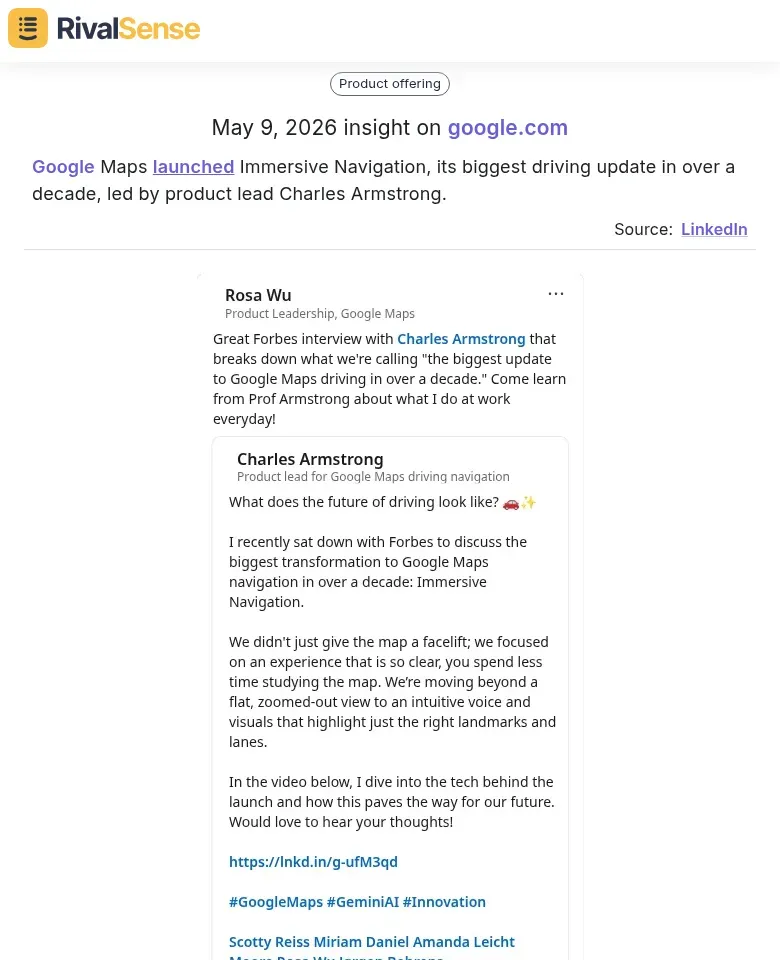
RivalSense captured that Google Maps launched Immersive Navigation, its biggest driving update in over a decade, led by product lead Charles Armstrong. This is a major product launch that will impact user experience and competitive dynamics.
Why this matters for your strategy: Major product launches often follow — or cause — internal culture shifts. If your competitor's Glassdoor reviews mention "exciting projects" or "new leadership" just before a launch, you know their talent is motivated. If reviews mention "burnout" after a launch, you can anticipate retention problems. Combine this signal with product updates to predict your competitor's next moves.
These examples show why tracking multiple sources — not just Glassdoor — gives you a 360-degree view. RivalSense does this automatically, so you never miss a critical signal.
Checklist: Your Monthly Competitor Review Routine
- [ ] Pull recent Glassdoor reviews for each competitor (or let RivalSense do it)
- [ ] Run AI summary (or read manually)
- [ ] Note any rating changes of 0.5 stars or more
- [ ] Identify 1–2 actionable insights (e.g., "Competitor X is losing engineers — poach them")
- [ ] Share findings with your team (keep it under 5 minutes)
Common Mistakes to Avoid
- Tracking too many competitors: Stick to 3–5. More creates noise.
- Reading every review: Skim for patterns, not details.
- Ignoring your own Glassdoor: Your reviews are just as important — monitor them too.
- Not acting on insights: A signal is useless if it doesn't inform a decision.
Final Tip: Combine Glassdoor with Other Signals
Glassdoor reviews are most powerful when combined with other data points. For example:
- A dip in Glassdoor rating + a sudden executive departure = serious trouble at a competitor.
- Positive reviews about "new product direction" + a product launch announcement = validate their strategy.
By setting up a simple tracking system — whether manual, AI-assisted, or using a dedicated tool like RivalSense — you'll turn competitor Glassdoor reviews from noise into a strategic advantage.
Ready to automate competitor tracking across Glassdoor, product updates, pricing, and more? Try RivalSense for free and get your first competitor report today. No login required — just insights in your inbox.
📚 Read more
👉 CRM Workflow for Key Account Tracking in Marine Port Services
👉 How Databricks’ EHR Deal Reveals a Gap in Your Competitive Strategy
👉 Boost Key Account Wins with Internet Competitor Insights
👉 2026 SaaS Automation Benchmarking Report: Key Account Tracking Insights