
Advanced Media Monitoring Tactics for Key Account Growth
Media monitoring is often mistaken for simple brand tracking—a passive scan for mentions. But for key account growth, it must be a proactive intelligence tool. Advanced monitoring uncovers strategic signals: a competitor's new feature launch, a shift in pricing, or a C-suite hire at your target account. These signals let you anticipate needs and outmaneuver rivals.
Key accounts demand tailored intelligence. Generic alerts won't cut it. Instead, build a custom monitoring framework around three pillars:
- Competitor Benchmarks: Track competitor product updates, funding rounds, and customer wins. Use tools like RivalSense to compare feature sets and pricing changes weekly.
- Key Account Events: Monitor job changes, earnings calls, and press releases. A new VP of Sales might signal a shift in procurement strategy.
- Competitor Playbooks: Analyze competitor content, webinars, and case studies to reverse-engineer their sales tactics.
Practical Tip: Create a shared dashboard for your account team with real-time alerts. Set up filters for each key account's industry and top competitors. Review weekly to identify expansion opportunities.
By shifting from reactive monitoring to strategic intelligence, you'll spot growth triggers before competitors do—and turn insights into revenue.
Leveraging Competitor Benchmarks to Quantify Industry Shifts
To quantify industry shifts, leveraging published benchmarks can reveal market trends and performance standards. Benchmark insights are valuable because they help you identify where your key accounts are falling behind and where they can leap ahead of competitors.
Take the Gelato 2026 AI Quoting Benchmark, which quantifies the shift from press speed to system integration. CEO Henrik argues for horizontal automation across procurement, production, and logistics.
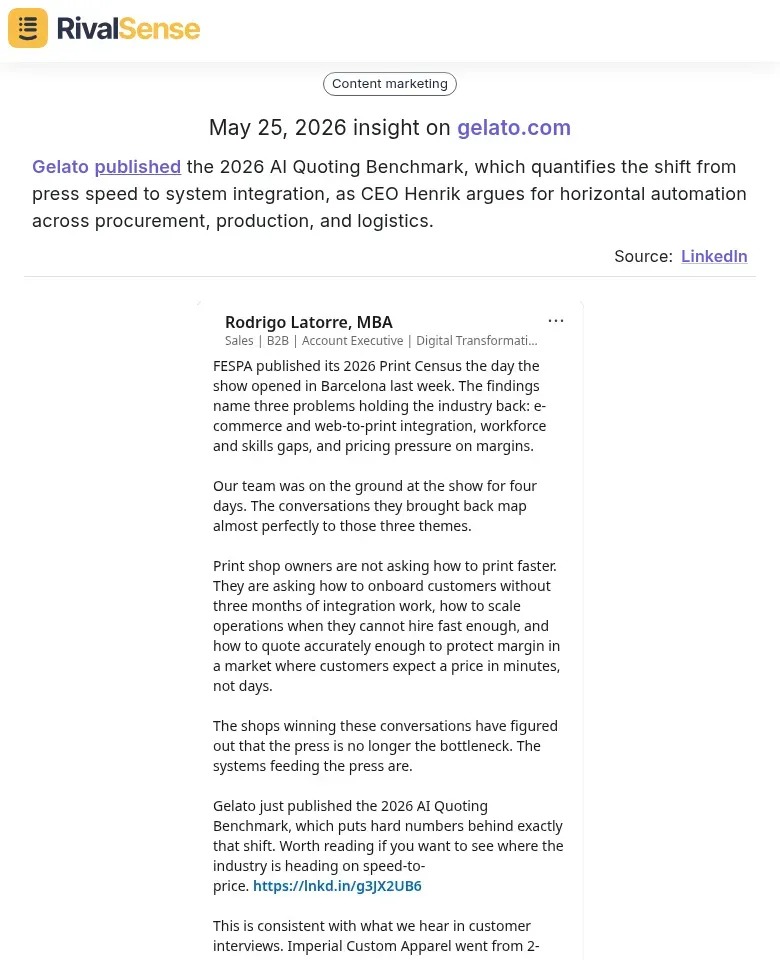
By studying such benchmarks, you can spot gaps in your key accounts' operations. If their quote turnaround lags behind the industry average, you can propose automation solutions that address the full workflow, not just isolated steps.
Actionable steps:
- Select 3–5 relevant benchmarks (e.g., quoting speed, integration coverage)
- Gather data from public reports or tools like RivalSense
- Analyze gaps between your key account's performance and the benchmark
- Propose targeted solutions (e.g., horizontal automation)
- Track improvement over time
Pro tip: Create a quarterly benchmark report for each key account and schedule a review meeting to discuss gaps—this positions you as a strategic advisor, not just a vendor.
Extracting Strategic Insights from Competitor Events and Keynotes
Competitor events and keynotes are goldmines for strategic intelligence. They reveal where rivals are investing and how they're positioning themselves for the future. Paying attention to event messaging helps you decode your competitor's target buyer and risk angle.
For example, Miro's Canvas26 event highlighted that AI's future is about turning individual productivity gains into organizational outcomes to accelerate time-to-market and de-risk competitive bets.
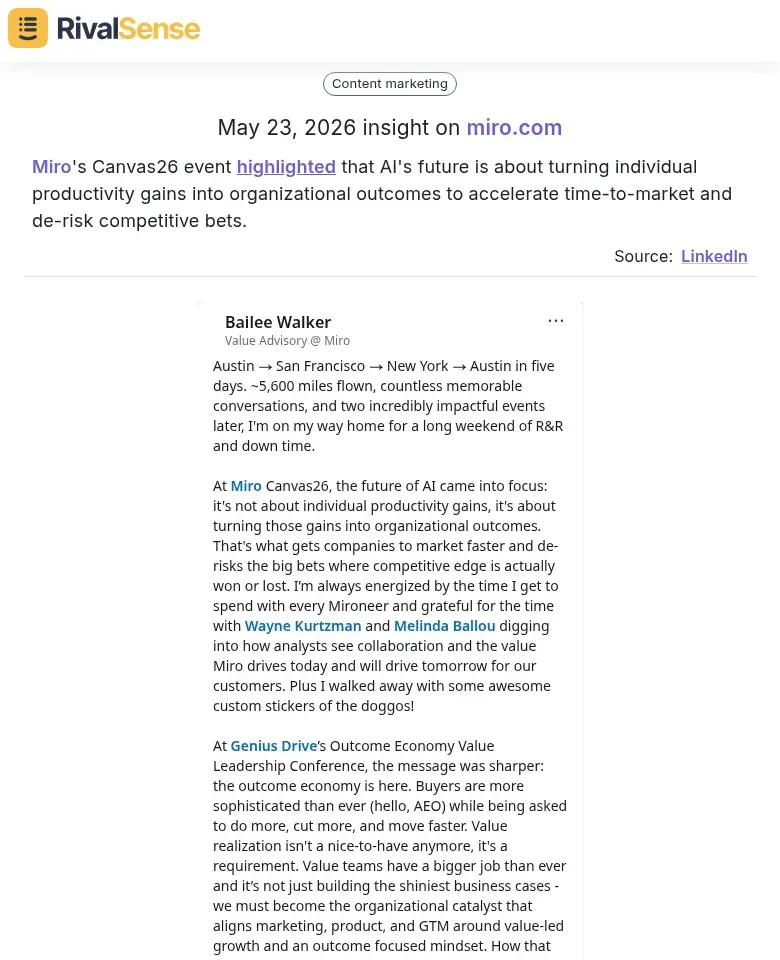
Why does this matter for your strategy? It signals that Miro is targeting enterprise buyers (VPs and C-suite) with a value proposition focused on organization-wide impact and risk reduction. If your key account is considering Miro-like solutions, you can counter with messaging around your own organizational velocity or risk mitigation.
How to extract actionable insights:
- Map the messaging shift: from individual productivity (e.g., “save 2 hours”) to organizational outcomes (e.g., “reduce time-to-market by 30%”)
- Decode risk reduction framing: note how competitors position compliance, security, or lock-in risks
- Create a competitive event tracker with a simple table:
| Theme | Key Metric | Risk Angle | Target Persona |
|---|---|---|---|
| AI for org outcomes | Accelerate time-to-market | De-risk competitive bets | VP, CTO |
Use this tracker to align your messaging with key account priorities. If a prospect mentions “we need to cut compliance risk,” you can directly reference how your solution addresses that—backed by competitor intelligence.
Pro tip: Record keynotes and use AI transcription to search for specific phrases like “time-to-value” or “risk mitigation.” This surfaces subtle shifts before they become public narratives.
Adapting Competitor Playbooks for Your Key Account Strategy
Competitor playbooks show you exactly how rivals structure campaigns around major events. By reverse-engineering their tactics, you can create localized versions for your key accounts—strengthening your relationship and demonstrating deep industry knowledge.
Consider Hostaway's playbook for vacation rental property managers to maximize bookings and revenue during the 2026 FIFA World Cup across 3 countries and 16 host cities.
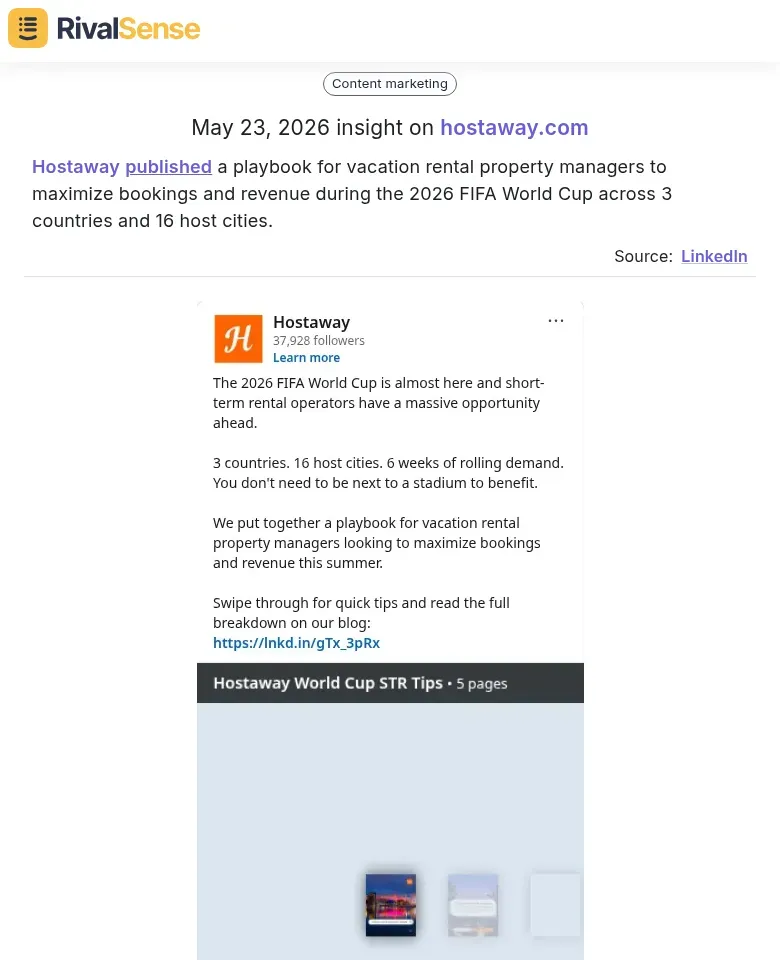
This type of insight is valuable because it reveals the segments, timing, and offers your competitor is using. You can adapt it to your own key account's context—for instance, if a competitor creates a “World Cup Special” for sports retailers, you could develop a “Regional Tournament Bundle” with tailored pricing and support.
Checklist for adapting playbooks:
- Identify upcoming events relevant to your key account's industry
- Analyze competitor campaigns for those events (use RivalSense to track announcements)
- Brainstorm localized offers or content (e.g., guide, bundle, webinar)
- Draft a timeline for outreach (pre-event, during, post-event)
- Execute and track engagement (opens, replies, conversions)
Pro tip: Send a personalized playbook to each key account, outlining how you can help them capitalize on the event. This proactive approach shows you understand their market and are invested in their success.
Building a Systematic Media Monitoring Framework
To build a systematic media monitoring framework, start by configuring alerts for three critical signal types: competitor benchmarks, event announcements, and published playbooks. Use tools like Google Alerts, Feedly, or RivalSense to track these across news, blogs, and social channels.
Next, categorize insights by strategic themes that align with your key account goals:
- Technology shifts: Track competitor R&D moves, patent filings, or platform updates
- Customer education: Monitor how competitors explain value (new guides, tutorials)
- Operational efficiency: Spot process innovations or cost-saving claims
Finally, integrate monitoring outputs directly into account planning and quarterly business reviews (QBRs). Create a shared dashboard or weekly digest that highlights top signals per account. During QBRs, reference specific media findings to justify upsell recommendations or risk mitigation strategies.
Pro tip: Assign a “signal owner” per account to ensure insights are actioned, not just collected.
Conclusion: Turning Insights into Account Growth
Consistent monitoring is your early warning system for expansion opportunities. When a competitor launches a new feature, drops a client, or shifts strategy, you can act first.
To turn insights into growth:
- Create a weekly intelligence brief for each key account. Highlight 1–2 competitor moves and your recommended response.
- Use a simple scoring system (e.g., 1–5) to prioritize opportunities by revenue potential and urgency.
- Schedule monthly reviews with account teams to track which actions were taken and their outcomes.
Measure what matters:
- Track account revenue growth vs. prior periods
- Monitor retention rates for accounts where intelligence-driven actions were applied
- Log each recommendation and its result (e.g., upsell, renewal, churn avoided)
Pro tip: Build a shared dashboard that links competitor alerts to account health scores. When a competitor loses a key client in your account's industry, trigger a proactive outreach campaign within 48 hours.
By systematically converting competitor signals into stakeholder recommendations, you shift from reactive monitoring to proactive growth. The result? Stronger relationships, higher retention, and measurable revenue impact.
Want to supercharge your media monitoring without the manual grind? Try RivalSense for free at https://rivalsense.co/ – we track competitor product launches, pricing updates, events, partnerships, and more, delivering a weekly report straight to your inbox. Get your first competitor report today and start turning insights into growth.
📚 Read more
👉 Uncovering Competitor Moves: How a Documentation Overhaul Signals Strategic Shift
👉 Key Account Management Webinar: Turning Insights into Retention & Growth
👉 Telemedicine Competitor Tracking Cheat Sheet
👉 How a Rival Caught Amazon's Shift from Retail to Space
👉 Advanced Tactics: Mining Internet Data for Competitor & Key Account Insights