
Key Account Manager Responsibilities: Actionable Telecom Strategies
In telecom, rapid tech shifts (5G, IoT, SD-WAN), high churn rates (averaging 20-30% annually), and complex B2B sales cycles make account retention a formidable challenge. Key Account Managers (KAMs) are the linchpin: they protect high-value accounts, reduce churn, and drive revenue growth. In a saturated market, KAM performance directly fuels competitive advantage. Here’s how to make KAMs your strategic weapon.
Practical Steps for Telecom KAMs:
- Conduct quarterly business reviews (QBRs) – Align your solutions with clients’ evolving needs (e.g., migrating to 5G or reducing latency).
- Map stakeholder influence – Identify decision-makers, users, and champions within each account to tailor engagement.
- Create an early-warning system – Monitor usage drops, support ticket spikes, or competitor activity (use tools like RivalSense) to proactively intervene.
- Develop co-innovation roadmaps – Propose joint pilots for new tech (e.g., private 5G networks) to deepen stickiness.
Quick Checklist for Reducing Churn:
- [ ] Track NPS score monthly per account.
- [ ] Automate renewal reminders 90 days before expiry.
- [ ] Offer exclusive beta access to upcoming features.
By embedding these practices, KAMs transform from order-takers to growth partners, directly enhancing your competitive edge.
Core Responsibilities of a Telecom Key Account Manager
-
Build & Nurture Executive Relationships
- Schedule quarterly business reviews (QBRs) with C-level contacts (CTO, CIO, Head of Digital).
- Tip: Use a CRM to track personal milestones (birthdays, work anniversaries) and send handwritten notes or relevant industry articles to strengthen rapport.
-
Develop Strategic Account Plans
- Align plans with clients’ strategic goals (e.g., digital transformation, cost reduction) and telecom trends (5G, SD-WAN, edge computing).
- Checklist: SWOT analysis of client’s current telecom setup; 12-month roadmap for upgrades; risk mitigation for vendor lock-in or regulatory changes.
-
Identify Cross-Sell & Upsell Opportunities
- Map client’s current services against emerging needs: IoT for asset tracking, cloud connectivity for hybrid work, managed security for cyber threats.
- Action step: Run a “service gap analysis” during QBRs. Present an ROI calculator showing cost savings or revenue uplift from adding a new service (e.g., shifting from MPLS to SD-WAN).
-
Monitor Competitive Landscape
- Use competitor tracking tools (e.g., RivalSense) to alert clients about competitor moves (new pricing, product launches) and position your solutions proactively.
-
Drive Contract Renewals & Expansion
- Start renewal discussions 6 months in advance. Bundle renewal with a new service trial to increase retention and reduce churn.
Actionable Telecom-Specific Strategies for KAMs
1. Leverage Network Usage Data for Personalization
Start by integrating analytics from network performance and usage patterns. Action step: Create a dashboard tracking metrics like data consumption spikes, latency issues, and dropped calls per account. Use this to recommend targeted upgrades—e.g., if a client’s video conferencing traffic surges, propose dedicated bandwidth or SD-WAN optimization. Tip: Set up automated alerts for anomalies so you can proactively offer solutions before the client notices the problem.
2. Proactive Account Reviews with Technical Roadmaps
Schedule quarterly business reviews (QBRs) that combine commercial updates with your telecom provider’s technical roadmap. Checklist for QBRs:
- Present upcoming network expansions (e.g., new 5G small cells)
- Share planned spectrum acquisitions or RAN upgrades
- Discuss sunset timelines (e.g., 3G phase-out) and migration paths
- Align their growth plans with your infrastructure investments
3. Co-Innovate Through Joint Business Plans (JBPs)
Formulate JBPs that go beyond procurement. Step-by-step:
- Identify a client’s strategic initiative (e.g., smart factory rollout)
- Map relevant 5G/edge capabilities (private network, MEC)
- Define success metrics (e.g., 30% latency reduction)
- Assign joint resources for a pilot project
Pro tip: Use innovation workshops to brainstorm use cases like AR-assisted maintenance or autonomous logistics. Fund a proof-of-concept jointly; this deepens trust and creates stickiness for your telecom services.
Leveraging Competitive Intelligence for Account Retention
To retain key accounts in telecom, competitive intelligence must be a real-time, actionable discipline. Start by monitoring competitor pricing, contract terms, and new service launches using tools like RivalSense. Set up alerts for changes and maintain a competitive tracking dashboard.
Here’s how specific types of intelligence—caught by RivalSense—can directly sharpen your account defense:
-
Regulatory & Technology Transitions
Knowing when a network sunset or compliance shift is coming lets you advise clients preemptively.
Example: AddSecure released a guide for security professionals on preparing for the shutdown of RTC, 2G, and 3G networks.
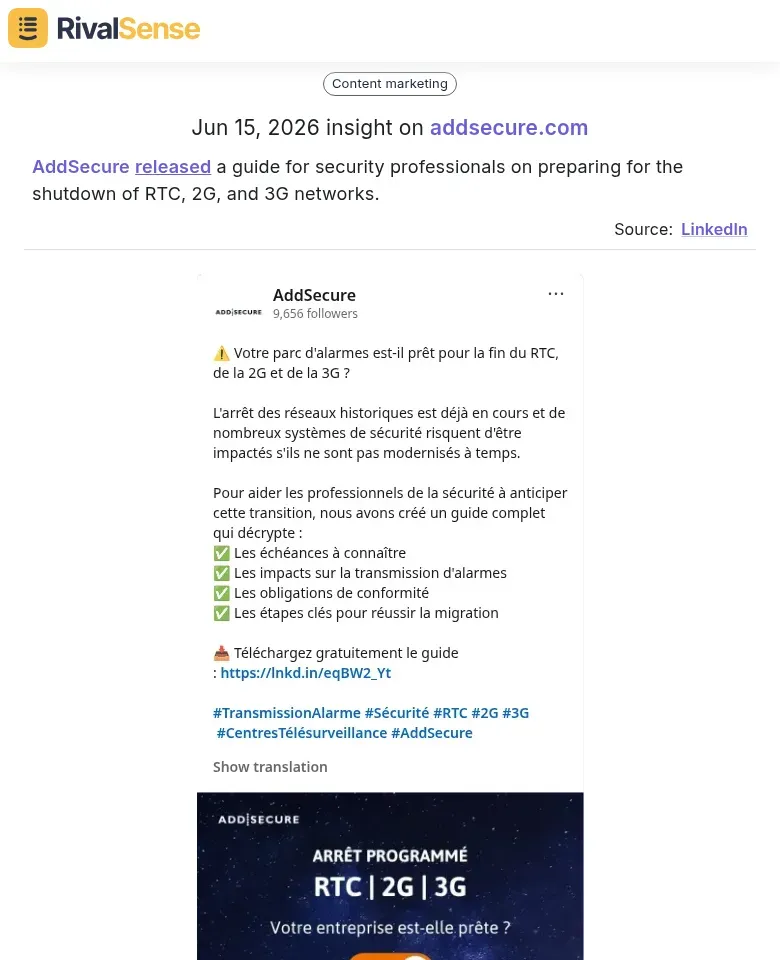
Value: Insight like this helps KAMs initiate migration conversations before clients are forced to react, positioning you as a strategic partner. -
Product & Partnership Launches
Competitor product drops or ambassador collaborations can signal new bundling strategies or market-share grabs.
Example: Hublot unveiled new watches including collaborations with ambassadors Kylian Mbappé and Usain Bolt, plus the Classic Fusion Titanium Retroverse.

Value: Seeing partnership trends early allows KAMs to build counter-narratives or even propose matching alliance opportunities for their own telecom services. -
Management Changes
A new sales director or C-suite hire often signals a shift in competitor strategy or geographic focus.
Example: David Douglas joined Adobe as Sales Director US West & Canada: State | Province | Local Government, previously Director of Sales: U.S. West & Western Canada at Rimini Street.
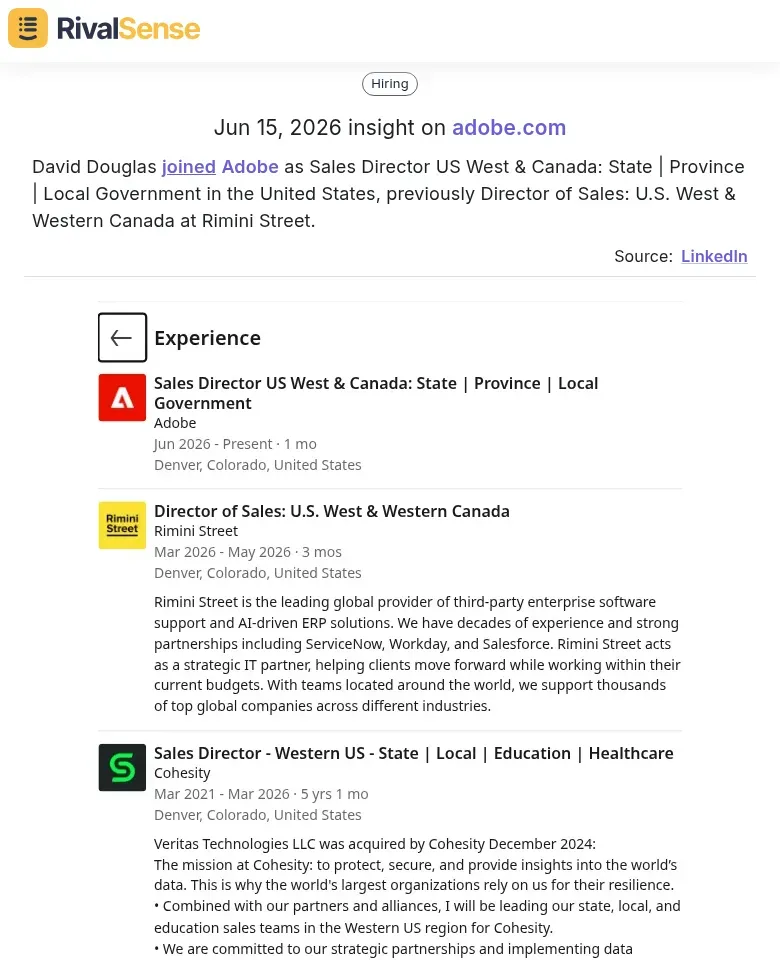
Value: If a rival brings on a heavy-hitter in a region where you hold key accounts, you can tighten relationships and offer retention incentives before they get poached.
Practical Integration Checklist:
- [ ] Set up a competitive tracking dashboard with fields: offer name, price, effective date, source.
- [ ] Conduct bi-weekly win/loss analysis on RFPs and renewals—categorize losses by reason (price, features, relationship).
- [ ] Before each client meeting, ask: “What competitor offers did you evaluate?” and log responses in CRM.
- [ ] Create a “Competitive Brief” for each key account—a one-page PDF summarizing recent competitor moves relevant to that client, updated monthly.
Train your KAMs to gather intelligence during every interaction and immediately log it. Pair data from RivalSense alerts with direct client validation to turn competitive signals into retention plays.
Tools, Metrics, and Performance Optimization
To excel as a Key Account Manager in telecom, you need the right toolkit. Start with a CRM like Salesforce to centralize client interactions, integrate CPQ for accurate quoting, and a telecom-specific analytics platform (e.g., Amdocs or Celona) to monitor network usage and customer health.
Track these KPIs:
- Net Revenue Retention (NRR): Measures revenue growth from existing accounts (expansion minus contraction). Target >100%.
- Account Health Score: Composite of product usage, support tickets, and sentiment. Use a 0–100 scale where <50 signals risk.
- Churn Rate: Percentage of accounts lost. Keep below 5% annually.
Performance Optimization Checklist:
- Monthly audits: Compare your Account Plan against recent market shifts (new competitors, regulatory changes). Ask: “What changed in the last 30 days?”
- Competitor tracking: Use RivalSense to monitor competitor product launches or pricing moves. Update account risks in your CRM.
- Quarterly health reviews: Flag accounts with declining health scores (e.g., <60) for immediate intervention with tailored retention offers.
Pro tip: Automate alerts when competitor mentions spike (e.g., via Google Alerts) to stay ahead. Pair data with human insight—call key contacts to validate your assumptions before adjusting the plan.
Conclusion: Future-Proofing Your Telecom KAM Strategy
The telecom landscape is evolving fast, and so must your KAM strategy. Three trends are reshaping the field: AI-driven churn prediction, automated account insights, and ecosystem partnerships.
Action Steps for Telecom Leaders:
- Empower with data: Equip KAMs with AI tools that flag at-risk accounts and suggest next-best actions. Integrate CRM, billing, and network data into a single dashboard.
- Invest in training: Shift KAMs from order-takers to strategic advisors. Provide workshops on consultative selling, financial acumen, and ecosystem mapping.
- Build cross-functional support: Create rapid-response teams (product, support, finance) dedicated to key accounts. Weekly syncs ensure KAMs can resolve issues fast.
Checklist for Tomorrow’s KAM:
- [ ] Use churn prediction models to prioritize account touchpoints.
- [ ] Automate routine reporting to free up time for high-value conversations.
- [ ] Map each account’s ecosystem—partners, suppliers, competitors—to uncover expansion opportunities.
In a commoditized market, KAMs who act as strategic advisors—armed with real-time insights and cross-functional backing—will drive loyalty and revenue. Start today by piloting one AI tool and one cross-functional team. The future of telecom account management is proactive, predictive, and partnership-driven.
🕵️♂️ See how competitor moves could affect your key accounts before your clients do. Try RivalSense for free and get your first actionable competitor report today: https://rivalsense.co/
📚 Read more
👉 How One Competitor Used RivalSense to Respond to Nextiva's Pricing Shift
👉 5 Competitor Intelligence Mistakes That Undermine Key Account Sales – And How to Fix Them
👉 Data-Driven Meeting Insights for Monitoring Key Account Growth
👉 The Webinar Competitive Intelligence Playbook: Uncover New Features, AI Upgrades & Ecosystem Shifts
👉 How Trimble’s Product Expansion Reveals 3 Competitor Moves You Can Act On Today