
5 Competitor Intelligence Mistakes That Undermine Key Account Sales – And How to Fix Them
Competitor intelligence isn’t just about knowing your rivals’ prices or product features—it’s about anticipating their strategic moves before they impact your key accounts. Yet many sales teams make critical mistakes that leave them blind to creeping threats. Here are five common mistakes and how to fix them, featuring real-world examples tracked by RivalSense.
Mistake #1: Overlooking Profitability Metrics in Favor of Top-Line Revenue
When a competitor misses revenue targets, it’s tempting to assume they’re vulnerable. But top-line revenue misses can mask underlying profitability improvements that signal strategic strength. For instance, a competitor reporting flat revenue but rising earnings per share (EPS) is likely executing cost controls and efficiency gains—moves that could fund aggressive pricing or enhanced service levels for your shared key accounts.
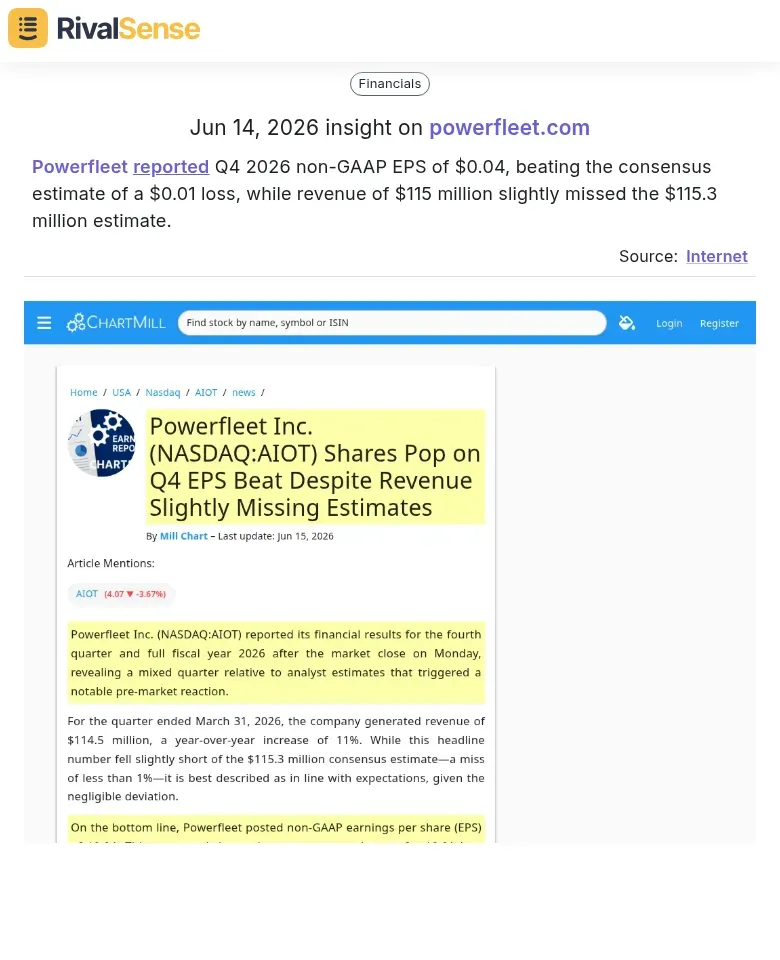
A real-world example from RivalSense: Powerfleet’s Q4 2026 earnings beat EPS estimates ($0.04 vs. an expected $0.01 loss) even though revenue of $115 million barely missed the $115.3 million consensus. This kind of insight is invaluable—it prevents you from writing off a competitor based solely on a top-line miss when they’re quietly getting stronger operationally.
What to watch instead:
- Track gross margin and operating margin trends over the last 4–8 quarters.
- Compare EPS surprises (beats vs. misses) alongside revenue surprises.
- Analyze the ratio of SG&A expense to revenue—declining suggests automation or scale benefits.
Practical steps for your team:
- Set up automated alerts for quarterly earnings releases of your top 5 competitors.
- Build a simple dashboard tracking revenue, COGS, operating income, and net income per competitor.
- Ask: “Is the competitor investing in growth (rising R&D, higher capex) or cutting costs to protect margins?”
Checklist for quarterly competitor review:
- [ ] Revenue growth (%) vs. industry average
- [ ] Gross margin trend (up, flat, down)
- [ ] Operating margin trend
- [ ] EPS growth vs. revenue growth
- [ ] Key expense line changes (R&D, SG&A, capex)
Don’t let a revenue miss blind you to a competitor who’s quietly getting stronger where it matters most for your key accounts.
Mistake #2: Failing to Analyze Trends and Forward Guidance
Many sales teams fixate on a single quarter’s data, mistaking a snapshot for a trend. A competitor that had a strong quarter may be losing momentum year-over-year, while a seemingly weak quarter could signal strategic investment rather than decline. Real competitor strength—or vulnerability—emerges only when you connect the dots across time.
Consider another Powerfleet insight from RivalSense: fiscal 2026 revenue hit $443.8M, up 22% YoY, with adjusted EBITDA surging 44% to $97M. More telling, the company guided fiscal 2027 revenue to $485–$490M with higher margins. This multi-quarter trajectory and forward guidance reveal a competitor accelerating profitability and expansion—early intelligence that lets you anticipate where they’ll invest next and which accounts they’ll target.
The fix: Look beyond the quarter. Compare YoY revenue growth, customer acquisition costs, and churn rates. For public companies, read earnings calls and forward guidance (e.g., next-quarter revenue projections, margin targets). A competitor projecting aggressive expansion into enterprise segments is a signal you should preemptively shore up relationships.
Practical checklist:
- Collect competitor data for at least 3–5 quarters, ideally 2+ years.
- Calculate YoY growth rates, not just QoQ changes.
- Read forward guidance statements for clues about strategic priorities (e.g., new markets, product launches).
- Map trajectory insights to your key accounts: which competitors are targeting them next?
Use trajectory analysis to anticipate moves. If a competitor is investing heavily in your key account segment, prepare counter-messaging, offer value-add insights, or accelerate contract renewals. Trending data, not single-point data, reveals where the battle will be fought—and gives you time to win it.
Mistake #3: Ignoring Product Development Announcements from Industry Events
Key account managers who overlook product announcements at trade shows and industry events miss critical early signals of competitive threats. A new product demo at GDC, CES, or SaaStr can indicate a rival’s strategic pivot months before launch—giving you a narrow window to prepare your accounts and adjust your value story.
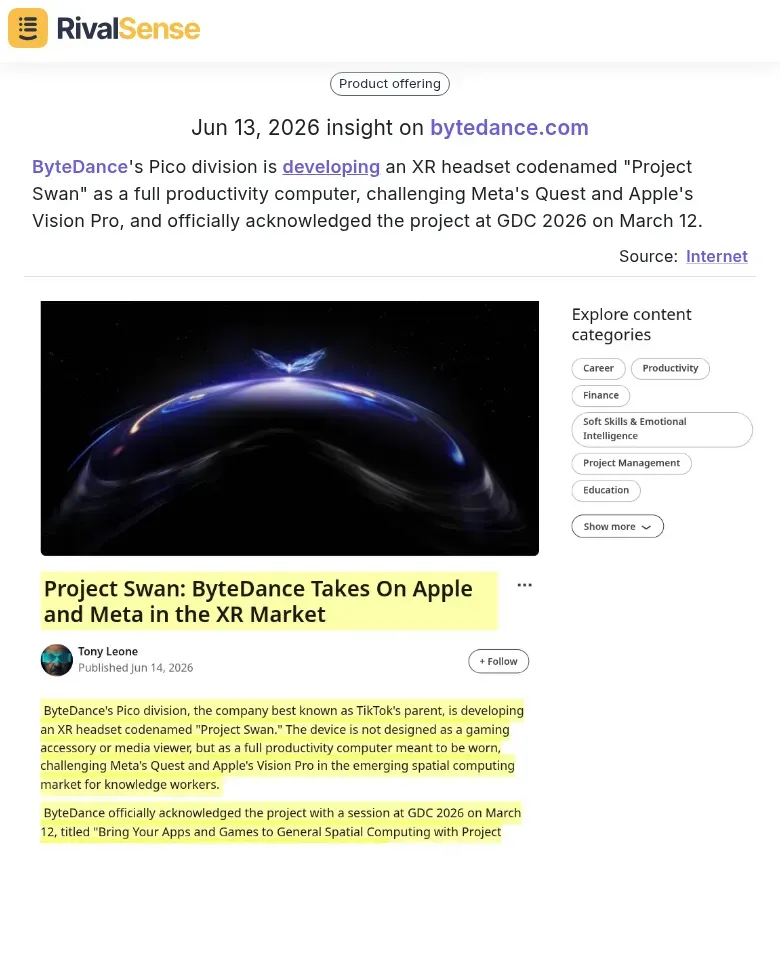
For example, RivalSense caught a major development at GDC 2026: ByteDance’s Pico division officially acknowledged “Project Swan,” an XR headset built as a full productivity computer, directly challenging Meta’s Quest and Apple’s Vision Pro. This type of event-driven intelligence signals a competitor’s long-term intentions and potential market disruption long before a product ships. If your key accounts operate in tech, design, or collaboration spaces, this announcement could shift their buying criteria.
Practical Steps to Stay Ahead:
- Monitor event agendas and press releases for relevant industry conferences. Set up Google Alerts for key competitors + event names.
- Track patent filings from competitors using tools like Google Patents or USPTO. A surge in filings around a specific technology suggests R&D focus.
- Create a competitive event calendar that notes when major trade shows occur and assign team members to monitor specific events.
- Analyze announcement patterns: If a competitor unveils a feature similar to your upcoming roadmap, your key contacts may become vulnerable.
Checklist for Early Detection:
- [ ] Identify 5 key industry events per year
- [ ] Subscribe to competitors’ press release RSS feeds
- [ ] Assign one team member per event to monitor and report
- [ ] Review patent filings quarterly
- [ ] Create a “threat alert” template for rapid internal communication
Pro Tip: When you spot a new product announcement, immediately map which of your key accounts would be most affected. Schedule a proactive check-in with those customers to discuss their evolving needs and reinforce your roadmap’s value. Early awareness lets you frame your narrative before the competitor’s sales team arrives.
Ignoring these signals leaves you reactive. A structured intelligence process turns event noise into strategic advantage.
Mistake #4: Overlooking Indirect Competitors and New Entrants
Focusing solely on direct competitors leaves your key accounts vulnerable to disruption from adjacent industries or emerging players. A startup or a company from another geography could offer a novel solution that sidelines your offering—often attacking from a blind spot you never monitored.
How to avoid it:
- Expand your tracking scope: Monitor companies in adjacent sectors and geographies using tools like RivalSense or Google Alerts.
- Analyze new entrants’ value propositions: Identify which pain points they solve that you don’t.
- Assign a team member to scan for disruptors monthly.
Quick checklist:
- [ ] Set up alerts for keywords like “AI-powered [your industry]” or “X-as-a-service for [your segment].”
- [ ] Review competitor lists quarterly and add at least one indirect rival.
- [ ] Conduct a “what-if” analysis: If a new entrant offered a 30% cost reduction, how would your key accounts react?
Counter-strategy example: If an adjacent player undercuts on price, emphasize your superior integration or compliance support. Prepare a battle card that compares your solution against indirect competitors’ weaknesses.
Mistake #5: Failing to Synthesize Multi-Source Intelligence into Actionable Sales Insights
The fifth mistake is failing to synthesize intelligence from multiple sources into actionable insights. Financial reports, product announcements, and market trends each tell a part of the story; alone, they’re fragmented. Combine them for a holistic view—e.g., a competitor’s R&D spend increase (financial data) plus a new product launch (product news) signals a market push that will directly affect your key account retention.
Actionable steps:
- Centralize intelligence in a shared dashboard (e.g., Notion, Tableau) that streams financial, product, and market updates.
- Create weekly briefings for key account teams: 3-5 bullet points linking data to specific accounts. Example: “Competitor X hired a new VP of Sales in your region (HR data); expect renewed contract pressure.”
- Use a synthesis framework: For each account, map competitor moves to three columns: Signal → Implication → Action. E.g., “Product launch (Signal) → Expands competitor portfolio (Implication) → Schedule renewal conversation early (Action).”
Checklist for synthesis:
- [ ] Cross-reference at least two sources per insight.
- [ ] Translate each data point into a sales talking point.
- [ ] Assign ownership for following up on intelligence.
Regular synthesis helps sales teams anticipate moves, tailor account plans, and strike before competitors gain ground.
Turn competitor chaos into account-winning clarity
Staying on top of competitor moves across financials, product launches, and management changes can be overwhelming. That’s where RivalSense comes in—it automatically tracks competitor updates across websites, social media, registries, and more, delivering a concise weekly email report. Stop guessing and start making proactive, account-saving decisions.
👉 Try RivalSense for free today and get your first competitor report—no more blind spots for your key accounts.
📚 Read more
👉 Data-Driven Meeting Insights for Monitoring Key Account Growth
👉 The Webinar Competitive Intelligence Playbook: Uncover New Features, AI Upgrades & Ecosystem Shifts
👉 How Trimble’s Product Expansion Reveals 3 Competitor Moves You Can Act On Today
👉 The Ultimate Key Account Management Playbook: A 30-Day Plan to Retain & Grow Strategic Accounts
👉 From Reactive to Predictive: A KAM Playbook for Med Equipment CEOs