
Competitor Financial Analysis: How to Decode Your Rivals' Financial Health
Understanding your competitors' financial health is like having a secret playbook. It reveals their capacity to invest, their vulnerabilities, and their strategic priorities. But while product launches and marketing campaigns are visible from the outside, financial data is often hidden—especially for private companies.
Competitor financial analysis is the process of gathering, interpreting, and acting on financial information about your rivals. It helps you answer critical questions: Are they profitable? How much runway do they have? Are they investing in R&D or cutting costs? Are they acquisition targets?
Let's dive into how to conduct competitor financial analysis effectively, what metrics matter most, and how to turn those insights into strategic advantages.
Why Competitor Financial Analysis Matters
Financial analysis goes beyond surface-level comparisons. It helps you:
- Anticipate competitive moves: A competitor with strong cash flow may be preparing to launch new products or acquire smaller players.
- Identify vulnerabilities: High debt or declining revenue signals weakness you can exploit.
- Benchmark performance: Compare your margins, growth rates, and efficiency ratios to industry peers.
- Inform pricing and investment decisions: Knowing your competitor's cost structure helps you set competitive prices and allocate resources wisely.
- Support fundraising or M&A: Investors and acquirers expect you to understand the financial landscape.
Key Financial Metrics to Track
Not all financial data is equally useful. Focus on metrics that reveal strategic intent and operational health.
1. Revenue & Growth Rate
- Revenue: Top-line sales, broken down by segment or geography if possible.
- Year-over-year (YoY) growth: Indicates momentum. A sudden drop may signal product issues or market share loss.
- Recurring revenue (ARR/MRR): For SaaS and subscription businesses, recurring revenue shows stability and predictability.
2. Profitability Metrics
- Gross margin: (Revenue – COGS) / Revenue. Reveals pricing power and cost efficiency.
- EBITDA margin: Earnings before interest, taxes, depreciation, and amortization. A proxy for operating cash flow.
- Net profit margin: Bottom-line profitability after all expenses.
- Burn rate & runway: For startups and unprofitable companies, how quickly they spend cash and how long they can survive.
3. Funding & Capital Structure
- Total funding raised: Indicates investor confidence.
- Valuation trend: Up rounds vs. down rounds signal market perception.
- Debt vs. equity: High debt increases risk and restricts strategic flexibility.
- Investor quality: Top-tier VCs often bring network and credibility.
4. Spending & Investment Patterns
- R&D spending as % of revenue: High R&D suggests innovation focus; low R&D may indicate cost-cutting or stagnation.
- Sales & Marketing spend: Reveals go-to-market intensity and customer acquisition cost trends.
- Headcount growth: Rapid hiring signals expansion; layoffs signal trouble.
5. Valuation & Multiples
- Revenue multiple: Valuation / Revenue. Useful for comparing peers.
- EV/EBITDA: Enterprise value relative to EBITDA. Common in mature industries.
- Price-to-earnings (P/E): For public companies, compares stock price to earnings per share.
How to Find Competitor Financial Data
The biggest challenge is data access—especially for private companies. Here's a practical guide to sources.
For Public Companies
Public companies file annual reports (10-K), quarterly reports (10-Q), and other disclosures with regulators. Key sources:
- SEC EDGAR (US filings)
- Stock exchange websites (NYSE, NASDAQ, LSE, etc.)
- Company investor relations pages (often have presentations and transcripts)
- Financial data platforms: Yahoo Finance, Google Finance, Bloomberg, Reuters
For Private Companies
Private companies aren't required to disclose financials, but you can piece together signals:
- Funding announcements: Crunchbase, PitchBook, TechCrunch—often include round size, valuation, and lead investors.
- Government databases: The UK's Companies House, Singapore's ACRA, India's MCA provide filings for registered entities.
- Credit reports: Dun & Bradstreet, Experian offer financial health scores for private firms.
- Customer & supplier interviews: Sometimes reveal volume commitments or pricing.
- Job postings: Rapid hiring in specific departments can indicate investment areas.
- Patent filings: R&D spending often correlates with patent activity.
- News & press releases: Product launches, office expansions, or contract wins hint at financial health.
Pro tip: Use RivalSense to track competitor news across 80+ sources—including funding announcements, management changes, and regulatory filings. Its weekly email report consolidates signals that hint at financial moves, so you never miss a clue.
Step-by-Step Process for Competitor Financial Analysis
Step 1: Identify Your Target Competitors
List 5–10 direct and indirect competitors. Prioritize those that affect your market share or strategic positioning.
Step 2: Define Your Analysis Objectives
What do you want to learn? Examples:
- Understand a new entrant's funding and burn rate
- Benchmark your gross margin against industry peers
- Assess if a competitor is acquisition-ready
Step 3: Gather Data from Multiple Sources
Use the sources above. For private companies, focus on funding rounds, hiring patterns, and public hints. Create a competitor matrix to organize data.
Sample Competitor Financial Matrix:
| Competitor | Revenue (est.) | Funding | Valuation | Gross Margin | Headcount | Recent Moves |
|---|---|---|---|---|---|---|
| Company A | $50M (ARR) | $200M | $1B | 75% | 500 | Launched AI product |
| Company B | $30M (ARR) | $80M | $400M | 68% | 300 | Hired 50 sales reps |
| Company C | $10M (ARR) | $15M | $60M | 60% | 120 | Raised Series B |
Step 4: Calculate Key Ratios
- Revenue per employee = Revenue / Headcount (efficiency indicator)
- Growth efficiency = New ARR / Sales & Marketing spend
- Runway = Cash / Monthly burn (for startups)
- Capital efficiency = Revenue raised / Total funding
Step 5: Interpret the Signals
Look for patterns:
- Rising headcount + flat revenue → Inefficiency or future investment
- High burn rate + low runway → Urgent need for funding or cost cuts
- Declining gross margin → Pricing pressure or rising costs
- Frequent small funding rounds → Struggle to secure large commitments
Step 6: Turn Insights into Action
Financial analysis is useless without action. Examples:
| Insight | Action |
|---|---|
| Competitor A has high cash reserves and is hiring aggressively in sales | Prepare retention offers for key customers; invest in direct sales to counter their expansion |
| Competitor B's gross margin dropped 10% due to rising component costs | Highlight your stable pricing in marketing materials; lock in supplier contracts |
| Competitor C is burning cash rapidly with limited runway | Consider outreach to potential customers to signal market share readiness; prepare acquisition bid |
Decoding Competitor Moves Through RivalSense Insights
Beyond numbers, specific competitor actions can offer powerful clues about financial health and strategy. RivalSense captures these moves in real time, turning scattered news into actionable intelligence. Here are three examples—and why they matter for your financial analysis.
1. Product integration signals ecosystem investment

Moon's 491 network player now supports Tidal Connect, allowing users to stream directly from the Tidal app without relying on Moon's own software. This type of integration shows Moon is doubling down on high-quality audio experiences and premium partnerships—likely aiming to increase average revenue per user and reduce churn. For your analysis, product integrations reveal where a competitor is allocating development resources and whether they're prioritizing ecosystem lock-in over standalone features.
2. Feature launches highlight innovation investment
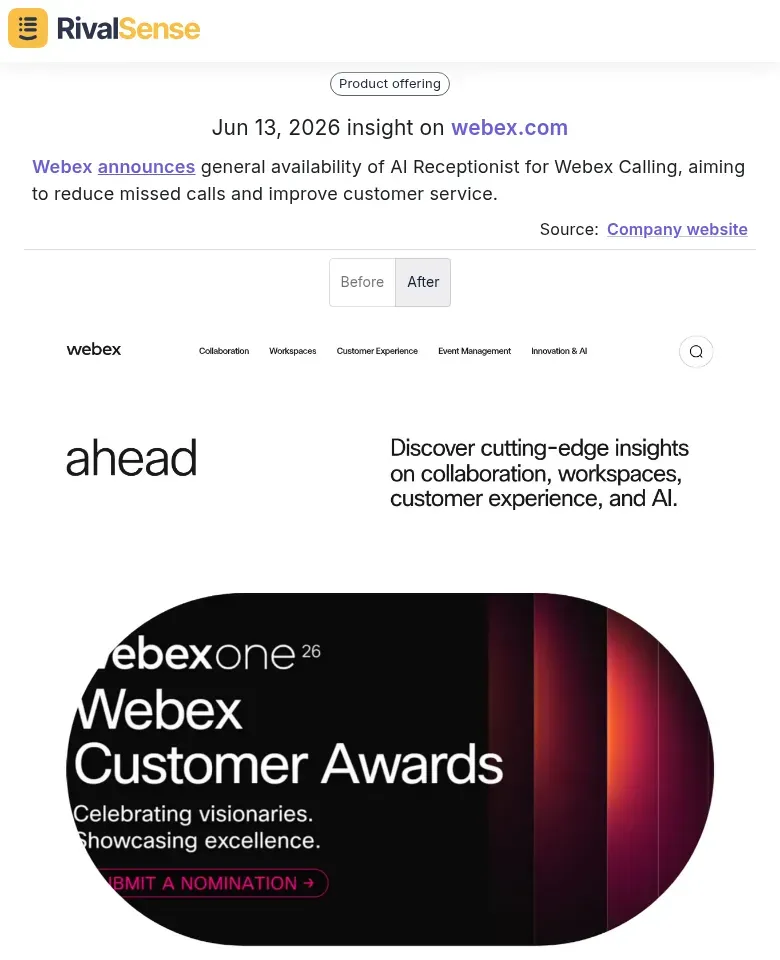
Webex announced general availability of an AI Receptionist for Webex Calling, designed to reduce missed calls and improve customer service. New feature launches like this indicate Webex is investing in AI to differentiate its calling solution, potentially driving enterprise adoption and recurring revenue. Tracking feature-level innovations helps you anticipate shifts in competitive offerings and adjust your own product roadmap before the market moves.
3. Anniversary events reflect customer retention tactics

Ubisoft is celebrating Dead by Daylight's 10th anniversary with a limited-time game mode and ONI hero skin in For Honor. Cross-game collaborations and anniversary events are strategic moves to re-engage lapsed players and boost short-term revenue. For competitor financial analysis, this suggests Ubisoft is leveraging its existing IP portfolio to drive engagement without heavy R&D spend—a signal of efficient marketing and customer retention tactics. This can inform your own event-based marketing strategy.
Tools for Competitor Financial Analysis
1. Crunchbase
Best for private company funding data, valuations, and investor info. Track funding rounds, M&A, and key executives.
2. PitchBook
Comprehensive private market data, including financial estimates, comparable company analysis, and deal flow.
3. SEC EDGAR / Company filings
Public company financial statements. Free but requires manual analysis.
4. SimilarWeb
Estimates website traffic and engagement, which can proxy for revenue trends in digital-first businesses.
5. RivalSense
Tracks competitor news across 80+ sources—funding announcements, management changes, regulatory filings, and media mentions—delivered in a weekly email. While it doesn't provide direct financial statements, it surfaces the events that drive financial changes, like a new funding round or a layoff announcement. Use it to maintain a continuous pulse on competitor financial signals without manual monitoring.
6. Dun & Bradstreet
Provides credit reports and financial health scores for private companies.
Checklist: Conduct a Monthly Competitor Financial Review
- [ ] Check funding news (Crunchbase, RivalSense, TechCrunch)
- [ ] Review public competitor quarterly filings (10-Q) for key trends
- [ ] Monitor hiring activity (LinkedIn job boards)
- [ ] Track pricing changes (competitor websites, review sites)
- [ ] Analyze social sentiment for signs of financial stress (Brandwatch)
- [ ] Update competitor matrix with new data points
- [ ] Recalculate at least three key ratios (growth rate, gross margin, burn rate)
- [ ] Identify one actionable insight and assign ownership
Common Pitfalls to Avoid
- Relying on outdated data: Financial information changes fast. Set up automated tracking where possible.
- Focusing only on public companies: Private competitors can disrupt your market. Use indirect signals.
- Overinterpreting single data points: A funding round doesn't mean success; look for consistent trends.
- Ignoring context: A high burn rate is okay for a hypergrowth startup; problematic for a mature company.
- Not acting on analysis: Insights without action are just trivia. Tie each finding to a decision or initiative.
Conclusion
Competitor financial analysis turns guesswork into strategy. By understanding your rivals' revenue, funding, spending, and growth patterns, you can anticipate their moves, exploit their weaknesses, and position your business for long-term success.
Start small: pick one key competitor, gather what financial data you can find, and calculate three meaningful ratios. Repeat monthly. Over time, you'll build a financial intelligence capability that gives you a genuine competitive edge.
Remember, the goal isn't to copy your competitors—it's to outthink them.
Ready to start tracking competitor financial signals without the manual grind? Try RivalSense for free at https://rivalsense.co/ and get your first competitor report today.
📚 Read more
👉 Key Account Manager Responsibilities: Actionable Telecom Strategies
👉 How One Competitor Used RivalSense to Respond to Nextiva's Pricing Shift
👉 5 Competitor Intelligence Mistakes That Undermine Key Account Sales – And How to Fix Them
👉 Data-Driven Meeting Insights for Monitoring Key Account Growth
👉 The Webinar Competitive Intelligence Playbook: Uncover New Features, AI Upgrades & Ecosystem Shifts