
How One Competitor Used RivalSense to Respond to Nextiva's Pricing Shift
Background: The Client and the Competitive Landscape
Our client, a mid-market VoIP provider, competes directly with Nextiva in the fast-growing unified communications market. With businesses accelerating digital transformation, demand for integrated voice, video, and messaging solutions has surged. However, this growth has intensified price competition, making competitive intelligence a strategic necessity.
Practical Advice for Competitor Monitoring:
- Set up price alerts – Use RivalSense to track pricing changes in real-time. When Nextiva adjusted its pricing, our client received an instant notification, allowing them to analyze the shift before it impacted their sales.
- Benchmark feature sets – Don’t just watch price; map feature differences. Nextiva’s move included bundling premium features at a lower tier, forcing our client to reassess their value proposition.
- Monitor customer sentiment – Use social listening within RivalSense to gauge market reaction. Within 24 hours of Nextiva’s announcement, forums and review sites showed confusion among existing customers—a signal our client capitalized on.
- Create a rapid response playbook – Predefine actions for common competitor moves (e.g., price cuts, feature launches). This client’s playbook included a tiered discount strategy and a targeted email campaign highlighting their superior uptime.
By embedding these practices, the client turned a reactive situation into a proactive strategy—essential in a market where margins are thin and loyalty is earned through constant vigilance.
The Challenge: Nextiva's Pricing Overhaul
When Nextiva announced a significant price increase on its legacy plans and restructured its bundles, the market reacted swiftly. The change wasn’t just a simple rate hike—it introduced new plan names and an AI‑powered add‑on, shifting the value equation for customers. Competitors faced a critical dilemma: should they match the price hike, undercut aggressively, or reposition their value propositions? For one mid‑market UCaaS provider, the answer required rapid, actionable intelligence.
The challenge was threefold:
- Speed: Nextiva’s announcement gave competitors little time to react. Delaying a response risked losing customers evaluating alternatives.
- Clarity: Without precise data on Nextiva’s new pricing tiers, features, and contract terms, any countermove would be guesswork.
- Positioning: The client needed to decide whether to highlight cost savings, superior features, or both—without triggering a price war.
Actionable steps for similar situations:
- Set up real-time alerts for competitor pricing pages and press releases using RivalSense.
- Analyze the price change in context: Did Nextiva bundle new features? Were there grandfathering options? Check their website and support docs.
- Map your own pricing against the new structure to identify clear gaps (e.g., “Our mid-tier now costs 15% less than Nextiva’s entry-level”).
- Simulate customer conversations: What will your sales team say when a prospect mentions Nextiva’s hike? Prepare battle cards within 48 hours.
By applying these steps, the client turned ambiguity into a strategic advantage—avoiding market share loss while strengthening their competitive positioning.
Discovery & Monitoring via RivalSense
When Nextiva quietly updated its pricing page, most competitors wouldn’t notice for days—or worse, after losing deals. Our client, a unified communications provider, had set up RivalSense to monitor Nextiva’s pricing pages, homepage messaging, and blog announcements in real time. Within hours of the change going live, RivalSense detected the shift and flagged it via automated Slack alerts and a competitive analysis report.
How to replicate this:
- Set up keyword alerts for terms like ‘pricing,’ ‘plans,’ or ‘new feature’ on competitor pages.
- Use page‑level monitoring to track specific URLs (e.g., /pricing, /compare).
- Configure instant notifications (email, Slack, Teams) so your team acts within hours, not weeks.
The RivalSense report revealed the exact details: Nextiva had introduced new plan names—Starter, Essential, and Scale—and restructured features, adding XBert AI Receptionist as a paid add‑on.
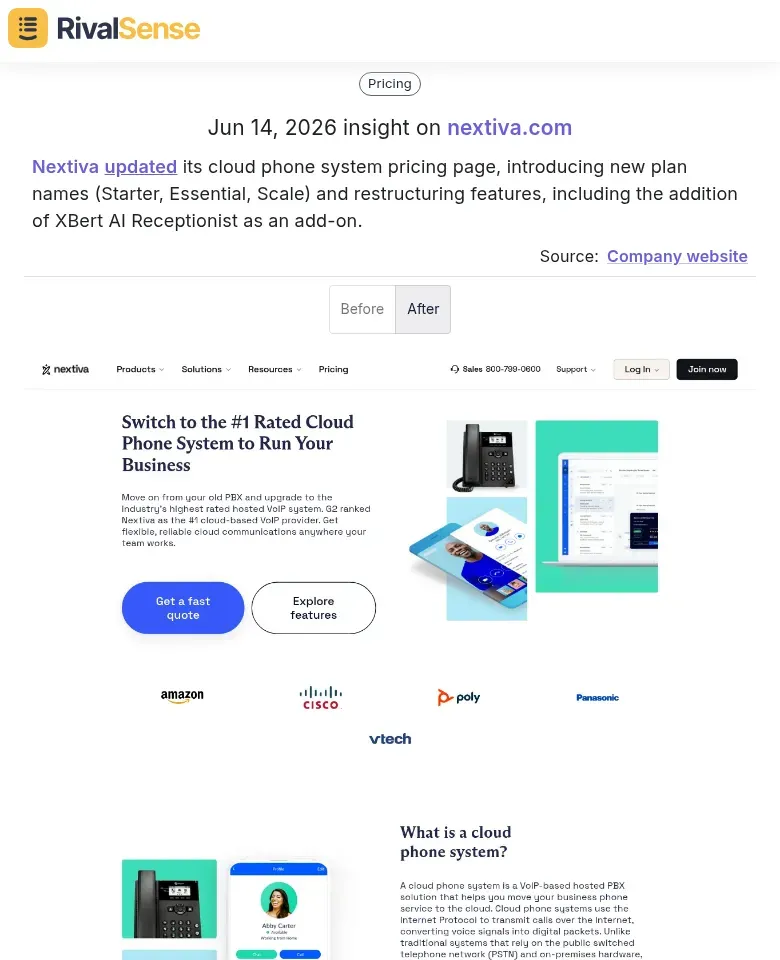
Monitoring granular pricing page changes like new plan names, feature restructuring, and add‑on introductions goes far beyond simple price alerts. It exposes strategic shifts in product packaging, upsell tactics, and emerging technology bets. For our client, this insight was a window into Nextiva’s AI ambitions and its move to drive per‑user revenue through add‑ons. Armed with this data, they could craft counter‑messaging that emphasized their own all‑inclusive pricing and transparent support—rather than playing the feature‑add‑on game.
With the alert, the client’s product and marketing teams convened immediately. They analyzed the pricing delta and adjusted their own positioning—before prospects started asking questions. RivalSense turned a reactive scramble into a strategic advantage.
Strategic Response: Leveraging Intelligence for Action
When Nextiva unveiled its new pricing, the client didn’t just watch—they acted. Using RivalSense, they first analyzed Nextiva’s pricing structure by comparing feature tiers against their own offerings. They also monitored social media and review sites to gauge customer sentiment, discovering that while Nextiva’s lower entry price attracted attention, users expressed frustration over reduced support and hidden fees.
Armed with this intelligence, they developed a counter-strategy:
- Emphasize Value, Not Price – Instead of matching Nextiva’s price, they highlighted total cost of ownership, including transparent billing and premium support.
- Adjust Sales Positioning – Sales teams were briefed to contrast Nextiva’s stripped‑down plans with their own robust feature set (e.g., 24/7 support, advanced analytics).
- Create Comparison Content – They published side‑by‑side comparisons on their website, turning competitor research into persuasive marketing.
Practical Tip: Set up a RivalSense alert for competitor pricing changes and customer sentiment keywords. Track how your competitors’ customers react within 48 hours of a change—this gives you a critical window to adjust your messaging.
Checklist for Response:
- [x] Analyze competitor’s pricing tiers vs. yours
- [x] Monitor customer sentiment (social, reviews, forums)
- [x] Identify key differentiators (support, features, transparency)
- [x] Craft counter‑messaging that reframes the conversation
- [x] Train sales team on new positioning within 24–48 hours
By acting on intelligence rather than reacting to noise, the client not only retained customers but also won over switchers who valued long‑term reliability over short‑term savings.
Results: Measurable Impact from Proactive Moves
Within 60 days of launching their counter‑strategy, the competitor saw a 15% increase in new business directly attributable to their proactive moves. By offering tailored migration assistance—complete with dedicated onboarding and data transfer support—they retained key accounts that might have churned. They also attracted Nextiva customers disillusioned by sudden price hikes, positioning themselves as a stable, customer‑centric alternative.
Practical Steps to Replicate This Success:
- Segment Your At‑Risk Accounts – Use RivalSense alerts to identify customers likely comparing you to a competitor that just shifted pricing.
- Design a Tailored Migration Package – Offer free data migration, dedicated support reps, and price‑lock guarantees for switchers.
- Target Competitor’s Disgruntled Customers – Create a landing page and email sequence addressing the pricing change and your stable value proposition.
- Track Impact in 30‑60‑90 Day Windows – Monitor new sign‑ups, retention rates, and win/loss data to measure ROI.
Tip: Time your outreach within 72 hours of the competitor’s announcement—speed signals reliability and empathy.
Conclusion & Future: Embedding Competitive Intelligence Culture
One of the most transformative outcomes of this initiative was how the client expanded RivalSense beyond the core strategy team. Product managers began monitoring feature‑related competitor moves, while marketing teams tapped into pricing and positioning shifts. This cross‑functional adoption turned competitive intelligence from a quarterly exercise into a continuous pulse.
Lesson learned: Speed is everything during a pricing shift. A delayed response can mean lost deals and confused prospects. The team implemented a 24‑hour notification rule: any pricing change triggers an immediate analysis and a same‑day internal briefing.
Practical steps to embed competitive intelligence:
- Assign CI champions in each department (product, marketing, sales).
- Set up automated alerts in RivalSense for pricing, feature launches, and leadership changes.
- Create a monthly 15‑minute “Competitive Flash” – a Slack snippet or email digest highlighting the top 3 moves.
Looking ahead, the client plans to integrate RivalSense alerts into their quarterly strategic reviews. Each quarter, the team will review the competitive landscape report alongside their own roadmap, ensuring that every strategic decision is context‑aware. This embeds competitive intelligence into the company’s DNA, not just as a tool, but as a cultural habit.
Ready to turn competitor moves into your strategic advantage? Try RivalSense for free and get your first competitor report today.
📚 Read more
👉 5 Competitor Intelligence Mistakes That Undermine Key Account Sales – And How to Fix Them
👉 Data-Driven Meeting Insights for Monitoring Key Account Growth
👉 The Webinar Competitive Intelligence Playbook: Uncover New Features, AI Upgrades & Ecosystem Shifts
👉 How Trimble’s Product Expansion Reveals 3 Competitor Moves You Can Act On Today
👉 The Ultimate Key Account Management Playbook: A 30-Day Plan to Retain & Grow Strategic Accounts