
Map Competitor Customer Journeys in Printing Industry
Understanding the customer journey from awareness to purchase is the foundation of any successful business strategy. In the printing industry, where relationships and service quality drive decisions, mapping how competitors guide their customers through this journey offers invaluable insights. By analyzing each stage—from initial search and comparison to final selection—you can uncover market trends and shifting customer preferences. For example, if a competitor launches a virtual proofing tool during the consideration phase, it signals a growing demand for faster, digital approvals.
This practice gives you a competitive advantage in anticipating customer needs before they articulate them. Start by identifying 3–5 key competitors and documenting their touchpoints: What content do they offer? How do they handle objections? Where do they lose leads? Use a simple spreadsheet to track these stages weekly. 💡 Tip: Look for patterns in their email sequences or trial offers—these reveal what they believe customers value most. By systematically mapping competitor journeys, you transform reactive observation into proactive strategy.
Identifying Customer Pain Points Through Service Changes
Your competitors’ service adjustments are a goldmine of insight into customer pain points. Here’s how to decode them.
-
Track Turnaround Options
Monitor shifts in delivery speed offerings. A competitor introducing an “Express 24h” tier signals growing demand for speed, while removing it suggests price sensitivity is winning. Create a simple matrix (standard vs. rush pricing) updated quarterly. -
Analyze Tier Additions/Removals
New tiers like “Pro Print” with premium paper stocks indicate customers willing to pay more for quality. Removed budget tiers hint at margin pressure or low uptake. Use a change-log template to record additions/removals with dates and speculated rationale. -
Benchmark Your Flexibility
Compare your service options against competitors’. If a rival offers same-day turnaround and you don’t, test demand via a limited rollout before full investment. Create a capability gap grid: list services (custom finishes, bulk discounts) and mark availability by competitor.
Real example: UPrinting recently updated its custom trading card offerings—adding a 1 Business Day turnaround while removing the 3 Business Days option.
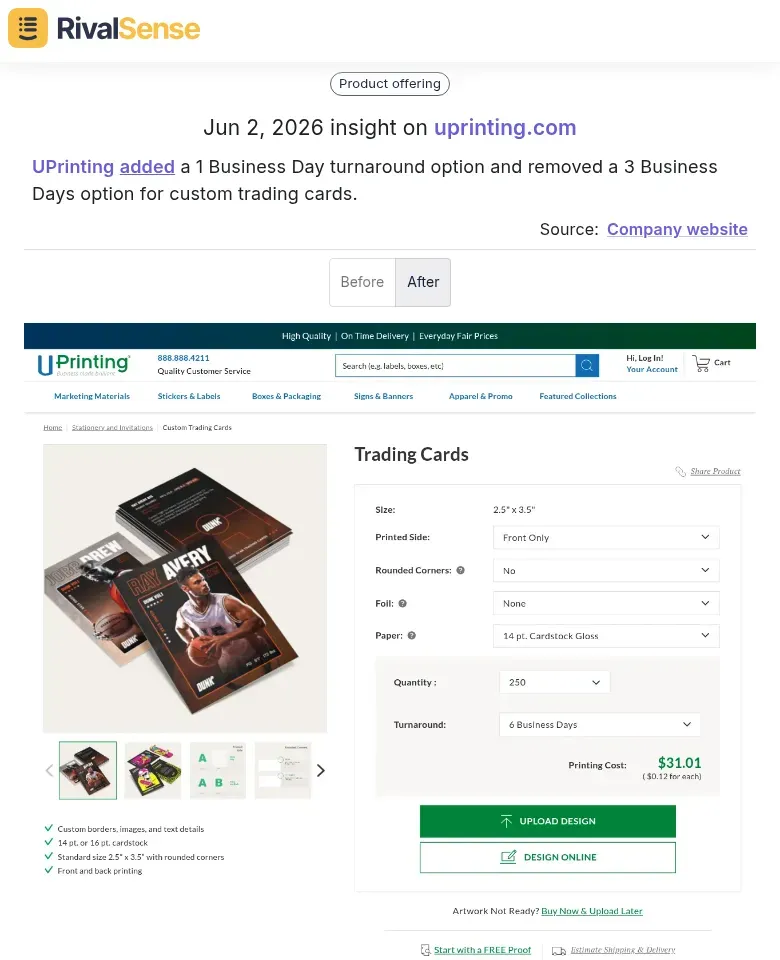
This type of insight signals a clear customer hunger for speed, and that a segment is willing to pay a premium for rapid fulfillment. Tracking such moves lets you adjust your own service levels before losing orders to faster rivals.
Action Steps:
- Set up monthly competitor site audits (focus on pricing, shipping, guarantees).
- Interview your sales team about customer requests they’ve lost to competitors—these are direct pain-point signals.
- Use change frequency as a proxy for market volatility: frequent changes indicate a rapidly shifting landscape.
Optimizing Product Lineups Based on Competitive Moves
Tracking competitor product line changes reveals which categories are heating up and which are fading. For example, if a rival like HP drops its entry-level inkjet models while expanding industrial label printers, they’re signaling a pivot to high-margin, high-demand segments. Similarly, Konica Minolta’s exit from small-office copiers in favor of managed print services shows portfolio rationalization—a move to focus resources on growth areas.
Practical steps to apply this:
- Set up alerts for product launches and discontinuations using tools like RivalSense or Google Alerts for key competitors.
- Maintain a live spreadsheet tracking each competitor’s product SKUs by category, noting additions and removals monthly.
- Calculate category velocity: rank product families by the rate of new entries vs. removals. High velocity = growing demand; low or negative velocity = sunsetting.
- Cross-reference with customer feedback—if a competitor drops a product and your customers complain about missing features, that’s a ripe opportunity to expand.
- Apply your own pruning rule: each quarter, eliminate the bottom 10% of low-margin SKUs and reallocate R&D budget to match the fastest-growing competitor categories.
Insight worth watching: When UPrinting revamped its banners line, it replaced vinyl, fabric, mesh, and table banners with vinyl, retractable, step and repeat, and fabric banners.
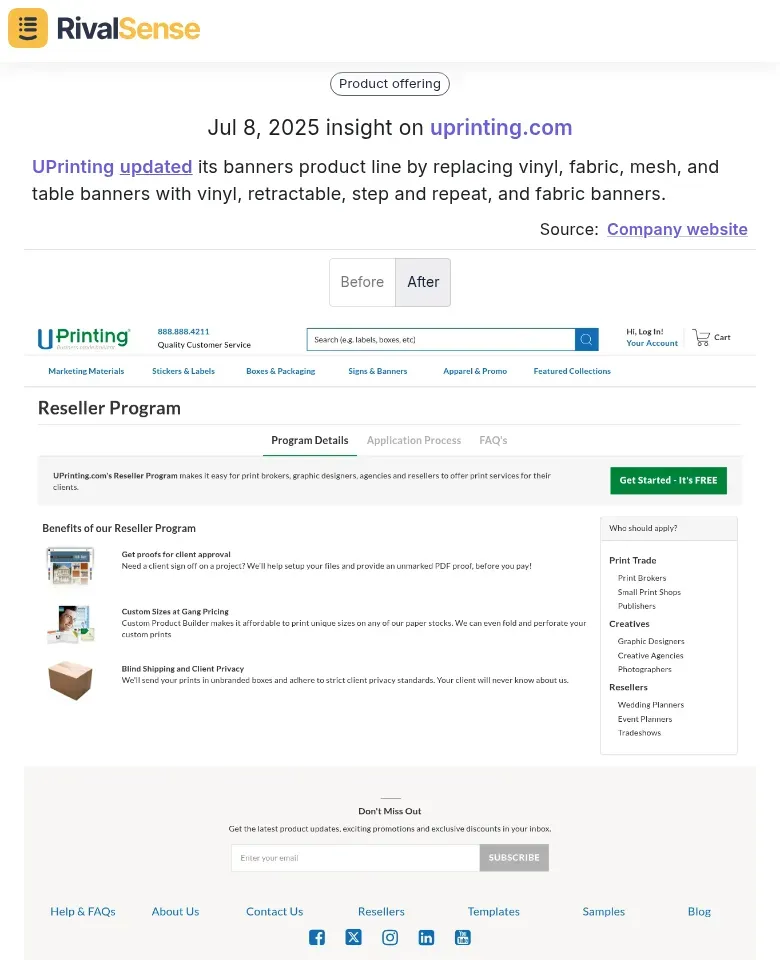
This shift highlights growing demand for event‑ready materials (retractable, step and repeat) and a move away from less specialized options. Observing such portfolio realignments helps you spot where customer use cases are evolving—and where you might fill a gap or expand your own lineup.
Pro tip: Watch for sudden price drops on legacy models—they often precede discontinuation, giving you a window to offer trade-in programs or bundle upgrades to capture switchers.
Enhancing Product Information and Customer Education
In the printing industry, friction often arises when customers lack clarity about product specifications. By analyzing competitors who excel at detailed descriptions—such as precise paper weights, color profiles, and finishing options—you can identify gaps in your own content. Implement ‘Learn More’ overlays or tooltips that explain technical terms without cluttering the page. For example, a competitor might offer a pop-up showing exact CMYK vs. RGB differences; adopt a similar approach with your material options.
Example from the field: UPrinting enhanced its envelope offerings by adding detailed descriptions and a ‘LEARN MORE’ button for Business, Announcement, and Donation Envelopes.
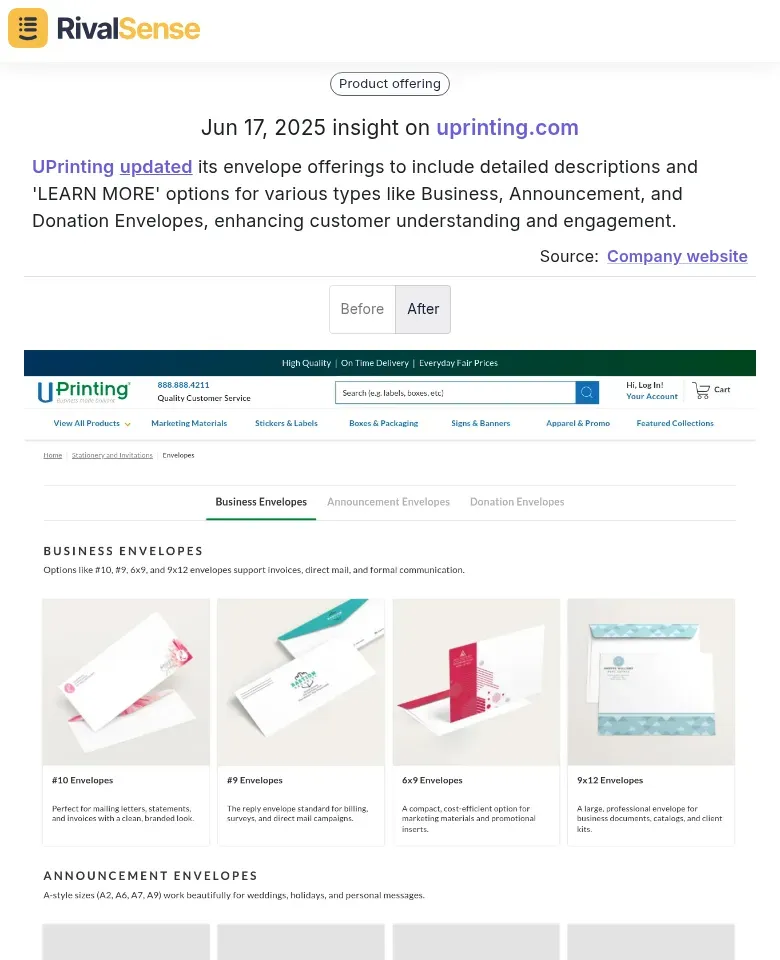
This type of insight underscores the value of self-service education. When competitors invest in clarity, they reduce buyer anxiety—and you can, too, by auditing your own product pages and plugging information gaps.
To build trust, create comparison tables that contrast your offerings with industry standards, and include real-world use-case examples (e.g., “best for business cards vs. posters”).
Quick improvement checklist:
- [ ] Audit top competitor product pages for missing details
- [ ] Add expandable sections for specs
- [ ] Embed short explainer videos for complex processes
- [ ] Use customer Q&A sections to address recurring doubts
These enhancements reduce decision paralysis and directly boost conversion rates—often by up to 20% in B2B printing contexts.
Building a Systematic Competitor Tracking Process
To gain a lasting edge, you need more than one-off audits. Build a repeatable process that turns competitor noise into strategic signals.
Step 1: Set Up Regular Monitoring
- Use a change-detection tool (e.g., RivalSense) to track competitor websites, pricing pages, and product updates. Get daily or weekly email digests.
- Create a shared dashboard in your CRM or project management tool listing all key competitors and their monitored pages.
Step 2: Document Changes Over Time
- Maintain a changelog – a simple spreadsheet or dedicated tool. Log each change with date, competitor, type (pricing, feature, messaging), and impact assessment.
- Tag patterns – e.g., “quarterly pricing update,” “new feature launch ahead of industry event.” This helps spot cadences and strategic shifts.
Step 3: Create Actionable Reports
- Link competitor moves to customer journey stages. For instance:
- Awareness: Did they run a new ad campaign?
- Consideration: Did they publish a comparison guide?
- Decision: Did they lower prices or offer a free trial?
- Use a simple scoring matrix (1–5) to rate threat/opportunity of each move.
- Share a weekly “Competitor Signal Brief” with your team – three bullets max. Focus on what to do next: update a sales playbook, refine a landing page, or test a new pricing model.
Quick Checklist
- [ ] Identify 5 top competitor pages to monitor
- [ ] Set up automated alerts
- [ ] Assign a person to review changes weekly
- [ ] Connect each change to a specific customer journey stage
- [ ] Circulate a 5-minute briefing every Monday
Turning Insights into Action: Applying Learnings to Your Business
Mapping competitor customer journeys reveals hidden pain points and opportunities. Here’s how to translate those insights into tangible improvements.
1. Prioritize Changes That Address Real Pain Points
Not all insights are equal. Use a simple matrix to rank pain points by impact (how much it hurts customers) and effort (time/resources to fix). For example, if competitors offer instant price quotes but your process takes 48 hours, that’s a high-impact, low-effort fix. Start there.
✔ Checklist:
- List top 3 pain points from competitor journey maps
- Rate each on a 1-5 scale for impact and effort
- Tackle low-effort, high-impact items first
2. Test and Iterate on Product/Service Adjustments
Run small-scale experiments before rolling out changes. For instance, if competitors excel at onboarding, A/B test a simplified welcome sequence with 10% of new customers.
✔ Quick Win: Launch a “competitor feedback loop”: assign one team member to monitor competitor reviews monthly. Share findings in a 15-minute standup and propose one test per quarter.
3. Foster a Culture of Competitive Awareness
Make competitive intelligence a habit, not a project. Set up a shared dashboard (e.g., RivalSense) tracking competitor pricing, features, and customer sentiment. Rotate responsibility among team members to keep everyone invested.
✔ Tip: Hold a monthly “Competitor Deep Dive” where each department presents one trend they spotted and suggests an action. This turns insights into shared ownership and drives customer-centric innovation.
By systematically applying what you learn, you’ll not only catch up but leap ahead—turning competitors’ strengths into your own opportunities. To make this process effortless, try RivalSense for free and get your first competitor report today. See every move your competitors make, just like the UPrinting examples above, and turn change into growth.
📚 Read more
👉 5 Mistakes in Competitor M&A Analysis for SaaS Key Accounts
👉 When a Competitor Shuts Down: How to Spot and Capitalize on Market Exits Before Everyone Else
👉 How to Track Competitor Podcast Appearances (2026 Guide)
👉 SaaS Case Study: How Competitor Testimonials and Real-Time Intel Fuel Growth
👉 How a Competitor Spotted IT.integro’s Sustainability Pivot and Accelerated Their Roadmap