
5 Mistakes in Competitor M&A Analysis for SaaS Key Accounts
Competitor M&A analysis is a pivotal strategic muscle for B2B SaaS companies. A rival's acquisition can reset the competitive landscape overnight—but only if you interpret it correctly. Too many teams either overreact or miss the signals entirely, leaving key accounts vulnerable. Here are five common mistakes in competitor M&A analysis, along with practical tips and real-world examples to turn analysis into advantage.
Mistake #1: Overlooking the “Why” Behind the Deal
Misjudging the true motivation behind a competitor’s acquisition is a fast track to flawed strategic assumptions. Many teams look at M&A as a sign of strength—more resources, more product, more market share. But the real question is: Why did they buy that company?
If a competitor acquires a startup to fill a product gap, they’re revealing a weakness. That gap existed before the deal—and likely still exists during integration. For example, if a competitor buys a compliance tool, their core platform probably lacked compliance features. That’s an opening you can exploit by highlighting your native compliance capabilities to mutual prospects.
Practical steps to decode the “why”:
- Map the acquisition to their GTM strategy. Does the acquisition target a new buyer persona within key accounts (e.g., security teams vs. end users)? If so, they’re trying to expand wallet share—you can preempt this by deepening relationships with your existing champions.
- Identify integration friction. Acquisitions create internal chaos: technical debt, culture clashes, sales team churn. Monitor product release velocity and review sites like G2 for customer complaints post-acquisition. This is your window to position your solution as stable and reliable.
- Categorize the deal:
- Talent grab → they needed specific expertise; your team’s knowledge is a moat.
- Customer acquisition → they bought a list; focus on retention and account expansion.
- Feature fill → they’re playing catch-up; accelerate your roadmap messaging.
Real insight in action: When CrowdStrike acquired SGNL, it wasn’t just a splashy headline. The move signaled a deliberate push into identity security, likely addressing a gap in their existing platform. Early detection of such a deal—and the strategic “why” behind it—gives you weeks or months of lead time to adjust your positioning and messaging before the market wakes up.
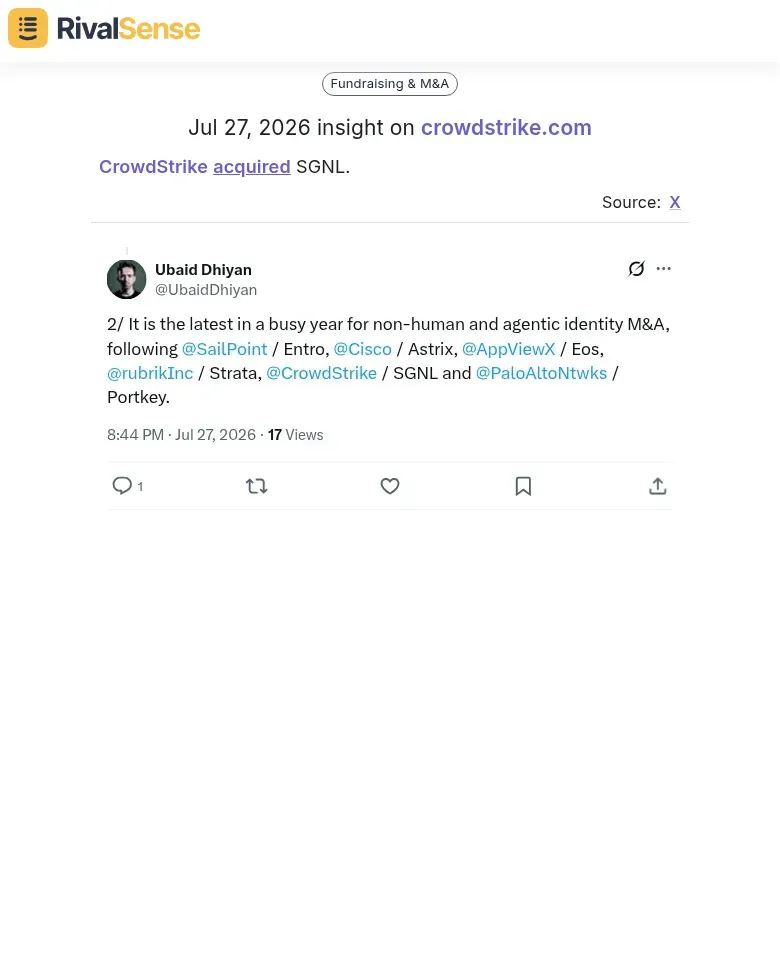
Why this insight matters: M&A alerts like this, surfaced by tools like RivalSense, let you decipher intent early. You can build an “M&A Intent Scorecard” for every competitor deal, rating it from 1 (desperation) to 5 (strategic strength). A score of 2 or below? Flag it to your sales team as a vulnerability to exploit.
Mistake #2: Dismissing Public Growth Signals
Many SaaS teams overlook publicly available competitor data—ARR milestones, customer logos, funding rounds—dismissing them as marketing fluff. This is a critical error. These signals are real indicators of market traction and momentum within your key accounts.
Why this matters: If a competitor lands a logo at one of your top accounts, that’s not just a PR win—it’s a red flag. Their next move may be to expand within that account or target similar ones on your roster.
Real insight in action: Consider Innovaccer CEO Abhinav Shashank publicly sharing that the company has reached $200M ARR and is used by 7 of the top 10 U.S. health systems. That’s not marketing fluff—it’s concrete validation of scale and penetration in a highly regulated market. For any B2B SaaS firm competing in health-tech, this is a blaring signal that Innovaccer is a serious threat in key accounts you may share.
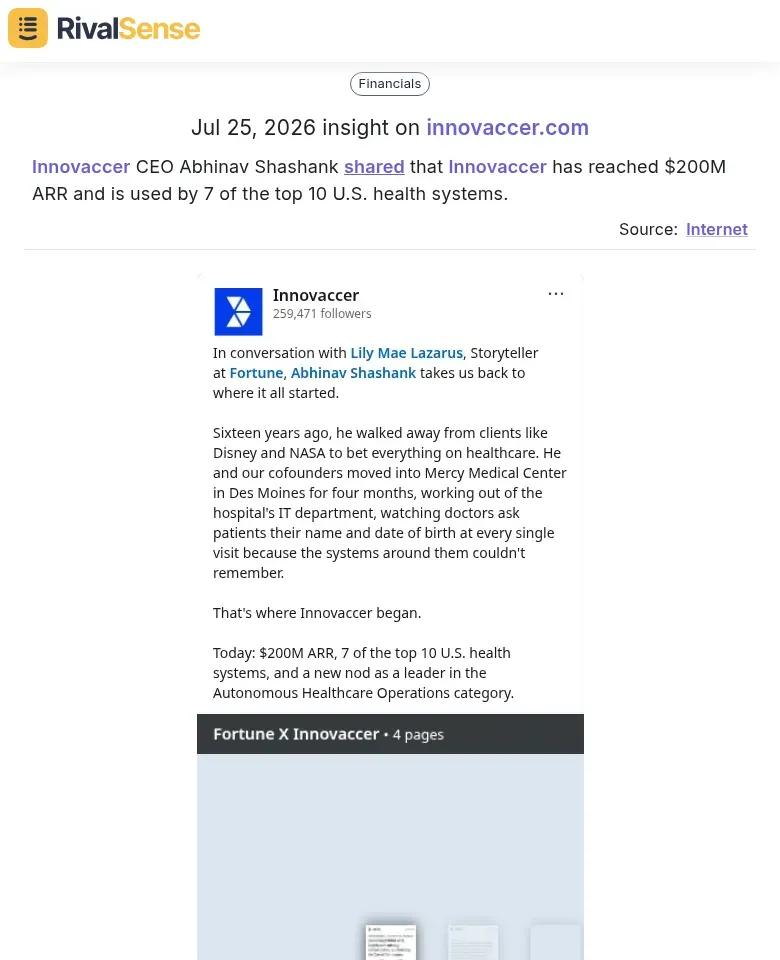
Why this insight matters: Monitoring public growth signals—ARR, customer count, and marquee logos—converts vanity metrics into ammunition. Cross-reference such wins with your own CRM data to identify accounts at risk, and arm your sales team with counter-evidence of your own momentum.
Practical steps to avoid this mistake:
- Set up alerts for competitor announcements (funding, new clients, product launches).
- Track key metrics: Monitor public ARR growth, customer count, and logos. Filter by industry or account tier.
- Validate win/loss analysis: Cross-reference competitor wins with your own win/loss data. Did a deal slip because a competitor offered a new feature they just announced? That’s a signal.
Checklist:
- [ ] Competitor alerts active for top 5 rivals
- [ ] Monthly ARR/milestone review
- [ ] Win/loss data cross-referenced with competitor announcements
Ignoring public signals is like flying blind. Turn them into competitive intelligence ammunition.
Mistake #3: Chasing Unsubstantiated Rumors
M&A rumors are a staple in the SaaS industry, but pursuing them without verification is a dangerous distraction. When a competitor is whispered to be acquired by a deep-pocketed buyer, panic can set in—leading you to rush defensive strategies, reallocate budget to speculative monitoring, or deprioritize validated insights. This misallocated energy often results in wasted resources and missed signals from actual competitive moves.
Real insight in action: Recently, rumors surfaced that Stripe was bidding on OpenRouter. Such a rumor could disrupt strategic planning for payment and AI-tooling companies—but only if verified. Chasing it prematurely would have consumed cycles better spent on confirmed threats.

Why this insight matters: Rumor alerts can be early warnings, but their primary value is in training your team to distinguish noise from signal. A tool that flags these rumors, and then lets you score them, prevents costly overreactions.
How to avoid this trap:
- Cross-reference every rumor against at least three independent sources—SEC filings, Crunchbase, PitchBook, or direct statements from the companies involved.
- Assess market context: Is the rumored buyer known for SaaS acquisitions? Does the target’s product fit their portfolio? If the logic is weak, treat it as noise.
- Set a validation delay: Before acting, wait 72 hours and recheck for confirmations. Most rumors dissolve in that window.
- Score rumors by credibility: Create a simple 1–5 scale based on source reliability, alignment with known strategies, and financial plausibility. Only act on scores of 4+.
Pro tip: Build a "rumor watchlist" in your competitive intelligence tool. Tag items as "unconfirmed" and review them weekly rather than reacting in real time. This separates signal from noise and keeps your focus on high-confidence intelligence.
Mistake #4: Neglecting Post-Merger Impact on Key Accounts
When a competitor acquires another company, the ripple effects on their product roadmap, pricing, and support can be significant. Neglecting to monitor these changes means missing early warning signs for your key accounts. If your accounts rely on the acquired product or depend on the competitor for complementary services, post-merger shifts could impact their satisfaction, usage, or even their willingness to stay with you.
To stay ahead, build a post-merger monitoring checklist:
- Track Integration Milestones: Monitor public announcements, press releases, and user forums for news about product consolidation, feature deprecation, or price hikes.
- Assess Support Quality: Check review sites and social media for complaints about service degradation after the merger. A dip in support can be your opening to offer a better experience.
- Watch for Account Outreach: If your key accounts suddenly receive cross-sell or upsell pitches from the merged entity, it signals a shift in strategy that could create churn risk or expansion opportunities for you.
Pro tip: Set up alerts for specific M&A keywords (e.g., “acquired by”, “merger update”) for each competitor. Then, correlate findings with your CRM to flag affected accounts proactively. By monitoring the post-merger impact, you can anticipate churn risks and pivot your retention or expansion plays before the dust settles.
Mistake #5: Treating M&A Analysis as a One-Off Event
Many teams only analyze M&A when a deal hits the news. By then, competitive dynamics have already shifted. Smart M&A monitoring is continuous, not reactive.
Why it matters: A competitor’s acquisition doesn’t start on announcement day. Signals appear months earlier—job postings for integration roles, patent filings, partnership changes, or funding rounds. Missing these cues means you’re always behind.
Build a systematic CI process:
-
Set up real-time alerts. Use tools like RivalSense, Google Alerts, or Crunchbase for daily feeds across your top 10 competitors. Include keywords like "acquires," "merger," "strategic investment."
-
Track rumor stages. Maintain a signal matrix with three tiers:
- Weak signals (board changes, hiring sprees)
- Medium signals (fundraising, patent activity)
- Strong signals (formal LOIs, regulatory filings)
-
Integrate into account planning. For each key account, add a "Competitor M&A Risk" section to your quarterly review. Ask: Could a competitor acquisition disrupt our relationship? Are they gaining technology or talent that threatens our value prop?
Checklist for your weekly CI routine:
- [ ] Scan for new M&A rumors or confirmations
- [ ] Update competitor capability maps
- [ ] Flag impact on top 5 key accounts
- [ ] Share one actionable insight with the account team
Continuous monitoring turns M&A analysis from a rearview mirror into a forward-looking competitive advantage.
Stop guessing about competitor moves. RivalSense automatically tracks competitor acquisitions, product launches, pricing shifts, and market rumors—delivering a crystal-clear weekly email report so you never miss a critical signal. From decoding M&A intent to spotting public growth milestones, RivalSense transforms raw data into actions your sales and strategy teams can use. Try it for free today and start getting your first competitor report now.
📚 Read more
👉 When a Competitor Shuts Down: How to Spot and Capitalize on Market Exits Before Everyone Else
👉 How to Track Competitor Podcast Appearances (2026 Guide)
👉 SaaS Case Study: How Competitor Testimonials and Real-Time Intel Fuel Growth
👉 How a Competitor Spotted IT.integro’s Sustainability Pivot and Accelerated Their Roadmap
👉 Productivity Techniques to Uncover Competitor Advertising Strategies via Website Changes