
Workflow Breakdown: Turning Internet Competitor Insights Into Pricing Power
Most teams treat competitor monitoring as a marketing chore — a weekly newsletter of “what the other guys shipped.” That’s a missed opportunity. The same signals that feed your content calendar can become the raw material for sharper pricing decisions, at essentially zero marginal cost. You’re already reading the data; the leverage is in how you interpret it.
Three signal types reveal strategic intent, not just activity:
Product launches. A feature drop aimed at your tier-two customers signals where they’re hunting. Check their pricing page alongside the announcement — are they bundling, unbundling, or quietly raising entry prices?
Capital events. Funding rounds and revenue disclosures change the game. A freshly funded competitor can sustain a price war longer than you can. Adjust your discounting guardrails accordingly.
Acquisitions. When a competitor buys a tool, they gain pricing power across a bundle. Ask: can they now cross-sell at a discount that undercuts your standalone price?
The goal is directional intelligence, not precision. Your pricing data will never be perfect — competitor signals are meant to validate or challenge your assumptions, not replace your own customer evidence. A quick framework: set up a simple tracker, review signals monthly, and ask one question per signal — “does this confirm, threaten, or change my current pricing?”
Practical tips: appoint a single owner, use a shared doc over fancy tools, and always pair a signal with a pricing hypothesis. Ten minutes a week beats a quarterly deep-dive.
Decoding Product Launches: Feature Expansion as a Pricing Signal
Every product launch is a pricing confession. When a competitor ships a new channel—a mobile app, an API, a Slack integration—they're signaling that customers want frictionless access. Convenience carries a price tag, and they expect to charge for it. Ask yourself: if they're investing to remove friction, what premium do they believe the market will absorb?
Build a simple launch-tracking workflow: (1) subscribe to changelogs and press pages, (2) log every launch with date, channel, and target segment, (3) note the packaging—is the feature free, gated behind a premium tier, or metered?
The packaging is the real tell. A competitor moving a formerly core feature behind a paid tier signals a shift toward tiered pricing. Metered usage (API calls, seats, storage) points to usage-based models. Beta or 'early access' gating means they're testing willingness to pay before committing.
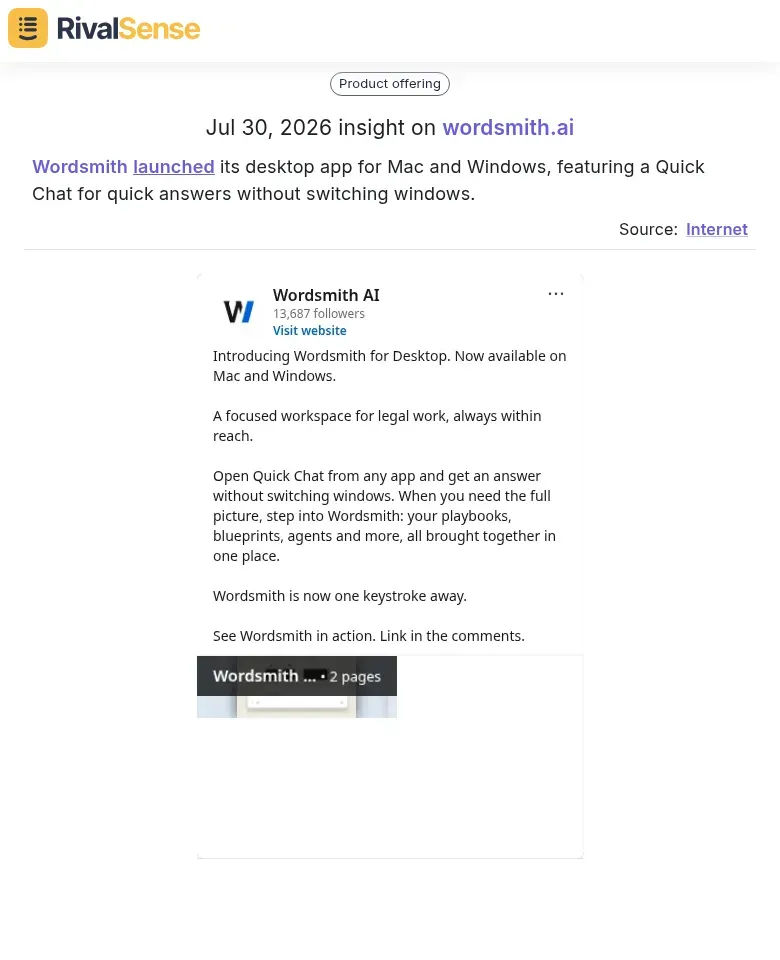
Real-world example: when Wordsmith launched its desktop app for Mac and Windows with a Quick Chat feature, it wasn’t just a UI upgrade. It signaled a move to embed AI deeper into daily workflows—potentially justifying a premium for “always-on” convenience. This kind of product signal is valuable because it reveals where a competitor believes customers will pay more for seamless access, giving you an early read on where the market’s pricing ceiling might rise.
Before you react, run the price-umbrella test:
- Does this launch expand their addressable market (new segment, new geography, new use case)?
- Can they sustain lower prices at scale, or is the launch a premium play?
- If the umbrella widens, your pricing must respond—or you'll be underpriced by association.
Pro tip: keep a spreadsheet with columns for date, channel, packaging, and pricing-model signal. Review it monthly. No single launch decides your pricing—but the pattern reveals where your competitor's pricing power is heading, and where yours must go too.
Reading Capital Signals: Investors and Funding as Strategic Bets
When a competitor raises a round, most teams skim the press release for headcount numbers and move on. We read it as a pricing signal. Institutional capital validates a market’s growth trajectory—and hands your rivals the runway to underwrite aggressive pricing.
A fresh Series B means they can hold below-market prices, absorb churn, and buy customers while you defend margin. That’s not speculation; it’s arithmetic. Investors fund growth, not profitability, so the pressure to convert that capital into market share lands squarely on pricing. Treat funding as a leading indicator. Within two to three quarters of a raise, expect discounting, bundling, or land-and-expand plays. Plan your counter-moves before the discounts land, not after.
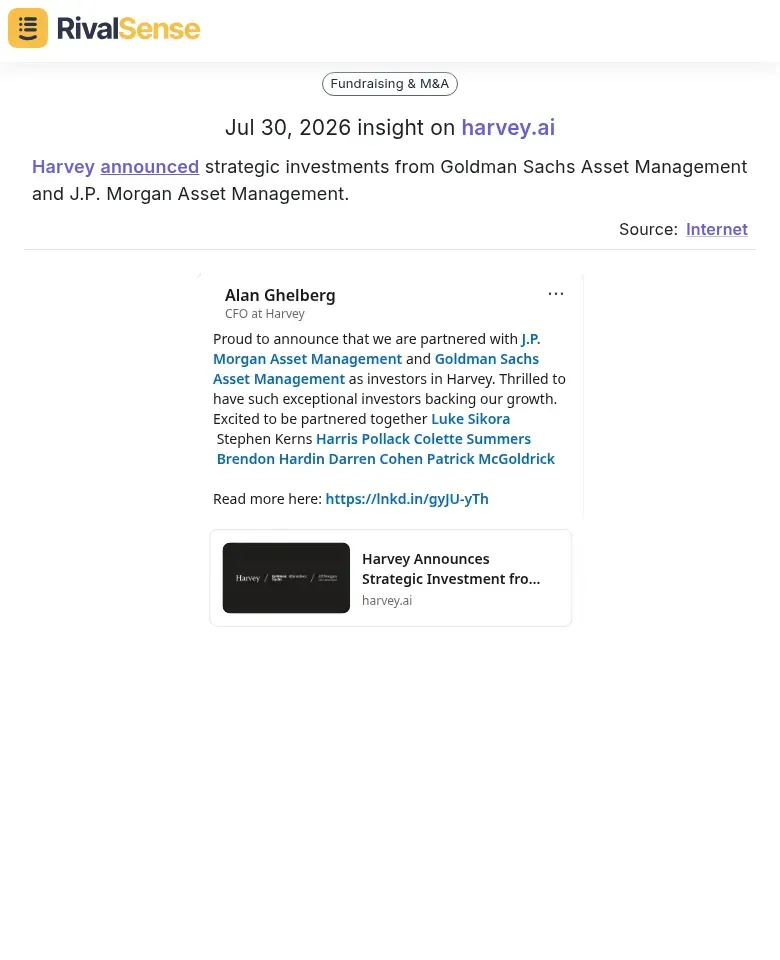
Consider Harvey’s strategic investments from Goldman Sachs Asset Management and J.P. Morgan Asset Management. That’s not just a cash injection—it’s a bet that legal AI will go mainstream, giving Harvey a deep war chest to price aggressively and capture market share before incumbents can react. Tracking such capital events helps you anticipate discounting pressure in your segment months before it hits your renewal pipeline.
Three practical steps:
- Map money to segments. Track which verticals and customer segments investors are backing. Venture capital gravitates toward where it believes profits live—mirror that logic in your own price segmentation. If a rival just raised to attack the mid-market, expect them to price for ownership there, not for margin.
- Estimate the burn clock. Divide the round by estimated monthly burn to calculate how long they can sustain discounts. That number defines your response window: hold pricing and compete on value, or reposition before their runway runs out.
- Set funding alerts. Monitor announcements for your top five competitors via Crunchbase or news alerts. Treat each raise as a trigger to re-run your pricing scenarios and refresh your win-loss data.
Quick tip: also watch secondary-market valuations and insider rounds—quieter, but often earlier and more honest signals than the celebratory press release.
Interpreting Acquisitions: M&A as a Roadmap for Pricing Power
An acquisition is your competitor publishing their pricing roadmap early. When a rival buys a capability leader, they're not just acquiring tech—they're buying the right to reposition around it. Consolidation almost always precedes a shift toward premium, outcome-based, or long-horizon pricing, because the acquirer now owns more of the value chain and can charge for outcomes instead of seats.
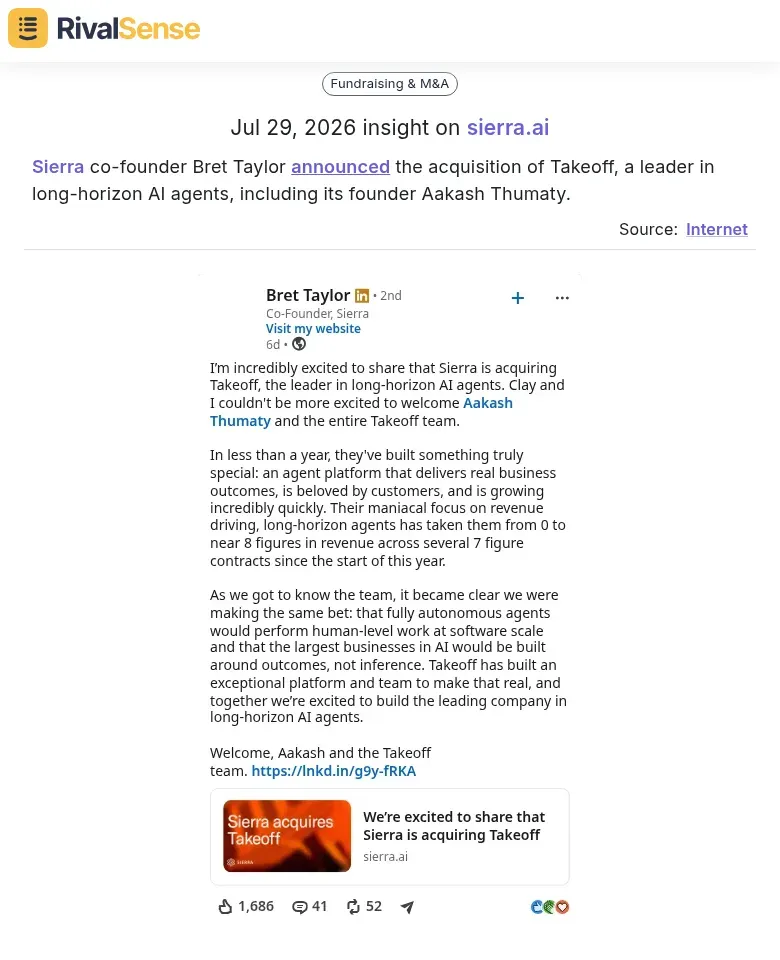
Take Sierra’s acquisition of Takeoff, a leader in long-horizon AI agents, and its founder Aakash Thumaty. It’s a textbook capability deal that signals an intent to offer sophisticated, multi-step automation—and likely to pivot pricing from per-seat to outcome-based metrics. Spotting this early gives you time to adjust your own packaging before the new tier becomes the market’s reference point.
Use this 3-step workflow to decode any deal:
- Classify the target. If the acquired company owns a capability your competitor lacked, expect an upmarket move. Set a reminder to re-check their pricing page for a migration from per-seat to usage-, value-, or outcome-based metrics within 6–9 months.
- Infer the adjacency. The acquired asset reveals which adjacent problem they'll solve next. Ask: what does this capability unlock? That's their next feature—and your pricing head start. Set your premium tier's price before their feature parity lands, because buyers anchor on whoever prices the capability first.
- Predict the packaging. Capability acquisitions typically surface as either a new standalone tier (a land-and-expand play) or a bundled enterprise suite (a consolidation play). Expect standalone tiers first, with suite bundles following within a quarter as they reprice the whole stack.
Pro tip: Add an "M&A watch" column to your competitor tracker. When a deal closes, flag their pricing page for review at day 30, 90, and 180—that's when repackaging usually ships.
Building a Weekly Competitor Intelligence Workflow
The most dangerous competitor insight is the one you read about, nod at, and then forget. Without a system, intelligence becomes noise. Here's how to build a weekly workflow that turns signals into pricing leverage.
Step 1: Lock your cadence. Block 60 minutes every Monday for a weekly scan—product launches, pricing updates, funding announcements, M&A moves. Once a month, schedule a 2-hour deep-dive to spot trends across the quarter. Both feed into one central log (a spreadsheet or Notion table works): date, competitor, signal type, source URL.
Step 2: Use a signal-to-implication template. For every logged signal, answer two questions: What happened? and What does it mean for our pricing? Force yourself to write a pricing hypothesis with a confidence level (High/Medium/Low). Example: "Competitor X introduced usage-based pricing tiers → our flat pricing may lose SMBs → Hypothesis: add a usage tier at $X/month (confidence: Medium)."
Step 3: Assign owners before acting. Every hypothesis needs a validator. The pricing owner checks primary sources—pricing pages, live trials, sales call notes—before anything changes. If a signal can't be verified within two weeks, it drops to the watch list.
Pro tip: Never change prices on an unvalidated signal. The workflow's job is to separate what's real from what's loud—and to make sure your pricing decisions are backed by evidence, not headlines.
From Intelligence to Action: Translating Signals Into Pricing Power
Raw competitor data is noise until you filter it through a pricing lens. Here's how to turn signals into action.
1. Prioritize by pricing headroom impact. Not every competitor move deserves a response. Score each signal on two axes: impact (does it directly threaten or expand your pricing headroom?) and urgency (how fast will it reach your buyers?). A rival's new enterprise tier with AI features is high-impact, high-urgency—act now. A redesigned logo? Log it and move on.
2. Run disciplined pricing experiments. Validate the signal before committing. When a competitor launches a cheaper entry plan, test your response in a controlled way:
- Tier changes: Add or reposition a tier to create a decoy effect
- Packaging: Bundle/unbundle features the competitor just highlighted
- Anchoring: Introduce a premium tier to reframe your mid-tier as the value pick
Pick one variable, define your metric (conversion rate, win rate, average deal size), and run it for 4–6 weeks against a control segment. Measure, then double down or roll back.
3. Close the loop quarterly. Competitors execute their roadmaps on their own timelines. Revisit your signal log every quarter: Which moves materialized? Which were vaporware? Did your pricing experiments hold up? Adjust your strategy accordingly—and archive signals that aged poorly.
Quick checklist:
- [ ] Score signals by impact + urgency
- [ ] One experiment at a time, with a clear metric
- [ ] Quarterly signal review on the calendar
Intelligence compounds only when it changes what you charge.
Stop chasing competitor intel manually. RivalSense tracks product launches, pricing updates, funding rounds, acquisitions, and more—across company websites, social media, and registries—and delivers a clear weekly email report. Turn the internet’s competitor noise into your next pricing move.
👉 Try RivalSense for free and get your first competitor report today.
📚 Read more
👉 Map Competitor Customer Journeys in Printing Industry
👉 5 Mistakes in Competitor M&A Analysis for SaaS Key Accounts
👉 When a Competitor Shuts Down: How to Spot and Capitalize on Market Exits Before Everyone Else
👉 How to Track Competitor Podcast Appearances (2026 Guide)
👉 SaaS Case Study: How Competitor Testimonials and Real-Time Intel Fuel Growth