
Track Competitor Website Changes: A Step-by-Step Guide
In the fast-paced world of B2B, your competitors' websites are a goldmine of strategic intelligence. Every page update, pricing change, or new case study can signal a pivot in their go-to-market strategy—often weeks before any press release or earnings call. By monitoring these changes in real time, you gain the ability to react faster to competitive moves, spot emerging industry trends, and adjust your own plans proactively.
Why focus on website changes?
- 🚀 Product updates: New features, integrations, or use cases appear first on product pages.
- 🎯 Positioning shifts: Taglines, value props, and target audience language reveal new market segments.
- 💰 Pricing adjustments: Price page updates hint at packaging changes or discount strategies.
- 📝 Content strategy: New blog topics, whitepapers, or webinars indicate areas where they’re investing thought leadership.
Quick-start checklist:
- Identify your top 3–5 competitors.
- Use a change detection tool (e.g., Visualping, Wachete, or RivalSense) to track key pages.
- Set up daily or weekly alerts for homepage, pricing, product, and careers pages.
- Create a shared dashboard to log and discuss findings with your team.
- Review changes weekly and ask: What does this mean for our roadmap?
By making competitor website monitoring a habit, you transform reactive guesswork into data-driven strategic decisions.
Setting Up a Competitor Website Tracking System
To set up an effective competitor website tracking system, start by selecting the right tools. Dedicated competitor tracking platforms like RivalSense offer automated monitoring of website changes, while change detection services (e.g., Visualping, Distill) can alert you to specific page updates. For budget-conscious teams, manual monitoring with browser alerts or RSS feeds works but requires discipline.
Next, define your competitor list. Prioritize based on market overlap (direct competitors), growth trajectory (fast-rising challengers), and strategic relevance (companies targeting similar customer segments). Limit your list to 5–10 key competitors to avoid overload.
Establish a review cadence: check high-priority competitors daily (e.g., homepage changes, pricing updates), secondary ones weekly (e.g., blog posts, case studies). Use a shared dashboard or spreadsheet to log findings.
Pro tip: Set up automated alerts for critical changes (pricing, product launches) and schedule a weekly 30-minute review session to analyze patterns. This prevents information overload while keeping you ahead of market moves.
What to Look For: Key Types of Website Changes
When tracking competitor website changes, focus on three high-impact areas:
1. Content & Messaging Shifts
Monitor webinar titles, case studies, and landing page copy. A sudden pivot to “AI-powered” or “enterprise-grade” language signals new value propositions or target audiences.
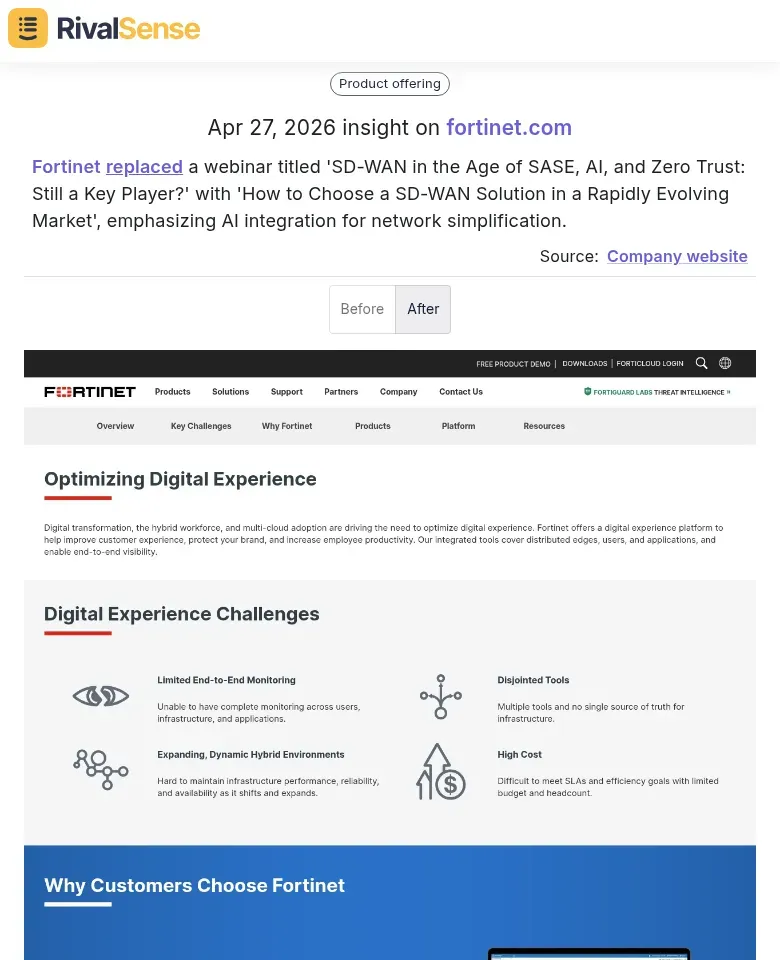
Real-world example: Fortinet replaced a webinar titled 'SD-WAN in the Age of SASE, AI, and Zero Trust: Still a Key Player?' with 'How to Choose a SD-WAN Solution in a Rapidly Evolving Market', emphasizing AI integration for network simplification. This type of content shift is valuable because it reveals where your competitor is doubling down on messaging—allowing you to counter with differentiated positioning or fill gaps they’ve abandoned.
Tip: Set up Google Alerts for competitor blog keywords to catch shifts early.
2. Product & Service Updates
Watch for new product categories, feature additions, or discontinued offerings. A competitor removing a pricing page often means they’re repositioning.
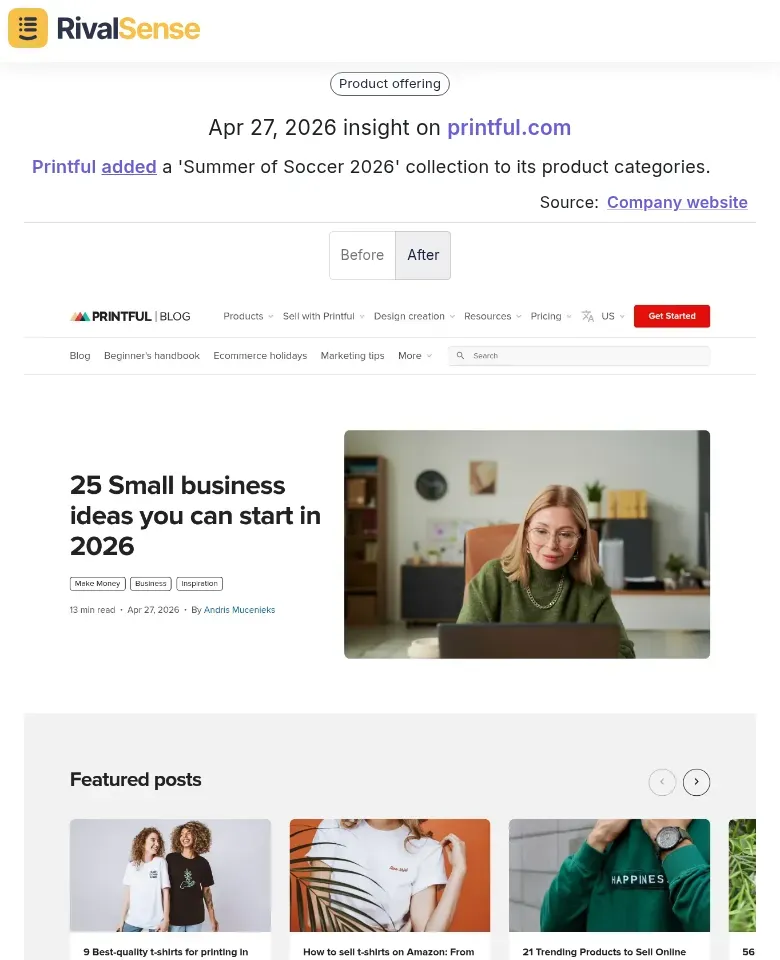
Real-world example: Printful added a 'Summer of Soccer 2026' collection to its product categories. This type of update matters because it signals seasonal, event-driven marketing—you can anticipate similar moves in your own industry (World Cup, Olympics) and plan campaigns or partnerships ahead of time.
Checklist: Track changelogs, “What’s New” pages, and job postings for engineering roles to infer upcoming features.
3. Corporate & Financial Disclosures
Annual reports, investor factsheets, and regulatory filings reveal performance and strategic priorities. Look for mentions of “restructuring,” “new markets,” or R&D spend increases.
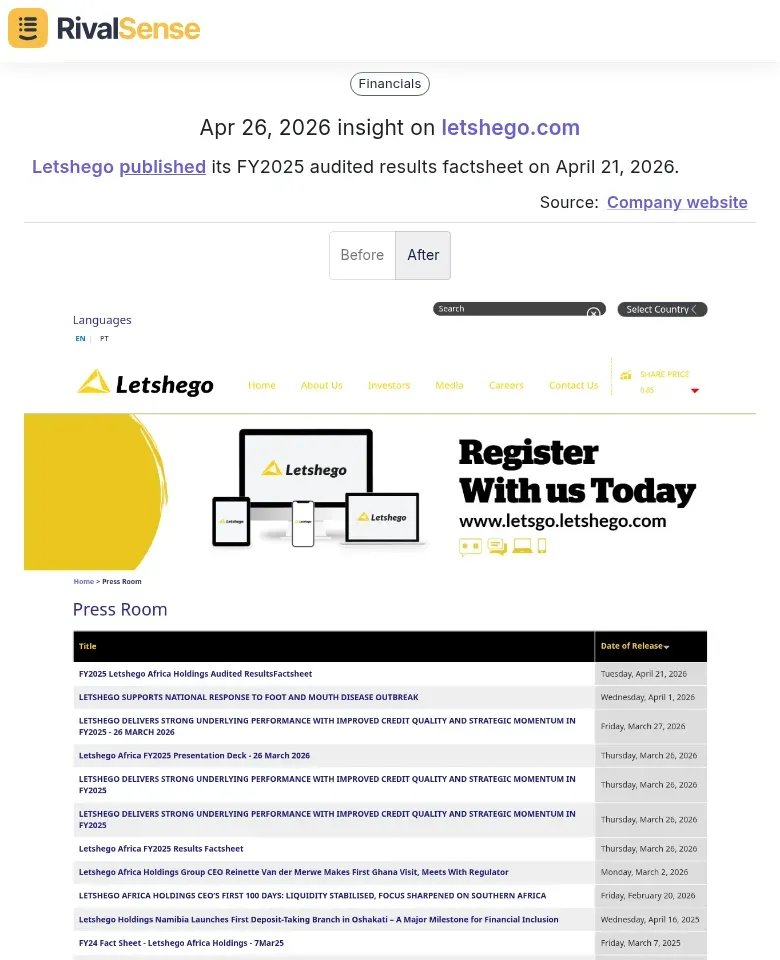
Real-world example: Letshego published its FY2025 audited results factsheet on April 21, 2026. This insight is invaluable because it provides hard data on revenue trends, regional growth, and investment focus—allowing you to benchmark your own performance and adjust strategic bets accordingly.
Hint: Use SEC EDGAR or your competitor’s investor relations page to automate alerts for filings.
Focus your tracking on these buckets to surface actionable intelligence, not noise.
Analyzing Website Changes for Actionable Insights
Once you've identified a competitor's website change, the real work begins: extracting actionable insights. Here's how to analyze changes systematically.
Connect changes to broader market trends. A competitor adding a soccer-themed collection isn't random—it signals seasonal or event-driven marketing. Ask: What major events (World Cup, back-to-school) are approaching? Are they targeting a new demographic? Use this to anticipate market shifts and align your own campaigns.
Identify gaps in your own offering. If a competitor suddenly emphasizes AI integration (like Fortinet’s webinar pivot), evaluate your product's stance. Checklist:
- Do we have comparable features?
- If not, is this a priority for our customers?
- Should we accelerate development or adjust messaging?
Assess timing and frequency. A sudden flurry of updates (new pages, redesigned pricing, multiple blog posts) often precedes a major launch or rebranding. Track change velocity using a simple spreadsheet: date, change type, URL, and your hypothesis. If you see 5+ changes in a week, dig deeper—visit their social channels, check job postings, and monitor press releases.
Pro tip: Set up alerts for specific pages (pricing, product, careers) to catch high-impact changes first. Combine website change data with third-party signals (Crunchbase funding, LinkedIn hiring) for a complete picture.
Turning Insights into Strategic Decisions
Once you’ve gathered competitor change data, the real value lies in acting on it. Here’s how to turn insights into strategic moves:
1. Refine Your Content & SEO Strategy
- Fill abandoned topics: If a competitor stopped covering a high-value keyword, create content to capture that traffic.
- Expand on emerging themes: When they publish on a new trend, double down with deeper analysis or unique angles.
- Checklist: Monthly, review competitor blog changes → identify gaps → update your editorial calendar.
2. Adjust Product Roadmap Priorities
- Feature launches: If a competitor ships a feature your customers request, consider accelerating your own or adding a differentiator.
- Deprecations: When they remove a feature, survey your users—if it’s valued, keep it and highlight your stability.
- Tip: Maintain a “competitive delta” list to track where you lead, match, or lag.
3. Empower Sales & Marketing
- Real-time intelligence: Share weekly digests of competitor changes with sales teams so they can update battle cards.
- Objection handling: If a competitor launches a new pricing model, prepare rebuttals and comparison sheets.
- Step: Set up a Slack channel where automated alerts feed competitor updates → sales reviews during weekly stand-ups.
By systematically turning competitor changes into actionable tasks, you stay ahead—not just reactive.
Best Practices for Sustainable Competitor Tracking
To make competitor tracking a lasting, high-impact practice, follow these guidelines:
1. Automate, Then Analyze
Use tools like RivalSense to monitor website changes, pricing updates, and content shifts automatically. But never skip human analysis. Automated alerts flag what changed; your team must interpret why—e.g., a new pricing page might signal a pivot to premium tiers or a response to market pressure. Schedule weekly 30-minute reviews to discuss context and intent.
2. Centralize Your Intelligence
Maintain a shared repository (e.g., a Notion database or Google Sheet) with columns for: date detected, change type (pricing, feature, messaging), category (product, marketing, hiring), and action items. Tag relevant team members. This ensures everyone—from product to sales—can access and act on insights without silos.
3. Revisit Your Scope Quarterly
Markets shift. Every quarter, audit your competitor list: remove irrelevant players, add emerging threats, and adjust tracking criteria (e.g., new keywords or feature categories). A checklist:
- Review top 5 competitors’ recent moves
- Scan industry reports for new entrants
- Update your tracking dashboard filters
Staying agile prevents wasted effort on outdated signals.
Pro Tip: Combine automated alerts with a monthly “Competitor Deep Dive” where one team member presents a single competitor’s trajectory—this builds collective intelligence and strategic foresight.
Ready to Make Competitor Tracking Effortless?
Competitor website changes hold the keys to your next strategic move—but manually checking every page is unsustainable. With RivalSense, you get automated weekly reports covering product launches, pricing updates, partnerships, management changes, and more—all curated from company websites, social media, and public registries.
Try RivalSense for free and get your first competitor report today.
📚 Read more
👉 Uncover Key Account Opportunities in Grocery Retail with Data-Driven Insights
👉 Unlock Growth: Track Key Account Feedback for Smarter Partnerships
👉 How to Turn a Competitor’s Tachograph Mandate Pivot Into Your Own Growth Opportunity
👉 The Real-World Benefits of Competitive Intelligence Software (And How to Actually Use It)
👉 Key Account Management Best Practices for Influencer Platforms