
How to Use Competitive Intel for Successful Market Entry
Entering a new market without competitive intelligence is like sailing without a map—you risk costly missteps, wasted resources, and strategic blunders. Competitive intel acts as your compass, transforming raw data into actionable insights that reveal gaps, threats, and timing opportunities.
Why it matters: Competitor moves—funding rounds, key hires, product launches, customer case studies—are early warning signals. A rival's expansion into a region might signal untapped demand or, conversely, a saturated battlefield. Their hiring spree in sales could indicate aggressive go-to-market plans. Their case studies highlight which customer segments are most receptive, validating your targeting assumptions.
Practical steps to start:
- Monitor funding and M&A – Use tools like Crunchbase or PitchBook to track who's investing where. A competitor's new funding often precedes market entry.
- Track hiring patterns – Sudden spikes in sales, marketing, or support hires in a specific geography signal imminent expansion.
- Analyze customer content – Review case studies, testimonials, and press releases to identify which verticals or use cases competitors prioritize.
- Set up alerts – Use Google Alerts or competitive tracking tools for real-time updates on competitor news.
Checklist for your next market entry:
- [ ] Identify top 3 competitors in the target market.
- [ ] Map their funding history and recent hires.
- [ ] Analyze their customer success stories for common pain points.
- [ ] Note any product gaps or underserved segments.
Competitive intel doesn't just reduce risk—it uncovers opportunities your rivals have missed. Use it to navigate confidently, avoid icebergs, and claim your market share.
Spotting Expansion Signals: Where and When Your Rivals Are Moving
When scouting new markets, your competitors' moves can reveal validated playbooks. Look for three key signals:
1. Revenue & Geographic Expansion
A sudden revenue spike followed by launches in new regions indicates a repeatable model. For example, Everlab grew revenue 23x last year and is expanding to New Zealand and the UK, with Stripe publishing a case study on its payments infrastructure. This type of insight is valuable because it highlights a proven business model and identifies high-potential markets where demand is already validated by a competitor's success.

2. Partnership Case Studies
Partnerships like Stripe's with Everlab hint at infrastructure choices. Track which integrations your rivals announce—they reveal operational priorities and tech stacks you can benchmark.
3. Hiring Patterns
A dedicated account manager in a new region signals serious local commitment. Use LinkedIn to track job postings: look for roles like "Regional Sales Lead" or "Customer Success Manager" in target geographies.
Actionable Checklist:
- Set Google Alerts for competitors + "expansion", "launch", "partnership".
- Review Crunchbase for funding rounds tied to geographic growth.
- Scan LinkedIn weekly for new hires in target regions.
- Analyze partnership announcements for technology or channel clues.
By decoding these signals, you can anticipate market moves and adapt your strategy before entering.
Regulatory and Political Triggers: Turning Threats into Opportunities
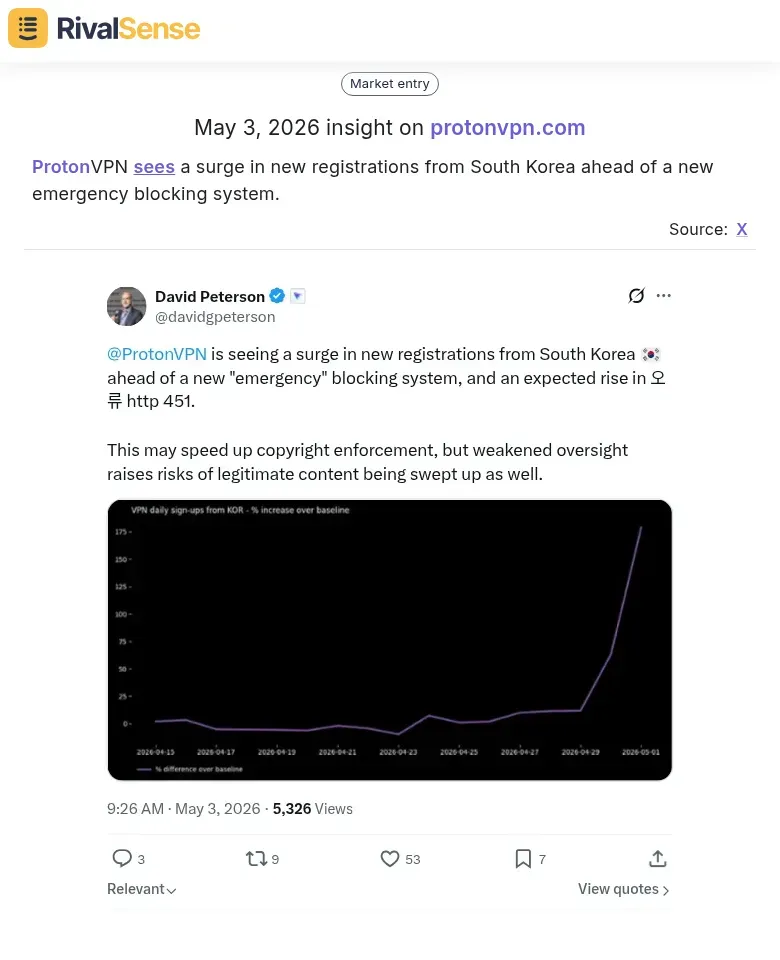
Regulatory and political shifts often create market chaos—but for the savvy entrant, they signal opportunity. For instance, ProtonVPN saw a surge in new registrations from South Korea ahead of a new emergency blocking system. This type of insight is valuable because it reveals a direct demand spike triggered by a regulatory change, allowing you to time your market entry with precise awareness of competitor traction and customer pain points.
Practical steps:
- Track competitor responses to recent regulations. Are they raising prices, limiting features, or exiting markets? Each move reveals an underserved segment. For example, if incumbents hike prices post-GDPR, you can enter with a privacy-first, lower-cost alternative.
- Use regulatory timelines as entry signals. When a new law is announced, competitors scramble to comply—often neglecting customer communication. Launch during this window with clear messaging about how your solution addresses the change.
- Build a regulatory watchlist. Set Google Alerts for keywords like "[industry] regulation" + "competitor name." Sudden policy shifts or compliance announcements are your cue to act.
Pro tip: Create a simple scorecard rating each competitor's readiness for upcoming regulations. The laggards are your entry points.
Decoding Hiring and Office Expansion: A Window into Strategic Priorities
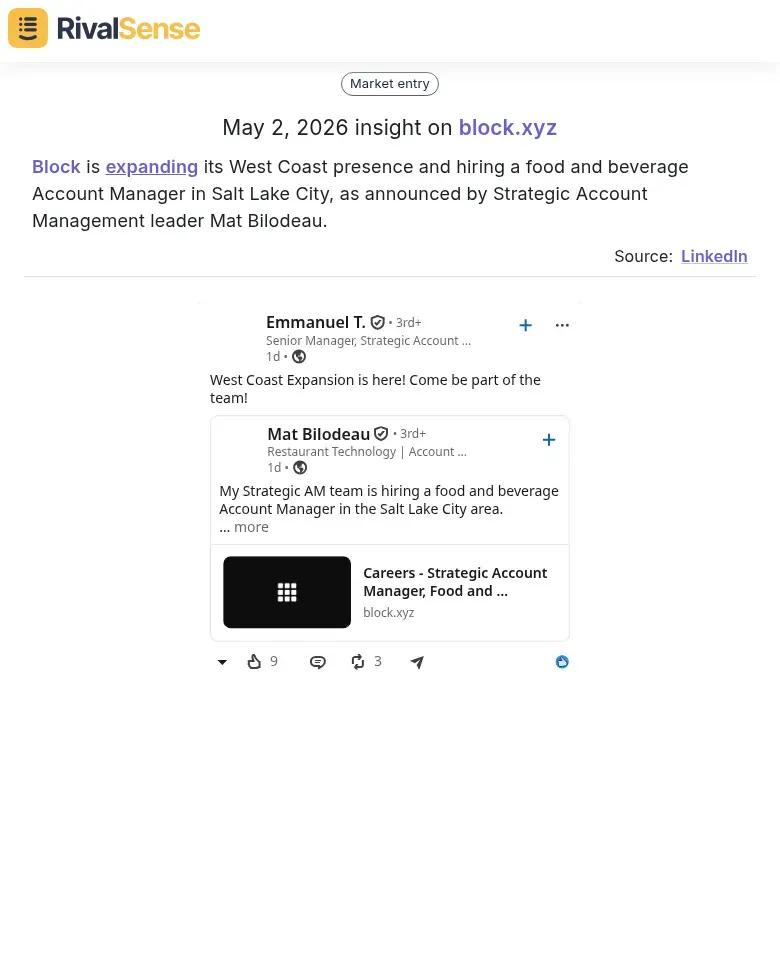
When a competitor opens a new office or posts a cluster of job listings in a specific geography, they're telegraphing where they see the next growth frontier. For example, Block is expanding its West Coast presence and hiring a Food and Beverage Account Manager in Salt Lake City, as announced by Strategic Account Management leader Mat Bilodeau. This type of insight is valuable because it reveals a specific vertical focus (food & beverage) and geographic priority, helping you decide whether to compete head-on or pivot to an underserved segment.
Actionable steps:
- Track geographic hiring patterns. Use tools like RivalSense to aggregate job postings by location. If a rival suddenly hires 20 sales reps in Austin, ask: Are they chasing a tech boom or a specific industry cluster?
- Analyze role-specific hires. A "Food & Beverage Account Manager" posting reveals a vertical focus. Decide whether to compete head-on or pivot to an underserved segment.
- Follow leadership announcements. When Mat Bilodeau publicly states they're "doubling down on enterprise," that's a direct signal of resource allocation.
Pro tip: Create a simple spreadsheet mapping competitor office openings and key hires to your own market entry timeline. This helps you anticipate their moves and differentiate your strategy.
From Signals to Strategy: Building Your Market Entry Playbook
Step 1: Synthesize signals into a market-specific SWOT.
Don't just list competitors' strengths and weaknesses in general. Map each signal (e.g., a new hire, a pricing change, a product launch) to your target market. For example, if a competitor opens a support center in Germany, that's a strength in DACH but irrelevant in APAC. Use a simple matrix:
- Strengths (e.g., brand loyalty in France)
- Weaknesses (e.g., poor local language support in Spain)
- Opportunities (e.g., unmet needs they ignore)
- Threats (e.g., their patent filings in your niche)
Step 2: Prioritize markets where competitors are weak or distracted.
Avoid head-on battles in saturated regions. Instead, look for:
- Markets where competitors are overextended (e.g., rapid hiring across multiple countries suggests thin resources).
- Regions they've just entered (they're still learning; you can leapfrog).
- Gaps in their product localization or customer support.
Checklist for market prioritization:
- [ ] Competitor market share < 15%
- [ ] No dominant local player
- [ ] Competitor's recent layoffs or office closures
- [ ] Regulatory changes favoring new entrants
Step 3: Validate timing with macro and regulatory data.
Cross-reference competitor moves with external factors. For instance, if a rival launches in Brazil right after a tax reform, that signals a favorable window. Use tools like Google Trends, government trade portals, and industry reports to confirm demand and regulatory ease.
Pro tip: Set up alerts for competitor job postings in target countries – a sudden spike in sales hires often precedes a market push. Use that as your cue to accelerate or pivot.
Conclusion: Stay Agile – Competitive Intel Is a Continuous Process
Market entry isn't a one-time launch—it's an ongoing cycle of adaptation. Competitors will pivot, new entrants will emerge, and customer needs will shift. To stay ahead, treat competitive intelligence as a continuous process, not a project.
Build a systematic intel-gathering process:
- Set up automated alerts (Google Alerts, Crunchbase, G2) for competitor product launches, funding news, and leadership changes.
- Schedule weekly 30-minute scans of competitor blogs, social media, and review sites.
- Hold monthly cross-functional reviews (product, marketing, sales) to discuss findings and adjust strategy.
Combine quantitative and qualitative data:
- Quantitative: Track growth rates, hiring numbers, website traffic, and pricing changes. Use tools like SimilarWeb or LinkedIn Talent Insights.
- Qualitative: Analyze case studies for customer pain points, read leadership interviews for strategic hints, and monitor support forums for feature requests.
Quick checklist for ongoing intel:
- [ ] Set up 5+ competitor alerts
- [ ] Create a shared dashboard (e.g., Notion, Airtable)
- [ ] Assign one owner per competitor
- [ ] Review insights monthly with your team
Remember: The goal isn't to copy competitors—it's to anticipate their moves and differentiate your offering. Stay agile, keep listening, and let competitive intel guide your market entry strategy from day one and beyond.
Ready to put these insights into action? Try RivalSense for free to automatically track your competitors' product launches, pricing updates, hiring moves, and more—all delivered in a weekly email report. Get your first competitor report today and start making smarter market entry decisions.
📚 Read more
👉 Real-World Competitor Analysis: Tracking Product Additions
👉 Key Account Sales Tracking: The Metrics That Actually Move the Needle
👉 How to Predict Your Competitors' Next Content Moves (and Win in App Dev)