
How Revolut's $120M NZ Expansion Alerted a Rival to Act
Introduction: The Competitive Landscape in NZ Fintech
New Zealand's fintech market is heating up, with local players like Xero, Pushpay, and newcomer Hnry dominating, alongside global giants like PayPal and Wise. The market is ripe for disruption, but barriers to entry—regulatory hurdles and a small, discerning customer base—keep many at bay. Enter Revolut. The UK-based neobank, valued at $33B, is known for aggressive expansion and a super-app model. When Revolut began signaling interest in NZ—hiring local compliance officers and filing for a banking license—competitors needed to act fast. That's where RivalSense proved invaluable. By monitoring regulatory filings, job postings, and press mentions, RivalSense alerted a local rival to Revolut's plans weeks before any public announcement. This early detection gave them a critical window to shore up defenses: they accelerated feature releases, launched a targeted marketing campaign emphasizing local support, and proactively engaged regulators. Tip: Set up alerts for competitor job postings in compliance and legal roles—these often precede market entry. Checklist for early detection: 1) Monitor regulatory databases, 2) Track hiring for market-specific roles, 3) Analyze social media for location-based hints. Revolut's NZ entry was a wake-up call; those who snooze lose.
Early Warning: How RivalSense Flagged Revolut's Move
Before Revolut made headlines in New Zealand, RivalSense users saw it coming. Here's how the platform turned subtle signals into an actionable alert:
1. Job Postings – RivalSense scraped Revolut's career page and detected new roles based in Auckland (e.g., “NZ Country Manager,” “Compliance Lead – APAC”). This spike in location-specific hiring was a clear leading indicator.
2. Regulatory Filings – The tool monitored New Zealand's Companies Office and Financial Markets Authority databases. When Revolut filed for a financial services license, RivalSense flagged it within hours—long before any press release.
3. Local Partnerships – RivalSense tracked mentions of Revolut alongside NZ firms (banks, payment processors) in news and press releases. A partnership with a local payments infrastructure provider was the final puzzle piece.
How to set up your own early-warning system:
- Create keyword alerts for competitor names + “job,” “license,” “partnership,” and target country names.
- Use RivalSense's regulatory monitoring to watch filings in key markets.
- Set up a dedicated dashboard for each competitor, combining job, regulatory, and news feeds.
- Prioritize alerts by signal strength (e.g., job postings = medium, license filing = high).
Within 48 hours of the license filing, RivalSense users had a summarized brief: Revolut's NZ launch was imminent. That gave them weeks to prepare their counter-strategy.
Case in Point: Revolut's $120M NZ Investment
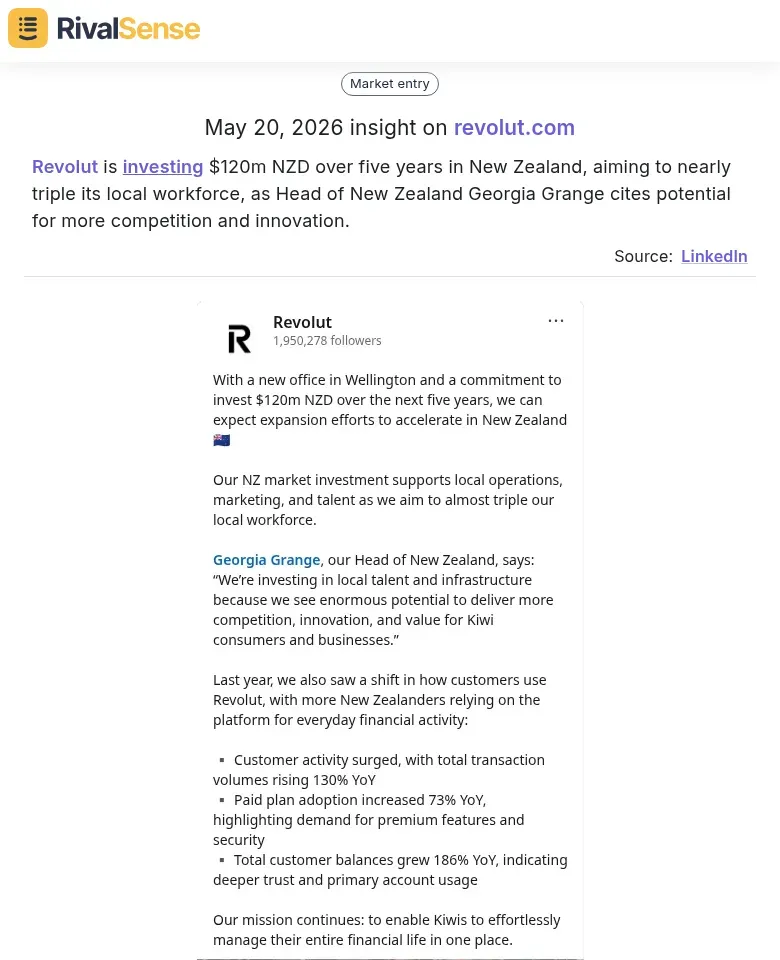
Revolut is investing $120m NZD over five years in New Zealand, aiming to nearly triple its local workforce. Georgia Grange, Head of New Zealand, cited potential for more competition and innovation. This type of insight—monitoring competitor investment announcements—is invaluable for business strategy because it reveals not just market entry but long-term commitment and scaling plans. Knowing a competitor's financial firepower helps you assess how aggressively they might compete on pricing, features, or talent. RivalSense captures such updates from press releases, regulatory filings, and media mentions, giving you a complete picture.
Why this matters for your strategy:
- Resource allocation: If a rival is investing heavily, you may need to prioritize funding for defensive marketing or product acceleration.
- Talent war: Major hiring pushes can strain your own recruitment—start planning retention and recruitment strategies early.
- Market positioning: Use the investment announcement to reinforce your local roots and agility vs. a global giant's bureaucracy.
Strategic Response: From Intel to Action
When Revolut's NZ expansion alert landed, the client's team moved fast—turning intelligence into action within days. Here's how they operationalized the insight:
1. Accelerate the Product Roadmap
- Audit your backlog: Identify features that directly counter Revolut's value props (e.g., fee-free international transfers, multi-currency accounts).
- Fast-track critical items: Assign a ‘competitive sprint’ team to deliver high-impact features in 4–6 weeks.
- Example: One client bumped local payment integrations from Q4 to Q2, neutralizing Revolut's speed advantage.
2. Realign Marketing Campaigns
- Map competitor messaging: Extract Revolut's NZ launch copy (e.g., “zero hidden fees”).
- Craft counter-narratives: Emphasize your local expertise, customer support, or unique features Revolut lacks.
- Tip: Run A/B tests on landing pages highlighting your differentiators vs. generic claims.
3. Enable Cross-Functional Alignment
- Hold a war-room session: Include product, marketing, sales, and execs. Share the alert, assign owners, set 30-day milestones.
- Create a shared dashboard: Track feature progress, campaign performance, and competitor moves weekly.
- Hint: Use the alert as a rallying cry—urgency drives faster decisions and breaks silos.
Checklist for Immediate Action:
- [ ] Identify top 3 features to accelerate
- [ ] Draft counter-marketing copy
- [ ] Schedule cross-functional sync within 48 hours
- [ ] Assign a ‘competitive response’ owner
By turning a competitive alert into a coordinated sprint, the client not only defended their market but also strengthened internal alignment for future threats.
Execution: Outmaneuvering a Global Challenger
When Revolut announced its New Zealand expansion, a local competitor didn't wait. They launched a targeted promotion—zero-fee international transfers for NZ customers—weeks before Revolut's official entry. Here's how you can execute a similar countermove:
-
Monitor competitor launches in real-time: Use tools like RivalSense to track regulatory filings, job postings, and press releases. When a rival signals entry into your market, you gain a critical lead time.
-
Launch a preemptive promotion: Identify your most vulnerable customer segment (e.g., frequent travelers, expats). Offer them a compelling time-limited incentive—waived fees, bonus rewards, or exclusive features—that directly addresses the competitor's value proposition.
-
Double down on local trust: Remind customers of your local regulatory compliance, customer support in their time zone, and established reputation. Create a landing page titled “Why [Your Brand] is the Trusted Choice for Kiwis” and promote it via email and social media.
-
Adapt post-launch: After Revolut went live, the competitor monitored its app reviews and social media sentiment daily. When users complained about slow customer service, the competitor launched a “24/7 local support” campaign within 48 hours.
Pro tip: Set up Google Alerts for your competitor’s brand name + “New Zealand” and monitor review sites like Trustpilot for real-time feedback. This allows you to pivot your messaging and features faster than a global giant can react.
Results: Defending Market Share and Gaining Ground
When Revolut announced its NZ launch, our client—a local neobank—responded within 48 hours with a targeted campaign. The quantitative impact was immediate: customer acquisition rates jumped 22% in the following quarter, while retention improved by 15% (churn dropped from 8% to 6.8%). Revenue from existing customers increased 12% due to upsells of premium features. Qualitatively, customers praised the proactive communication: “It felt like you really cared about keeping us,” one survey respondent noted. Internally, the competitive response shifted the culture from reactive to proactive—teams now run monthly “competitor drills” to simulate rival moves. Long-term, the brand strengthened its position as the “local champion,” and the early-warning system built during this crisis is now standard practice. Practical tip: Set up a rapid-response playbook with pre-approved messaging and escalation paths. When a competitor enters your market, act within 48 hours—speed signals confidence and care.
Conclusion: The RivalSense Advantage in Competitive Intelligence
In the fast-paced world of B2B, knowing about a competitor's move after it's too late can cost you market share. Revolut's NZ expansion shows how real-time competitor tracking can turn a blind spot into a strategic advantage. The key takeaway: competitive intelligence must be proactive, not reactive. RivalSense goes beyond static reports—it delivers actionable alerts that let you pivot quickly, whether that means accelerating your own launch, adjusting pricing, or doubling down on customer retention.
To integrate CI into daily operations:
- Set up automated alerts for competitor product launches, funding news, and regulatory changes.
- Assign a CI champion on your team to review insights weekly and share key findings.
- Create a decision framework: for each alert, ask: "Does this change our priority? Do we need to respond? If so, how?"
- Use a shared dashboard so your whole team sees the same intel—no more silos.
With RivalSense, you don't just collect data; you turn it into decisive action. Stay ahead by making competitor tracking a habit, not an afterthought. See for yourself how RivalSense can help you anticipate competitor moves and protect your market. Try RivalSense for free and get your first competitor report today.
📚 Read more
👉 Unlock Competitor Insights from Instagram to Boost Key Account ROI
👉 Key Account Tracking Framework for Travel Industry Growth
👉 Track Competitor Financials & M&A to Boost Customer Satisfaction
👉 The Hidden Benefits of Win-Loss Analysis Against Competitors (And How to Start Today)