
Unlock Competitor Insights from Instagram to Boost Key Account ROI
Introduction: Why Instagram is a Goldmine for Competitor Intelligence
Instagram isn't just for lifestyle influencers—it's a real-time window into your competitors' strategic playbook. While most marketers track likes and follower counts, savvy competitive intelligence pros dig deeper. Instagram reveals subtle yet powerful signals: new partnerships tagged in Stories, product teasers in Reels, messaging shifts in captions, and audience sentiment in comments. These insights directly impact your key account ROI by helping you refine positioning, anticipate competitor moves, and tailor outreach.
How to extract actionable intel:
- 📅 Monitor Stories daily – Competitors often announce partnerships or limited-time offers here before anywhere else. Set a 10-minute daily scan.
- 💬 Analyze comment sentiment – Look for recurring customer pain points or praise. Use tools like Emplifi or native insights to spot trends.
-
️⃣ Track hashtag strategy – Are they targeting new industry hashtags? That signals a positioning shift.
- 📈 Benchmark engagement rates – Calculate (likes+comments)/followers. A sudden spike may indicate a viral campaign worth studying.
- 📝 Create a competitive Instagram tracker – Use a spreadsheet to log key moves weekly: new collaborators, content themes, CTAs.
Pro tip: Turn on post notifications for top 3 competitors. You'll catch real-time moves before they're buried in the algorithm.
🎯 Spotting Brand Pivots and Campaign Strategies
Instagram is a goldmine for detecting competitor pivots before they hit the mainstream. A logo change or visual rebrand often signals a major campaign, product launch, or strategic shift. For instance, Spotify changed its logo to a disco ball to celebrate its 20th anniversary with the campaign "Your Party of the Year(s)."
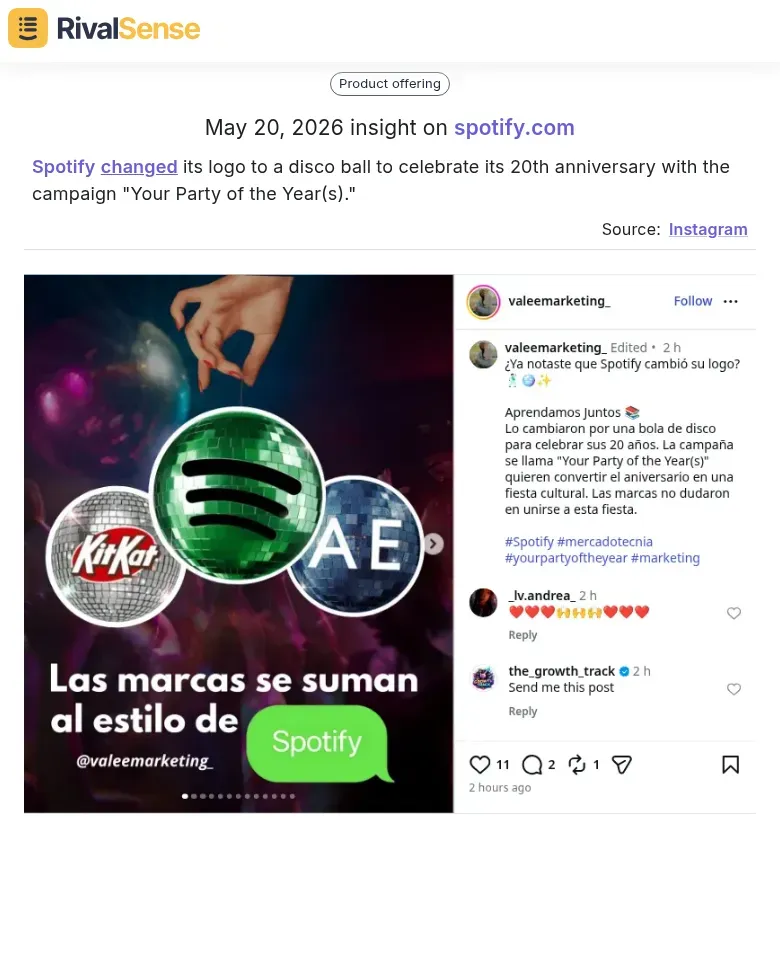
This type of insight is valuable because it reveals a competitor's marketing focus and timing—important for planning your own account campaigns. If a competitor invests heavily in a nostalgic campaign, you can differentiate by positioning your product as forward-looking.
How to analyze:
- 🔍 Track visual changes: Use a tool like RivalSense to monitor profile pics, highlights, and feed aesthetics weekly. Note the exact date of change.
- ⏰ Decode the timing: Was it tied to a holiday, industry event, or earnings report? For example, a fintech brand switching to a minimalist logo right before a new app release.
- 🗣️ Gauge audience reaction: Scroll comments and sentiment. Did followers love or hate it? High engagement with confusion might mean the pivot needs clarification.
- 🔗 Connect the narrative: Pair the visual shift with recent captions or Stories. Are they teasing something? Spotify's disco ball preceded a Wrapped campaign—your competitor might be signaling a loyalty push.
Actionable steps:
- Create a “visual pivot log” in a spreadsheet: date, brand, old vs. new asset, suspected reason.
- Set Google Alerts for your competitor’s brand name + “logo” or “rebrand”.
- Use Instagram’s “Following” feed to catch changes in real time.
Refine your own strategy:
- If a competitor pivots to a playful aesthetic, test a similar tone with your top accounts.
- Launch seasonal offers that mirror their timing but with your unique spin (e.g., if they go dark and serious, you go bright and celebratory).
🤝 Identifying Partnership and Sponsorship Opportunities
Instagram is a goldmine for spotting grassroots and niche partnerships your competitors are quietly building. For example, Pinter partnered with Walthamstow FC and Wood Street Walls to support grassroots football at Wadham Lodge.
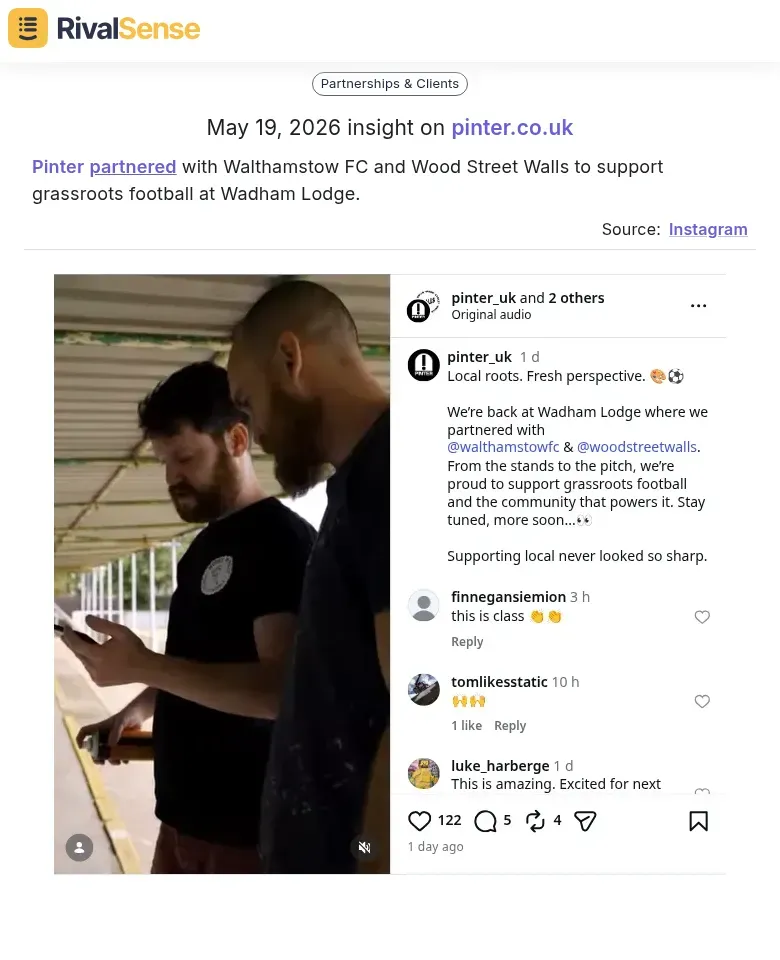
This kind of insight is valuable because it reveals a competitor's target demographic, community engagement tactics, and co-branding potential. You can leverage similar opportunities for your key accounts.
To uncover such opportunities, follow this checklist:
- [ ] Monitor competitor Instagram feeds weekly for partnership announcements. Use tools like RivalSense to track mentions and tags.
- [ ] Analyze the partner’s audience – check their follower demographics and engagement rates to see if they align with your key account’s target market.
- [ ] Identify the engagement tactics used (e.g., co-hosted events, limited-edition products, exclusive discounts).
- [ ] Assess co-branding potential – look for visual or thematic synergies between the competitor and partner.
Practical tip: Create a swipe file of competitor partnership posts and annotate what worked (e.g., high comment engagement, user-generated content). Then pitch a similar model to your key account, customizing it to their audience. For example, if a competitor partnered with a local sports club, propose a similar collaboration with a club in your key account’s region. This demonstrates proactive value and strengthens your relationship.
🎙️ Mining Thought Leadership and Educational Content
Competitors’ podcasts, interviews, and expert posts are goldmines for insights. For instance, Hostfully's Host Planet podcast featured architect Peter Markos warning that most UK holiday lodge cabins have a shelf life of just 5–10 years, impacting long-term budgeting for investors.

This type of insight is valuable because it flags regulatory or market shifts early—allowing you to address key account concerns before competitors do.
How to mine effectively:
- 🔁 Identify recurring themes – Note pain points or trends mentioned across multiple episodes or posts (e.g., “rising compliance costs”).
- 📊 Extract actionable data – Use a simple tracker (spreadsheet or tool) to log themes, frequency, and competitor mentions.
- 💡 Build value propositions – Turn themes into talking points: “We’ve seen 40% of leaders cite X – here’s how we solve it.”
Pro tip: Set a weekly alert for competitor podcasts. Listen while commuting and jot down 3 insights per episode. Over a month, patterns emerge that differentiate your pitch.
Checklist for each piece:
- [ ] What pain point is highlighted?
- [ ] What solution is implied?
- [ ] How can I reframe this for my key account?
By tracking these, you’ll enter conversations with data-driven authority, not just opinions.
🔄 Translating Instagram Insights into Key Account Actions
To turn Instagram insights into actionable key account strategies, build a competitive intelligence dashboard. Use tools like RivalSense to monitor competitor posts, engagement spikes, and new partnerships. Then, map each insight to specific accounts.
Step 1: Identify Signals
Track competitor announcements (e.g., product launches, collaborations, leadership changes). For example, if a competitor partners with a logistics firm, your key account in the same industry may need a revised value proposition.
Step 2: Personalize Outreach
Reference a competitor’s recent Instagram campaign in your email: “Noticed [Competitor] is highlighting [feature]. We’ve taken a different approach that directly addresses [Account’s Pain Point].”
Step 3: Anticipate Objections
If a competitor posts about a price drop, prepare talking points emphasizing your total cost of ownership or ROI.
Step 4: Demonstrate Market Awareness
Share a brief competitive update during quarterly reviews. Example: “We’ve seen [Competitor] push into [segment]; here’s how our roadmap keeps you ahead.”
Checklist for Your Dashboard:
- [ ] Competitor Instagram handles
- [ ] Key metrics: post frequency, engagement rate, sentiment
- [ ] Alerts for new partnerships or product tags
- [ ] Notes on account-specific implications
By systematically translating social signals into strategic moves, you’ll strengthen relationships and drive ROI.
📈 Conclusion: Turning Social Signals into Revenue Growth
Instagram is an underutilized goldmine for competitor insights that can directly boost your key account ROI. By regularly monitoring and analyzing your competitors' social signals, you uncover opportunities for differentiation and deeper client engagement. Start small: pick three competitors, track their Instagram for a month, and apply learnings to one key account. Use this checklist:
- [ ] Identify 3 competitors relevant to your key account's industry.
- [ ] Track weekly: Note their content themes, engagement tactics, and client interactions.
- [ ] Analyze patterns: What gaps can you fill? What resonates with shared audiences?
- [ ] Apply insights: Adjust your messaging or offer a unique value proposition to your key account.
- [ ] Measure impact: Track account engagement, satisfaction, and revenue changes.
Even 15 minutes a week can yield actionable data. Turn social signals into revenue growth by making competitor analysis a routine part of your key account strategy.
Want to automate this process? Try RivalSense for free to get a weekly email report covering competitor product launches, pricing updates, partnerships, and more. Start with your first competitor report today.
📚 Read more
👉 Key Account Tracking Framework for Travel Industry Growth
👉 Track Competitor Financials & M&A to Boost Customer Satisfaction
👉 The Hidden Benefits of Win-Loss Analysis Against Competitors (And How to Start Today)
👉 Predicting Competitor Pricing Shifts in Industrial Machinery Maintenance