
Unlock Growth: Track Key Account Feedback for Smarter Partnerships
Introduction: Why Account Feedback Is the Missing Link in Growth
Most B2B companies obsess over product roadmaps, sales pipelines, and competitor moves—but overlook a goldmine of growth intelligence: account feedback. Every conversation with a key account contains signals about unmet needs, emerging use cases, and partnership friction. Yet without systematic tracking, these insights remain anecdotal, lost in email threads or meeting notes.
Why this matters: Account feedback reveals hidden opportunities for product expansion and partnership deepening. A single comment like 'We wish your tool integrated with our CRM' could spark a new integration that unlocks a $1M upsell. When you track feedback across accounts, patterns emerge—turning whispers into strategic data.
Competitor proof point: Salesforce famously built its AppExchange ecosystem by listening to enterprise accounts requesting third-party add-ons. By systematically cataloging feature requests, they prioritized a marketplace that now drives 70% of their platform revenue.
Quick start checklist:
- Create a simple feedback log (spreadsheet or CRM field) with columns: account name, date, feedback type (feature request, pain point, competitive intel), and priority score.
- Assign a team member to review logs weekly and tag recurring themes.
- Share top 3 insights monthly with product and leadership teams.
Start small—pick 5 key accounts and track every interaction for 30 days. You'll uncover growth signals hiding in plain sight.
Spotting Early Signals of Account Expansion
Early signals of account expansion often hide in plain sight—in client headcount changes, revenue jumps, or shifting feedback patterns. Here's how to catch them before your competitors do.
1. Monitor Headcount & Revenue Trends
Use tools like LinkedIn or Crunchbase to track employee growth. A 20%+ headcount increase in 6 months? That's a scaling partner. Pair this with revenue signals (e.g., funding rounds, public filings).
2. Listen for Feedback Clues
When a client starts requesting more integrations, asking about enterprise features, or mentioning new teams, they're hinting at expansion. Log these in your CRM and flag for proactive outreach.
3. Learn from Real Insights: Digmatix's Client Growth
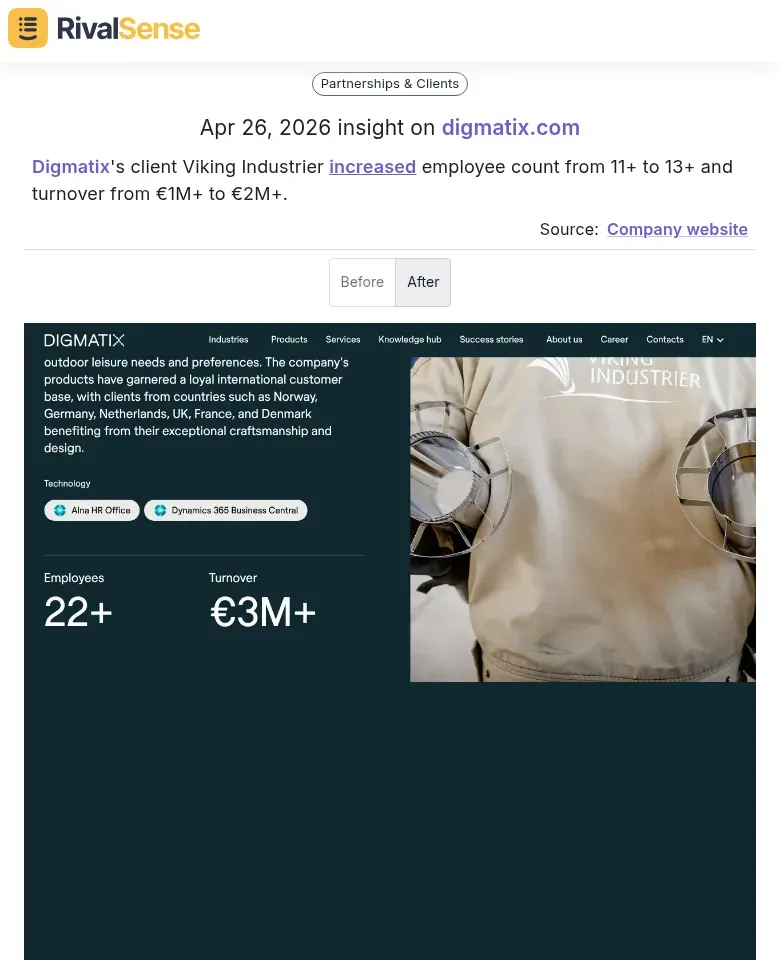
RivalSense tracked a key account named Viking Industrier. Their headcount jumped from 11+ to 13+ and turnover from €1M+ to €2M+ (see image below). For a B2B SaaS company like Digmatix, this signals scaling—meaning more users, more complexity, and a need for advanced features. By spotting this early, you can offer a tailored upgrade before the client even asks, securing a larger contract.
Why this matters for strategy: Tracking headcount and revenue changes in your accounts helps you anticipate their evolving needs. You shift from reactive support to proactive partnership, locking in expansion revenue.
Action Checklist
- [ ] Set up alerts for client headcount changes (LinkedIn, ZoomInfo).
- [ ] Review support tickets monthly for expansion keywords.
- [ ] Schedule quarterly account reviews to map growth signals.
- [ ] Create a “proactive offer” template for scaling clients.
Leveraging Technology Investments for Partnership Alignment
To align your partnerships with client technology shifts, start by monitoring their tech migrations—such as cloud adoption or AI integration. Use competitor tracking tools to detect announcements, job postings, or case studies that signal infrastructure changes. When a client migrates to a new platform (e.g., Azure, AWS), proactively identify integration or support opportunities.
Real Insight: TriHealth's Azure Migration
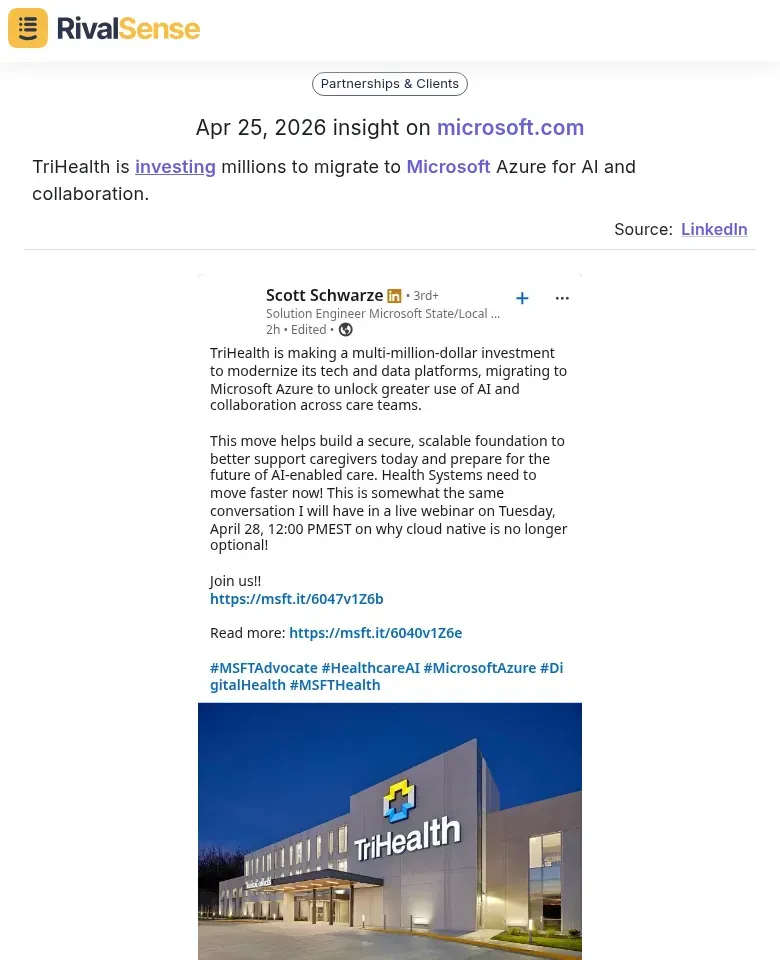
RivalSense spotted that TriHealth is investing millions to migrate to Microsoft Azure for AI and collaboration (see image below). This is a massive technology shift. For a partner offering security, compliance, or cloud management solutions, this is an open door to propose a tailored integration or advisory service. Why it's valuable: Tech migrations create immediate needs for compatibility, migration assistance, and new workflows. If you can help them navigate the change, you deepen the partnership and create stickiness.
Practical Steps:
- Set up alerts for client tech keywords (e.g., “migrating to [platform]”).
- Analyze job postings for new tech roles (e.g., “Cloud Architect”).
- Map client’s new infrastructure to your product’s compatibility.
- Schedule a discovery call to discuss their migration challenges.
Checklist for Partnership Alignment:
- [ ] Track client tech announcements monthly.
- [ ] Identify 2-3 integration points per migration.
- [ ] Prepare a value proposition for each opportunity.
- [ ] Review feedback from support teams on new infrastructure issues.
By systematically following client tech shifts, you can position your offerings as essential to their evolving needs, turning technology investments into stronger, smarter partnerships.
Innovating with Alternative Data from Partner Feedback
To innovate beyond competitors, tap into alternative data from partner feedback. When clients mention underserved segments, treat it as a product roadmap. For instance, a fintech partner might reveal that gig workers lack credit access. Instead of building a generic solution, integrate non-traditional data sources like employment APIs.
Real Insight: PayJoy + Belvo
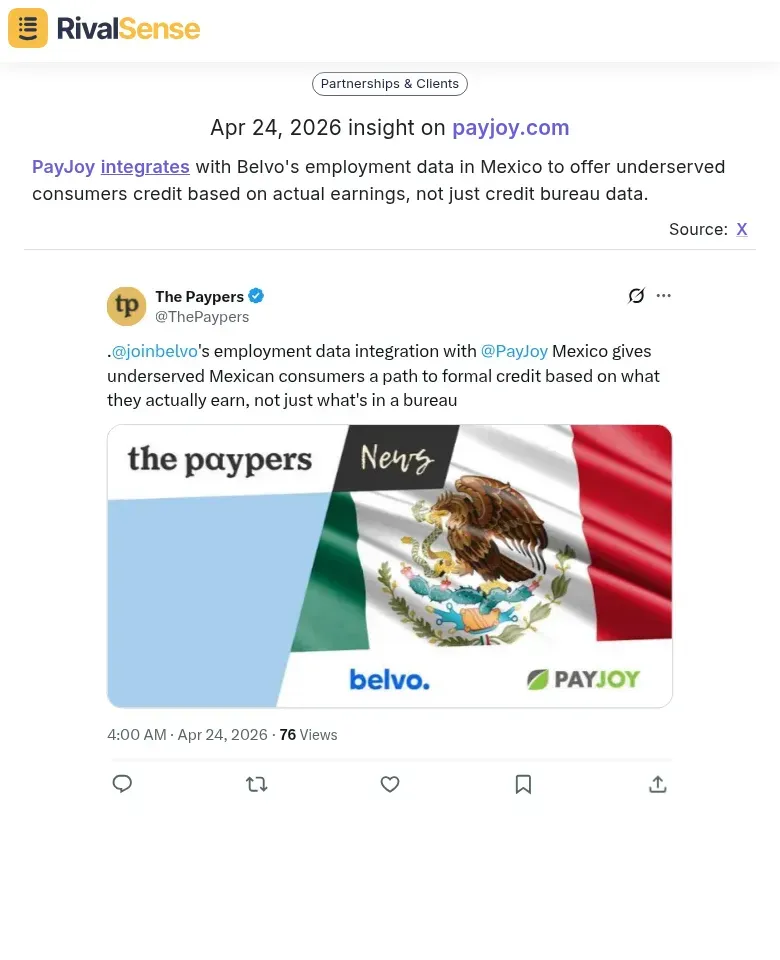
RivalSense tracked that PayJoy integrates with Belvo's employment data in Mexico to offer underserved consumers credit based on actual earnings, not just credit bureau data (see image below). Why this matters for your strategy: This shows how listening to partner feedback about data gaps can lead to breakthrough products. By leveraging alternative data (employment records, utility payments, etc.), you can serve segments your competitors ignore. Use competitor tracking to see if rivals are experimenting with similar sources.
How to start:
- Mine partner conversations for recurring pain points about data gaps.
- Identify alternative data sources (e.g., utility payments, payroll, social signals).
- Run a pilot with one partner to validate the new data's predictive power.
- Build a feedback loop—share insights with partners to refine the offering.
Tip: Use a competitor tracking tool like RivalSense to monitor if rivals are experimenting with similar alternative data. Early signals let you adjust before they scale.
Building a Systematic Feedback Tracking Process
To build a systematic feedback tracking process, start by establishing regular touchpoints with key accounts. Schedule quarterly business reviews (QBRs) and monthly check-ins to capture both qualitative insights (e.g., sentiment, pain points) and quantitative data (e.g., NPS scores, usage metrics). Use a CRM or dedicated feedback tool to centralize all inputs, tagging each piece of feedback to the relevant account and linking it to business outcomes like retention or upsell revenue. Create a cross-functional review cycle—involving sales, product, and customer success—to triage and act on insights within two weeks.
Tip: Set up automated alerts for negative feedback to trigger immediate follow-up.
Checklist:
- [ ] Define feedback categories (product, support, pricing).
- [ ] Assign owners for each category.
- [ ] Schedule monthly cross-functional syncs.
- [ ] Track action items in a shared dashboard.
This process ensures no insight slips through the cracks and turns feedback into growth levers.
Conclusion: Turning Feedback into a Strategic Growth Engine
Account feedback isn't a one-time project—it's a renewable resource for partnership intelligence. Competitors like Salesforce and HubSpot prove that systematic feedback tracking drives revenue, reduces churn, and sparks innovation. To turn feedback into a strategic growth engine, start small: pick one key account, set up a simple feedback collection process (e.g., quarterly business reviews with structured notes), and track themes in a shared document. Measure impact by linking feedback-driven changes to metrics like NPS, renewal rates, or upsell revenue. Once you see results, scale: automate collection with tools like RivalSense, train your team on active listening, and create a cross-functional feedback review cadence. Remember, the goal isn't just to listen—it's to act. Every piece of feedback is a signal for a smarter partnership.
Ready to track competitor and account signals effortlessly? Try RivalSense for free at https://rivalsense.co/ and get your first competitor report today. No strings attached—just actionable insights delivered weekly.
📚 Read more
👉 How to Turn a Competitor’s Tachograph Mandate Pivot Into Your Own Growth Opportunity
👉 The Real-World Benefits of Competitive Intelligence Software (And How to Actually Use It)
👉 Key Account Management Best Practices for Influencer Platforms