
Competitor Innovation Insights: A Beginner's Guide to Media Mentions
Media mentions offer a real-time window into competitor activities that may not yet be reflected in official channels like websites or press releases. A startup quietly piloting a new feature with select customers might be covered by a niche industry blog before any public announcement. This early signal gives you a head start to analyze and respond.
Beyond basic announcements, media coverage provides context and nuance. An interview where a CEO discusses their “AI-first strategy” reveals strategic intent and market positioning that a dry press release omits. Look for quotes, analyst opinions, and comparisons to your own company—these reveal how the market perceives your competitor.
Tracking mentions over time helps detect shifts in focus. A sudden spike in coverage about sustainability partnerships or R&D labs indicates a strategic pivot. Create a simple tracking sheet: log each mention, tag topics (e.g., “partnership,” “new product,” “hiring spree”), and note sentiment. Use free tools like Google Alerts or Mention to automate collection. Review weekly to spot patterns—for example, a competitor consistently mentioned alongside “SaaS automation” may be repositioning its brand.
Quick checklist:
- Set up alerts for competitors, their executives, and key products.
- Note the publication source—industry trades signal deeper insight.
- Differentiate between paid coverage (press release pickups) and earned media (journalist-initiated stories).
- Archive mentions in a shared doc with tags and action items for your team.
Decoding Research Collaborations and Studies
When competitors announce joint research projects, they’re often signaling investment in novel technologies or therapeutic areas. To decode these signals, follow this 3-step checklist:
- Identify the Partner: Academic or clinical partners lend credibility. A partnership with a top-tier university suggests the competitor is validating internal hypotheses. For example, if a biotech firm collaborates with a cancer research institute, it may be exploring a new immunotherapy approach.
- Analyze the Scope: Look for specifics like funding size, duration, and milestones. A multimillion-dollar, multi-year project indicates a major strategic bet, while a short-term pilot may be exploratory.
- Track Study Outcomes: Even early-stage results can foreshadow future features. A phase 1 trial showing safety in a rare disease may hint at an eventual product for that niche. Monitor clinical trial registries (e.g., ClinicalTrials.gov) and academic publications.
Pro Tip: Set up Google Alerts for your competitors’ names combined with keywords like “clinical trial,” “collaboration,” or “research agreement.” This surfaces announcements before they’re widely reported.
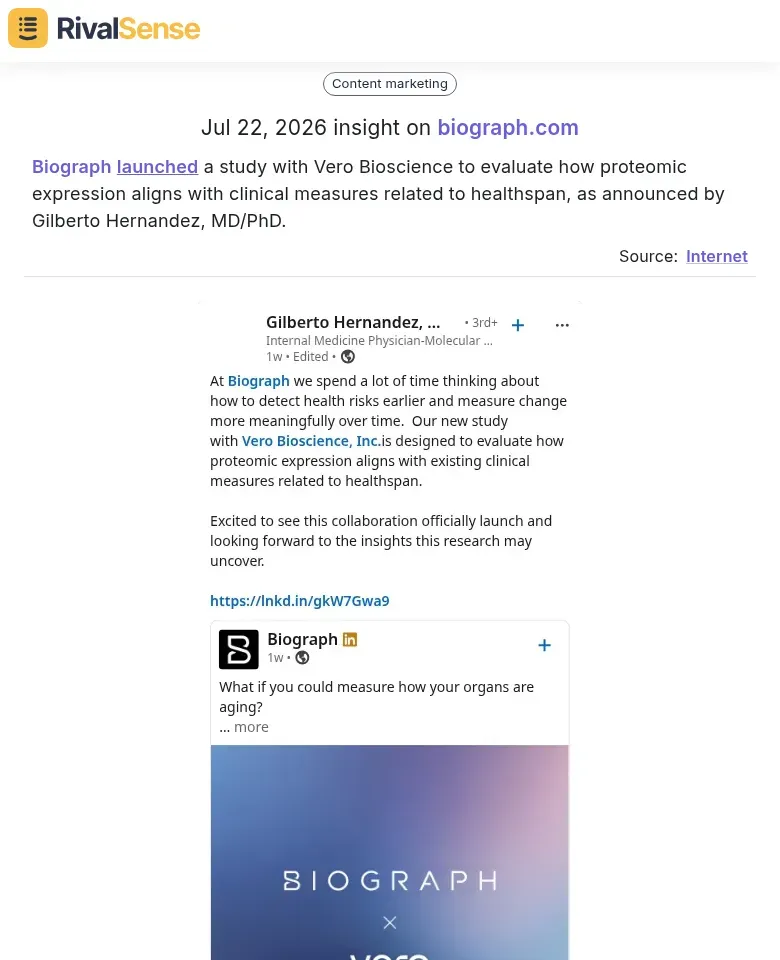
For example, RivalSense recently flagged that Biograph launched a study with Vero Bioscience to evaluate how proteomic expression aligns with clinical measures related to healthspan, as announced by Gilberto Hernandez, MD/PhD. Research collaborations like this are valuable for business strategy because they reveal a competitor’s long-term scientific bets and potential pivot into new areas like longevity biomarkers—giving you a head start to adapt your own innovation pipeline.
By systematically decoding research collaborations, you can anticipate product roadmaps and adjust your own strategy—turning competitor news into actionable intelligence.
Mining Thought Leadership and Executive Appearances
To mine competitor innovation signals, monitor where executives appear and what they say. Start by tracking podcast and interview appearances—these platforms give leaders space to articulate long-term visions and technical priorities that rarely surface in press releases or earnings calls. Create a simple spreadsheet logging each appearance, the host, and key quotes.
Practical steps:
- Set up alerts: Use tools like Google Alerts or Mention for competitor CEO/CTO names plus "podcast,” “interview,” or “fireside chat."
- Categorize platforms: Is the appearance on a niche industry podcast (e.g., “The SaaS Revolution”) or a mainstream business show? The platform choice reveals which audience the competitor seeks to influence—developers, C-suites, or investors.
- Identify bottleneck talk: Listen for executive commentary about what’s “hard,” “broken,” or “the next frontier.” These statements pinpoint where the company sees competitive advantage. For example, a CTO lamenting “data silos hinder AI adoption” suggests their product roadmap prioritizes integration.
Checklist for analysis:
- [ ] Flag any mention of new technology stacks, partnerships, or hiring pushes.
- [ ] Compare messaging across different executives—inconsistencies may signal internal friction.
- [ ] Note predictions or timelines (e.g., “By Q3 we’ll solve X”) to track execution.
Pro tip: Archive audio transcripts using a service like Otter.ai and run keyword searches for terms like “patent,” “breakthrough,” or “roadmap.” This transforms scattered appearances into a structured intelligence feed.
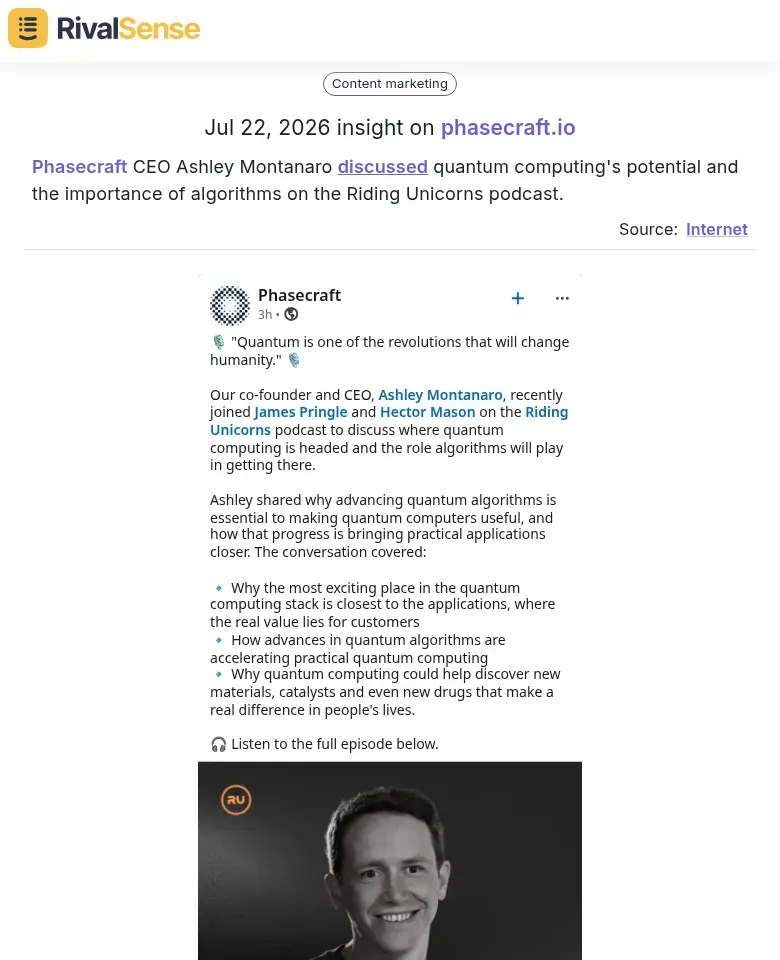
A great example came via RivalSense, which surfaced that Phasecraft CEO Ashley Montanaro discussed quantum computing’s potential and the importance of algorithms on the Riding Unicorns podcast. Executive podcast appearances like this are valuable because they highlight strategic focus areas—here, the emphasis on algorithms signals Phasecraft’s core differentiation and may foreshadow upcoming algorithmic breakthroughs or new quantum software products. Monitoring such thought leadership gives you early visibility into a competitor’s technical roadmap before any formal announcement.
Learning from CSR and Community Initiatives
Your competitors' CSR projects often reveal more than goodwill—they signal strategic market moves. Here's how to decode them.
1. Spot expansion clues. A company funding schools in a new country may be testing talent pipelines before launching operations. Tip: Map CSR locations against your competitor's office openings to spot patterns.
2. Watch educational partnerships. Long-term play for brand loyalty and future hiring. Check if they sponsor STEM programs or university labs. Action: Search for press releases about scholarship programs—they often precede hiring sprees in those regions.
3. Track infrastructure funding. Investments in mapping, data collection, or environmental monitoring hint at geospatial or community data market ambitions. Checklist:
- Does the initiative generate proprietary data?
- Is the data applicable to new product lines?
- Who are their partners (govt, NGOs, tech firms)?
Quick tip: Set Google Alerts for [Competitor Name] + "grant", "foundation", or "community partnership" to stay ahead.
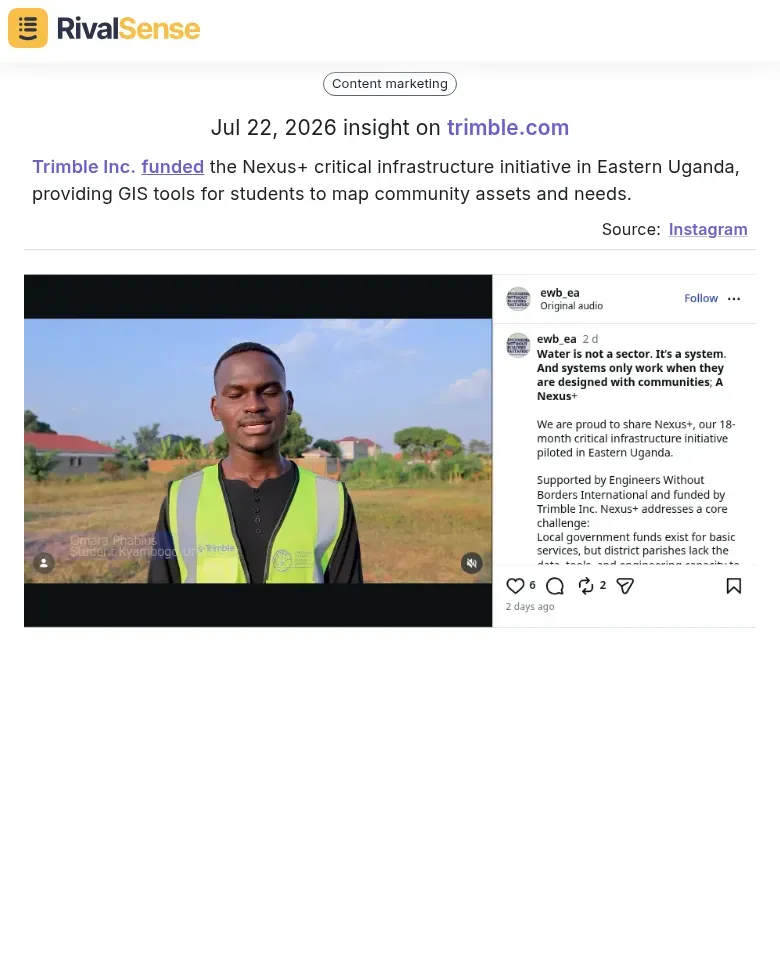
RivalSense recently captured that Trimble Inc. funded the Nexus+ critical infrastructure initiative in Eastern Uganda, providing GIS tools for students to map community assets and needs. CSR insights like this are strategically valuable because they hint at market entry and talent pipeline building in a new region—Trimble’s geospatial ambitions in East Africa may signal a future local product or service expansion before any press release.
By analyzing these moves, you can forecast where competitors are planting flags before they make public announcements.
Building a Systematic Media Monitoring Process
To build a systematic media monitoring process, start by setting up keyword alerts for competitor names, their key executives, and product categories they operate in. Use tools like Google Alerts, Mention, or Feedly to track news, press releases, and blogs. Next, categorize each mention by type—for example, product launches, research publications, thought leadership articles, executive interviews, or CSR initiatives. This structured taxonomy helps you filter noise and focus on high-signal items. Create a simple spreadsheet or use your chosen tool's tagging feature to log mentions with date, source, category, and a brief summary. The real magic lies in trend analysis. Instead of reacting to a single press release, look for patterns over time: Is a competitor publishing more research in a specific domain? Are their executives appearing on more podcasts? A sudden spike in hiring announcements might signal a new product push. Schedule a weekly or bi-weekly review to spot these shifts. By moving from reactive scanning to proactive pattern recognition, you transform raw media mentions into actionable competitive intelligence that informs your strategic decisions.
Turning Insights into Actionable Strategy
Collecting competitor media mentions is only half the battle—the real value lies in turning those insights into strategic action. Here’s how to operationalize your findings.
1. Cross-validate with hard data. A competitor’s press release might hype a new feature, but is it real? Check their patent filings (USPTO, Google Patents) for technical claims, or scan job postings for roles like “AI Engineer” that signal actual R&D investment. If both sources align, the move is credible; if not, treat it as speculative.
2. Update your competitive landscape map. Every quarter, refresh a simple 2×2 matrix plotting competitors on axes like “innovation intensity” vs. “market focus.” Plug in validated insights from step 1. This reveals whitespace—e.g., areas where no competitor is investing that align with your strengths. Use tools like Miro or Notion to keep it collaborative.
3. Embed insights into strategic reviews. At your next quarterly planning session, dedicate a 15-minute slot to “Competitor Innovation Briefing.” Share 3 key narratives from media tracking (e.g., “Company X is pivoting to vertical SaaS”) and discuss implications for your roadmap. Assign owners to monitor each trend.
Quick checklist:
- Verify top 3 media claims with patents or job ads monthly
- Refresh landscape map after each product launch cycle
- Include competitor narratives in every sprint retrospective
By systematizing this pipeline, you move from reactive news consumption to proactive strategy—and uncover opportunities your competitors miss.
Manually sifting through thousands of sources to catch every research collaboration, executive podcast, and CSR move is daunting. RivalSense automates this process, tracking competitor product updates, management changes, event participations, partnerships, and regulatory moves across websites, social media, registries, and news. The insights above—like Biograph’s proteomic study, Phasecraft’s quantum podcast, and Trimble’s Uganda initiative—are exactly the kind of actionable intelligence you receive in a concise weekly email report. Try RivalSense for free at rivalsense.co and get your first competitor report today.
📚 Read more
👉 How a Website Page Update Revealed a Competitor's Pivotal Partnership Shift
👉 Competitor Target Audience Analysis: The 2026 Guide to Winning the Right Customers
👉 Workflow Breakdown: Telecom Competitor Market Research Reports
👉 Turning NVIDIA's AI Agent Insight into a Competitive Win
👉 5 Instagram Competitor Analysis Mistakes Startups Make (And How to Fix Them)