
Competitor Target Audience Analysis: The 2026 Guide to Winning the Right Customers
Imagine trying to hit a target you can't see. That's what running a business without understanding your competitors' audience is like.
In 2026, the competitive intelligence market has surged to over $60 billion and is projected to reach $122.8 billion by 2033. Yet, 44% of companies admit they have zero competitor visibility. That's nearly half the market operating blind.
Competitor target audience analysis bridges that gap. It reveals who your rivals are actually attracting, why those customers choose them, and—most importantly—where they're leaving opportunities on the table.
In this guide, you'll get a step-by-step framework, practical checklists, and actionable templates to turn competitor audience data into a growth engine for your business.
What Is Competitor Target Audience Analysis?
Competitor target audience analysis is the systematic process of identifying, profiling, and understanding the customers your competitors serve. It goes beyond surface-level demographics to uncover:
- Who they attract (demographics, psychographics)
- Where their audience engages (platforms, communities, channels)
- What they care about (interests, pain points, motivations)
- How they differ from your audience (overlaps and gaps)
Unlike a generic competitor analysis that focuses on features and pricing, this approach centers on people—the real humans making purchasing decisions every day.
Why it matters in 2026: With 81% of consumers researching online before buying and 70% of marketers reporting that reaching target audiences has become harder due to fragmented tools, understanding your competitor's audience is no longer optional—it's survival.
The 7-Step Framework for Competitor Target Audience Analysis
🎯 Step 1: Identify Who to Analyze (Direct & Indirect Competitors)
Before you can analyze an audience, you need to know whose audience to study.
Direct competitors sell similar products to similar customers solving similar problems.
Indirect competitors solve the same problems but through different means.
Practical Checklist:
- [ ] List 3-5 direct competitors
- [ ] List 2-3 indirect competitors
- [ ] Verify using customer feedback ("Who else did you consider?")
- [ ] Check keyword overlap using tools like Semrush
- [ ] Review LinkedIn "Similar Companies" suggestions
Pro tip: Start with a manageable number. Five competitors is plenty for your first analysis. Going beyond eight usually creates noise, not insight.
📊 Step 2: Map Audience Demographics
Once you've identified your competitors, dig into who their customers actually are—not who they claim to target.
Key demographic dimensions to analyze:
| Dimension | What to Look For | Why It Matters |
|---|---|---|
| Gender | Dominant vs. balanced segments | Messaging tone and visuals |
| Age | Core age clusters | Channel and format choices |
| Location | Countries, regions, languages | Market positioning |
| Income | Affordability signals | Pricing strategy |
| Occupation | Job roles, industries | Content depth and tone |
| Education | Complexity tolerance | Messaging clarity |
Where to find this data:
- Social media analytics tools (demographic breakdowns)
- LinkedIn company pages (employee and follower profiles)
- Customer review platforms (Trustpilot, G2, Capterra)
- Industry reports and market research
🧠 Step 3: Uncover Audience Interests & Pain Points
Demographics tell you who the audience is. Interests and pain points tell you what drives them.
Three proven methods:
-
Analyze competitor content themes – What topics do they repeatedly cover? If a competitor constantly addresses "security concerns," that's a signal of customer anxiety you can capitalize on.
-
Mine customer comments and reviews – Look for patterns in what people praise and complain about. Repeated questions indicate friction; skeptical comments reveal trust gaps.
-
Monitor social conversations – Use social listening to track what people say about your competitors in real-time.
Practical Tip: Create a "Pain Point Database" with columns for competitor name, recurring complaint, sentiment, and your opportunity to address it. Update this monthly.
🌐 Step 4: Analyze Platform Presence
Where your competitor's audience hangs out tells you where to invest your marketing dollars.
Questions to answer:
- Which platforms drive the most engagement for each competitor?
- What content formats perform best (video, text, infographics, podcasts)?
- Are there platforms where your competitors are weak or absent?
Common mistake: Assuming your competitor's audience uses the same platforms yours does. Always verify with data.
Action step: Create a platform matrix with competitors as rows and platforms as columns. Rate their presence (Strong / Moderate / Weak / Absent) to spot underserved channels you can own.
🔎 Step 5: Conduct SEO & AEO (Answer Engine Optimization) Analysis
In 2026, understanding how competitors attract audiences through search engines and AI-generated answers is critical. Today, 37% of product discovery queries start in AI-powered interfaces.
What to analyze:
- Keyword rankings (which terms drive their traffic)
- Content strategy (what topics and formats they prioritize)
- AI visibility (do they appear in ChatGPT, Perplexity, or Gemini answers?)
- Website structure and technical SEO
Quick win: Search for your core product feature + "vs [competitor name]" to see what comparison content exists. If competitors aren't addressing comparison queries, that's content you can own.
🔄 Step 6: Compare Their Audience to Yours
This is where analysis turns into strategy. Comparing audiences reveals overlaps (where you compete directly) and gaps (where you can differentiate).
Comparison framework:
| Dimension | Your Audience | Competitor A | Competitor B | Opportunity |
|---|---|---|---|---|
| Core demographics | ||||
| Key platforms | ||||
| Top pain points | ||||
| Content preferences | ||||
| Price sensitivity |
Key questions:
- Who are they attracting that you're not?
- Where does your shared audience overlap?
- What segments are both of you ignoring?
Case study example: A project management SaaS company discovered their main competitor's audience was 80% mid-level managers, heavily focused on reporting features. By targeting senior executives with strategic planning content—a segment the competitor ignored—they grew their pipeline by 40% in six months.
⚡ Step 7: Turn Insights into Action
Analysis without action is just data hoarding. Here's how to operationalize your findings:
1. Refine your positioning
- If competitors all target enterprise, consider SMBs
- If they emphasize price, highlight quality or service
- If they focus on features, emphasize outcomes
2. Adjust your content strategy
- Fill content gaps your competitors leave open
- Create comparison content that highlights your differentiators
- Address pain points competitors ignore
3. Optimize your channel mix
- Invest in platforms where competitors are weak
- Experiment with formats they don't use
- Target underserved audience segments
4. Sharpen your investor pitch
- Demonstrating competitive landscape awareness increases investor confidence
- Show specific gaps your company fills
- Use data, not assumptions
🔍 How Ongoing Monitoring Reveals Audience Shifts: Real Examples
Even the best analysis becomes stale. Markets shift, competitors pivot, and customer expectations evolve—often in weeks, not months. Continuous monitoring of competitor activities not only keeps your intelligence fresh but also exposes audience targeting changes as they happen.
Here are three real competitor intelligence signals—like those you'd get from automated tracking—and how they translate into strategic insight:
1. Product Feature Overhauls Signal a New Target Persona
When Revolut replaced 'Single-use virtual cards' with 'Self-destructing virtual cards' and introduced numberless physical cards (with PAN, expiry, and CVV only visible in-app), it wasn't just a product tweak. It was a clear move toward a privacy-obsessed, digital-first audience—likely younger, tech-savvy users who value security and seamless digital experiences. For a competitor, this insight flags an opportunity to differentiate by emphasizing simplicity, multi-generational trust, or a different value proposition for the less tech-forward segment.
2. Strategic Partnerships Expose Focus Accounts and Verticals
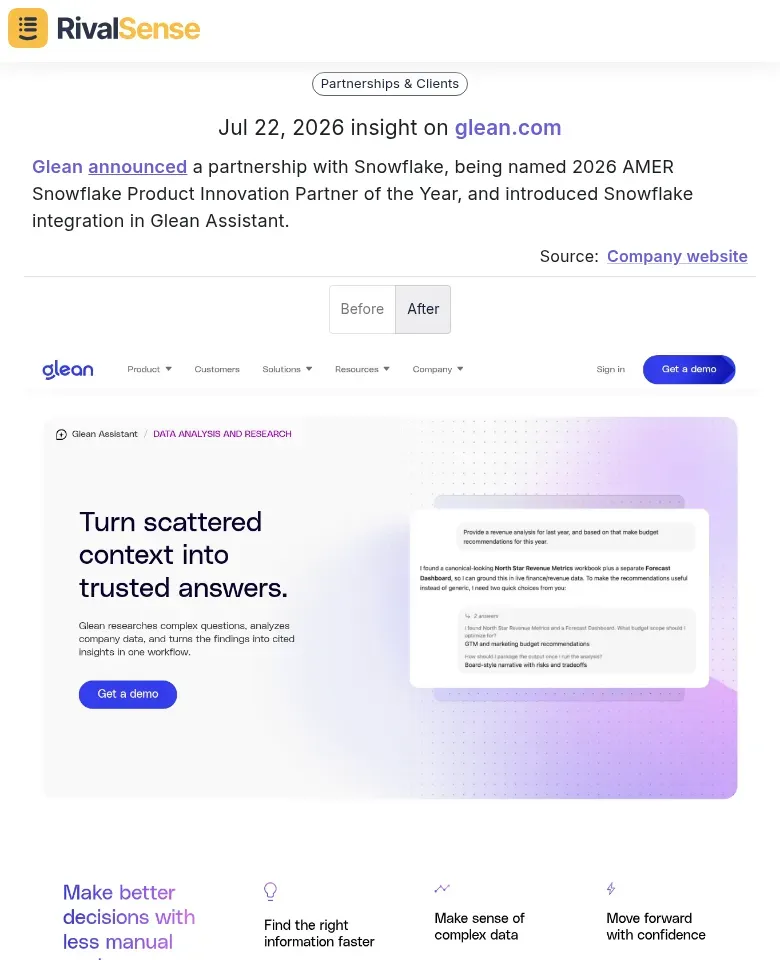
Glean's Snowflake integration and being named 2026 AMER Snowflake Product Innovation Partner of the Year reveals a deep commitment to data-heavy enterprise buyers. If you're in the enterprise search, knowledge management, or data analytics space, this signals that Glean is likely aligning its sales and marketing efforts around Snowflake's customer base—impacting your own pipeline. Monitoring such partnership announcements helps you preemptively adjust your positioning or even form a counter-alliance.
3. Simplified Onboarding Points to a Broader, Less Technical Audience
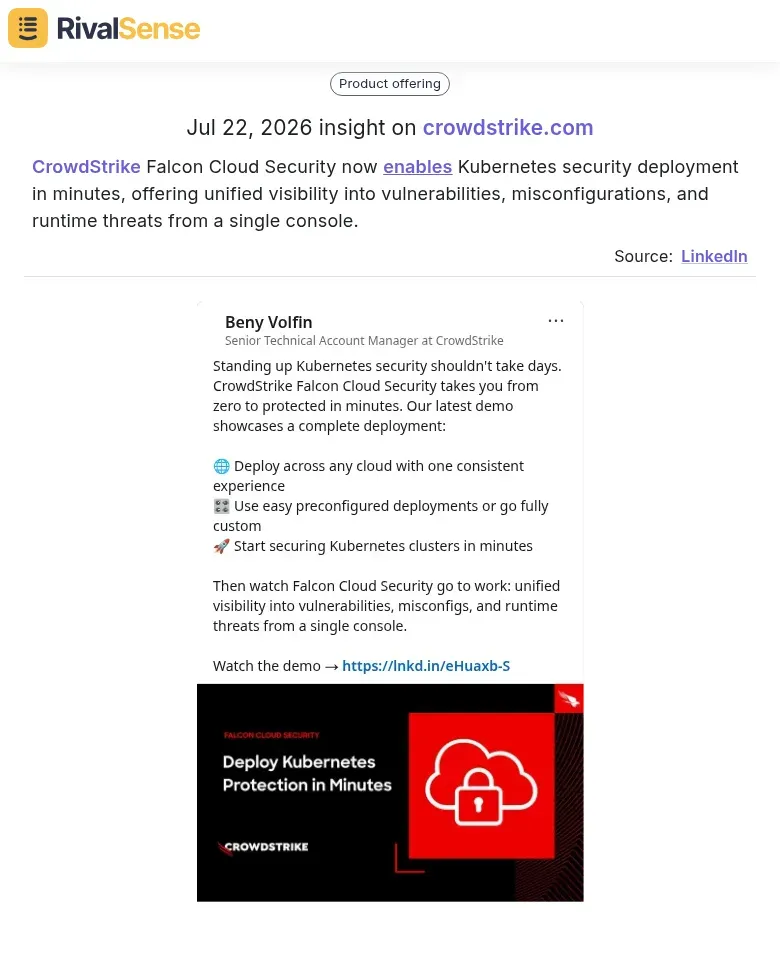
CrowdStrike Falcon Cloud Security now enables Kubernetes security deployment in minutes, offering unified visibility from a single console. Historically, Kubernetes security products required deep DevOps expertise. By streamlining the process, CrowdStrike is likely expanding its target audience beyond hardcore security engineers to include IT generalists and platform teams who prioritize speed and simplicity. If you compete in cloud security, this tells you that complexity may be a barrier you can either exploit (by keeping advanced capabilities) or match (by simplifying your own offering).
These types of insights—product updates, partnerships, management changes—are exactly what turn a static analysis into a dynamic strategy engine.
Common Mistakes to Avoid
| Mistake | Why It's Dangerous | Better Approach |
|---|---|---|
| Copying competitors | You'll always be second-best | Find your unique angle |
| Ignoring indirect competitors | You miss emerging threats | Include 2-3 indirect competitors |
| Relying only on historical data | Markets shift rapidly | Update analysis quarterly |
| Over-analyzing without acting | Insights become shelfware | Assign owners to each action item |
| Analyzing in isolation | Context matters | Always compare to your own data |
Free Checklist: Competitor Target Audience Analysis
Use this quick checklist for your next analysis session:
- [ ] Identify 5 competitors (3 direct + 2 indirect)
- [ ] Gather demographic data for each (gender, age, location, income, occupation)
- [ ] Map audience interests and pain points (content analysis + reviews)
- [ ] Analyze platform presence (which channels, which formats)
- [ ] Run SEO/AEO audit (keywords, AI visibility)
- [ ] Compare audiences side-by-side (overlaps and gaps)
- [ ] Document 3-5 actionable insights
- [ ] Assign owners and deadlines for each action item
- [ ] Set a calendar reminder for next analysis (90 days)
The Bottom Line
In a world where 90% of startups fail—often due to poor strategic positioning—competitor target audience analysis gives you the clarity to compete intelligently.
You stop guessing who your market is. You start knowing.
You stop copying competitors. You start differentiating.
You stop hoping your strategy works. You start building it on real data.
The companies that thrive in 2026 and beyond won't be the ones with the most features or the biggest budgets. They'll be the ones who understand their audience—and their competitors' audience—better than anyone else.
Ready to turn competitor monitoring into a competitive edge? Try RivalSense for free and get your first weekly competitor report today—covering product launches, pricing shifts, partnerships, and more. Visit https://rivalsense.co/ and start seeing what your competitors are planning next.
📚 Read more
👉 Workflow Breakdown: Telecom Competitor Market Research Reports
👉 Turning NVIDIA's AI Agent Insight into a Competitive Win
👉 5 Instagram Competitor Analysis Mistakes Startups Make (And How to Fix Them)
👉 Salesforce Key Account Tracking Cheat Sheet for Semiconductor Firms
👉 Productivity Techniques for Competitor Financial & M&A Insights