
Competitor Analysis in Action: How Shufti’s Japan Pivot Reveals Hidden Market Shifts
Regulatory changes can upend entire markets overnight. Competitors that pivot early often capture new opportunities while slower players struggle to catch up. When you track these moves, you transform compliance pain into strategic advantage.
A single regulatory tweak can signal where a rival is placing its bets—on new technology, a geographic expansion, or a fresh customer segment. Ignoring those signals means missing the chance to adjust your own roadmap, refine your value proposition, or strengthen your key accounts before the landscape shifts.
📌 Real-World Example: Shufti Prepares for Japan’s 2027 Deadline
Japan will retire photo‑upload identity checks from April 2027, mandating stronger remote identity verification for account opening. Here’s how Shufti responded:
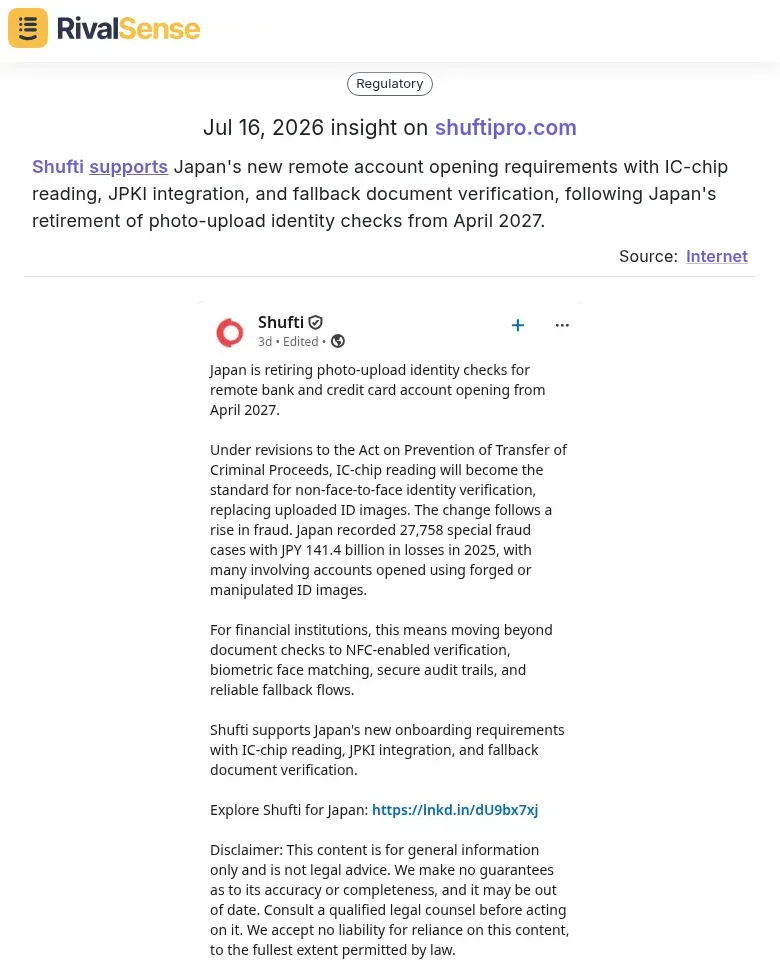
- IC‑chip reading: Shufti now supports extracting data directly from the integrated circuit in Japanese identity documents, raising the bar for document authenticity.
- JPKI integration: Seamless linking with Japan’s Public Key Infrastructure for individuals cuts friction for regulated entities.
- Fallback document verification: When chip reading isn’t available, a multi‑layer document check ensures compliance without abandoning the user.
This move is more than a product update—it’s a strategic signal. Shufti is investing heavily in the Japanese fintech segment, betting that early compliance will win key accounts before competitors react. For any company in the identity verification space, this would be a trigger to assess whether your own roadmap matches that level of local‑market commitment.
🛠️ Actionable Steps to Monitor Competitor Regulatory Moves
- ✅ Map regulatory triggers: Identify the top 5 upcoming regulatory changes in your target markets. Note which competitors have publicly mentioned them.
- ✅ Set up automated alerts: Use tools to track competitor blogs, press releases, and social media for rule‑based keywords (e.g., “IC‑chip reading”, “JPKI”, “PAD compliance”).
- ✅ Analyze product launch sequences: When a competitor adds multiple features in a single region (chip reading + fallback + local ID integration), it likely signals a deep partnership pipeline. Share these patterns with your key account teams.
- ✅ Quantify the market opportunity: Japan’s remote account opening market is forecast to reach ¥X billion by 2028 (placeholder for internal data). If a rival has pre‑positioned, what’s your cost of inaction?
- ✅ Involve your key account managers: Ask them if their top prospects in Japan have mentioned these new requirements. Competitor activity often surfaces inside customer conversations first.
🚀 How RivalSense Simplifies This
Manually scouring hundreds of sources is unrealistic. RivalSense tracks product updates, pricing changes, event participations, partnerships, regulatory moves, and management changes across company websites, social platforms, and registries—then delivers a clean email report. The Shufti insight above is exactly the kind of signal RivalSense surfaces so you never miss a strategic shift.
Spin up a free trial and get your first competitor report today: Try RivalSense for free.
📚 Read more
👉 The Benefits of a Competitive Audit: A Practical Guide for Business Leaders
👉 Workflow Breakdown: Tracking Leaders to Boost Healthcare IT Consulting
👉 How Lumia's New Security Features Prompted a Rival's Response