
Beginner’s Guide: How Transport Competitors Attract Customers
To attract customers, analyze pain points like limited routes or inconvenient schedules. Step 1: Gather data through surveys, social media listening, and ticket sales analysis. Step 2: Prioritize pain points by frequency and impact.
Improve accessibility: Extend routes to underserved areas or add new stops near business districts and residential hubs. Tip: Use a heatmap of customer locations to identify gaps. For example, Autotransporta direkcija recently added a new bus stop ‘Strauti’ in Jēkabpils region to two regional routes.
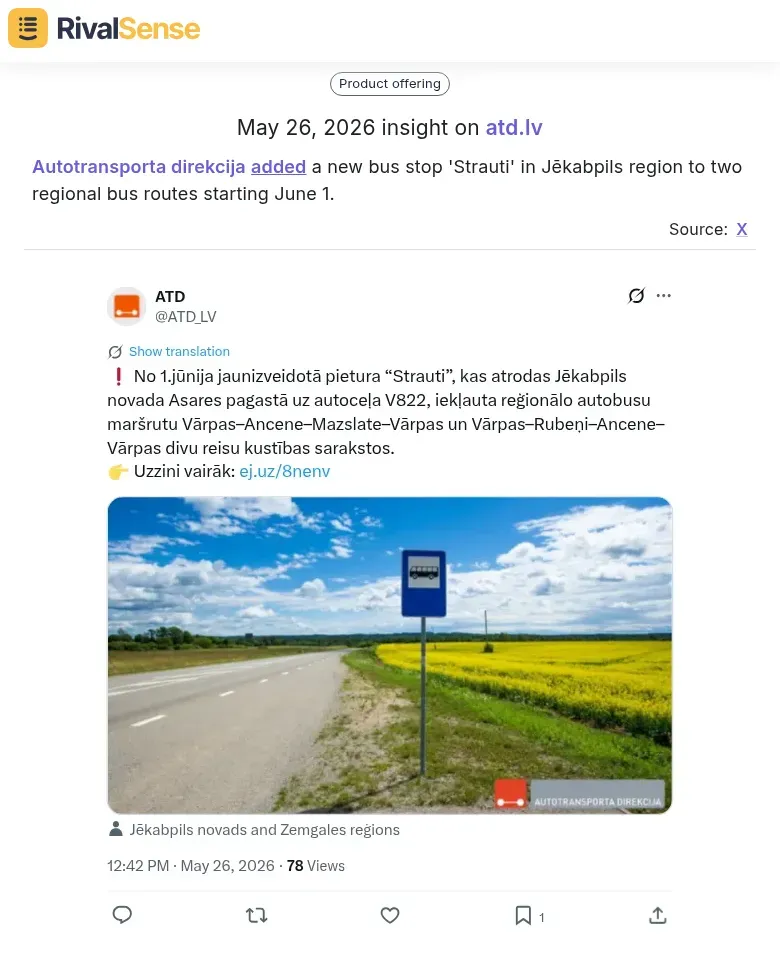
👉 Tracking competitor stop additions through tools like RivalSense reveals underserved pockets and emerging demand before the public data catches up, helping you prioritize route expansions strategically.
Offer temporary experimental services: Launch pop-up routes or shuttle services for 3–6 months to test demand. Checklist:
- Define success metrics (e.g., ridership, NPS).
- Communicate as a trial to manage expectations.
- Collect feedback via QR codes on vehicles.
Adapt to seasonal/event needs: Modify schedules for holidays, concerts, or festivals. Hint: Use historical data from similar events to predict demand.
Pro tip: Create a “customer pain point map” aligned with your operational capabilities, then iterate based on real-time feedback.
Leverage Technology for Convenience
In today’s competitive transport landscape, a dedicated mobile app is no longer optional—it’s essential. Here’s how to leverage technology to attract and retain customers.
1. Simplify Core Functions
Build an app with seamless booking, real-time tracking, and integrated payments. Ensure users can book a ride in under 30 seconds. Include push notifications for arrival alerts and fare updates.
2. Address Safety & Compliance Needs
Add features that build trust, especially in niche markets:
- Child transport: Offer in-app driver verification, live GPS sharing with parents, and kid-friendly driver profiles.
- Medical transport: Include wheelchair accessibility filters, trained staff badges, and insurance documentation.
- Corporate travel: Provide expense reporting, multi-stop routing, and compliance with company travel policies.
A real-world example: Autotransporta direkcija registered a new mobile app called VEDU, specifically for safe transportation of children.
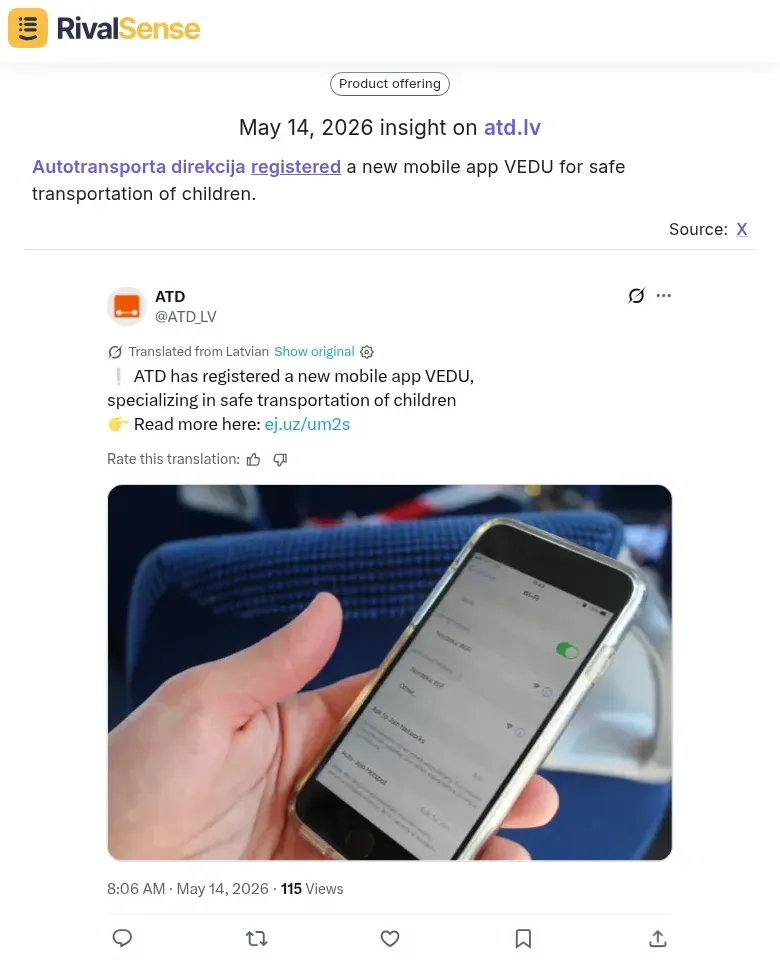
👉 Monitoring competitor app registrations can alert you to technology bets that differentiate a service. Knowing about a new safety-focused app early helps you assess whether to build a similar capability or emphasize your own strengths.
3. Differentiate with Digital Extras
Go beyond basics:
- Loyalty programs with points redeemable for free rides.
- Scheduled rides with recurring booking options for daily commuters.
- In-app feedback that resolves issues instantly (e.g., lost item reporting).
Practical Checklist for Your App Launch:
☐ One-click booking from saved profiles
☐ Live map tracking with ETA accuracy within 1 minute
☐ Digital payment via card, wallet, or invoicing
☐ Safety features: SOS button, driver ratings, trip history
☐ Accessibility options: wheelchair, language, vehicle type
By addressing specific pain points and making every interaction frictionless, your app becomes a competitive advantage that customers won’t want to leave.
Experiment with New Services
To stay ahead, transport competitors constantly experiment with new services. Here’s how you can do it too:
1. Launch Pilot Programs
Start small—test a new route or service type (e.g., express lanes, on-demand shuttles) on a limited scale. This minimizes risk and investment.
2. Set a Clear Time Frame
Define a trial period (e.g., 3 months). This creates urgency and makes it easier to measure impact. Use a countdown dashboard internally.
3. Collect & Analyze Data
Track key metrics: ridership, revenue, customer satisfaction, and operational costs. Compare against baselines from existing services. Use surveys and usage logs.
Take inspiration from Autotransporta direkcija, who introduced four experimental bus trips to the Bērzezers garden area and extended service to Alieši and Celtnieks garden areas until September 30.
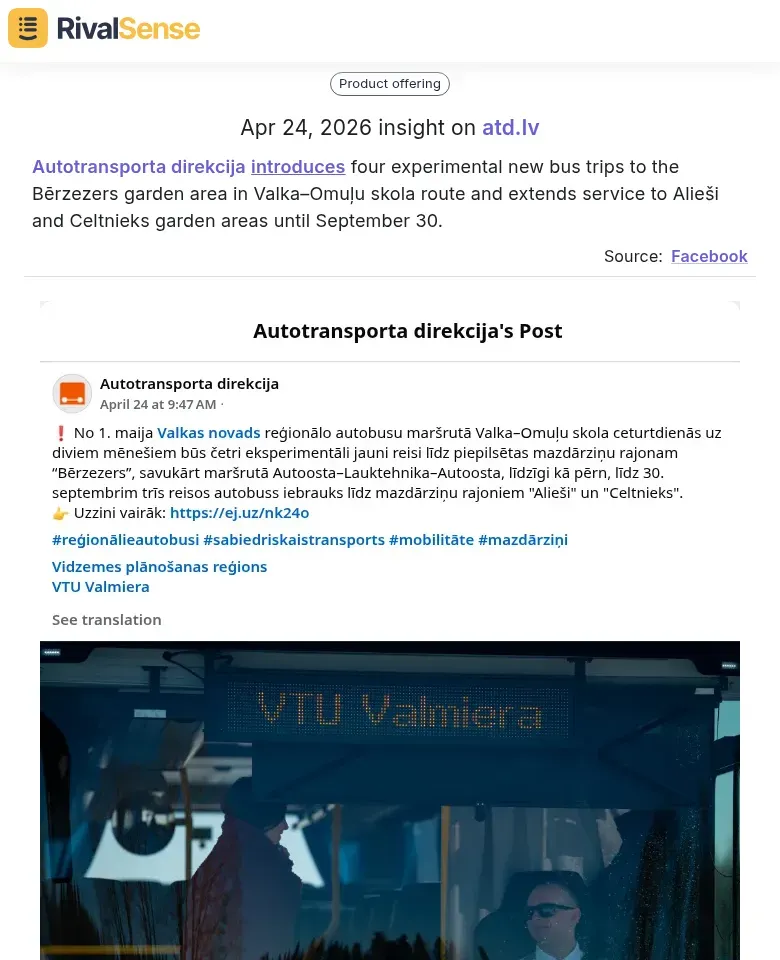
👉 Observing a competitor’s pilot programs gives you a zero-cost glimpse into demand validation. You can learn what works (or doesn’t) without taking the first risk, then refine your own experimental roadmap.
Checklist for Your Pilot:
- [ ] Define success criteria (e.g., 20% increase in rider retention).
- [ ] Choose a small, controlled sample (e.g., one route or demo cluster of users).
- [ ] Communicate the pilot clearly to users (e.g., “Try our new weekend express service for a limited time”).
- [ ] Set up automated data collection from day one.
- [ ] Build a go/no-go decision protocol: if criteria met, scale; if not, iterate or kill.
Tip: Use A/B testing for service variants—e.g., different pricing or frequency—to see what resonates before committing.
By treating services as experiments, you’ll innovate faster and make data-backed decisions that attract customers.
Build Trust Through Safety and Reliability
In transport, safety is non-negotiable. To attract risk-averse customers, make your safety credentials impossible to miss.
1. Showcase Certifications
Feature industry certifications (e.g., ISO 39001, DOT compliance) prominently on your website and booking pages. Add a “Safety Badge” to quotes and emails—one logistics company saw a 22% increase in inquiries after adding a simple ‘Fleet Safety Rating’ widget.
2. Communicate Service Improvements
When you upgrade vehicles, implement new driver training, or reduce accident rates, tell your audience. Use a monthly “Safety Update” email or a dedicated blog category. Example: “We reduced on-time delivery delays by 35% after installing real-time GPS tracking.”
3. Make Reliability a Brand Pillar
Build messaging around “On Time, Every Time” or “Zero Surprises.” Create a checklist customers can use to evaluate your service:
- [ ] Real-time tracking available
- [ ] Emergency response plan published
- [ ] Average delay time < 5 minutes
- [ ] Driver vetting process explained
Tip: Offer a “Safety Guarantee”—if a delivery is late due to a safety issue, refund 10% of the fee. This signals confidence and builds trust.
By consistently highlighting safety and reliability, you turn cautious prospects into loyal customers.
Optimize for Local and Seasonal Demand
Transport companies succeed by adapting routes to where people actually need to go. Tip: Use public data (e.g., census reports, building permits) to identify growing residential or business areas. Step 1: Map current stops against projected population clusters; add new stops 3–6 months before occupancy peaks. Step 2: For seasonal demand (e.g., summer gardens, ski resorts), launch temporary shuttles during peak months. Checklist:
- [ ] Review ridership data quarterly for shifts.
- [ ] Survey passengers about desired route changes.
- [ ] Pilot seasonal routes with a 4-week trial before full launch.
Proactively adjusting to demographic shifts—like a new tech hub or aging population—keeps your service relevant and captures competitor defectors.
Measure and Communicate Improvements
To stay ahead, track key metrics like ridership numbers, customer satisfaction scores, and cost per new stop monthly. Use free tools like Google Data Studio to visualize trends and set benchmarks.
Publicize wins via:
- Targeted ads on Google/LinkedIn (e.g., “New express route – 20% faster commutes”).
- Social media posts with before/after data and customer testimonials.
- Press releases for major upgrades (e.g., app features or sustainability milestones).
Create a feedback loop:
- Add in-app surveys with one open-ended question: “What one change would improve your ride?”
- Use sentiment analysis on support tickets to spot recurring issues.
- Share “You asked, we delivered” updates bi-weekly to show responsiveness.
✅ Pro tip: Run A/B tests on ad copy – “On-time rate now 95%” outperforms generic claims. Always link back to a landing page with detailed metrics.
By measuring what matters and broadcasting improvements, you build trust and attract riders who value transparency and progress.
From Insights to Action
The examples above—new stops, a safety-focused app, and seasonal experiments—aren’t just isolated moves. They’re signals of where the market is heading. RivalSense automatically tracks competitor moves like these across websites, social media, and registries, then delivers the most relevant ones in a weekly email report. You’ll spot new route registrations, app launches, partnership announcements, and more—without manual digging.
👉 Try RivalSense for free and get your first competitor report today.
📚 Read more
👉 Benchmarking Competitors' Client Partnerships: Trend Insights
👉 How CoreStream’s Free TPRM RFP Exposes a Powerful Competitive Move
👉 Key Account Management Training: A Strategic Blueprint for B2B Leaders
👉 Key Account Performance Dashboard: Real Examples for Heavy Equipment Repair
👉 How DoYouSpain’s SIXT Addition Revealed a Lucrative Gap—and How We Exploited It