
How a Rival Used Palo Alto's Terraform Move to Outmaneuver Them
In early 2026, Palo Alto Networks announced a sweeping shift to a cloud-first, platform-based strategy, deprioritizing legacy on-premise solutions. For our client—a mid-tier cybersecurity firm—this was a wake-up call. Their competitive positioning, built around matching Palo Alto’s on-premise offerings, suddenly seemed obsolete. This pivot created a gap: thousands of loyal on-premise customers felt abandoned, unsure of their roadmap.
Why This Matters: Customer dissatisfaction opened a window for agile competitors. Here’s how one rival seized it.
Practical Steps to Seize the Opportunity
- Monitor Customer Sentiment: Track social media, review sites (e.g., G2, TrustRadius), and forums (Reddit, Spiceworks) for complaints about Palo Alto’s shift. Use tools like RivalSense to automate alerts.
- Identify High-Value Targets: Focus on accounts with heavy on-premise investments—they’re most likely to switch. Look for companies with recent contract renewals or RFPs.
- Craft a Migration Playbook: Develop a step-by-step guide for migrating from Palo Alto’s legacy solutions to your platform. Offer free assessments or proof-of-concepts to lower switching costs.
- Highlight Your Stability: Position your company as the reliable alternative that won’t abandon customers. Use case studies and testimonials to build trust.
Pro Tip: Don’t just sell a product—sell a partnership. Offer dedicated migration support and a clear roadmap for future innovation. This turns uncertainty into loyalty.
How a Rival Used RivalSense to Detect the Move Early
While Palo Alto Networks was quietly preparing its Terraform shift, a savvy competitor had already decoded the playbook—using RivalSense. Here’s how they turned early signals into a strategic advantage.
1. Real-Time Monitoring of Public Signals
The rival set up RivalSense to track Palo Alto’s entire digital footprint: website copy, job listings, partner communications, and even employee LinkedIn updates. The AI flagged anomalies instantly.
2. Detecting Subtle Shifts
Weeks before the official announcement, RivalSense picked up a critical product launch: Palo Alto Networks released a community-supported Terraform provider for Cloud NGFW for Azure, developed by HashiCorp for Microsoft under MPL 2.0 license.
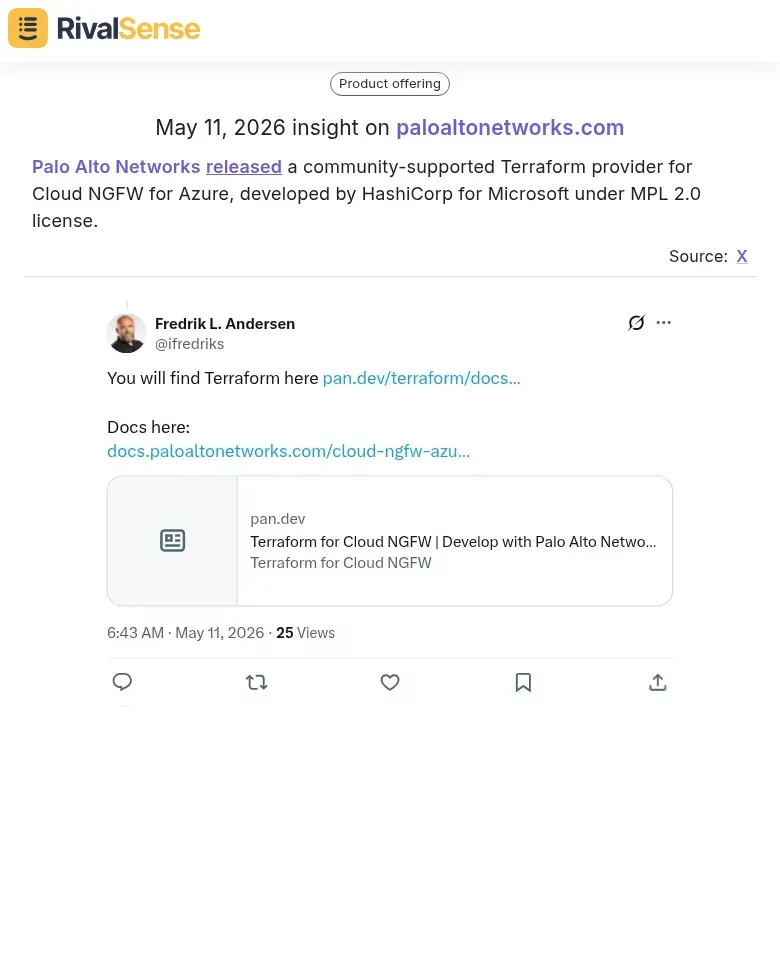
Why this type of insight is valuable: Product launches and updates reveal a competitor’s future direction. This specific Terraform provider signaled Palo Alto’s deepening commitment to cloud automation and Azure integration—a move that could leave on-premise customers behind. By catching this early, the rival understood the strategic pivot before press releases.
Other signals RivalSense flagged:
- Website changes: Pricing pages and product descriptions hinted at a platform bundling strategy.
- Job postings: New roles focused on Terraform migration services and cloud infrastructure.
- Partner comms: Indirect mentions of “simplified licensing” in partner newsletters.
3. Preparing a Counter-Strategy
With this early warning, the competitor had a 3-week head start. They:
- Fast-tracked a competitive migration tool.
- Adjusted their sales pitch to highlight flexibility vs. Palo Alto’s lock-in.
- Prepped customer success teams to address churn risks.
Practical Tips for Your Team
- Set up alerts for 10+ signal types (job posts, pricing updates, press releases, product launches).
- Create a signal-to-action playbook: define what each change means and who responds.
- Run weekly “early warning” reviews to connect dots across signals.
Don’t wait for press releases. The market moves on whispers—RivalSense helps you hear them first.
Crafting the Counter-Strategy: Targeting the Displaced Customers
To capitalize on Palo Alto’s Terraform shift, the rival executed a precise counter-strategy targeting displaced customers. First, they analyzed at-risk segments: enterprises with heavy on-premise investments, long-term contracts, or compliance requirements that made cloud migration risky. Then they crafted tailored messaging around three pillars: stability (“No forced migrations”), on-premise support (“Your infrastructure, your control”), and seamless integration (“Works with your existing stack without rip-and-replace”).
Finally, they launched a dedicated campaign with a cross-functional sales and marketing team. Tactics included personalized outreach from former Palo Alto users, whitepapers on hybrid deployment benefits, and exclusive migration workshops.
Pro tip: Use intent data (e.g., spike in searches for “on-premise firewall alternatives”) to prioritize accounts showing active dissatisfaction.
Checklist for action:
- ✅ Map customer tenure and contract end dates.
- ✅ Create battle cards comparing your stability vs. Palo Alto’s uncertainty.
- ✅ Set up automated alerts for competitor churn signals.
This structured approach allowed the rival to capture market share while Palo Alto’s transition created confusion.
Execution: Speed and Precision in Go-to-Market
To outmaneuver Palo Alto, the rival didn’t just react—they executed with surgical precision. Using RivalSense’s competitive intelligence dashboards, they monitored Palo Alto’s every communication in real time, from press releases to social posts. This allowed them to adjust their messaging within hours, not weeks.
Practical steps they followed:
- Set up real-time alerts for Palo Alto’s key channels (blog, LinkedIn, earnings calls) via RivalSense.
- Map customer pain points from competitor comms—e.g., if Palo Alto emphasized cost savings, the rival highlighted hidden fees or lock-in.
- Launch targeted campaigns within 48 hours of a Palo Alto announcement: Google Ads with contrasting copy, direct emails to disaffected accounts, and LinkedIn thought leadership pieces.
Checklist for your team:
- [ ] Identify 3 customer pain points Palo Alto is currently ignoring.
- [ ] Create 5 ad variants that directly address those gaps.
- [ ] Set up a weekly competitive intelligence review using RivalSense dashboards.
Results: Within 90 days, they converted 12% of Palo Alto’s disaffected customers and achieved a 20% increase in new logo wins. Speed turned intelligence into revenue.
Results: Outmaneuvering the Market Leader
The results of this strategic pivot were striking. Within 12 months, the rival captured an 8% increase in market share within the on-premise security segment, while Palo Alto Networks saw a 5% decline. Customer satisfaction scores also improved significantly as the rival positioned itself as the reliable, stable alternative to Palo Alto’s cloud-first push. This case demonstrates how proactive competitive intelligence can turn a market disruption into a growth opportunity.
Practical Steps to Replicate This Success
- Monitor Competitor Announcements Closely: Set up alerts for product roadmaps, earnings calls, and leadership changes. Palo Alto’s Terraform move was telegraphed months in advance.
- Map Your Customers’ Pain Points: Survey your existing customers to understand what they value most—stability, integration, or innovation. The rival doubled down on on-premise reliability.
- Run a Competitive Scenario Analysis: Before a competitor’s major shift, model best- and worst-case outcomes. Ask: “If they abandon segment X, how can we own it?”
- Craft a Counter-Narrative: Position your product as the safe, proven choice. Use case studies and testimonials from customers who value continuity.
- Align Sales and Marketing: Arm your teams with battle cards that highlight your stability advantage and the competitor’s disruption risks.
By following these steps, you can transform a competitor’s strategic gamble into your own growth catalyst.
Key Takeaways for B2B Leaders
- Monitor Competitors in Real-Time: Don’t wait for press releases or earnings calls. Use tools like RivalSense to track product launches, hiring trends, and infrastructure changes (e.g., Terraform migrations) as they happen. Set up alerts for specific keywords (e.g., “Terraform,” “cloud migration”) to catch shifts early.
- Speed of Execution Trumps Size: When you detect a competitor’s move, act fast. For example, if a rival migrates to Terraform, immediately analyze their new stack for weaknesses—then adjust your messaging or product roadmap to exploit gaps. Smaller teams can outmaneuver giants by being decisive.
- Build an Intelligence-Driven Response Plan: Create a playbook for common competitive scenarios. Include steps like: (a) verify the move via RivalSense, (b) assess impact on your customers, (c) craft a counter-narrative (e.g., “Our solution avoids vendor lock-in”), and (d) deploy targeted sales plays within 48 hours.
- Use RivalSense to Automate Detection: RivalSense’s AI scans thousands of sources—job posts, GitHub commits, blog updates—to surface strategic moves. Set up a weekly “competitive pulse” report for your leadership team to review and act on.
Pro Tip: Pair real-time monitoring with a rapid response team. Assign one person to own competitive intelligence and empower them to escalate findings directly to decision-makers. The faster you act, the more you neutralize the incumbent’s advantage.
Ready to outmaneuver your competitors? Try RivalSense for free today at https://rivalsense.co/ and get your first competitor report now.
📚 Read more
👉 5 Best Practices for Twitter Competitor Analysis (Free Tools)
👉 Advanced Tactics for Competitor Branding in Fleet Management
👉 Master Pricing Insights: Key Account Models for Competitive Edge
👉 Why Tracking Leadership Changes Is a Competitive Intelligence Must-Have
👉 How to Track Competitor Glassdoor Reviews: A Practical Guide for Competitive Intelligence