
5 Key Account Management Strategies for Environmental Consultants (and Any B2B Firm)
Environmental consultants operate in a high-stakes arena where regulatory compliance meets client relationships. Unlike traditional B2B sales, environmental consulting involves long sales cycles—often 6–18 months—and a web of stakeholders: regulators, project managers, legal teams, and community representatives. Balancing deep technical expertise with trust-building is critical. A single misstep in account management can derail years of relationship investment, while effective management unlocks cross-selling opportunities across remediation, permitting, and sustainability services.
Practical Tips for Environmental Account Managers:
- 🗺️ Map the stakeholder ecosystem early: Identify decision-makers, influencers, and blockers. Create a contact matrix with roles, concerns, and communication preferences.
- 📅 Establish a regulatory rhythm: Schedule quarterly regulatory updates with clients to demonstrate proactive compliance support, not just reactive problem-solving.
- 🚀 Leverage project milestones for cross-selling: After a successful Phase I ESA, introduce Phase II services during the same meeting—timing is everything.
- 📊 Track engagement metrics: Monitor email open rates, meeting attendance, and proposal follow-ups to gauge relationship health.
By systematizing these practices, consultants can shorten sales cycles, boost retention, and grow revenue per client.
Strategy 1: Deepen Industry Expertise to Become a Trusted Advisor
To become a trusted advisor, environmental consultants must go beyond basic compliance. Stay ahead of evolving regulations like EPA updates or the EU Green Deal by subscribing to regulatory alerts and attending industry briefings. Develop a niche specialization—for example, PFAS remediation or ESG reporting—to differentiate your firm. Share insights proactively: publish white papers on emerging trends, host webinars on regulatory changes, and contribute to industry publications.
Practical tip: Create a 'regulatory radar' checklist that you update quarterly, tracking key deadlines, policy shifts, and enforcement trends. This not only positions you as an expert but also gives clients actionable intelligence they can't get elsewhere.
Strategy 2: Leverage Data-Driven Account Planning
Stop relying on gut feelings. Use CRM and competitive intelligence tools like RivalSense to track client engagement, project history, and competitor moves. Set up alerts for competitor bids, regulatory changes, or new contracts involving your client.
Map the Client’s Organization
- Identify key decision-makers and influencers beyond your direct contact. Use LinkedIn Sales Navigator or org charts to understand reporting lines. Note who champions sustainability, who controls budgets, and who signs off on environmental compliance.
Set Measurable Account Goals
- Define SMART goals: e.g., grow revenue by 20% YoY, achieve NPS > 70, secure 3 referrals per quarter. Break these into quarterly milestones.
Action Checklist:
- [ ] Audit CRM data for completeness (contacts, past projects, communication logs)
- [ ] Set up competitor monitoring for each key account
- [ ] Create an org chart with influence levels (high/medium/low)
- [ ] Define 3-5 SMART account goals
- [ ] Schedule quarterly account reviews with your team
Pro Tip: Use a simple scoring system (1-5) for account health across relationship strength, project pipeline, and competitive risk. Review monthly to spot early warning signs.
Enhance Account Planning with Competitive Intelligence
Beyond internal data, tracking competitors' moves can reveal opportunities and threats for your clients. For example:
🔍 Pricing campaigns – A competitor offering aggressive discounts might lure price-sensitive clients. RivalSense detected that Akulaku Indonesia launched a mid-month savings campaign with discounts up to 90% and free shipping. While this is a retail example, any significant pricing shift in your market can signal a need to reinforce your value proposition.
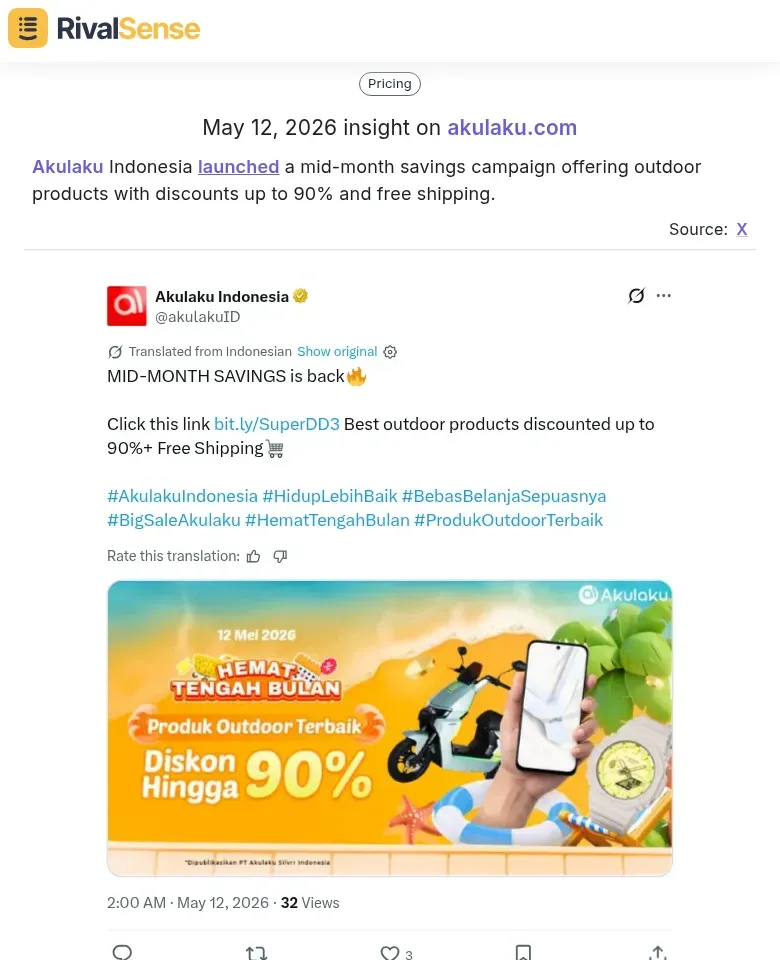
Why this matters: Monitoring competitors' pricing tactics helps you proactively address client concerns about cost, reinforcing your expertise and long-term partnership.
🔍 Product or service renaming – A competitor rebranding a flagship offering often indicates a strategic pivot. RivalSense reported that Palo Alto Networks renamed 'Prisma Access Agent' to 'Prisma Agent' with a new description of 'next-generation unified agent'. This could signal a shift toward broader integration – information you can use to differentiate your own services.
Why this matters: Understanding competitors' product changes helps you position your firm as more stable and specialized, especially when clients are considering alternatives.
🔍 Geographic expansion – When a competitor extends availability, your existing clients may be approached. RivalSense noted that AddSecure expanded its NGP solutions from UK-only to global and added PathLink, restructuring its menu to include PSTN/ISDN and 2G/3G switch-offs. This kind of expansion can threaten your local stronghold.
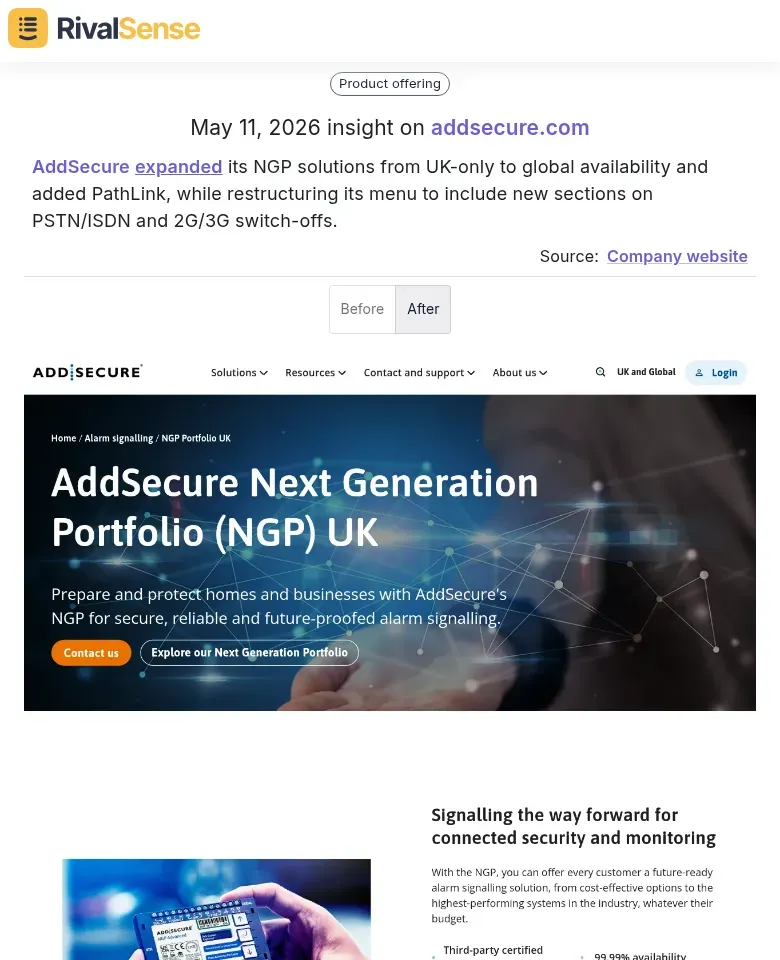
Why this matters: Early awareness of geographic moves allows you to strengthen relationships with clients before competitors can establish a local presence.
Integrate these insights into your account plans using tools like RivalSense to automatically monitor such signals every week.
Strategy 3: Build Long-Term Partnerships Through Value-Added Services
To move beyond transactional relationships, environmental consultants must embed themselves as indispensable partners. Start by offering complimentary audits or risk assessments—a no-cost environmental scan that reveals hidden compliance gaps or efficiency opportunities. This not only demonstrates expertise but uncovers new service needs. For example, a Phase I ESA might lead to stormwater management consulting.
Next, create a client advisory board comprising 5–7 key clients. Meet quarterly to co-develop solutions, test new service ideas, and gather feedback. This transforms clients from passive buyers into active collaborators, deepening loyalty.
Finally, provide ongoing compliance monitoring and alerts. Use automated tools to track regulatory changes (e.g., EPA rule updates) and send monthly compliance summaries. This reduces the client’s burden of staying current and positions you as their early-warning system.
Quick Tips:
- Start with one complimentary audit per quarter; track conversion rates.
- Rotate advisory board members annually to keep perspectives fresh.
- Use a simple CRM to automate alerts—no need for expensive software.
By layering these value-added services, you shift from a vendor to a strategic partner, ensuring recurring revenue and referrals.
Strategy 4: Align Internal Teams for Seamless Client Experience
Environmental consulting projects often involve multiple specialists—project managers, technical experts, and sales—who must work in lockstep to deliver a unified client experience. Start by establishing cross-functional account teams for each major client. Assign a dedicated account lead who coordinates across departments and serves as the client’s primary point of contact.
Implement regular internal syncs (e.g., weekly 30-minute stand-ups) to review client feedback, project milestones, and upcoming deliverables. Use a simple agenda template: (1) wins and challenges, (2) client feedback highlights, (3) action items. This prevents silos and ensures everyone is aligned on priorities.
Use shared dashboards (e.g., in Asana, Monday.com, or a CRM) for real-time visibility into account health. Include key metrics like project status, budget burn rate, client satisfaction scores, and upcoming deadlines. Set up automated alerts for any red flags (e.g., overdue tasks, budget overruns).
Pro tip: Create a “client pulse” scorecard that each team member updates weekly. This simple tool keeps everyone focused on the client’s evolving needs and helps identify upsell or risk signals early.
Strategy 5: Measure and Optimize Account Performance
To ensure your account management efforts drive real results, you need to measure performance and optimize continuously. Track key performance indicators (KPIs) such as Net Promoter Score (NPS), contract renewal rates, and upsell revenue. NPS reveals client loyalty and satisfaction; a score above 50 is excellent. Renewal rates should be at least 90% for healthy accounts. Upsell revenue indicates growth—aim for 10-20% year-over-year.
Conduct quarterly business reviews (QBRs) with each client. Use a structured agenda: review past performance, discuss current challenges, align on upcoming goals, and present new opportunities. Send a pre-meeting survey to gather feedback. After the QBR, share a summary document with action items and timelines.
Iterate your account plans based on performance data and changing client priorities. For example, if a client’s NPS drops, investigate the cause and adjust your approach—perhaps increase check-in frequency or assign additional support. If a client’s business shifts toward sustainability, propose new services like carbon footprint analysis. Use a CRM to track interactions and trigger alerts when KPIs deviate from targets.
Quick checklist for optimization:
- Monthly: Review NPS and upsell pipeline.
- Quarterly: Conduct QBR and update account plan.
- Annually: Analyze renewal trends and adjust strategy.
By systematically measuring and optimizing, you turn account management into a growth engine.
Ready to gain an edge? Try RivalSense for free at https://rivalsense.co/ and get your first competitor report today.
📚 Read more
👉 How a Rival Used Palo Alto's Terraform Move to Outmaneuver Them
👉 5 Best Practices for Twitter Competitor Analysis (Free Tools)
👉 Advanced Tactics for Competitor Branding in Fleet Management
👉 Master Pricing Insights: Key Account Models for Competitive Edge
👉 Why Tracking Leadership Changes Is a Competitive Intelligence Must-Have