
AWS Competitor Monitoring: Workflow for Key Account Insights
In the hyper-competitive cloud services market, real-time competitor intelligence isn't just a nice-to-have—it's a strategic imperative. AWS's rapid pivots, from Graviton processors to generative AI accelerators like Trainium, signal shifts in market priorities and customer needs. Missing these signals means losing relevance with key accounts that expect you to anticipate their next move.
Why this matters for key accounts:
- Proactive positioning: When AWS launches a new service, your key accounts will ask about alternatives. Be ready with a comparative analysis before they ask.
- Risk mitigation: AWS price cuts or new region expansions can disrupt your account's budget or compliance plans. Monitor changes to advise proactively.
- Opportunity identification: AWS's deprecations or feature gaps are your openings. Track their product roadmap to spot where you can fill the void.
Practical tip: Set up a simple monitoring checklist covering these four areas: product launches, pricing changes, partnership announcements, and executive speeches (re:Invent keynotes are goldmines). Assign a team member to scan these weekly and flag anything that impacts your top 10 accounts. This systematic workflow ensures you move from reactive firefighting to strategic account management.
Tracking Product Launches and Feature Announcements
To stay ahead of AWS's moves, set up a systematic tracking process for product launches and feature announcements. Start by subscribing to the AWS What's New RSS feed and the official AWS News Blog. Use a tool like RivalSense to aggregate these updates and filter by relevance to your key account segments.
Step 1: Categorize Launches
- New services (e.g., Amazon Now) → assess if they could replace your offering.
- Feature updates → check if they target your customer base (e.g., enhanced compliance for finance).
Step 2: Analyze Timing & Messaging
- Launch timing (e.g., re:Invent, pre-holiday) reveals strategic priorities.
- Messaging tone (e.g., “enterprise-grade,” “cost-effective”) signals target segments.
Step 3: Map to Your Accounts
- For each update, list which of your key accounts would benefit and how.
- Create a competitive response playbook: reinforce your differentiators or adjust roadmap.
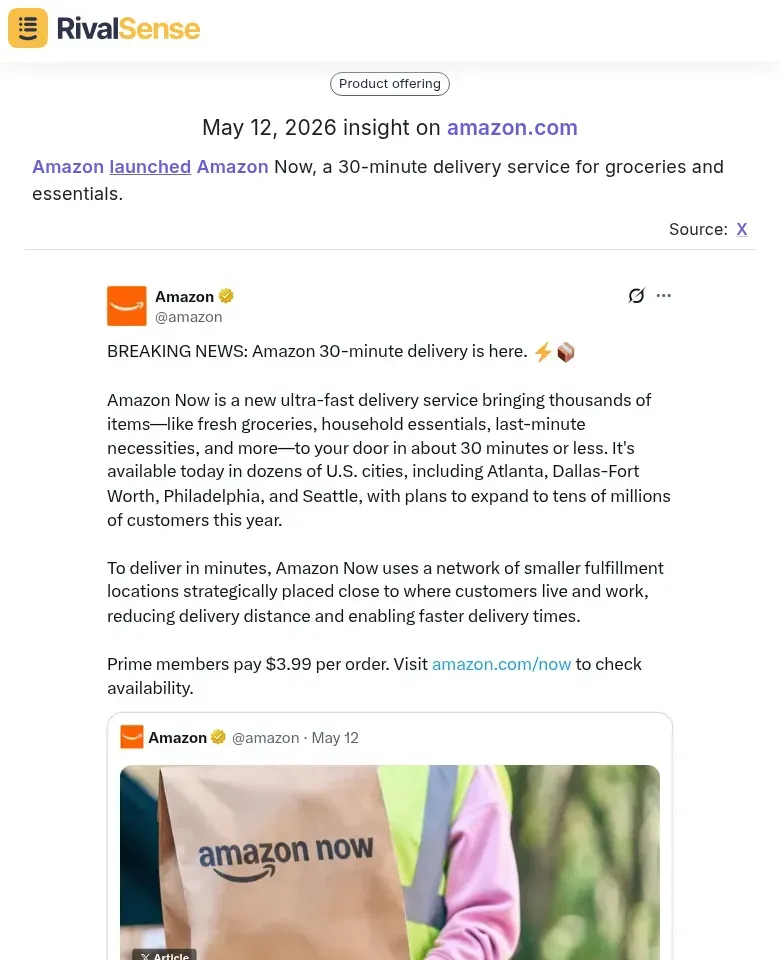
RivalSense Insight: Amazon launched Amazon Now, a 30-minute delivery service for groceries and essentials. For a competitor in the quick-commerce space, this is a critical signal: Amazon is entering the hyperlocal delivery market. Why this matters: Tracking product launches helps you anticipate new competitive threats and identify partnerships or operational adjustments before your key accounts are approached by the new entrant.
Tip: Set up weekly alerts for keywords like “new,” “launch,” “now available” combined with your industry terms. Track AWS's press releases and analyst briefings for deeper context.
Checklist:
- [ ] RSS feed monitored daily
- [ ] Feature updates tagged by account segment
- [ ] Quarterly competitive threat assessment based on launch patterns
Detecting Strategic Partnerships and Ecosystem Moves
To detect strategic partnerships, start by monitoring AWS's official announcements, press releases, and investor calls. Use tools like RivalSense to aggregate mentions of new alliances (e.g., Anthropic's $4B investment) and analyze the technology domain—AI, edge computing, or security.
Steps to assess ecosystem moves:
- Categorize the partnership type: technology integration, co-selling, or joint product development. Each signals different lock-in levels.
- Map capability gaps: Compare the partner's offering against AWS's existing services. For example, Anthropic fills a generative AI gap, reducing reliance on external models.
- Track partner portfolio changes: If a partner launches a new AWS-native service, expect tighter integration and potential deprecation of multi-cloud support.
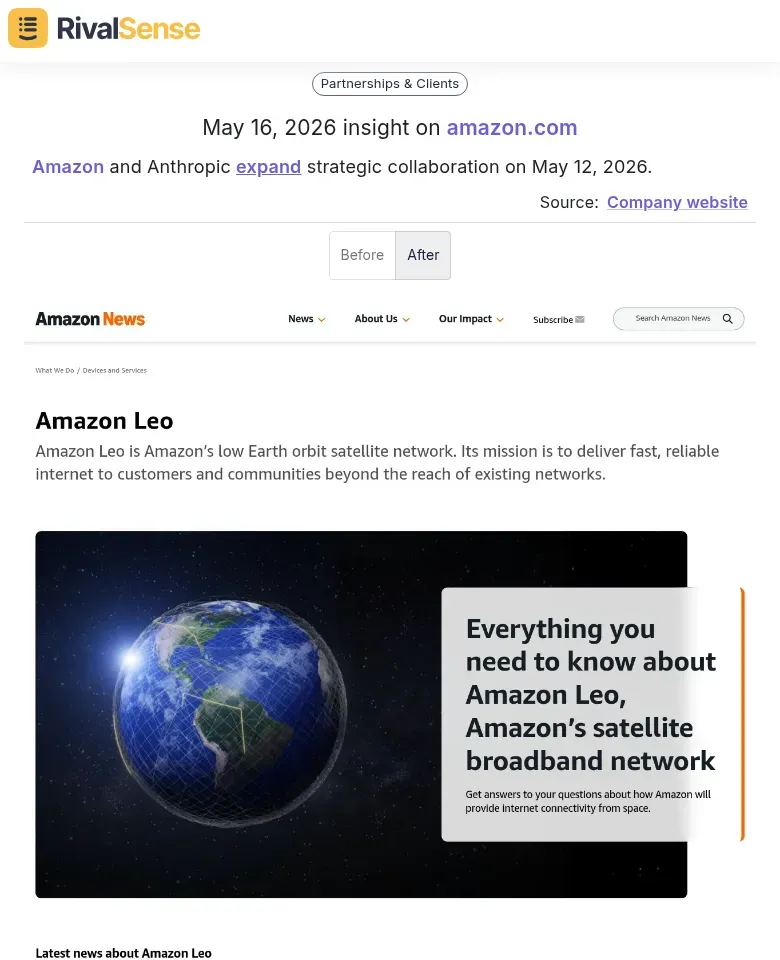
RivalSense Insight: Amazon and Anthropic expanded their strategic collaboration on May 12, 2026. Why this matters: Partnership monitoring reveals how competitors strengthen their ecosystem. For a SaaS provider relying on third-party AI models, this expansion signals that AWS is doubling down on its own AI stack—which could affect your key accounts' vendor choices and integration plans.
Checklist for actionable insights:
- [ ] Did the partner previously work with competitors? (e.g., Anthropic also partners with GCP)
- [ ] Is the partnership exclusive? (e.g., AWS-only SKU)
- [ ] What new use cases does it enable? (e.g., real-time fraud detection)
Pro tip: Set up alerts for partner earnings calls—they often reveal roadmap dependencies. For instance, Datadog's deeper AWS integration hints at future observability features. By connecting these dots, you can predict product integrations before official launches and adjust your competitive strategy accordingly.
Reading Between the Lines: Content and Positioning Shifts
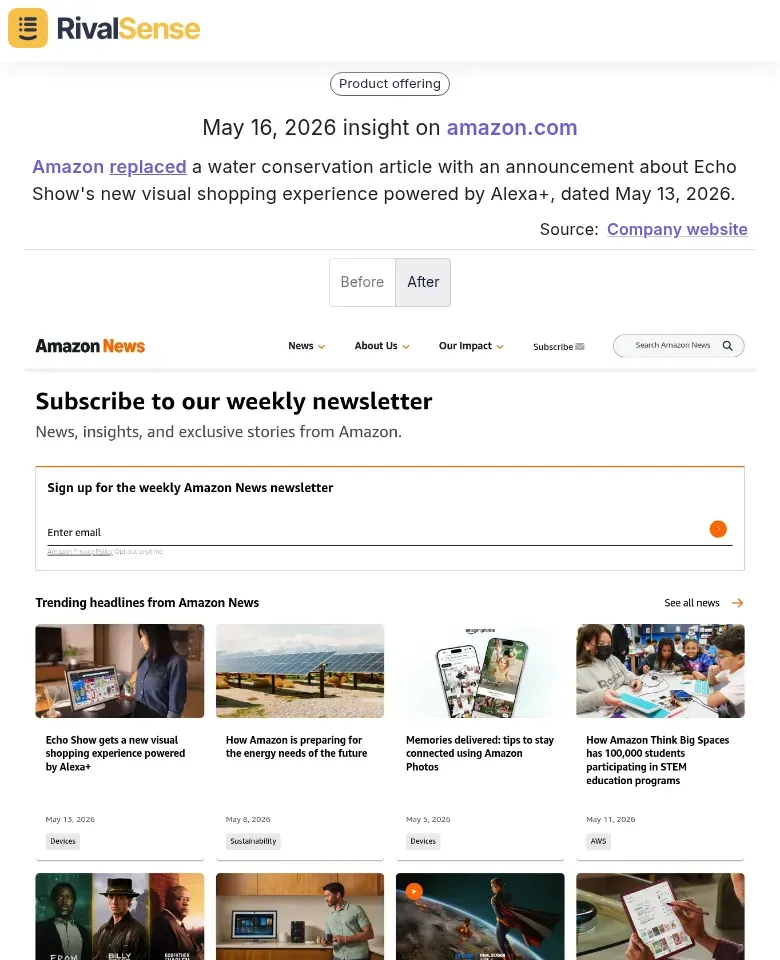
Homepage and blog updates often reveal strategic pivots before official announcements. For instance, when Amazon replaced water conservation messaging with Echo Show promotions, it signaled a shift toward revenue-driving features. To decode these signals:
- Track changes weekly: Use tools like RivalSense to capture homepage banners, value props, and blog headlines. Compare versions side-by-side.
- Categorize swaps: Label each change as 'customer segment shift' (e.g., enterprise vs. SMB), 'feature push' (new product emphasis), or 'messaging refresh' (brand tone).
- Correlate with business moves: A new case study on the blog + updated homepage hero = likely targeting a new vertical. Cross-reference with job postings or partnership news.
RivalSense Insight: Amazon replaced a water conservation article with an announcement about Echo Show's new visual shopping experience powered by Alexa+, dated May 13, 2026. Why this matters: Content shifts like this reveal strategic priorities. For a retail or consumer electronics competitor, this indicates a push toward conversational commerce—alerting you to prepare your own positioning or feature roadmap before losing mindshare with key accounts.
Pro tip: Look for removed content—it's often more telling than additions. If a competitor drops 'cost savings' from their homepage, they may be repositioning as a premium solution. Document these shifts in a shared tracker and discuss during weekly strategy meetings to align sales and product teams.
Building a Continuous Monitoring Workflow
To build a continuous monitoring workflow for AWS competitor insights, start by configuring automated alerts. Use tools like RivalSense to track website changes, press releases, and social media updates. Set up daily email digests and Slack notifications for immediate visibility. Next, establish a cross-functional review cadence. Schedule a weekly 30-minute meeting with sales, product, and marketing teams to discuss recent alerts. Use a shared dashboard (e.g., Notion or Airtable) to log findings and assign action items. Finally, integrate insights into account planning. For each key account, maintain a 'Competitive Intel' section in your CRM. When a competitor launches a new feature, update your battle card and adjust your pitch. For example, if AWS announces a price drop on EC2, your team should preemptively craft a value narrative around your managed services. Pro tip: Create a 'Competitive Response Playbook' with predefined actions for common scenarios (e.g., new product launch, partnership announcement). This ensures your team reacts swiftly and consistently.
Conclusion: Turning Insights into Actionable Account Strategies
To turn competitor insights into actionable account strategies, follow this three-step process:
1. Prioritize Insights by Account Impact
Not all competitive moves matter equally. Map each insight against your key accounts using a simple matrix: threat level (low/medium/high) × account value (revenue, strategic importance). Focus on high-threat, high-value intersections first. For example, if a competitor launches a feature your top 5 accounts requested, prioritize counter-messaging immediately.
2. Develop Proactive Counter-Strategies
For each priority insight, create a playbook:
- Counter-value proposition: Highlight your unique strengths (e.g., “Our uptime is 99.99% vs. their 99.9%”).
- Account-specific action: Schedule a QBR, send a competitive comparison one-pager, or offer a pilot of a new capability.
- Timeline: Assign owners and deadlines (e.g., “CSM to deliver comparison doc by Friday”).
3. Measure ROI
Track three metrics monthly:
- Account retention rate among accounts where you acted on insights vs. control group.
- Expansion revenue from upsells triggered by competitive wins.
- Win/loss rate in competitive deals.
Checklist for your next review:
- [ ] Top 3 competitor moves affecting key accounts identified?
- [ ] Counter-strategies documented and assigned?
- [ ] ROI dashboard updated?
By systematically prioritizing, acting, and measuring, competitor monitoring becomes a growth engine—not just a data dump.
Ready to put this workflow into action? RivalSense tracks competitor product launches, pricing changes, partnerships, content shifts, and more—delivering a weekly email report so you never miss a critical move. Try RivalSense for free and get your first competitor report today.
📚 Read more
👉 The Competitor Financial Intelligence Cheat Sheet: Decoding Funding, M&A, and Analyst Signals
👉 🚨 Competitor Watch: Ola, Uber & Rapido Face App Store Removal – What This Means for Your Business
👉 Key Account Tracking Data Export: A Practical Guide for B2B Leaders
👉 5 Key Competitor Tracking API Mistakes in Custom Software Development
👉 How RivalSense Helped Meta Uncover a Competitor's AI Efficiency Breakthrough