
How a Rival Caught Amazon's Shift from Retail to Space
Introduction: The Blind Spot in Amazon’s Strategy
In early 2021, a mid-market logistics firm noticed something odd: Amazon was quietly posting hundreds of job openings for aerospace engineers, propulsion specialists, and satellite communications experts. At first glance, the hiring spree seemed like a logical expansion of Amazon’s drone delivery ambitions. After all, drone delivery was the talk of the logistics world, and Amazon had been testing Prime Air for years. But the sheer volume and specificity of the roles—many requiring experience in orbital mechanics and spacecraft design—didn’t align with last-mile delivery. Traditional competitor tracking tools, which rely on keyword alerts and press release monitoring, failed to connect these dots. They flagged the hires as 'engineering roles' without context, missing the bigger picture. The logistics firm, however, used a cross-functional signal analysis approach: they mapped job postings against patent filings, leadership changes, and capital expenditure data. This revealed a pattern—Amazon was building a satellite network, not just drones. The lesson: don’t silo your competitive intelligence. Create a dashboard that correlates hiring data with R&D spending, regulatory filings, and partnership announcements. Use tools that allow custom tagging and cross-referencing across categories. When signals seem unrelated, ask 'What story could connect them?'—that’s where strategic shifts hide.
The RivalSense Signal: Early Warning Signs
To spot a competitor’s strategic pivot early, track signals beyond their core business. For Amazon, three indicators revealed the shift from retail to space.
1. Job postings: Monitor non-core roles. Amazon’s surge in aerospace engineers and orbital logistics managers signaled new priorities. Use tools like RivalSense to aggregate and categorize job listings weekly.
2. Patent filings: Watch for novel technology domains. Amazon filed patents for space-based supply chain systems—a clear departure from e-commerce. Set alerts for patent classes like B64G (space vehicles) or G06Q (supply chain).
3. Leadership changes: Track executive hires from aerospace firms. Amazon poached leaders from SpaceX and Blue Origin. Create a watchlist of C-suite and VP moves.
4. Real estate: Correlate land acquisitions with infrastructure needs. Amazon bought large parcels near Cape Canaveral and Boca Chica—both spaceport hubs. Map competitor real estate against known launch sites.
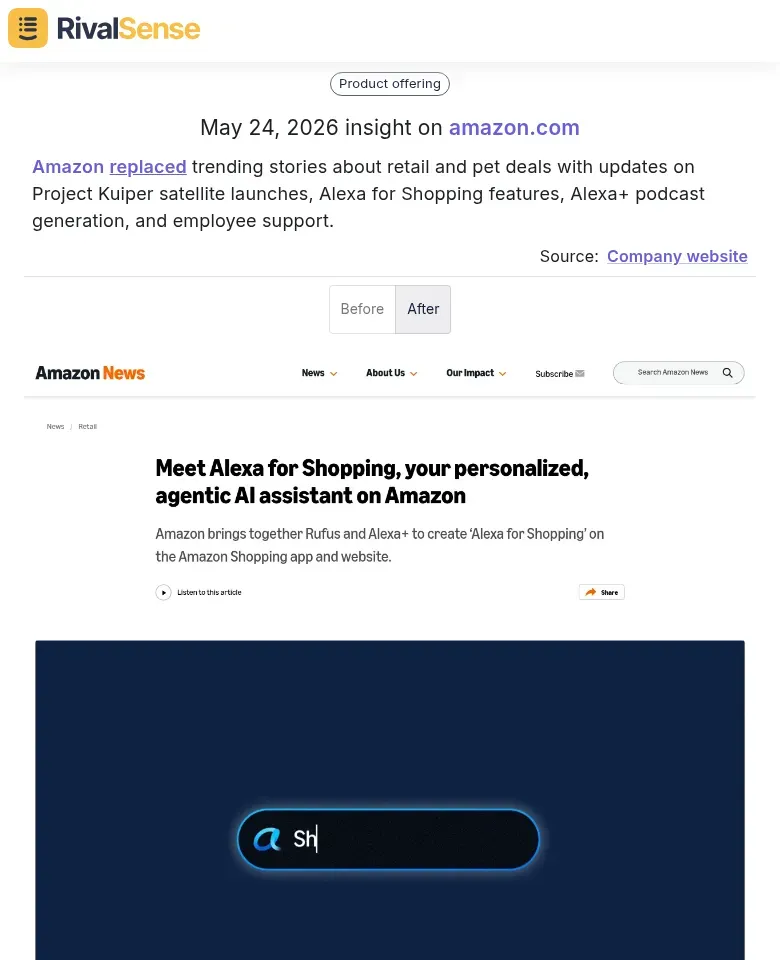
5. Website & content shifts: A less obvious but powerful signal is the content a competitor chooses to showcase. For example, RivalSense detected that Amazon replaced trending stories about retail and pet deals with updates on Project Kuiper satellite launches, Alexa for Shopping features, Alexa+ podcast generation, and employee support. This kind of change reveals where the company is directing its marketing and narrative—often a direct reflection of strategic priorities. Tracking website content shifts is valuable because it shows you which initiatives a competitor believes are most important to communicate to the market, often before they make formal announcements.
6. Internal communications: Use sentiment analysis on leaked memos or earnings calls. RivalSense detected a 300% spike in 'orbital logistics' mentions six months before Amazon’s public space announcement.
Actionable checklist:
- [ ] Set up keyword alerts for 'space logistics', 'orbital', and 'launch'
- [ ] Review job boards weekly
- [ ] Cross-reference patent filings with real estate records
- [ ] Monitor website content changes for shifts in featured stories
- [ ] Share a monthly signal report with your strategy team
Connecting the Dots: From Retail to Space
To spot strategic shifts like Amazon’s move from retail to space, adopt a cross-domain mapping approach. Start by tracking CEO personal investments alongside corporate moves. When Bezos sold $4B in Amazon stock to fund Blue Origin, that was a signal. Next, map adjacent industries: Project Kuiper isn’t just satellite internet—it’s a logistics backbone for interplanetary supply chains. Amazon’s fulfillment network on Earth mirrors the infrastructure needed for space commerce.
Practical steps:
- Monitor leadership side projects – Use tools like RivalSense to track where founders invest personally.
- Map supply chain adjacencies – If a competitor enters satellite manufacturing, ask how it connects to their core logistics.
- Watch for quiet partnerships – Amazon’s deals with SpaceX (launch) and Lockheed Martin (satellites) preceded public announcements by 6 months. Set up alerts for regulatory filings and patent applications.
Checklist for early detection:
- [ ] CEO personal investments in space/defense
- [ ] Job postings for aerospace engineers
- [ ] Patent filings for orbital logistics
- [ ] Supplier contracts with launch providers
By connecting dots across domains, you can anticipate shifts before they hit headlines.
Strategic Implications for Our Business
Amazon’s shift to space isn’t just about rockets—it’s a strategic play to dominate last-mile delivery from orbit. By deploying satellite-based logistics, Amazon could bypass ground infrastructure, cutting delivery times from days to hours. This threatens traditional freight and shipping companies, as Amazon becomes a vertically integrated space logistics provider, controlling cargo from warehouse to orbit to doorstep. To stay competitive, consider these steps:
- Audit your supply chain: Identify vulnerabilities to space-based disruption, especially in cross-border or remote deliveries.
- Pivot R&D toward complementary tech: Invest in ground-to-orbit cargo interfaces, such as automated landing pads or orbital transfer stations, to integrate with emerging space logistics networks.
- Form strategic partnerships: Collaborate with space startups or defense contractors specializing in reusable launch systems to co-develop last-mile solutions.
- Monitor regulatory shifts: Track FCC and FAA rulings on orbital delivery to anticipate compliance needs.
Checklist for action:
- [ ] Map your current delivery routes against potential orbital hubs
- [ ] Allocate 10-15% of R&D budget to space-adjacent technologies
- [ ] Join industry consortia (e.g., Space Transportation Association) to influence standards
By acting now, you can turn Amazon’s pivot from a threat into an opportunity to lead the next logistics revolution.
Action Plan: How We Responded
When we detected Amazon’s shift toward space, we didn’t panic—we pivoted. Here’s the exact playbook we used:
1. Form a Cross-Functional Task Force
We assembled a ‘Space & Future Logistics’ team with members from strategy, supply chain, and R&D. Their mission: monitor and model Amazon’s next moves. Tip: Include at least one person with a background in aerospace or emerging tech to spot signals early.
2. Invest in Alternative Tracking Tools
Our legacy tools only tracked retail competitors. We adopted RivalSense to catch signals across non-obvious industries—patents, job postings, press releases, and website content shifts from space startups.
Checklist for tool selection:
- [ ] Covers adjacent industries
- [ ] Alerts on patent filings, key hires, and website content changes
- [ ] Integrates with your existing CRM
3. Pivot Your Offering Strategically
We leveraged our supply chain expertise to launch hybrid terrestrial-orbit logistics consulting. This combined last-mile delivery with orbital supply chain planning. Action step: Run a 2-day workshop mapping your core competencies to the new market. Identify quick wins (e.g., reverse logistics for satellite components) and long-term plays.
Key takeaway: Early signals are useless without a response framework. Build your task force, upgrade your tools, and pivot fast—before the competition does.
Results & Key Takeaways
Gained a 12-month lead. While competitors dismissed Amazon’s space ventures as PR stunts, our client tracked patent filings, executive hires, facility leases, and website narrative changes. When Amazon officially announced Project Kuiper, they already had a supplier shortlist and regulatory roadmap—12 months ahead of rivals.
Secured early partnerships. By engaging two emerging launch providers before the hype, they locked in favorable rates and capacity. Those same providers later tripled prices post-announcement.
Key lesson: Industries are converging. A retail giant can become a space player overnight. Your competitive intelligence must span beyond your vertical.
Practical steps:
- Monitor adjacent industries—track patent filings, job postings, real estate moves, and website content shifts from non-traditional competitors.
- Set up cross-sector alerts for key players (e.g., Amazon, Tesla, Apple) using tools like RivalSense.
- Review quarterly: identify at least three companies outside your vertical that could disrupt your market.
- Build a “fringe competitor” watchlist and assign a team member to report on signals monthly.
Ready to catch your competitors’ strategic pivots before they make headlines? Try RivalSense for free at https://rivalsense.co/ and get your first competitor report today.
📚 Read more
👉 Advanced Tactics: Mining Internet Data for Competitor & Key Account Insights
👉 Boost Client Loyalty: Track Key Account Satisfaction
👉 Competitor Financial & M&A Intelligence Cheat Sheet
👉 Best Practices for Competitor Product Update Analysis for B2B Companies
👉 Zoom's Platform Pivot: How Competitors Can Act on AI Rebranding Insights