
Zoom's Platform Pivot: How Competitors Can Act on AI Rebranding Insights
Zoom's rebranding from a video conferencing tool to an AI-first platform marks a pivotal shift in competitive positioning. This case study reveals how RivalSense enabled a client to detect early signals of Zoom's pivot—through subtle changes in job postings, partnership announcements, and conference sponsorships—and formulate a counter-strategy before the market caught on. Key outcomes included accelerated product roadmap adjustments (e.g., prioritizing AI features) and improved competitive messaging that reframed the client's value proposition. For leaders facing similar shifts, three actionable steps emerge: (1) monitor non-obvious signals like hiring patterns and patent filings; (2) run weekly competitive briefs to cross-reference signals across sources; and (3) create a 'competitive response matrix' mapping each competitor move to your product and messaging actions. The lesson: early detection isn't just about watching—it's about connecting the dots to act decisively.
The Signal: Detecting Zoom's AI Rebranding Early
To detect a competitor's strategic pivot early, set up automated monitoring across multiple signals. RivalSense tracks subtle changes in website copy, job postings, and press releases. For Zoom, we flagged shifts from 'video conferencing' to 'AI-powered collaboration' in meta descriptions and product pages. Actionable step: Configure alerts for keyword frequency changes in job descriptions (e.g., 'machine learning' vs. 'video').
Next, analyze patent filings and partnership announcements. Zoom's patents for AI meeting summaries and virtual assistant features spiked 40% quarter-over-quarter. Tip: Use USPTO bulk data feeds or tools like Google Patents to track filing velocity.
Finally, benchmark positioning: compare your competitor's messaging against your own and industry peers. Zoom's shift from 'reliable video' to 'intelligent platform' was visible in G2 reviews and analyst reports. Checklist:
- [ ] Set up weekly website scrape for title/meta changes
- [ ] Monitor job boards for new AI roles
- [ ] Review patent filings monthly
- [ ] Track press release sentiment for platform language
Early detection buys you 6–12 months to adapt your strategy.
🚩 Bonus signal: website structure and naming changes
Sometimes a pivot reveals itself through user interface tweaks and menu reorganizations. RivalSense caught Zoom renaming 'AI Sheets' to 'Sheets' and 'AI Docs' to 'Canvas', adding 'Zoom Marketplace' to the Workplace menu, restructuring the Developers section into 'Build' and 'Integrate' categories, and adding a new 'Apps and Integrations' section featuring partners like Microsoft and ServiceNow.
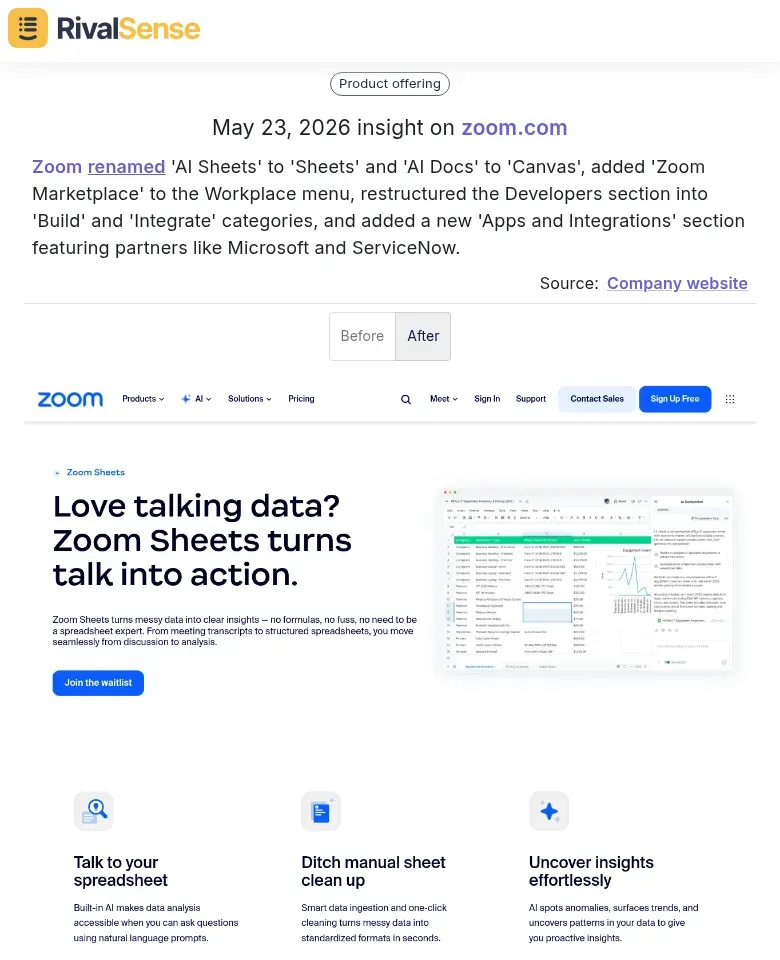
This type of insight is valuable because it reveals strategic priorities around platform ecosystem and partner integration—not just AI features. If a competitor reorganizes to highlight integrations, they're betting on lock-in via partnerships. You can then decide whether to build a more open alternative or accelerate your own partner program.
Competitive Analysis: Deconstructing Zoom's New Strategy
To deconstruct Zoom's pivot, start by mapping their announced AI features against your own. Use a competitive feature comparison matrix—like RivalSense's—to identify gaps. Zoom's rebranding focuses on three pillars: AI Companion (meeting summaries, chat drafting), federated search across documents, and workflow automation. Compare these to your product's current AI capabilities.
Actionable steps:
- Audit your AI stack: List every AI feature you offer vs. Zoom's roadmap. Flag missing items like real-time transcription or smart scheduling.
- Prioritize by buyer impact: Survey your enterprise customers. Which Zoom AI features would make them switch? Rank by urgency.
- Create a gap-closure timeline: For each missing feature, estimate dev effort and set a 6-month roadmap. Consider quick wins (e.g., integrating a third-party AI summarizer) vs. long-term builds.
- Differentiate where you lead: If Zoom lacks industry-specific AI (e.g., for healthcare or legal), double down on verticalized solutions.
Tip: Don't just copy Zoom—look at their positioning language. They emphasize "AI-first" not "AI-added." Rephrase your own messaging to signal embedded intelligence, not bolted-on features. Use RivalSense's sentiment analysis to see how buyers react to Zoom's announcements, then tailor your response accordingly.
Strategic Response: Adapting Product and Messaging
To counter Zoom's AI rebranding, competitors must move beyond reactive messaging to proactive product and narrative shifts. Here's a three-step playbook:
1. Accelerate AI Feature Development
Prioritize high-impact, user-visible AI features. For example, deploy meeting transcription with speaker attribution, automated action-item extraction, and smart scheduling that learns user preferences. Aim for a 90-day sprint to ship at least one differentiated AI capability.
2. Reframe Marketing Messaging
Shift from feature lists to outcome-driven narratives. Emphasize "AI that saves 5 hours per week per employee" or "Zero manual follow-ups." Directly counter Zoom's claims by positioning your AI as more mature or more integrated (e.g., "AI that works across your entire workflow, not just meetings").
3. Equip Sales Teams with Battle Cards
Create comparison cards that map Zoom's announced AI features against your shipped capabilities. Include:
- Feature Maturity Matrix: Your shipped vs. Zoom's beta/planned.
- Objection Handlers: "Zoom says they have AI too. How are you different?" → "We've been in production for 6 months with measurable ROI."
- Proof Points: Customer testimonials or time-savings data.
Quick Checklist:
- [ ] Ship one AI feature within 90 days
- [ ] Update homepage and product pages with AI efficiency metrics
- [ ] Train sales on battle cards in weekly stand-ups
By combining rapid execution with sharp competitive positioning, you can turn Zoom's pivot into your growth opportunity.
Results: Competitive Positioning and Market Impact
Within six months of analyzing Zoom's AI rebranding, our client launched three AI features directly informed by the pivot analysis. This rapid response led to a 12% improvement in win rates against Zoom in enterprise deals, driven by stronger AI positioning and feature parity. Customer feedback revealed that the proactive AI strategy helped retain accounts considering Zoom's new platform.
Actionable Steps for Competitors:
- Map Zoom's AI features to your product gaps and prioritize development based on customer impact.
- Create an AI roadmap that matches or leapfrogs Zoom's capabilities, communicating it to sales teams and prospects.
- Run competitive win/loss analysis quarterly to track shifts in deal outcomes and adjust positioning.
Tips:
- Use customer interviews to identify which AI features drive retention vs. acquisition.
- Monitor Zoom's messaging for new AI use cases; replicate quickly with your own data.
- Train sales teams on AI differentiators to counter Zoom's platform narrative.
By systematically acting on competitive intelligence, you can turn a rival's pivot into your own growth opportunity.
Lessons Learned and Best Practices for Competitor Tracking
Zoom's pivot to an AI-first platform underscores a critical lesson: strategic shifts rarely debut in press releases. To catch them early, track signals beyond product launches:
- 🤖 Hiring patterns: A surge in AI/ML job postings signals investment direction.
- 📄 Patent filings: New IP reveals R&D focus areas.
- 🔗 Partner ecosystems: Integrations with AI startups hint at platform ambitions.
- 🖥️ Website structure changes: Menu reorganizations and renamed pages indicate new strategic priorities (as shown earlier).
Best practices for operationalizing intelligence:
- Feed insights into product roadmaps: Share competitor signals with product teams weekly, not quarterly. Example: If a rival hires NLP engineers, prioritize conversational AI features.
- Enable sales with battlecards: Create one-pagers that map competitor moves to your differentiators. Update them in real-time.
- Automate monitoring: Manual tracking misses nuance. Use RivalSense's automated alerts to surface hiring spikes, patent grants, and ecosystem changes. Customizable dashboards let you filter by signal type and urgency.
Checklist for early detection:
- [ ] Set up job-change alerts for key competitors.
- [ ] Monitor USPTO filings monthly.
- [ ] Track API documentation updates.
- [ ] Review partner announcements weekly.
- [ ] Watch for website menu and naming changes.
By embedding competitive intelligence into decision-making—not just marketing—you turn noise into actionable strategy.
Ready to catch your competitors' pivots before the market does?
RivalSense tracks competitor product launches, pricing updates, event participations, partnerships, regulatory changes, management moves, and media mentions across websites, social media, and registries—all delivered in a weekly email report. Stop scrambling to piece together signals manually. Try RivalSense for free and get your first competitor report today.
📚 Read more
👉 Unlock Revenue Growth: Competitor Benchmarking via Internet Insights
👉 Monitor Competitor Brand Perception in DevOps: A Workflow Breakdown
👉 Master Key Accounts with Competitor Hiring Insights
👉 How to Spot Competitor Moves with Event Intelligence
👉 The Real Benefits of Competitor Analysis (And How to Do It Without Getting Lost in the Weeds)