
Boost Client Loyalty: Track Key Account Satisfaction
In today’s crowded B2B landscape, client retention is a revenue multiplier. Acquiring a new customer costs 5–7x more than retaining an existing one, and a mere 5% increase in retention can boost profits by 25–95%. Satisfied accounts don’t just stay—they become advocates, driving referrals and upsells. Yet most companies track satisfaction reactively (e.g., annual surveys). Proactive tracking—using real-time metrics like NPS, CSAT, and customer health scores—gives you a competitive edge. Start by defining a “healthy account” scorecard: include product usage, support ticket trends, and renewal likelihood. Then set up automated alerts for dips (e.g., login frequency drops 20%). Finally, act fast: assign a CSM to reach out within 24 hours of a negative signal. This shift from reactive to proactive builds trust and differentiates your brand. Practical tip: use a simple traffic-light system (green/yellow/red) for each account, reviewed weekly in team stand-ups. The result? Higher loyalty, lower churn, and a defensible moat.
Learn from Compliance Signals: Privacy & Data Protection as Trust Builders
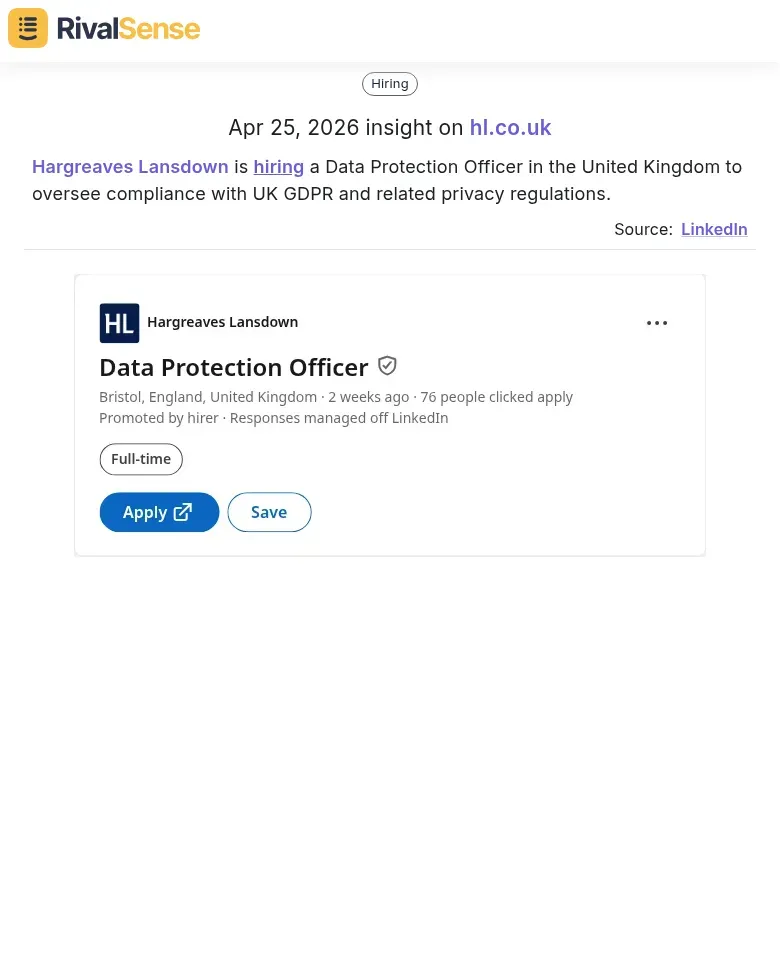
Privacy compliance isn’t just a legal checkbox—it’s a competitive advantage. When your competitors hire a Data Protection Officer (DPO), they signal a serious commitment to client data security. You can do the same to build trust with key accounts.
Example from RivalSense: Hargreaves Lansdown, a major financial services firm, is hiring a Data Protection Officer in the United Kingdom to oversee compliance with UK GDPR and related privacy regulations. This move shows they are investing in data protection as a trust signal. Why is this insight valuable? Because it reveals a competitor's strategic priority—if they are beefing up privacy, you should too, or risk losing trust-sensitive clients.
Practical Steps to Turn Compliance into Trust:
- Appoint a DPO (or equivalent). Even if not legally required, designate a person responsible for data protection. Announce this role to clients—it shows accountability.
- Publish transparent privacy practices. Create a clear, jargon-free privacy policy. Include how you collect, store, and share data. Add a “Privacy Promise” on your website summarizing your commitments.
- Conduct regular compliance audits. Schedule quarterly internal audits and annual third-party audits. Share a summary of findings (without sensitive details) with key accounts to demonstrate proactive risk management.
- Offer a client privacy checklist. Provide a simple checklist that shows how you handle data at each stage: collection, storage, processing, and deletion. This educates clients and reinforces your diligence.
- Get certified. Pursue certifications like ISO 27001 or SOC 2. Display badges prominently—they’re visual trust signals.
Checklist for Your Next Compliance Review:
- [ ] DPO appointed and contact info shared with clients
- [ ] Privacy policy updated within last 6 months
- [ ] Audit schedule defined for next 12 months
- [ ] Client-facing privacy documentation created
- [ ] Certification roadmap in place
By treating privacy as a trust-building tool, you turn a regulatory requirement into a loyalty driver. Clients who see you proactively protecting their data are more likely to stay—and advocate for you.
Learn from Legal & Risk Management: Proactive Dispute Resolution
Legal and risk management teams excel at proactive dispute resolution—a practice that can transform client relationships. Here’s how to apply their strategies.
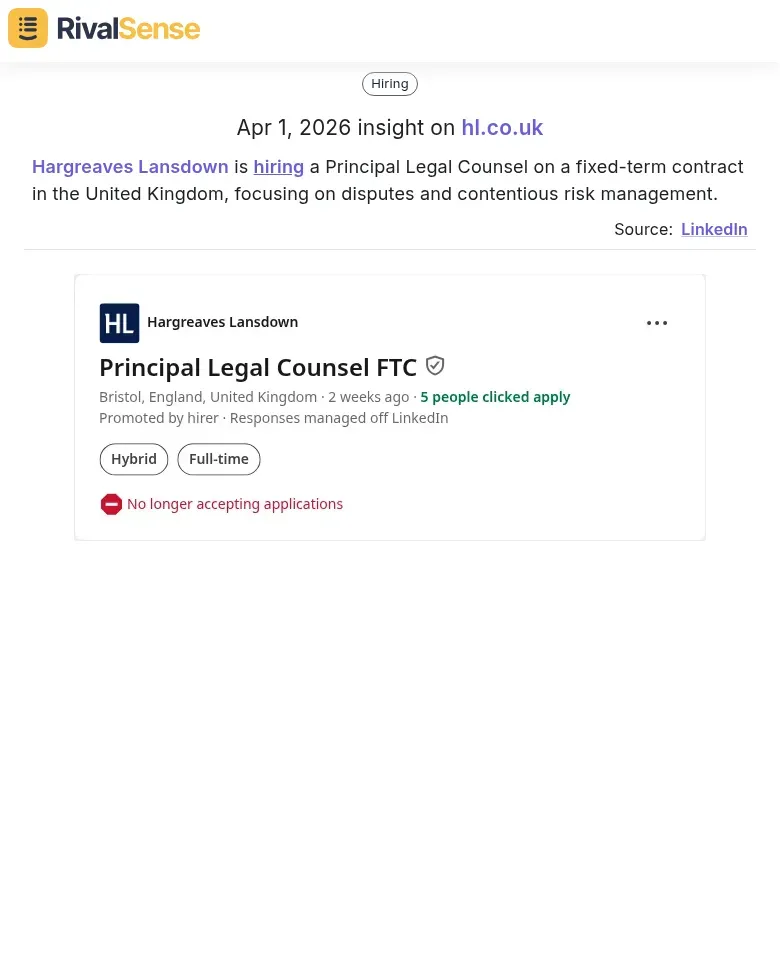
Example from RivalSense: Hargreaves Lansdown is hiring a Principal Legal Counsel on a fixed-term contract in the United Kingdom, focusing on disputes and contentious risk management. This hiring signals that the company is preparing for escalation risks and taking a structured approach to conflict. For you, tracking such roles helps anticipate competitor service gaps—if they are beefing up legal support, they may be expecting more disputes, which could signal dissatisfaction among their clients that you can address with your own accounts.
1. Assign a Dedicated Client Advocate
Just as legal counsel handles disputes, designate a single point of contact for client issues. This person owns the resolution process, ensuring no concern falls through the cracks. Tip: Choose someone with strong empathy and problem-solving skills, not just seniority.
2. Use Fixed-Term Problem-Solving Roles
When a recurring issue emerges (e.g., billing errors), create a temporary role (e.g., “Billing Improvement Lead”) with a clear 30-day mandate. This signals urgency and focus, similar to how legal teams deploy specialists for specific risks.
3. Build a Clear Escalation Path
Map out a three-step process:
- Step 1: Frontline support (aim for 24-hour acknowledgment).
- Step 2: Account manager (escalate if unresolved in 48 hours).
- Step 3: Client advocate (final decision within 72 hours).
Publish this path in your client portal and review it quarterly. Checklist: Include response SLAs, owner names, and backup contacts.
By formalizing dispute resolution, you reduce friction, build trust, and turn potential churn into loyalty.
Learn from Internal Communications: Transparency Builds Trust
Clients value honesty. When you share internal changes—like office moves or renovations—you humanize your brand and reinforce a partnership mindset. Here’s how to turn internal updates into trust-building content.
Example from RivalSense: David Humphreys, Senior Video Producer at Hargreaves Lansdown, documented the company's office move and renovations at the Welcome Building on March 19. This kind of behind-the-scenes content shows clients that the company is investing in its environment, which often translates to better service and stability. Tracking such competitor communications helps you benchmark your own transparency and find opportunities to share your story.

- Document the journey. Film a time-lapse of construction, share photos of new meeting rooms, or write a “behind the scenes” post about choosing furniture. This shows you’re invested in your workspace and, by extension, in serving them better.
- Give early access. Before a major change, send clients a preview email or invite them to a virtual tour. This makes them feel like insiders and reduces uncertainty.
- Explain the “why.” Don’t just announce a move—explain how it benefits clients (e.g., “Our new lab means faster product testing for you”).
- Create a dedicated update channel. Use a monthly newsletter or Slack community to share company milestones. Keep it consistent.
Pro tip: Set a recurring calendar reminder to share one internal update per month. Even small wins (team birthdays, charity runs) build transparency. Avoid speculation by being proactive—if you’re quiet, clients will fill the gaps with doubt.
Actionable Framework: Building a Key Account Satisfaction Tracking System
To build a key account satisfaction tracking system, start by defining metrics tied to client business outcomes. Use Net Promoter Score (NPS) to gauge loyalty and Customer Satisfaction Score (CSAT) for transactional feedback. For deeper insights, track Customer Effort Score (CES) and renewal intent. Align these with client KPIs like time-to-value or ROI.
Schedule regular check-ins using competitor-inspired triggers. For example, if a rival launches a new feature, send a pulse survey asking, “How does our current solution compare?” Use a 90-day rhythm: monthly CSAT surveys, quarterly NPS, and annual business reviews. Automate reminders in your CRM to ensure consistency.
Integrate satisfaction data into CRM and account planning. Tag accounts with satisfaction scores, flag at-risk clients, and create automated workflows (e.g., trigger a call if NPS drops below 7). During quarterly planning, review trends and adjust strategies. Use a simple dashboard showing score history, open feedback, and action items. This turns data into continuous improvement, boosting retention and loyalty.
Conclusion: Turning Insights into Long-Term Loyalty
Loyalty isn’t built on guesswork—it’s built on insights. By monitoring competitor hiring and communication patterns, you uncover the hidden drivers that keep clients loyal. For example, if a rival is aggressively hiring customer success managers, it signals a shift toward proactive support. Respond by enhancing your own touchpoints before clients feel neglected.
Turn insights into action:
- Track weekly: Use a simple spreadsheet or tool like RivalSense to log competitor job postings, blog tone, and social engagement.
- Identify triggers: A sudden spike in competitor support hires? Schedule a check-in call with at-risk accounts.
- Measure impact: After implementing a change (e.g., faster response times), survey clients on satisfaction. Compare Net Promoter Scores before and after.
Start small: Pick one insight this week. Maybe a competitor launched a new onboarding video. Create a quick checklist for your team to review your own onboarding process. Implement one tweak, then measure client feedback within 30 days.
Consistent tracking plus responsive action transforms satisfied clients into vocal advocates. They stay because you understand—and act on—what truly matters to them.
Ready to make client loyalty your competitive edge? Try RivalSense for free to get weekly competitor insights—from hiring and pricing to product updates and office moves. Get your first competitor report today and start turning signals into satisfaction.
📚 Read more
👉 Competitor Financial & M&A Intelligence Cheat Sheet
👉 Best Practices for Competitor Product Update Analysis for B2B Companies
👉 Zoom's Platform Pivot: How Competitors Can Act on AI Rebranding Insights
👉 Unlock Revenue Growth: Competitor Benchmarking via Internet Insights
👉 Monitor Competitor Brand Perception in DevOps: A Workflow Breakdown