
Advanced Tactics: Mining Internet Data for Competitor & Key Account Insights
The internet is a goldmine of competitive intelligence, yet most companies only scratch the surface by monitoring social media or press releases. Beyond the obvious lies a wealth of structured and unstructured data that reveals competitors' strategic moves before they hit the mainstream. To systematically mine this data, focus on three insight types: regulatory moves, financial signals, and ecosystem shifts.
Regulatory moves – Track patent filings, FDA approvals, or GDPR-related changes. For example, a competitor's new patent can hint at product direction. Financial signals – Monitor job postings (e.g., a surge in AI roles suggests an upcoming feature), funding rounds, or supplier contracts. Ecosystem shifts – Watch for partnership announcements, API deprecations, or open-source contributions.
How to collect systematically:
- Set up Google Alerts for competitors + keywords like "patent," "hiring," "partnership."
- Use RSS feeds for regulatory databases (e.g., USPTO, SEC).
- Create a shared spreadsheet or use a CI tool to tag signals by type and urgency.
- Review weekly: categorize as "low/medium/high impact" and assign ownership.
Pro tip: Don't just collect – connect the dots. A hiring spree + new office lease + patent filing often signals a major product launch. By building a habit of structured collection, you turn noise into foresight.
Regulatory & Policy Signals: Anticipating Market Rule Changes
Regulatory shifts can reshape markets overnight. To stay ahead, monitor government announcements and local regulations that may constrain competitors or open opportunities. Tracking these signals lets you anticipate rule changes before they take effect and adjust your strategy accordingly.
For instance, when ride-hailing apps surge, cities often impose price caps or licensing limits—a defensive move that incumbents can leverage. A real-world example: Madrid capped VTC fares to prevent Cabify and other ride-hailing apps from price gouging during emergencies like blackouts and snowstorms, effective May 23, 2026.

This regulatory insight is valuable because it signals both a threat to your competitors (if they rely on surge pricing) and an opportunity for your business to position itself as a compliant, stable alternative. By catching such regulations early, you can pivot your pricing model or marketing narrative before rivals even adjust.
Practical steps to track regulatory signals:
- Set up alerts for keywords like “price cap,” “ride-hailing regulation,” or “transport authority” on government websites and news aggregators.
- Monitor city council agendas and transport authority meeting minutes (many publish online). Use tools like GovTrack or OpenStates for U.S. filings.
- Scan regulatory filings via SEC EDGAR (for public companies) or local equivalents. Look for risk factors mentioning pending regulations.
- Create a regulatory calendar with key dates for hearings, comment periods, and enforcement deadlines.
Checklist for weekly review:
- [ ] New bills or amendments in target jurisdictions
- [ ] Recent city council or transport authority meeting notes
- [ ] Industry association statements on regulatory trends
- [ ] Competitor lobbying disclosures
Financial Health Indicators: Reading Between the Lines of Earnings Reports
Earnings reports are treasure troves of competitive intelligence, but the real insights lie beneath the surface numbers. To extract strategic value, go beyond net income and focus on three key indicators:
1. Operating Losses vs. Net Losses
A company can report a net profit while bleeding from operations due to one-time gains (e.g., asset sales). Track operating income (EBIT) over multiple quarters. A widening operating loss signals structural issues—potential vulnerability you can exploit or a restructuring opportunity to poach talent or customers.
Consider Ubisoft, which lost 1.3 billion euros (about 1.4 billion dollars) last year—a record loss according to its CFO—and expects further operating losses of 500 million euros.
This financial signal matters because it reveals a competitor under severe pressure. You can anticipate cost-cutting measures (layoffs, divestitures) and prepare to capture market share or hire top talent before rivals stabilize.
2. Revenue Trends & Mix
Look for deceleration in core segments. If a competitor’s SaaS revenue grows 10% but its professional services revenue jumps 40%, they may be discounting services to win deals—a sign of desperation. Compare their revenue per employee to industry benchmarks; a declining ratio suggests inefficiency.
3. Forward Guidance & CFO Language
During earnings calls, note changes in forward guidance. A downward revision often precedes layoffs or R&D cuts. Use sentiment analysis on CFO statements: phrases like “uncertain macro environment” or “prudent cost management” can indicate hidden trouble.
Practical Checklist:
- [ ] Pull last 4 quarters of 10-Q/10-K filings
- [ ] Calculate operating margin trend
- [ ] Compare revenue growth vs. industry average
- [ ] Highlight any guidance changes in last 2 calls
- [ ] Note repeated mentions of “cost optimization” or “restructuring”
Ecosystem & Business Model Shifts: Uncovering Strategic Pivots
To detect ecosystem and business model shifts, monitor executive interviews, press releases, and industry analyst reports for profitability milestones and strategic pivot announcements. Such signals reveal when a competitor’s long-term bet is paying off—or failing.
For example, a first-time profitability announcement after years of investment signals a maturing business model. Rakuten's Mobile Division achieved profitability for the first time since entering the MNO business in 2019, driven by its ecosystem strategy, according to co-CEO Sharad Sriwastawa.
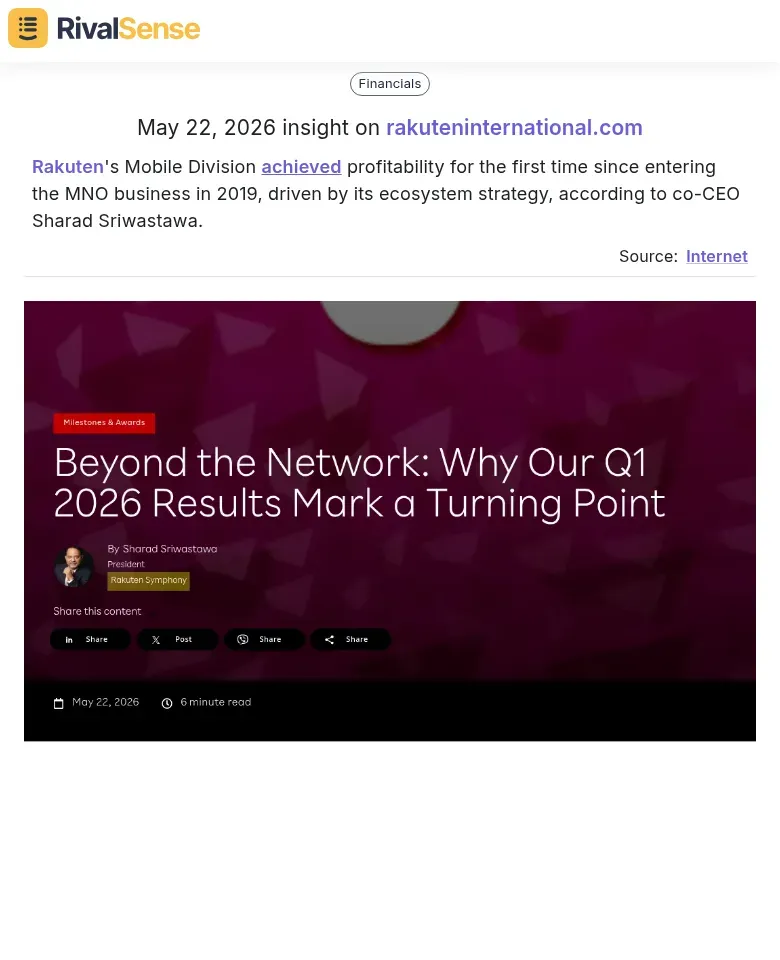
This ecosystem insight is valuable because it indicates that a rival has cracked the code on a previously unprofitable segment. You can analyze their cost structure changes and revenue mix shifts to reverse-engineer their strategy. Pair profitability news with hiring data—sudden senior hires in new domains often precede ecosystem plays.
How to stay on top of shifts:
- Set up alerts for phrases like “first profitable quarter,” “strategic partnership,” or “ecosystem expansion.”
- Use a competitive intelligence tool to aggregate these signals.
- When a competitor announces profitability, analyze their cost structure changes and revenue mix shifts.
- Check if they’ve exited non-core segments or entered new verticals.
- Create a timeline of their funding rounds versus profitability milestones to spot inflection points.
- Build a dashboard tracking key phrases across 10+ sources, and review weekly for pattern recognition.
Actionable Frameworks: Turning Internet Data into Competitive Moves
1. Build a Competitive Intelligence Dashboard with Real-Time Alerts
- Use tools like RivalSense or Feedly to aggregate data from news, social media, regulatory filings, and job postings.
- Set up keyword-based alerts for competitor product launches, funding rounds, leadership changes, and patent filings.
- Create a dashboard with sections for each competitor, updated daily. Include a traffic-light system: green (no change), yellow (minor signal), red (high-impact event).
2. Cross-Reference Multiple Data Types for Holistic Insights
- Combine regulatory data (e.g., FDA approvals, SEC filings) with financial data (funding, revenue estimates) and ecosystem signals (partner announcements, hiring spikes).
- Example: A competitor’s sudden hiring of regulatory affairs specialists + a new patent filing + a partnership with a clinical research organization = likely preparing for a product launch in a regulated market.
- Use a matrix: list data sources on one axis, competitors on the other. Score each intersection for signal strength (1-5).
3. Prioritize Signals Based on Potential Impact
- Assign each signal an impact score (1-10) based on how it affects your market share, revenue, or strategic position.
- Use the Eisenhower Matrix: urgent & important (act now), important not urgent (plan), urgent not important (delegate), neither (ignore).
- Checklist for weekly review:
- [ ] Did any competitor announce a new feature that directly competes with our core offering?
- [ ] Are there regulatory changes that could shift the competitive landscape?
- [ ] Has a key account started engaging with a competitor (e.g., via social media or case studies)?
- [ ] Are there unusual hiring patterns (e.g., doubling sales team in a region)?
Pro Tip: Automate the first pass with AI-driven sentiment analysis to flag negative or positive shifts in competitor news, then manually validate high-priority items.
Conclusion: Building a Sustainable Internet Mining Practice
To build a sustainable internet mining practice, start by automating data collection with RSS feeds for news and blogs, web scraping for competitor websites and reviews, and social listening tools for real-time trends. Use a workflow like: 1) Define key sources, 2) Schedule daily/weekly scrapes, 3) Store data in a centralized dashboard.
Ethical considerations: Always respect robots.txt, avoid scraping personal data, and adhere to terms of service. Verify data reliability by cross-referencing multiple sources and timestamping entries.
Integrate insights into strategy by creating a weekly competitive intelligence brief shared with leadership. Use a simple checklist:
- [ ] Identify top 3 competitor moves
- [ ] Note shifts in customer sentiment
- [ ] Update SWOT analysis
- [ ] Assign action items to teams
Foster collaboration by using shared tools (e.g., Slack channels, Notion databases) where teams can tag insights and discuss implications. Regularly audit your sources and refresh your scraping scripts to maintain accuracy. This turns raw data into a strategic advantage.
Manually tracking all these signals across the internet can be overwhelming. That’s where RivalSense comes in. We automatically monitor competitor product launches, pricing updates, event participations, partnerships, regulatory changes, management shifts, and media mentions—across company websites, social media, and public registries—and deliver a curated weekly email report. Try RivalSense for free at https://rivalsense.co/ and get your first competitor report today to start turning internet noise into actionable strategy.
📚 Read more
👉 Boost Client Loyalty: Track Key Account Satisfaction
👉 Competitor Financial & M&A Intelligence Cheat Sheet
👉 Best Practices for Competitor Product Update Analysis for B2B Companies
👉 Zoom's Platform Pivot: How Competitors Can Act on AI Rebranding Insights
👉 Unlock Revenue Growth: Competitor Benchmarking via Internet Insights