
Best Practices for Competitor Product Update Analysis for B2B Companies
In any B2B industry, staying ahead of the competition requires more than just internal innovation—it demands a keen eye on what rivals are doing. Product updates from competitors—new features, pricing changes, partnerships, or regulatory shifts—often signal emerging market trends, customer demands, or compliance requirements. Ignoring them can leave you reacting to change instead of shaping it. For founders and CEOs, systematic analysis of these updates turns external noise into actionable strategy.
To build a competitive intelligence process:
- ✅ Identify 3–5 key competitors in your space.
- ✅ Set up alerts for their product releases, pricing changes, and public filings.
- ✅ Analyze each update against your own roadmap—ask: Does this solve a known pain point? Could it become a new standard?
- ✅ Prioritize actions: adopt, monitor, or ignore.
This approach transforms competitor moves into strategic foresight, helping you anticipate shifts before they become industry norms.
Establishing a Systematic Monitoring Framework
To stay ahead, start by mapping your competitive landscape. Identify key players across product categories or market segments. Create a competitor matrix listing each company and their core offerings.
Next, set up automated alerts using tools like Google Alerts, patent databases (e.g., USPTO, Espacenet), or industry-specific news aggregators for each competitor. Track patent filings, press releases, and regulatory announcements. Use RSS feeds or platforms like Feedly to aggregate updates.
Categorize updates by impact level:
- Incremental improvements (e.g., material changes, efficiency tweaks) – low urgency, monitor quarterly.
- Breakthrough innovations (e.g., new AI-driven diagnostics or platform integrations) – high urgency, escalate to R&D.
💡 Tip: Assign a team member to review alerts weekly and maintain a shared dashboard (e.g., Trello, Notion) with columns for competitor, product, impact level, and action items. This ensures no critical update slips through.
Analyzing Technical Specifications and Performance Metrics
When analyzing competitor product updates, focus on key performance indicators relevant to your industry. For example, in aviation fuel system maintenance, critical parameters include flow rate, pressure tolerance, material durability, and maintenance intervals. But in SaaS, you might track uptime, feature velocity, integration depth, or API latency.
Checklist for technical analysis:
- [ ] Verify claimed metrics against industry benchmarks or independent lab reports.
- [ ] Check if competitors reference newer standards or certifications.
- [ ] Test claims by requesting datasheets or trial access.
Benchmarking tip: Map competitor specs to your product roadmap using a 2x2 matrix—plot performance vs. compliance (or feature depth vs. ease of use) to spot gaps. For example, if a rival offers a 15% faster processing speed with full compliance, prioritize R&D for a similar upgrade. Conversely, if they lack a compliance standard you meet, highlight that as a differentiator in your marketing.
📅 Pro tip: Set up automated alerts for standard updates (e.g., via regulatory dashboards or industry bodies) to ensure your analysis stays current. Revisit your comparison table quarterly.
Assessing Market and Customer Implications
When a competitor updates their product, assess the market impact by analyzing pricing strategies and total cost of ownership (TCO). Compare their pricing model (e.g., subscription vs. per-use) and hidden costs like training or downtime. Use this checklist:
- [ ] Calculate TCO over 3–5 years for a typical customer.
- [ ] Benchmark against your own pricing and value proposition.
- [ ] Identify if they target cost-sensitive or premium segments.
Review customer feedback via industry forums, case studies, and social media. Track adoption rates: search for mentions of their product update in the last 6 months. Look for patterns in praise (e.g., “reduced inspection time by 20%”) or complaints (e.g., “integration issues”).
Finally, identify strategic moves: partnerships (e.g., with OEMs or software providers), acquisitions, or new market segments. Monitor press releases and LinkedIn for hiring in sales or R&D for specific segments.
Real-World Examples of Competitor Insights
To illustrate how diverse competitor updates can be—and why each type matters—here are three real signals tracked by RivalSense:
📱 Product/Feature Launch
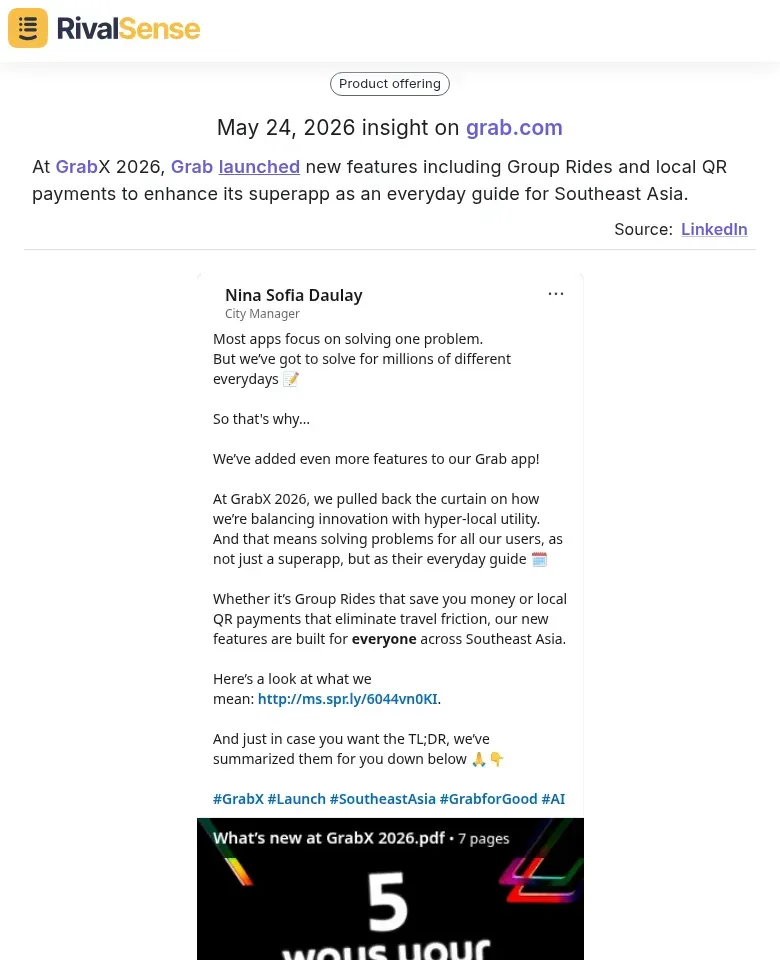
At GrabX 2026, Grab launched new features including Group Rides and local QR payments to enhance its superapp as an everyday guide for Southeast Asia.
Why this matters: Major feature launches from competitors can redefine user expectations. For companies in the mobility or fintech space, this signals a shift toward superapp strategies and integrated payment experiences. Monitoring such moves helps you anticipate feature parity demands from your own customers.
🛍️ Integration/Partnership Update
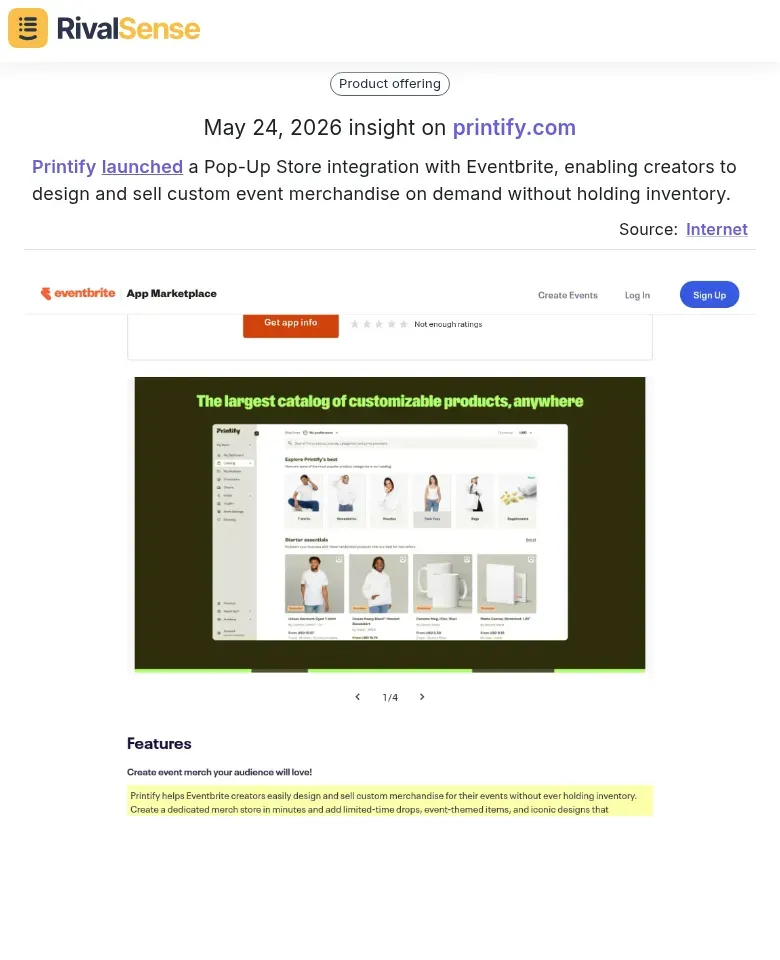
Printify launched a Pop-Up Store integration with Eventbrite, enabling creators to design and sell custom event merchandise on demand without holding inventory.
Why this matters: New integrations often open up distribution channels or simplify workflows for customers. For e-commerce or print-on-demand companies, this update signals a growing demand for event-specific merchandise solutions and seamless connection between event ticketing and merch sales.
🔒 Regulatory/Policy Update
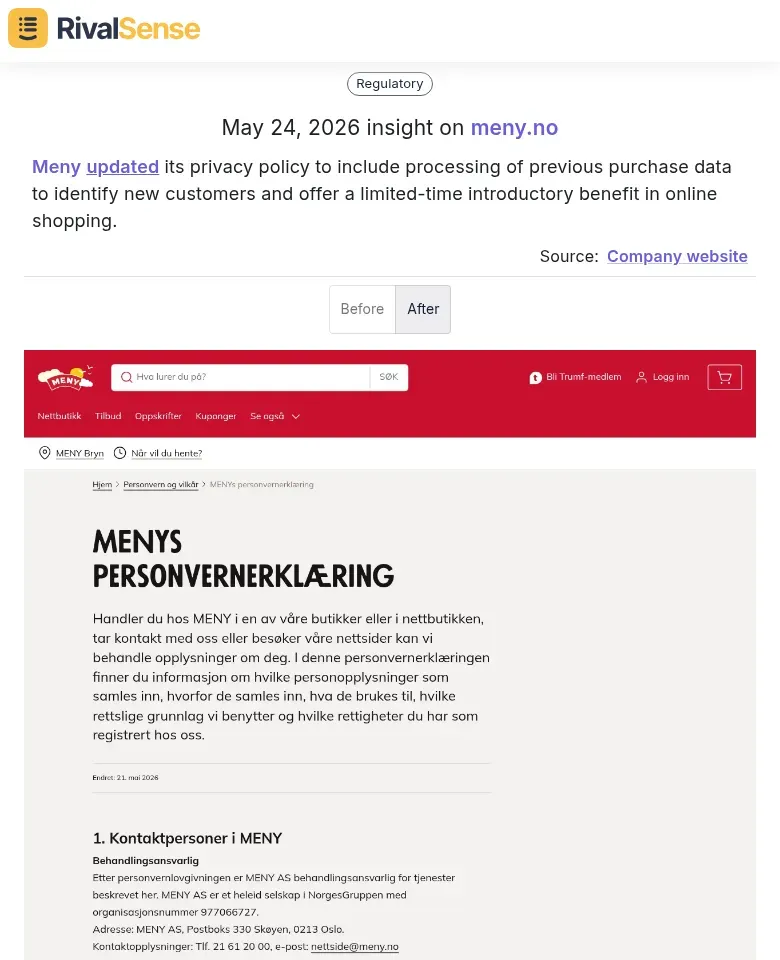
Meny updated its privacy policy to include processing of previous purchase data to identify new customers and offer a limited-time introductory benefit in online shopping.
Why this matters: Changes in privacy policies or data usage can indicate a new marketing or personalization strategy—and also potential regulatory risks. For B2B companies, understanding how competitors handle customer data can inform your own compliance and customer trust initiatives.
Use these examples as a template: whenever you spot a product launch, integration, or policy update from a competitor, ask “What does this mean for our roadmap and customer expectations?”
Integrating Insights into Strategic Decision-Making
To turn competitor insights into strategic advantage, follow these steps:
1. Prioritize R&D Investments
- Map competitive gaps: identify features competitors lack but customers demand (e.g., predictive analytics, compliance automation).
- Score opportunities by impact vs. effort; invest in high-differentiation, quick-win areas first.
- Use a quarterly “competitive gap matrix” to track emerging trends (e.g., AI-driven diagnostics) and reallocate budget accordingly.
2. Adjust Go-to-Market Messaging
- Audit competitor positioning: highlight where your solution outperforms (e.g., 30% fewer false alarms, faster onboarding).
- Create “battle cards” for sales: compare your product against top rivals on key criteria (uptime, cost, compliance).
- Test messaging with A/B campaigns—emphasize unique value props like “real-time dashboards” or “seamless integrations.”
3. Build Cross-Functional Intelligence Sharing
- Establish a monthly “Competitor Insights Sync” with engineering, sales, and product leads.
- Use a shared dashboard (e.g., Notion or Confluence) to log competitor updates, customer feedback, and market shifts.
- Assign a “competitive intelligence champion” to curate findings and prompt action items.
Checklist for Success:
- [ ] Quarterly R&D priority review based on competitive gaps
- [ ] Updated battle cards after each major competitor release
- [ ] Cross-functional meeting scheduled for next month
By embedding these practices, your team can proactively shape strategy rather than react to competitors.
Conclusion: Staying Ahead in a High-Stakes Market
In today’s fast-paced B2B landscape, staying ahead means embracing a continuous improvement cycle: monitor competitor product updates, analyze their implications, act on insights to refine your own offerings, and review outcomes to inform the next iteration. Speed-to-insight is critical—a new feature or regulatory shift in a competitor’s update can directly impact your market position.
To accelerate this cycle, leverage tools that automate competitor tracking and surface relevant changes without manual overhead. RivalSense tracks competitor product launches, pricing updates, partnerships, regulatory changes, management moves, and media mentions across websites, social media, and registries—delivering a weekly email report. By systematizing competitor intelligence, you transform raw data into strategic advantage.
👉 Try RivalSense for free here and get your first competitor report today.
📚 Read more
👉 Zoom's Platform Pivot: How Competitors Can Act on AI Rebranding Insights
👉 Unlock Revenue Growth: Competitor Benchmarking via Internet Insights
👉 Monitor Competitor Brand Perception in DevOps: A Workflow Breakdown