
Key Account Metrics from Competitor Events: A Cheat Sheet
Competitor events—webinars, conferences, and roundtables—are a treasure trove of account-level insights. The topics speakers choose and the themes of panels reveal strategic priorities: a sudden focus on AI compliance signals a pivot to regulated industries, while a surge in healthcare sessions hints at a new vertical push. But the real gold lies in the attendee list. Who’s in the room? If your competitor’s webinar on ‘Scaling B2B SaaS in Europe’ features 20 VP-level attendees from mid-market firms, you’ve just uncovered their target accounts and buyer personas. 🕵️
Practical steps:
- Monitor event agendas monthly via tools like RivalSense to spot shifts in session themes.
- Scrape publicly shared attendee lists (e.g., from LinkedIn event pages) and cross-reference with your CRM to identify overlapping accounts.
- Track repeat attendees across multiple events—they’re likely high-intent prospects.
Pro tip: Create a shared tracker for your team: log event name, key sessions, and notable attendees. Over time, patterns emerge—like a competitor consistently targeting Series A fintechs. Use this to prioritize your own outreach and differentiate your messaging. Events aren’t just noise; they’re a roadmap to your competitor’s next move.
Decoding Strategic Priorities from Panel Participation
Panel participation at industry events is a goldmine for decoding competitor priorities. The topics they choose to discuss—whether transparency, sustainability, or AI adoption—directly reflect their current messaging focus and strategic bets. Tracking these themes helps you anticipate where they’re investing thought leadership and which buyer personas they’re trying to influence.
Example: When Avocado Green’s VP of Marketing, Brooke Witt, joined a panel on Earth Day to discuss transparency and safer materials, it signaled a strong push toward sustainability as a differentiator in the home goods market. For a competitor, this insight would suggest that Avocado Green is targeting eco-conscious consumers and companies—potentially shifting their account strategy toward accounts with ESG mandates.

Practical Steps:
- Track panel themes across 3–5 events. Note recurring keywords (e.g., “customer-centricity,” “automation”).
- Identify speaker seniority. VP-level or C-suite participation signals high-priority initiatives and thought leadership plays. A CTO on an “innovation” panel suggests a product push; a CMO on “trust” hints at brand repositioning.
- Cross-reference with your account tiers. Map each theme to your customer segments (e.g., enterprise vs. SMB). If a competitor emphasizes “scalability” at enterprise events but you lack that tier, you’ve spotted a gap.
Pro Tip: Create a simple matrix with competitors as rows and panel themes as columns. Update quarterly to spot shifts before they hit the market.
Identifying Target Accounts Through Conference Presence
To identify target accounts from competitor events, start by analyzing co-presenting partners. If a competitor co-presents with a specific product or partner, it signals a joint account focus—often revealing the verticals or buyer segments they’re prioritizing.
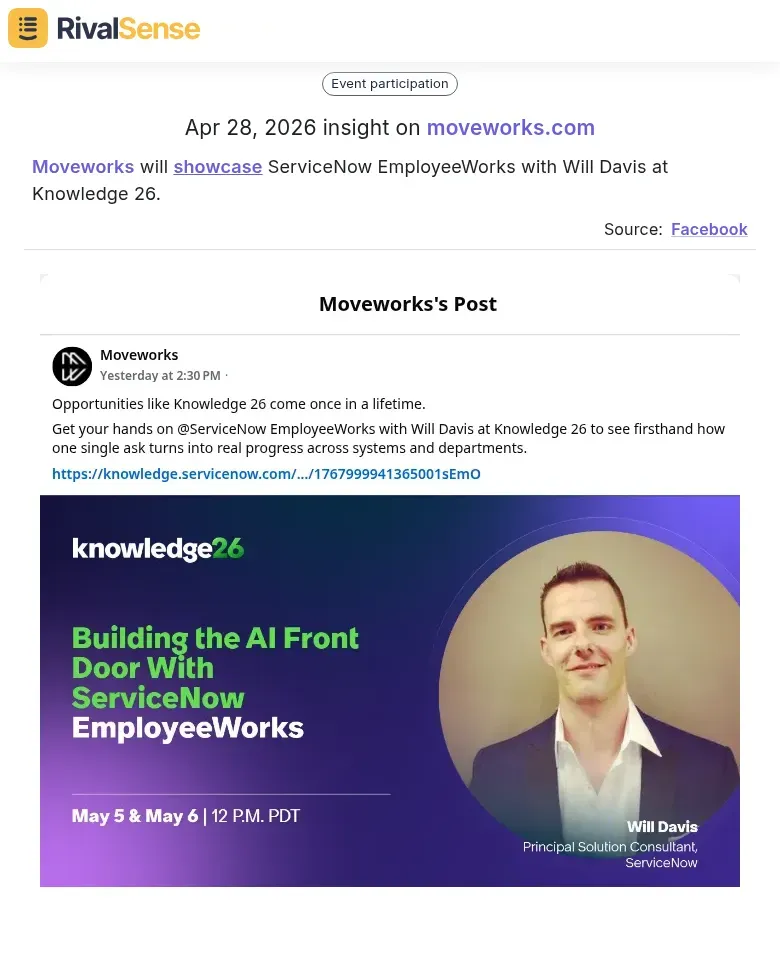
Example: Moveworks will showcase ServiceNow EmployeeWorks with Will Davis at Knowledge 26. This partnership hints that Moveworks is targeting large enterprises with complex HR and IT workflows—likely accounts already invested in the ServiceNow ecosystem. For your team, this means those accounts are now in play and may need a competitive alternative.
Next, decode conference themes. An event centered on AI or enterprise workflows reveals the buyer segments being courted. For example, an AI-focused event suggests they're targeting tech-forward companies, while a compliance theme points to regulated industries. Use tools like RivalSense to track theme shifts across events over time.
Finally, filter by geography and industry. A competitor hosting a regional event in Munich signals a push into DACH-based accounts. Similarly, industry-specific events (e.g., healthcare tech summits) narrow down vertical targets.
Checklist:
- [ ] List all competitor events for the quarter.
- [ ] Note location and industry focus.
- [ ] Map against your high-value accounts.
- [ ] Prioritize accounts appearing in multiple competitor events.
By combining these signals, you can build a targeted account list and preempt competitor moves.
Mining Speaker Bios and Session Descriptions for Account Clues
Speaker bios are goldmines. Job titles like “VP of Enterprise Sales” or “Head of Customer Success” reveal which decision-makers your competitor is courting. Cross-reference these with your own target account list—if a competitor’s speaker matches a key contact at your prospect, they’re likely already in conversation. Similarly, session abstracts often name-drop specific industries, use cases, or pain points.
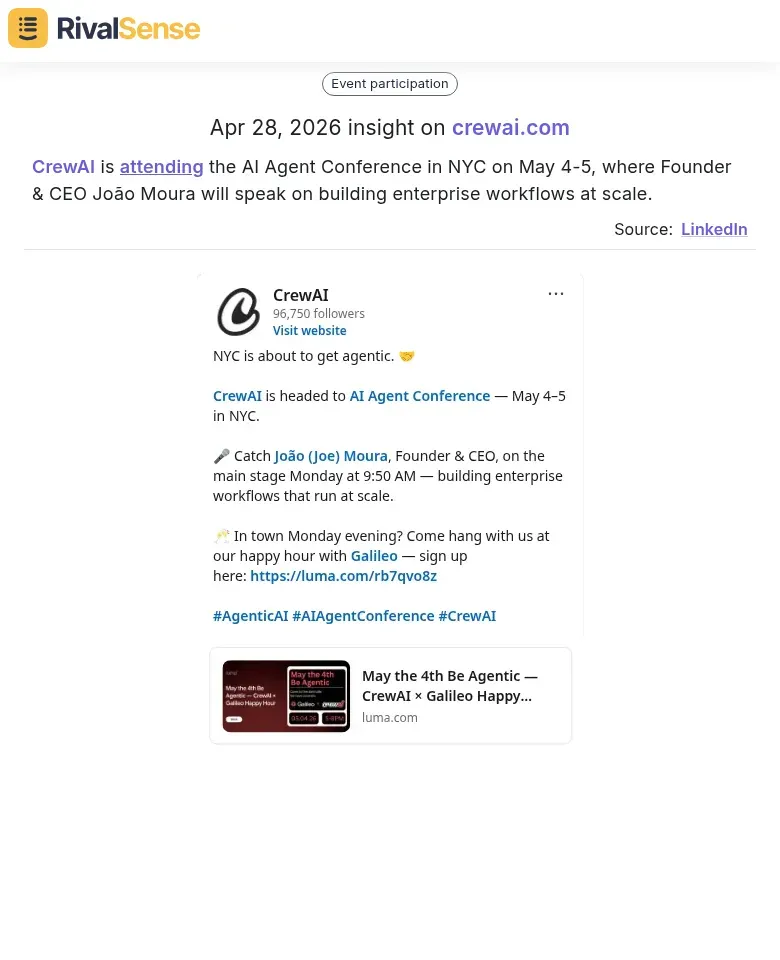
Example: CrewAI is attending the AI Agent Conference in NYC on May 4-5, where Founder & CEO João Moura will speak on building enterprise workflows at scale. This signals CrewAI is targeting enterprise accounts with AI automation needs—and the conference itself attracts tech-forward decision-makers. Knowing this, you can identify overlapping accounts and craft counter-messaging around scalability or ease of integration.
Practical Steps:
- Create a speaker tracker: Log names, titles, companies, and event dates. Look for patterns—e.g., a sudden shift from “Director” to “C-level” speakers may indicate a move upmarket.
- Abstract keyword map: Extract industry terms, competitor names, and challenge phrases. Compare across events to spot new segments.
- Compare lineups: If a competitor’s past events featured mid-market leaders but now feature enterprise VPs, they’ve pivoted. Adjust your account prioritization accordingly.
Pro Tip: Use a simple spreadsheet to track speaker-company pairs. A competitor speaking at a niche industry event? They’re planting flags in that vertical.
Building a Competitive Event Tracking System
To systematically capture competitor intelligence from events, build a structured tracking system. Start by creating a Competitor Event Calendar using a tool like Google Calendar, Notion, or Airtable. For each event, tag it by:
- Theme: e.g., AI, SaaS, Fintech
- Geography: e.g., North America, EMEA, APAC
- Partner: e.g., co-host, sponsor, exhibitor
Pro Tip: Set alerts for event agenda releases. Agendas reveal which accounts are speaking, sponsoring, or attending. Map these accounts over time to spot engagement patterns.
Next, integrate event insights into your CRM. Create custom fields or tags (e.g., "Competitor Event – Account Spoke") and link them to opportunities. When a deal appears in a competitor’s event, flag it for immediate action.
Checklist:
- [ ] Set up a shared calendar with competitor events
- [ ] Tag each event with theme, geography, partner
- [ ] Review agendas and log account mentions
- [ ] Create CRM fields for event-related insights
- [ ] Assign follow-up tasks for flagged opportunities
This system turns scattered event data into a competitive advantage.
Conclusion: Turning Event Intel into Account Strategy
To turn event intel into a winning account strategy, start by synthesizing findings into actionable account profiles. For each competitor event, create a one-page profile that captures: (1) key announcements (product launches, partnerships, funding), (2) target accounts mentioned or hinted at, (3) messaging themes, and (4) attendee engagement signals (e.g., which prospects visited their booth). Use these profiles to update battle cards—short documents that arm your sales team with counter-messaging, competitive positioning, and objection handling.
Next, share insights cross-functionally. Hold a 30-minute weekly sync with sales and marketing to review event takeaways. Use a shared dashboard (e.g., Notion or CRM) to log findings and tag relevant accounts. This alignment ensures your outreach is timely and tailored—for instance, if a competitor launched a feature for healthcare, your team can proactively address it in conversations with healthcare prospects.
Finally, make competitor event monitoring a continuous process. Set up alerts for key competitors’ event schedules, follow their social media for real-time updates, and assign a team member to attend or monitor each event. Regularly revisit and refresh your account profiles and battle cards—monthly or after each major event. This loop keeps your strategy agile and your team ahead of competitor moves.
Ready to simplify competitor event tracking? Try RivalSense for free at https://rivalsense.co/ and get your first competitor report today. We monitor product launches, pricing updates, event participations, partnerships, and more—so you can focus on outmaneuvering the competition.
📚 Read more
👉 How a Single Product Page Update Revealed Sierra's Strategic Pivot
👉 Key Account Tracking Automation: A Practical Guide
👉 How to Turn Competitor Intelligence into a Growth Engine for Your B2B Company
👉 Spotting Competitor Moves Before They Scale: How RivalSense Uncovered Barings Law's PPI 2.0 Strategy
👉 Uncover Competitor Moves: Website Change Insights for Key Account Wins