
How to Perform a Competitor SWOT Analysis in Nanotech
In nanotech, where breakthroughs happen overnight and R&D costs run deep, a single competitive blind spot can derail years of progress. A structured SWOT (Strengths, Weaknesses, Opportunities, Threats) analysis turns scattered intelligence—patent filings, funding rounds, product specs—into actionable strategy. This post walks through each quadrant using real nanotech examples, from graphene startups to quantum dot leaders. 🚀 Practical tip: Start by mapping your competitors' patent portfolios to spot technical strengths early.
Strengths: Identifying What Your Rivals Do Best
To identify your rivals' strengths in nanotech, start by auditing their proprietary technology. For example, a competitor with a pilot production system achieving 50% higher output than previous models holds a clear edge in scalability. Check patents, white papers, and technical blogs for clues.
Next, map strategic partnerships. A co-development deal with a manufacturing partner like Applied Materials signals accelerated industrial production capabilities—a strength that’s hard to replicate quickly.
💡 Real insight: VSPARTICLE received its pilot production system on February 17, which prints low-iridium catalyst layers onto large-scale porous transport layers for PEM water electrolysis with higher output than its VSP-P1, as part of the NXTGEN Hightech project to scale the technology for industrial production, co-developed with manufacturing partner MTA Group.
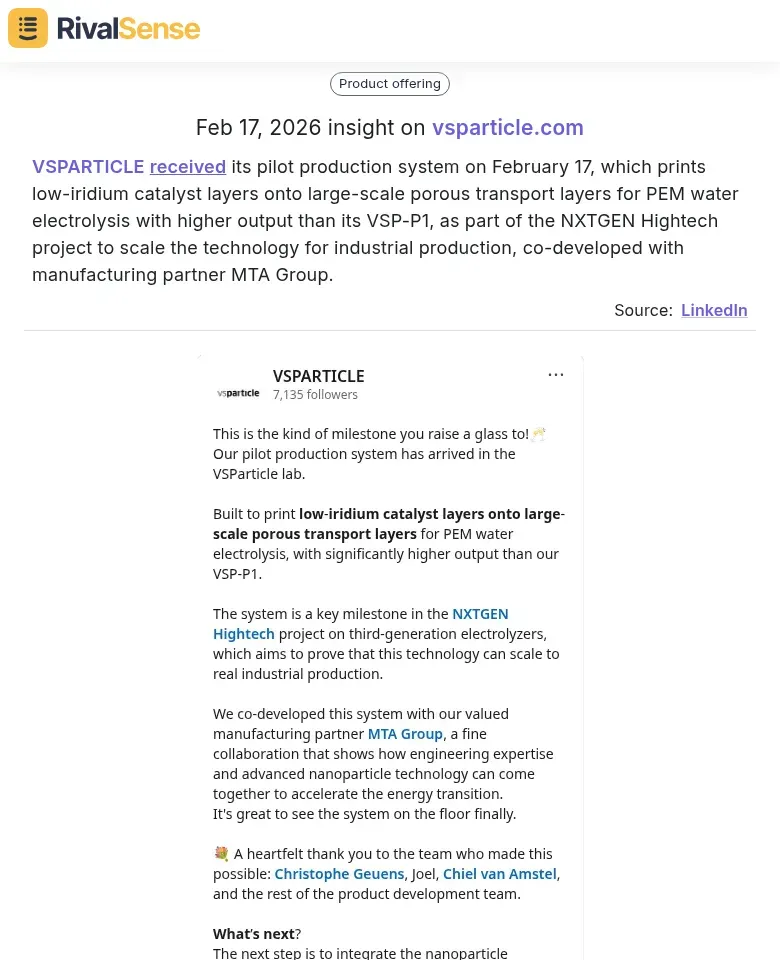
Why this matters: Tracking product milestones like pilot system deliveries reveals a competitor’s scalability advantages. If they can produce more efficiently, they can undercut your pricing or accelerate time-to-market. Use this intelligence to benchmark your own production ramp.
Finally, monitor industry awards and finalist positions in challenges like the NanoTech Summit Innovation Awards. These signal third-party validation and visibility.
💡 Real insight: VSPARTICLE became a finalist in the Future of Materials & Manufacturing track at the Energy Tech Challengers 2026, pitching in Bilbao in April.
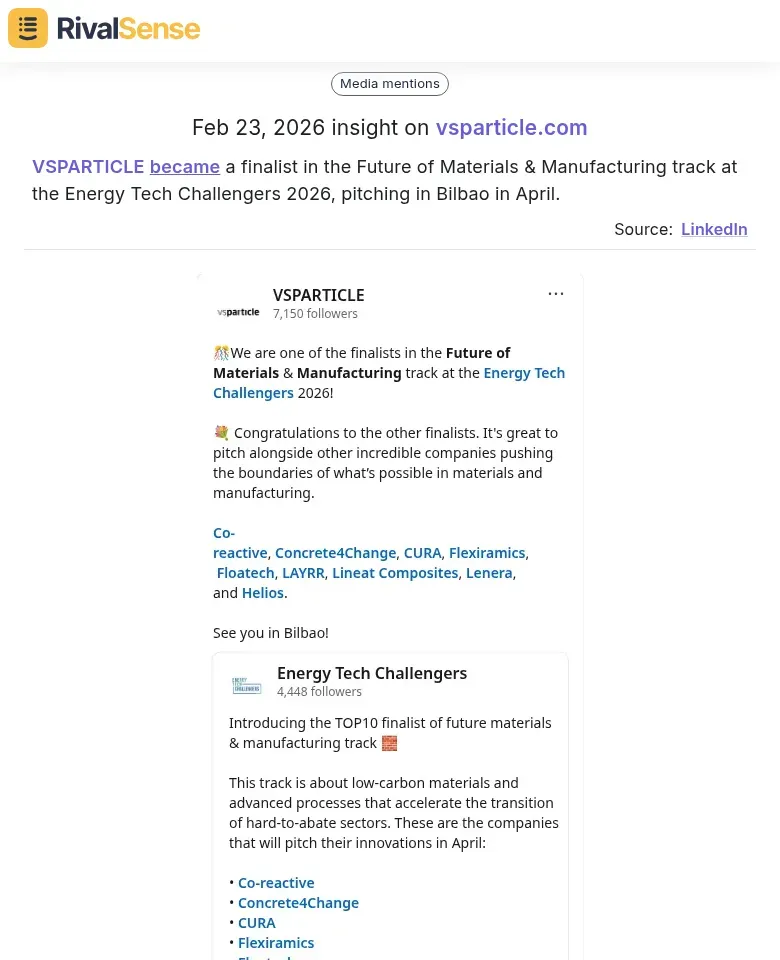
Why this matters: Award finalist mentions indicate that a competitor is gaining recognition from industry experts and potential investors. It also tells you where they are pitching—use that to anticipate their next market moves or partnership targets.
Tip: Create a competitive strengths matrix with columns for technology, partnerships, and awards. Rate each rival on a 1–5 scale and note evidence.
✅ Checklist:
- ☐ Identify top 3 tech advantages per competitor
- ☐ List key partners and their role
- ☐ Track recent award wins or finalist mentions
This structured approach reveals where rivals truly excel.
Weaknesses: Uncovering Gaps and Vulnerabilities
Identifying weaknesses in nanotech competitors reveals where they are exposed. Start by analyzing their funding sources. A heavy reliance on government grants or venture capital rounds (e.g., Series A vs. self-sustaining revenue) signals financial fragility—especially if grants are tied to specific milestones. Check their production scale: are they still at pilot or lab-scale? If so, they lack the cost advantages of full industrial manufacturing, limiting market reach and pricing power. For example, a competitor producing graphene only in small batches can't compete on price with a scaled producer.
Next, assess their application focus. A narrow portfolio (e.g., only medical diagnostics) leaves them vulnerable to shifts in adjacent markets like electronics or energy storage. Use this checklist:
- ✅ Review latest funding announcements (Crunchbase, SEC filings).
- ✅ Compare production capacity (kg/year vs. tons/year).
- ✅ Map their product lines to end-markets; note over-concentration.
Tip: Look for patents expiring soon—these may force competitors to pivot, creating openings for your strategy.
Opportunities: Where the Market Is Moving
Nanotech companies can capitalize on several macro trends and programs.
1. Leverage National & Regional Investment Programs
Governments are pouring billions into nanotech. For example, the EU’s €33 billion Horizon Europe fund includes dedicated calls for nanotechnology. But there's also Japan’s massive €33 billion bet on European deeptech and AI startups—a clear signal that global investors are hungry for nanotech innovation.
💡 Real insight: VSPARTICLE receives investment as part of Japan's €33 billion bet on European deeptech and AI startups.
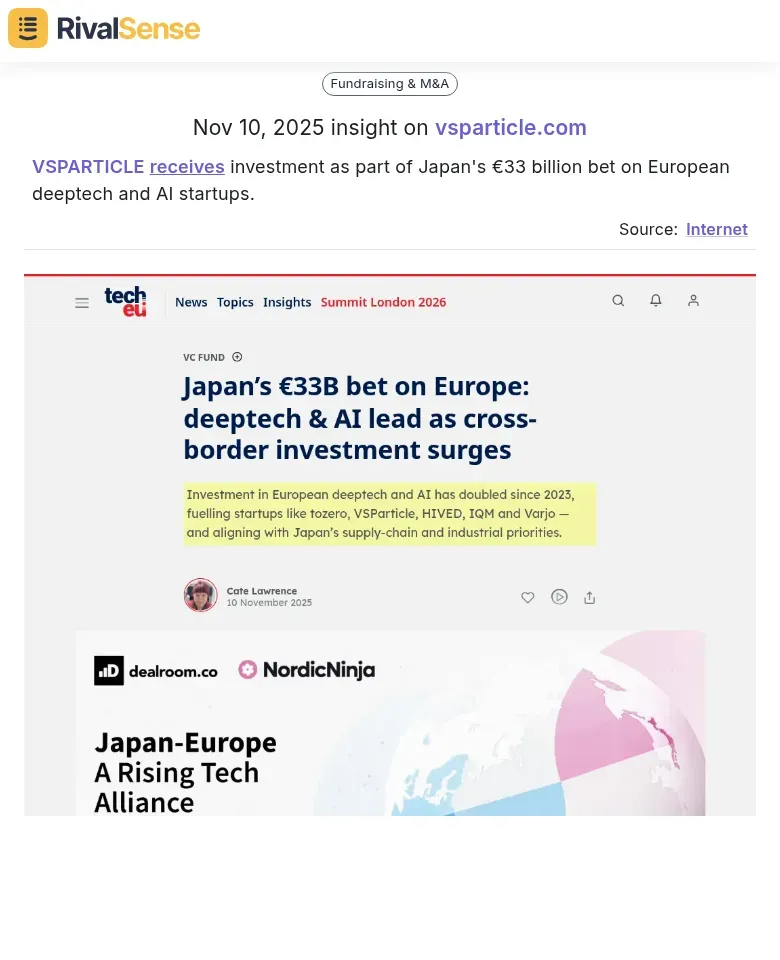
Why this matters: Tracking which competitors receive investments from large national funds tells you where the money is flowing and which markets are being prioritized. It also reveals potential partners or acquirers. Use this to target similar funding sources or to anticipate a competitor’s expansion plans.
Action step: Assign a team member to monitor funding databases (e.g., EU Funding & Tenders Portal) and set up alerts for keywords like “nano-coatings” or “nanomaterials.” Apply for collaborative grants—they also open doors to R&D partners.
2. Ride the Sustainable Energy Wave
Demand for green hydrogen and efficient electrolysis is soaring. Nanotech innovations in catalyst layers (e.g., using platinum-group-metal-free catalysts) can dramatically reduce costs. Tip: Partner with electrolyzer manufacturers to co-develop next-gen membranes. Attend industry events like the Hydrogen Technology Expo to showcase your IP.
3. Pitch at Global Competitions
Events such as the Energy Tech Challengers offer direct access to investors and corporate partners. Checklist for success:
- ✅ Prepare a 3-minute pitch focused on your nanotech’s unique value proposition.
- ✅ Bring a prototype or simulation video.
- ✅ Research attending VCs beforehand and book 1:1 meetings.
By systematically targeting these opportunities, you can accelerate growth and outmaneuver competitors.
Threats: External Risks That Could Derail Competitors (and You)
In nanotech, external threats can upend even the most promising strategies. Here are three critical risks to monitor:
-
Geopolitical Shifts & Trade Policies: Tariffs or export controls on nanomaterials can redirect investment flows. For example, US–China tensions may limit access to rare-earth elements, affecting competitors reliant on those supply chains. Action step: Track policy changes via trade association alerts and diversify supplier bases.
-
Technological Obsolescence: A competitor’s approach could be leapfrogged by a novel method (e.g., graphene replacing silicon nanowires). Tip: Set up alerts for patent filings and academic preprints in adjacent fields to spot disruptive shifts early.
-
Supply Chain Dependencies: Specialized components like porous transport layers (PTLs) for fuel cells have few suppliers. A single factory fire or logistics bottleneck can halt production. Checklist:
- ✅ Map your tier-1 and tier-2 suppliers.
- ✅ Identify single-source components.
- ✅ Develop backup suppliers or stockpile critical materials.
By systematically assessing these threats, you can anticipate vulnerabilities in your own operations and exploit those of competitors.
Turning SWOT Insights into Strategic Action
Synthesize your SWOT findings into a strategic action plan. Prioritize R&D investments by matching strengths to market opportunities—e.g., if your nanotech IP (Strength) aligns with a gap in medical diagnostics (Opportunity), allocate resources there. Use weaknesses and threats to decide partnership moves: if you lack manufacturing scale (Weakness), seek a contract manufacturer; if a competitor’s pilot plant (Threat) looms, accelerate joint ventures. Time market entries by monitoring competitor milestones—set alerts for pilot system deliveries or award finalists, then update your SWOT immediately. Keep it as a living document: after each milestone, reassess and adjust priorities. For a holistic view, layer SWOT with Porter’s Five Forces—e.g., high supplier power (e.g., rare nanomaterials) may turn a Strength into a necessity.
Practical steps:
- Create a 2×2 matrix of SWOT intersections (SO, WO, ST, WT).
- List 3 actions per quadrant with deadlines.
- Review quarterly or after any competitor event.
This turns analysis into agile strategy. 💡
Staying Ahead with Automated Tracking
Manually gathering all the competitor intelligence we’ve discussed—production milestones, award finalists, investment rounds—is time-consuming and error-prone. To keep your SWOT analysis fresh without drowning in data, consider using a dedicated competitor tracking tool. RivalSense monitors product launches, pricing updates, partnerships, funding, and more across your competitors’ websites, social media, and public registries—then delivers a weekly email report. Try it for free today and get your first competitor report to fuel your next SWOT analysis.
📚 Read more
👉 Key Account Metrics from Competitor Events: A Cheat Sheet
👉 How a Single Product Page Update Revealed Sierra's Strategic Pivot
👉 Key Account Tracking Automation: A Practical Guide
👉 How to Turn Competitor Intelligence into a Growth Engine for Your B2B Company
👉 Spotting Competitor Moves Before They Scale: How RivalSense Uncovered Barings Law's PPI 2.0 Strategy