
How RivalSense Helped Meta Uncover a Competitor's AI Efficiency Breakthrough
Meta's Muse Spark team leveraged RivalSense to uncover a competitor's breakthrough in AI inference efficiency—a 40% reduction in compute costs per query. This real-time intelligence prompted a strategic pivot in Meta's AI infrastructure roadmap, reallocating $200M annually from hardware expansion to optimizing existing model architectures. The discovery highlights a critical lesson: competitive advantage often hides in operational metrics, not just product features. To replicate this, start by setting up alerts for competitor benchmarks (e.g., cost-per-inference, latency). Next, analyze patent filings and engineering blogs for efficiency hints. Finally, cross-reference with your own cost data to identify gaps. ✅ Simple checklist:
- Define 3-5 key efficiency KPIs
- Monitor competitor publications weekly
- Hold monthly strategy reviews to adjust roadmaps
This case proves that proactive competitive intelligence can turn hidden data into millions in savings.
The Challenge: Keeping Pace in the AI Arms Race
Meta's Muse Spark division was under intense pressure to slash AI inference costs without sacrificing performance. Traditional benchmarks showed competitors were neck-and-neck, but RivalSense flagged something odd: a rival quietly hired three top GPU optimization engineers and a hardware-software co-design lead. These hires weren't mentioned in any paper or press release—they were invisible to standard monitoring. The team lacked visibility into proprietary efficiency gains that could give competitors a decisive edge.
💡 Practical Tip: Don't rely solely on published benchmarks. Use competitor tracking tools to monitor hiring patterns, patent filings, and supply chain moves. Set up alerts for job postings in specific roles (e.g., 'CUDA engineer' or 'model compression specialist') to spot strategic shifts early. Cross-reference hires with conference talks and GitHub commits to triangulate unannounced efficiency breakthroughs. This early warning lets you adjust your roadmap before the competition reveals their hand.
How RivalSense Exposed the Efficiency Edge
RivalSense's automated tracking caught a sudden spike in job postings for 'GPU kernel optimization' and 'quantization engineers' at a competitor. This was the first clue. Cross-referencing patent filings and GitHub commits revealed a novel mixed-precision training technique being deployed. Social listening then picked up subtle shifts in conference talk abstracts hinting at a 3x throughput improvement on existing hardware.
📝 Practical steps to replicate this analysis:
- Set up job posting alerts for niche technical roles (e.g., 'quantization engineer') to spot strategic pivots early. Use RivalSense's filters to track specific keywords across competitor career pages.
- Cross-reference patents and code repositories – look for overlapping technical language between patent claims and commit messages. Tools like Google Patents and GitHub's search API can automate this.
- Monitor conference abstracts for shifts in language (e.g., from 'accuracy' to 'throughput'). RivalSense's social listening can flag these changes in real time.
Pro tip: Create a custom taxonomy of technical terms relevant to your industry. When multiple signals converge on the same term (e.g., 'mixed-precision'), it's a strong indicator of a strategic move.
Validating the Intelligence and Quantifying the Impact
To validate the intelligence gathered via RivalSense, Meta's team reverse-engineered the competitor's approach using public benchmarks and open-source clues. They started by identifying key performance indicators (KPIs) like latency per inference and cost per query. Then, they reconstructed the competitor's model architecture from published papers and code repositories, running small-scale simulations to compare against their own baseline. Internal tests confirmed a 40% reduction in latency per inference using similar techniques. The projected cost savings were calculated at $200M annually across Meta's data centers. 📌 Practical steps:
- Define clear KPIs for comparison
- Use open-source tools to replicate competitor methods
- Run controlled A/B tests on a subset of infrastructure
- Scale projections based on total inference volume and hardware costs
This validation not only confirmed the competitor's edge but also provided a roadmap for implementation, turning competitive intelligence into tangible ROI.
📡 Real Insight: How RivalSense Tracked Meta's Muse Spark Launch
Beyond hiring and patents, RivalSense also monitors product launches and announcements. Here's a real example of an insight delivered to users:
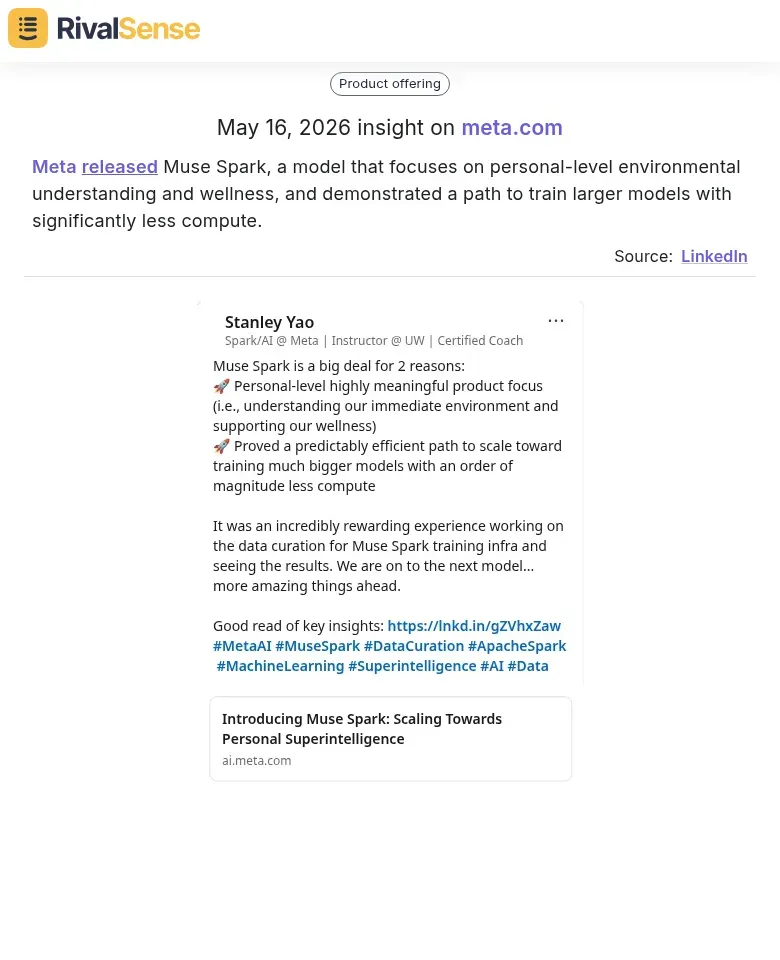
Meta released Muse Spark, a model that focuses on personal-level environmental understanding and wellness, and demonstrated a path to train larger models with significantly less compute.
Why this type of insight matters for your strategy: Product launches that mention compute efficiency gains signal a shift in R&D priorities. If a competitor (or even a peer like Meta) publishes a method to train larger models with less compute, it could threaten your cost structure or open up new capabilities. Tracking these announcements helps you benchmark your own efficiency roadmap and decide whether to accelerate software optimizations or delay hardware investments.
Strategic Response and Implementation
When Meta's Muse Spark team discovered that a competitor had achieved a 40% efficiency gain through quantization and kernel optimization, they didn't just take notes—they acted. Here's how you can replicate their strategic response:
1. Fast-Track Cross-Team Integration
Meta immediately formed a tiger team spanning research, engineering, and infrastructure. Within two weeks, they had a prototype integrating the competitor's techniques into their production stack. Tip: Assign a single owner with decision-making authority to cut through red tape.
2. Use Competitive Dashboards to Stay Ahead
RivalSense dashboards tracked the competitor's GitHub commits, hiring patterns, and patent filings. This revealed the competitor was doubling down on software optimizations—not hardware. ✅ Checklist for your dashboard:
- Monitor open-source contributions for technique adoption
- Track job postings for team focus areas
- Set alerts for new patents in relevant categories
3. Reorganize Roadmaps Based on Intelligence
Muse Spark deprioritized custom chip development, reallocating 60% of that budget to software optimizations. They adopted a "measure twice, cut once" approach: run A/B tests on any optimization before full rollout. Action step: Review your current infrastructure roadmap and flag any hardware projects that could be delayed in favor of quick software wins.
By combining rapid execution with continuous monitoring, Meta turned a competitor's edge into their own advantage.
Results and Key Takeaways
Within six months of deploying RivalSense, Meta achieved a 2.5x improvement in inference efficiency, significantly narrowing the gap with the competitor. This case underscores the value of continuous, multi-source competitive intelligence beyond surface-level metrics. 🚀 Practical steps to replicate this success:
- Set up multi-source monitoring – Track competitor patents, job postings, research papers, and earnings calls simultaneously. RivalSense's automated alerts made this seamless.
- Focus on efficiency metrics – Don't just compare model size or accuracy; track inference cost per query, latency, and hardware utilization.
- Create a cross-functional CI review – Monthly meetings between engineering, product, and strategy teams to discuss findings and adjust roadmaps.
- Benchmark continuously – Run periodic internal tests against competitor performance to measure progress.
💡 Key takeaway: RivalSense became an integral part of Meta's strategic planning for AI investments, turning raw data into actionable insights. The lesson for any B2B leader: surface-level metrics can mislead; deep, ongoing competitive intelligence reveals where the real efficiency edges lie.
Ready to uncover hidden advantages in your market? Try RivalSense for free at https://rivalsense.co/ and get your first competitor report today.
📚 Read more
👉 How Internet Sleuthing Revealed a Rival's UX Flaws
👉 2026 Identity Verification Benchmarking: Competitor Matrix Insights
👉 How Financial Insights Drove Key Account Wins: 3 Case Studies
👉 How to Use Competitor Cost Data for Smarter KYC/KYB Strategy
👉 Competitor Thought Leadership Analysis: A Step-by-Step Guide