
Advanced Tactics: Turning Regulatory Intel into Customer Service Wins
Regulatory changes are often viewed as compliance burdens—expensive checklists that distract from growth. But forward-thinking companies are flipping this narrative: they treat regulatory intelligence as a customer experience (CX) accelerator. By monitoring regulatory shifts through a competitive intelligence lens, you can anticipate customer anxieties before they escalate, communicate proactively, and turn potential friction into trust-building moments.
This article unpacks three overlooked regulatory insights—policy timeline changes, enforcement pattern shifts, and compliance requirement divergences—and shows how each can be transformed into a concrete CX win. Start by setting up a regulatory radar: use tools like RivalSense to track competitor filings, agency announcements, and legislative calendars. Then map each development to a customer pain point (e.g., data privacy changes → easy opt-out guides). Finally, test your messaging with a small segment before company-wide rollout. The result? Customers see you as a trusted guide through complexity, not just another company scrambling to comply.
From Privacy Policy Updates to Trust Building
When regulations broaden definitions—like classifying AI-powered 'agentic sessions' as part of 'Services'—customers may worry about how their data is used. Instead of burying updates in legalese, turn compliance into a trust-building moment. Proactively email or in-app notify users of the change, paired with a plain-language breakdown: 'We’ve updated our privacy policy to cover new AI features that help automate your workflows. Your data remains encrypted and you control what’s shared.'
Example: RivalSense recently surfaced that Anthropic updated its Privacy Policy effective July 8, 2026, broadening the definition of Services to include agentic sessions and connected services, and clarifying that Outputs may result in actions outside the Services based on user permissions.
Why this insight type matters: Monitoring privacy policy updates ahead of their effective date allows you to anticipate customer concerns about AI and data usage. By catching definitional shifts early, you can craft preemptive, transparent communication that turns compliance into a competitive trust advantage.
Practical steps:
- Monitor regulatory shifts using a competitive intelligence tool like RivalSense to catch definition changes early.
- Draft a customer-facing summary that strips out jargon. Use the formula: What changed → Why it matters → What you gain.
- Highlight the upside—for example, expanded functionality or stronger user controls—to show the change benefits them.
This approach reduces churn by addressing confusion head-on and reinforces loyalty by positioning your brand as transparent and customer-centric.
Checklist:
- ✅ Notify before effective date
- ✅ Use FAQ format for common concerns
- ✅ Provide an opt-in/opt-out for new data uses
Navigating Tax Regulation Changes with Customer Transparency
When a tax ruling shifts your cost structure, proactive transparency turns confusion into loyalty. Start by notifying customers before the change takes effect—not after. A simple email or in-app message explaining how the new regulation affects your pricing (e.g., “We’re required to collect 5% VAT starting July 1”) shows honesty. Avoid jargon; use plain language and link to the official ruling.
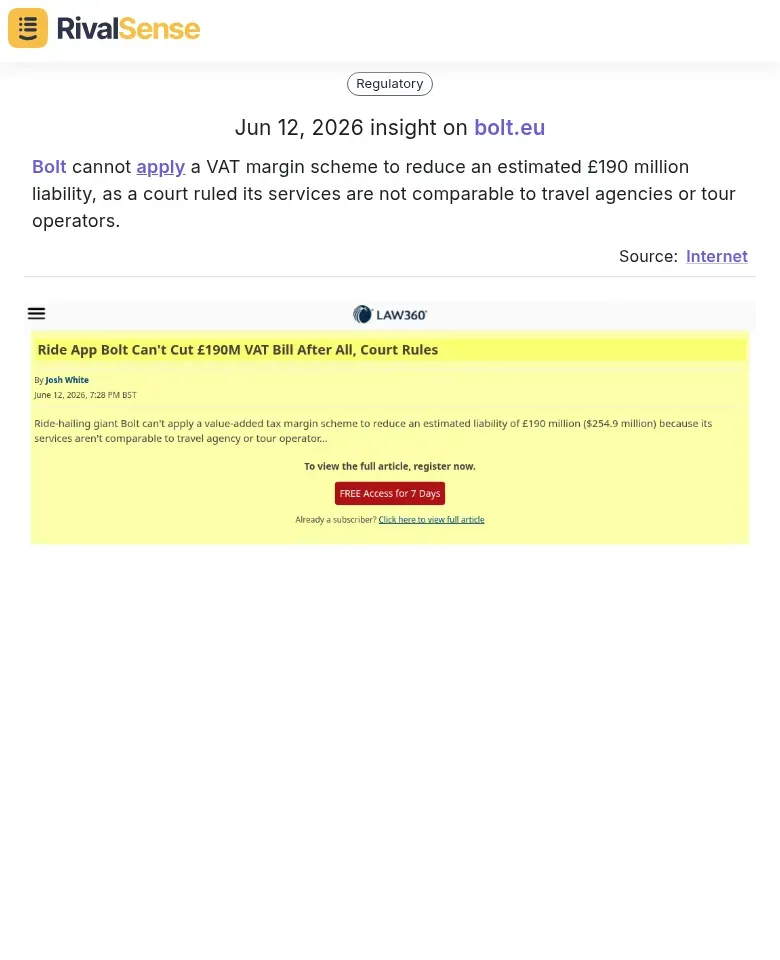
Example: On our radar, Bolt cannot apply a VAT margin scheme to reduce an estimated £190 million liability, as a court ruled its services are not comparable to travel agencies or tour operators. RivalSense captured this ruling, highlighting how tax interpretations can dramatically impact cost structures.
Why this insight type matters: Tracking tax rulings in your industry reveals potential financial pressures and can signal upcoming pricing changes for you or your competitors. It enables you to adjust customer communication and pricing models early, presenting any necessary price adjustments as transparent and inevitable rather than unexpected.
Practical steps:
- Audit the impact: Calculate exactly which customer segments are affected and by how much.
- Draft a clear message: State what changed, why, and the new price. Include an FAQ addressing common worries (e.g., “Will this apply to my previous order?”).
- Offer options: Where possible, grandfather existing contracts for a set period (e.g., 6 months) or let customers prepay at the old rate. For SaaS, consider absorbing the cost for high-value accounts.
- Create a feedback loop: Set up a dedicated email or chat channel for questions. Track sentiment and adjust your communication if confusion persists.
Checklist:
- [ ] Impact analysis complete
- [ ] Notification drafted and reviewed
- [ ] Grandfathering/alternative plan defined
- [ ] Customer support briefed on expected questions
By being upfront and giving customers control, you transform a regulatory headache into a trust-building moment.
Leveraging Operational Restrictions as a Quality Promise
When regulators slow down product approvals or impose compliance reviews, customers may perceive instability. Reframe these restrictions as a commitment to quality and safety.
Example: European regulators, including the ECB, placed restrictions on Revolut over the speed of its product approvals, requiring a third-party review of its risk and compliance functions and blocking new customer onboarding outside the EEA. RivalSense identified these enforcement actions, showing how regulators are demanding higher standards.
Why this insight type matters: Regulatory enforcement actions reveal the bar regulators are setting across your industry. Monitoring them helps you understand what “good” looks like, allowing you to proactively align your messaging—framing compliance delays or audits as proof of rigorous quality controls that protect customers.
Practical steps:
- Proactive Communication: Send a brief email or in-app notification explaining how the delay ensures a more secure service (e.g., 'We’re conducting extra security audits to protect your data').
- Transparency Dashboard: Create a public page showing compliance milestones and certifications, turning abstract restrictions into concrete proof of reliability.
- Customer FAQs: Publish Q&As addressing common concerns (e.g., 'Why is approval taking longer?' → 'We’re meeting higher standards to prevent compliance issues later').
- Sales Enablement: Train your team to highlight restricted markets as 'most rigorously vetted environments' where your product is battle-tested.
Checklist for regulatory quality messaging:
- [ ] Map each restriction to a customer benefit (e.g., audit = data privacy).
- [ ] Include a timeline or ETA for resolution to show control.
- [ ] Share third-party validation (e.g., 'Our compliance process exceeds ISO 27001 requirements').
By framing restrictions as quality gates, you build trust instead of doubt. A fintech startup facing licensing delays sent weekly updates detailing how each regulatory checkpoint reduces fraud risk, resulting in a 35% drop in churn among enterprise clients.
Proactive Communication: The Key to Turning Compliance into Customer Wins
Proactive communication transforms regulatory compliance from a burden into a competitive advantage. Instead of waiting for customers to discover changes, you can educate and guide them, building trust and reducing churn.
1. Monitor with Purpose
Set up alerts for regulatory bodies (e.g., SEC, FDA, GDPR authorities) and use tools like RivalSense to track competitor responses. Focus on changes that directly impact your customers’ workflow or obligations.
2. Segment Your Audiences
- Individuals: Use plain language, avoid legalese. Example: “Your data consent preferences will reset on June 30—here’s how to update them.”
- Businesses: Provide technical specifics and compliance deadlines. Example: “New reporting requirement under KYC 3.0: File by Q3 to avoid penalties.”
3. Choose the Right Channels
- Email: Ideal for detailed explanations and action items. Send a “What’s New in Compliance” digest.
- In-app notifications: Great for urgent, short alerts. Use modals or banners with a single call-to-action.
- Blog posts: Create a dedicated compliance hub where customers can self-serve updates anytime.
Pro Tip: Create a compliance communication calendar. Map out expected regulatory deadlines and draft templates in advance. When changes happen, you’ll be ready to publish within 24 hours.
Checklist for Your Next Compliance Update:
- [ ] Identify affected customer segments
- [ ] Draft two versions: simple and technical
- [ ] Schedule multi-channel rollout
- [ ] Add a feedback loop (survey or support ticket tag)
- [ ] Measure open rates, click-throughs, and support ticket volume
By proactively guiding customers through regulatory shifts, you turn a potential headache into a trust-building moment.
Conclusion: Competitive Advantage Through Regulatory Intelligence
Turning regulatory intel into customer service wins demands a mindset shift from reactive compliance to proactive customer care. Companies that excel here differentiate by building deeper trust and reducing customer anxiety. The payoff? Stronger retention, enhanced brand reputation, and a defensible market position.
Actionable Steps for Your Team:
- Set up a regulatory radar – Use competitive intelligence tools to monitor regulatory changes across your industry weekly. Flag anything affecting customer data, privacy, or compliance burdens.
- Create a cross-functional response team – Include legal, product, and customer support. Meet weekly to translate regulatory changes into customer-facing updates.
- Proactively communicate – Before customers ask, send clear, jargon-free emails or in-app messages explaining what changed and how it benefits them. Example: 'New data privacy rules mean we now encrypt all your files by default—no action needed on your part.'
- Build a FAQ library – Anticipate common customer concerns around regulatory shifts. Train support teams to address them confidently.
- Measure impact – Track support ticket volume related to compliance topics, customer satisfaction scores post-regulatory updates, and retention rates among affected segments.
Checklist for Success:
- [ ] Legal briefs shared with product/support within 48 hours
- [ ] Customer-facing copy reviewed for clarity and reassurance
- [ ] Support team trained on new regulations before enforcement
- [ ] Feedback loop established to refine messaging
Invest in competitive intelligence tools and cross-functional collaboration. The companies that turn regulatory noise into customer empathy will own the trust advantage.
Ready to transform regulatory updates into customer wins? Try RivalSense for free and get your first competitor report today—see how monitoring regulatory intelligence can give you the edge in customer communication.
📚 Read more
👉 How to Decode Competitor Funding Events Like Civinity’s €13.54M Bond Issuance
👉 Competitor Financial Analysis: How to Decode Your Rivals' Financial Health
👉 Key Account Manager Responsibilities: Actionable Telecom Strategies
👉 How One Competitor Used RivalSense to Respond to Nextiva's Pricing Shift
👉 5 Competitor Intelligence Mistakes That Undermine Key Account Sales – And How to Fix Them